
Every parent knows register six. It is wherever your kid discovered that crying loud enough sometimes produces toys. For Logan Reyes of Wichita, register six was literal – the aisle where his 7-year-old, Nova, pointed at a $58 robot dog and asked why the card in his pocket could not buy it. His search for allowance for kids by age started in the parking lot, before the engine did.
Nova’s second question came from the booster seat: “Is the card where money lives?” Logan, 35, manages the produce department at a supermarket; Tess, his wife, is a dental assistant. He knew exactly why he had no answer ready – in the house he grew up in, money was a fight heard through a wall, never a conversation. The card question deserved better than the silence he inherited.
The answer arrived as a system: a weekly amount matched to her age, three labeled jars, grocery-store games, and a tracker with exactly eleven squares between Nova and that robot dog. What follows is the whole twelve weeks, quit attempt included.
The window nobody tells parents about
Here is the uncomfortable math of money education. Habits are mostly set by second grade. Schools – where they teach personal finance at all – start around tenth. The eight years in between belong entirely to whatever happens at home. A kid with no money of her own during that window learns her economics from watching checkout lanes.
Nova was not misbehaving at that register. She was applying the only model available: toys come from cards, and cards never seem to empty. Changing the model – not the volume of the “no” – was the actual job.
One detail made it personal: Logan’s own card statement that week held $214 in small impulse buys. Children imitate; they rarely invent. The system he was about to buy for Nova would quietly get run on him too.
The robot-dog Saturday capped a brutal little week. Meltdown three of the month had already cost a $9 surrender and a memorable look from the cashier. Nova had liberated $5 from his wallet for playground slime – “you have lots of the paper ones, Daddy.” And Friday’s school newsletter confirmed the curriculum would not touch money until high school, eight years too late by Cambridge’s clock.
Parents googling allowance for kids by age at midnight are rarely chasing a parenting trend. Mostly they are trying not to photocopy their own childhood. Logan bought the Guide that night – it cost less than Tuesday’s surrender at the register.
The three dead ends most parents try first
Logan’s pre-Guide scoreboard will look familiar:
Paying the toll
A small toy per meltdown kept the peace and funded the next one. Each surrender confirmed the theory being tested: volume converts to merchandise.
The four-word wall
“Because I said so” stops a tantrum the way a dam stops a river – nothing downstream learns anything. It was also the exact soundtrack of Logan’s own childhood.
The premium cartoon course
$149 bought an animated pig lecturing all ages identically about wants and needs. Nova lasted two episodes, then asked to visit the robot dog.
All three shared one flaw: Nova never touched actual money. Theory without a jar is just noise to a second-grader.
I grew up in a house where money was a fight you heard through a wall. I wasn’t going to hand her that. I just didn’t know what to hand her instead.
The Guide asked him a handful of questions – her age, the meltdown triggers, the thing she wanted most in the world – and assembled a plan around the robot dog itself. The obsession became the curriculum.
One Sunday, four working parts
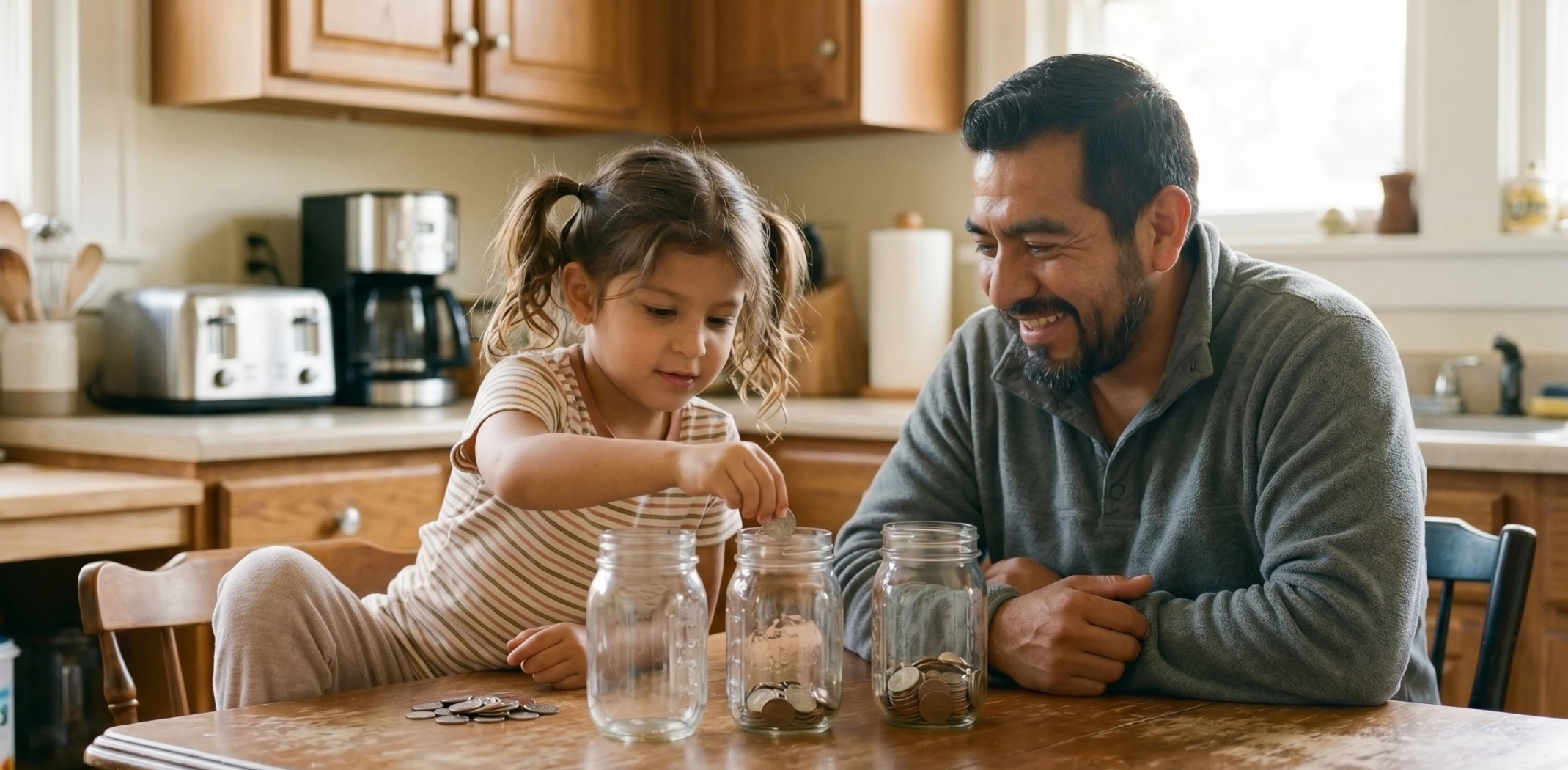
Setup took an afternoon and three dollar-store jars:
Behind Nova’s setup sits a ladder that re-sizes everything by age – the same purchase covers a preschooler and a teenager:
Week by week: from jars to the $58 banker moment
Twelve weeks, one wobble, one standing ovation:
Sunday launch. The split takes ten seconds: $3.50 saved, $2.80 to spend, 70¢ to give. Nova insists on labeling the jars.
Cereal mission: cheapest box per ounce. First store trip in months with zero tears. Register six’s cashier visibly relaxes.
The forecast quit attempt arrives. Script: count the jar aloud, together. Thirty-one dollars later Nova re-lids it herself – sovereignty intact.
A car-wash Saturday earns $4 in extras; the 3-day cool-off rule silently deletes two impulse wants from the spend jar.
Back to register six. Nova counts $58 in bills, unhurried, like a banker closing a deal. Applause from the cashier; suspicious eye moisture from Dad.

The part that got me was the script for when she wants to quit. It knew she’d want to quit before I did. That’s when I trusted it.
Postscript for the grown-ups: Logan ran the 3-day rule on his own cart too. The $214 of monthly impulse buys shrank to $61. The system does not check your age.
Price check: four ways to teach kids money
What the alternatives really cost, once you count the register:
Video courses · $50–$200
One cartoon pig, every age at once, no actual money in any child’s hand. Passive screens teach passive lessons.
Parenting blogs · free
Five tabs, five contradictory philosophies, zero amounts for your specific 7-year-old. Research becomes procrastination.
Winging it · a toy per meltdown
The most expensive plan on the list – paid weekly at the register, forever, while teaching that noise buys toys.
Child’s First Money Guide · $7
✓ Amounts scaled to age ✓ jars, games and tracker ✓ scripts for the hard conversations ✓ one purchase, every kid in the house.
🤔
“What if I’m the one with bad money habits?”
Then you are the Guide’s core customer – that worry is the number-one reason parents buy it. Amounts come pre-calculated, conversations come pre-scripted, and the quiet bonus is that the rules work upward: Logan’s own impulse column fell from $214 to $61 a month on the same 3-day rule he taught his daughter. Nobody has to arrive qualified.
Other households, same jars

“Three kids, three different ages, one purchase – it built a separate plan for each. My 11-year-old just bought his own soccer cleats with $42 he saved himself. I didn’t say a word at that register.”
April J. · mom of three, Fort Wayne IN

“I’m 66 and raising my grandson. Nobody ever taught me this stuff either – we’re learning together, jar by jar. He’s at $67 and counting for a telescope. Best seven dollars I ever spent.”
Russ T. · grandfather, Reno NV
ALSO IN THE BOX
Past the jars and tracker: the full age ladder (4 through 16), scripted lines for quit weeks and wallet raids, the extra-earn chore menu, the 3-day impulse rule, and guidance for the register conversations that used to end in tears. Buy once; it re-sizes for every birthday and every sibling.
Allowance for kids by age: five rules that hold
Match money to birthdays
A dollar per year of age per week is the standard; what the child pays for should climb the ladder with the amount.
Give every dollar a jar
Save, spend, give – physical, visible, countable. Abstractions wait for adolescence; jars work now.
Let the dream set the goal
The robot dog did more teaching than any lecture could. Obsession is free motivation – borrow it.
Teach where the tantrums lived
Store missions reclaim the checkout lane. A kid hunting unit prices has no bandwidth left for demanding toys.
Script the wobble in advance
Every multi-week goal hits a quit week. Count the jar together, out loud, and hand the decision back. Lids go back on.
Nova’s first money memory is now a cashier applauding while she counts her own bills. Whatever she asks next, Logan has somewhere to point – and it is not a wall with a fight behind it.
Ready for your own year-long money system?
The window closes around second grade – but it opens with three jars, one Sunday, and amounts that match a birthday cake.
From register-six meltdowns to an 11-week finish line – set up the same age-fit system Logan gave Nova, this Sunday.
*Individual results may vary. Educational parenting guidance, not financial advice.