



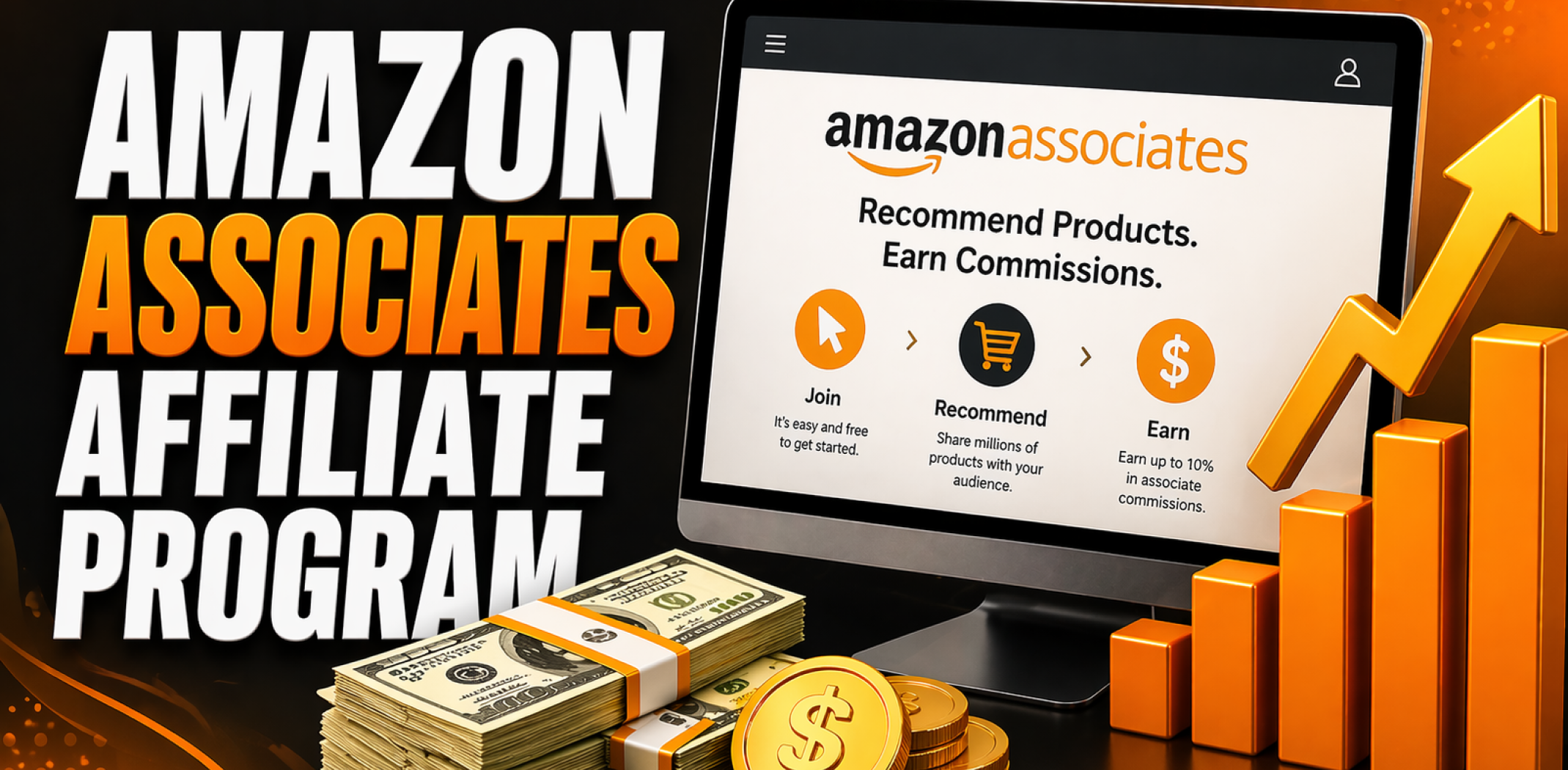
If you have been searching for a reliable way to earn money online, the Amazon Associates affiliate program is probably one of the first names that came up. And for good reason – it is one of the oldest, most trusted affiliate programs in the world, with millions of products to promote and a brand that virtually every online shopper already trusts. But is it actually worth your time in 2026? How much can you realistically earn? And how does it compare to other programs like ClickBank, ShareASale, and CJ Affiliate?
This guide covers everything you need to know – from signing up for the first time to understanding commission rates, cookie windows, and which categories pay the most. By the end, you will have a clear picture of whether Amazon Associates is the right starting point for you.
Quick answer: The Amazon Associates affiliate program lets you earn commissions of 1–20% by promoting Amazon products through unique links on your website, blog, or social media. It is free to join, beginner-friendly, and one of the most widely used affiliate programs in the world.
What is the Amazon Associates affiliate program?
Amazon Associates is Amazon’s in-house affiliate marketing program, launched back in 1996 – making it one of the original programs of its kind. The concept is simple: you sign up for free, generate unique tracking links to Amazon products, share those links with your audience, and earn a commission every time someone clicks through and makes a qualifying purchase.
What sets Amazon Associates apart from the competition is the scale of the ecosystem behind it. Amazon carries hundreds of millions of products across virtually every category imaginable. When someone clicks your affiliate link, you earn a commission not just on the product you linked – but on everything they add to their cart and purchase during that session. So if you link to a $20 kitchen gadget and your reader ends up buying a $400 laptop on the same visit, you earn commission on the full order.
The program is open to content creators, bloggers, YouTubers, social media influencers, and app developers. As long as you have a platform where you can share links and generate traffic, you are eligible to apply. Signing up is free and the onboarding process is straightforward.
Why this works in 2026: Amazon remains the first destination for most online shoppers. Research shows that mobile commerce now accounts for around 59% of total ecommerce sales globally – and Amazon dominates mobile shopping. The brand trust alone gives your affiliate links a conversion advantage that most other programs simply cannot match.
How much can you realistically earn with Amazon Associates?
This is the question everyone wants answered honestly. The short version: earnings range dramatically depending on your niche, traffic volume, and the product categories you focus on.
Commission rates on the Amazon Associates affiliate program run from 1% to 20% depending on the product category. Amazon Games sits at the top at 20%. Luxury beauty and Amazon Explore come in at 10%. Digital and physical music, handmade goods, and digital video earn 5%. Most everyday categories – electronics, toys, tools, and general merchandise – pay between 1% and 3%.
These figures assume a conversion rate of roughly 5–8%, which is typical for well-targeted content in product-focused niches like home and kitchen, tech, fitness, or beauty. Traffic from review articles and “best of” comparison posts tends to convert significantly better than general informational content.
One note on ceiling figures: Top earners with established niche sites do pull in $5,000–$20,000 per month or more, but those results typically take 12–24 months of consistent publishing and SEO work to achieve. For most new affiliates, the realistic starting range is $50–$200 per month, scaling upward as traffic grows.
Beyond standard commissions, Amazon also runs a Bounty Program where you earn fixed fees for referrals to Amazon services. These bounties range from $3 to $25 and apply to sign-ups for Prime, Audible, Kindle Unlimited, Amazon Music Unlimited, and other subscription products. If your audience includes people likely to try Amazon services, these bounties can add meaningful extra income on top of product commissions.
In 2025 and into 2026, Amazon also introduced two high-priority categories worth paying attention to: Amazon Games at 20% and Amazon Haul at 7%. These elevated rates signal that Amazon is actively trying to grow traffic to those areas – and that early movers can capture strong returns.
How to join the Amazon Associates affiliate program: step by step
Getting started with Amazon Associates is genuinely simple. The signup process takes 15–20 minutes and does not require any upfront payment or technical expertise. Here is what the process looks like from start to finish.
Setting up your account
Step 1 – Go to the Amazon Associates homepage
Head to affiliate-program.amazon.com and click “Join Now for Free.” You will need an existing Amazon account or can create a new one. Make sure you are signing up through the correct regional program for your target audience – Amazon runs separate Associates programs for the US, UK, EU, Canada, and other markets, and commissions are paid per region.
Step 2 – Add your websites and platforms
You will be asked to list all the websites, apps, YouTube channels, or social media profiles where you plan to share affiliate links. Be thorough here – Amazon reviews your application based on this information. If your site is still fairly new or thin on content, focus on building it out before applying. Accounts with minimal content are frequently rejected or closed quickly.
Step 3 – Describe your traffic and monetization strategy
Amazon will ask how you drive traffic to your platform and how you plan to use their affiliate links. Be honest and specific. Mention whether you run a review blog, a comparison site, a YouTube channel, or a social media account. This step helps Amazon assess whether your platform is a good fit for the program.
Step 4 – Enter your payment and tax details
Once approved, you will complete your payment profile. Amazon pays commissions approximately 60 days after the end of the month in which they were earned. Payment options include direct deposit, Amazon gift cards, or a physical check. You will also need to submit tax information – a W-9 for US residents or a W-8BEN for international affiliates.
Step 5 – Start creating links and publishing
After account approval, you have access to Amazon’s full suite of link-building tools. The SiteStripe toolbar lets you generate links directly from any Amazon product page. You can create text links, image links, or full product widgets. The key at this stage is to start publishing content that naturally incorporates your affiliate links – product reviews, comparison articles, “best of” roundups, and tutorial posts all tend to perform well.
Staying active and keeping your account
One critical rule to know: if you do not generate at least three qualifying sales within your first 180 days as an associate, Amazon will close your account. You can reapply after this point, but the 180-day window is a real pressure for new affiliates who have not yet built consistent traffic. This is a practical reason to focus on getting your first few conversions early – even small ones – before going deep on content production.
Important: Amazon requires clear affiliate disclosure on all content containing associate links. You must include a statement like “As an Amazon Associate I earn from qualifying purchases” wherever your links appear. Failure to disclose can result in account termination. This is non-negotiable under the program’s operating agreement.
Amazon Associates vs other affiliate programs: which is right for you?
Amazon Associates is not the only affiliate program worth considering in 2026. Depending on your niche, content style, and earning goals, other platforms may actually serve you better. Here is an honest comparison of the four most popular options.
On paper, Amazon’s commission rates look lower than the competition. In practice, the picture is more nuanced – because Amazon’s conversion rates are consistently among the highest of any affiliate platform, largely due to the brand’s trust and the familiarity most shoppers already have with it.
Amazon Associates
The biggest advantage of Amazon Associates is simplicity and trust. Almost everyone shops on Amazon, so converting traffic into sales is genuinely easier here than on lesser-known platforms. The 24-hour cookie window is its most significant limitation – if your reader clicks your link but does not purchase until the next day, you earn nothing. That said, Amazon’s same-session cart attribution means you can earn on everything in a buyer’s cart during that session, which partially compensates for the short window.
Best for: Beginners, lifestyle bloggers, product review sites, and anyone covering physical goods in high-conversion niches like home, kitchen, tech, beauty, and fitness.
ClickBank
ClickBank is built almost entirely around digital products – online courses, ebooks, software, and subscription services. Commission rates here are dramatically higher, often reaching 50–75% per sale. The 60-day cookie window is also a major advantage over Amazon. The trade-off is product quality variability: ClickBank’s open marketplace includes some excellent offers alongside plenty of low-quality products. Newer affiliates need to vet products carefully to avoid promoting something their audience will regret buying.
Earning potential: $100–$500+ per sale in high-ticket digital niches, though competition is intense and conversion rates are lower than Amazon.
Best for: Marketers in health, wealth, self-improvement, or digital education niches who are comfortable with higher-risk, higher-reward products.
ShareASale
ShareASale is one of the most versatile affiliate networks available, connecting affiliates with over 25,000 merchants across dozens of industries. Commission rates range from 4% to 50% depending on the merchant, and the cookie windows are generally much more generous than Amazon’s. The platform suits bloggers in specific niches – fashion, home goods, wellness, SaaS – who want to work with smaller, more focused brands rather than a single giant marketplace. Approval times can run up to 20 business days, and some merchants have strict requirements for affiliates.
Best for: Niche content creators and email marketers who want flexibility and a wide variety of brand partnerships beyond Amazon’s ecosystem.
CJ Affiliate
CJ Affiliate (formerly Commission Junction) is the go-to network for affiliates who want to work with major, recognizable brands. The platform connects publishers with over 3,000 advertisers, including globally recognized names across retail, travel, finance, and tech. Commission rates typically sit between 5% and 10%. CJ does require a more established platform to get approved, and individual advertisers have their own approval processes on top of network access. The real-time reporting and data tools are among the best in the industry.
Best for: Mid-level to advanced affiliates with established traffic who want to diversify into premium brand partnerships and data-driven optimization.
Tips for earning more with the Amazon Associates affiliate program
Getting approved and generating your first few links is the easy part. Turning Amazon Associates into a consistent income stream requires a more strategic approach. These are the practices that actually make a difference.
Focus on high-commission, high-intent categories
Not all niches are created equal within Amazon Associates. Luxury beauty products at 10% commission are significantly more valuable than electronics at 2.5% – especially when you factor in average order values. High-intent categories like home and kitchen, fitness, beauty, and outdoor gear tend to combine reasonable commission rates with strong conversion rates. Focus your content on product categories that sit at the intersection of decent commission rate and buyer intent.
Build comparison and review content
The highest-converting affiliate content on Amazon is not generic blog posts – it is specific product comparisons, detailed reviews, and “best of” roundups targeting people who are already close to a buying decision. Someone searching “best espresso machine under $200” is ready to buy. Someone searching “history of coffee” is not. Align your content strategy with purchase intent, and your conversion rates will reflect it.
Use the 24-hour window to your advantage
Amazon’s short cookie window is a real limitation, but it is less damaging than it looks on paper if you structure your content correctly. Embed your affiliate links within content that people visit right before making a purchase decision – product reviews, comparison posts, and buying guides. A reader who arrives at your comparison post has already done their research. They are clicking to check prices, not to browse indefinitely.
Stack bounties alongside product commissions
Many affiliates overlook Amazon’s Bounty Program, which pays fixed fees of $3–$25 for referrals to Amazon services like Prime, Audible, and Kindle Unlimited. If you cover books, audiobooks, streaming, or personal finance topics, weaving in service referrals alongside product links can add a meaningful additional layer of earnings without much extra effort.
Monitor your performance data and double down on what works
Amazon Associates provides solid reporting through its dashboard – you can see clicks, conversion rates, and earnings by product, link type, and page. Review this data regularly. If one comparison post converts at 12% and another at 1.5%, the obvious move is to update and expand the high-performer and rethink the underperformer. Small optimization decisions compound quickly once you have a few months of data to work with.
Legal and ethical considerations for Amazon Associates affiliates
Affiliate marketing operates within a clear set of legal and ethical guidelines, and Amazon’s program is no exception. Violating the rules – even accidentally – can result in account termination, withheld commissions, or worse. Here is what to know.
Disclosure is mandatory, not optional
The US Federal Trade Commission (FTC) requires that affiliates clearly disclose their relationship with the programs they promote. Amazon’s own operating agreement reinforces this. Every page, post, video, or social media update containing Amazon affiliate links must include a clear disclosure statement. A simple line like “This post contains affiliate links. As an Amazon Associate I earn from qualifying purchases” is sufficient – but it must be present, visible, and above the fold where possible.
Key principle: Disclosure protects your audience and your account – treat it as a non-negotiable baseline, not an afterthought.
What Amazon prohibits outright
Amazon’s operating agreement is detailed and worth reading in full before you start. A few practices that result in immediate termination: placing affiliate links in offline materials, email campaigns (unless through an approved method), or PDF downloads; using misleading price claims; running paid ads that direct traffic straight to Amazon product pages without prior written approval; and offering rebates or incentives for clicking your affiliate links. Amazon also prohibits using affiliate links in any content that targets children under 13.
Fake reviews and inflated claims
Writing dishonest product reviews – or publishing positive reviews for products you have never used – is both an ethical and a practical problem. Beyond the obvious trust issue with your audience, it violates Amazon’s content policies and can result in account termination. It also damages long-term SEO performance, as Google increasingly filters thin or untrustworthy affiliate content from its rankings. The most sustainable affiliate sites are built on genuine, experience-based recommendations. Authenticity is not just an ethical position – it is the better business model.
Who should start with Amazon Associates – and who should look elsewhere
Amazon Associates is a genuinely excellent program, but it is not the right starting point for everyone. Here is an honest breakdown by reader profile.
Complete beginners
If you are new to affiliate marketing and do not yet have an established platform, Amazon Associates is probably the best place to start. The signup process is straightforward, the product catalog gives you something to promote in virtually any niche, and the brand trust means your links will convert reasonably well even on a new site. Focus on building a niche content site with clear purchase intent – product reviews, comparisons, and buying guides – before expecting meaningful income.
Realistic starting timeline: 60–90 days to first commission, 6–12 months to consistent monthly earnings.
Intermediate / part-time affiliates
If you already have a site with some traffic, Amazon Associates can serve as a reliable baseline income while you test higher-commission programs like ClickBank or ShareASale alongside it. Many mid-level affiliates run Amazon Associates as their primary program in product-heavy niches and supplement it with service bounties or merchant-specific programs for software, courses, or subscriptions. Diversifying across two or three programs reduces your dependence on any single platform’s commission changes.
Advanced / full-time income goal
If your goal is a full-time income from affiliate marketing, Amazon Associates alone is unlikely to get you there quickly – the commission rates are simply too low relative to the traffic required. Advanced affiliates typically use Amazon as one revenue layer within a broader monetization stack that includes higher-commission programs, digital product sales, sponsored content, and email list monetization. The most successful full-time affiliate marketers treat Amazon as a trust-building tool while relying on higher-margin programs for the bulk of their income.
Ecommerce entrepreneurs
If your goal goes beyond earning commissions and you want to build a real, scalable online business, affiliate marketing has a fundamental ceiling: you are always dependent on someone else’s product, someone else’s pricing, and someone else’s program rules. Amazon has changed its commission structure multiple times over the years, cutting rates in major categories with little notice. Building a business on top of someone else’s rules is a fragile foundation.
That is exactly why many people who start with the Amazon Associates affiliate program eventually look for a model where they keep more of every sale – and are not subject to someone else’s rate cuts. Selling digital products through your own store is one of the clearest paths to doing that.
Why Sellvia is a game-changer for your online store 🚀
Sellvia isn’t just another ecommerce tool. We are a trusted name in the industry, recognized by Forbes and even ranked in Inc.’s list of the 5,000 fastest-growing companies in the U.S. So if you’re serious about starting as a solopreneur, this is a smart place to begin.
Starting an online business can feel overwhelming, but that’s exactly where Sellvia steps in. It takes care of the tricky parts, so you can focus on making sales and growing your brand. Let’s break down what makes it such a great choice.
Get a ready-to-go store hassle-free 🎯
Want to start selling but don’t know where to begin? No worries! Just share your ideas, and Sellvia’s team will build a free ecommerce website that’s fully set up and ready to take orders from day one. No coding, no stress – just a store that works right out of the box.
A $100 welcome gift to grow your business faster 🎁
Starting a business takes momentum – and Sellvia gives you a head start. When you claim your free store today, you also get a $100 welcome gift to put toward growing your business. Use it to upgrade your store, boost your marketing, or unlock new tools. It is a real dollar value, handed to you on day one, with no catch and no hoops to jump through.
A massive catalog of digital products to sell 🏆
One of the biggest struggles in starting an online business is figuring out what to sell. Sellvia solves that completely. Your store comes pre-loaded with digital products – guides, courses, checklists, and tools – all created by Sellvia. You keep 50–70% of every sale. No inventory. No shipping. No logistics headaches.
Everything in one easy-to-use platform 🔥
Managing an online store shouldn’t be complicated. With Sellvia, you can handle orders, add new products, and even chat with customers – all from a simple and user-friendly platform. No need to mess with confusing tools or deal with unnecessary tech stuff. It’s all smooth sailing.
No upfront costs, just start selling 💰
A big reason people hesitate to start an online business is the cost. But here’s the good news: With Sellvia, you don’t need to invest in stock, storage, or shipping supplies. You can run your store with no upfront costs, keeping things low-risk while still making money.
Support that’s always got your back 🤝
Running a business comes with questions, but you’re never alone. Sellvia’s dedicated support team is available 24/7 to help with anything you need. Whether it’s a small question or a big challenge, they’ve got you covered.
The Amazon Associates affiliate program is a great starting point, but keeping 1–10% of someone else’s sale has real limits – your Sellvia store lets you keep 50–70% of every digital sale you make. Claim your free store today and start building income that is truly yours.