If you have been searching for examples of digital products, you are already thinking in the right direction. Digital products are one of the most accessible ways to earn money online in 2026 – no warehouse, no inventory, no shipping label. You source them once, and they can sell indefinitely.
Quick Answer: Digital products are files or access-based goods delivered electronically. Real examples include ebooks, online courses, templates, printable planners, stock photos, fonts, and software tools. They cost almost nothing to replicate and can be sold to unlimited buyers at the same time.
But knowing what they are is only step one. The more important question is which types actually sell, how much you can realistically earn, and what the fastest path to getting started looks like. This article covers all of that – in plain language, with real numbers.
The digital product market has grown dramatically over the last few years, and 2026 is shaping up to be its strongest year yet. Remote work, online learning, and the creator economy have pushed demand for downloadable goods to new highs. Whether you want to create your own products or sell ready-made ones, the opportunity has never been more open.
What are digital products?
A digital product is any item that exists in a digital format and is delivered to the buyer electronically – no physical handling required. The buyer receives a download link, a licence key, account access, or a streaming file. There is no weight, no shipping cost, and no stock limit.
What makes digital products particularly attractive from an income perspective is the margin structure. Once the product exists, duplicating it costs essentially zero. You can sell the same PDF guide to one buyer or ten thousand buyers without any change in your costs. That is a very different model from anything that involves physical goods or hourly services.
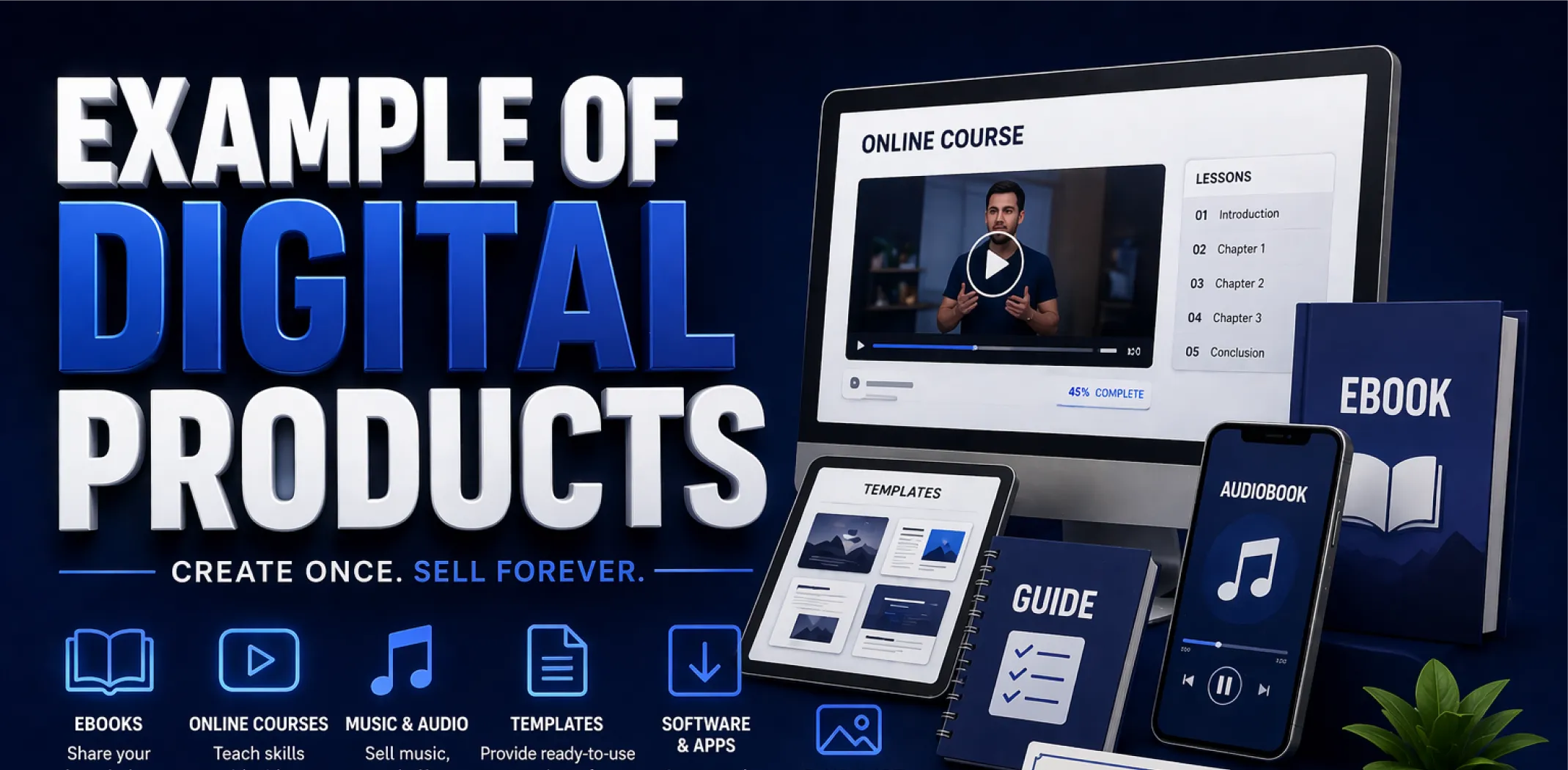
In 2026, the category spans an enormous range – from short one-page checklists to full software applications, from a single photo preset to a complete video course. The examples of digital products available today are more varied than most people realize when they first start looking.
Why this works in 2026: Buyers are more comfortable than ever paying for digital downloads, and platforms that allow instant delivery have removed most of the friction that used to slow conversions.
How much can you realistically earn selling digital products?
Earning potential from digital products varies widely depending on what you are selling, how you are marketing it, and how much time you invest. Here is an honest breakdown of the main approaches:
The table above gives realistic ranges, not guarantees or ceilings. Courses and memberships sit at the high end because they command premium prices, but they also take the most time to build. Ready-made stores sidestep the creation bottleneck entirely and can start generating revenue much sooner.
One note on the higher figures: The $5,000/month course income applies to sellers with an established audience. For most beginners, the first 60–90 days are about building traffic and trust. Treat early revenue as validation, not a salary.
Whichever method you choose, the underlying logic stays the same – digital products scale in a way physical goods cannot. Your cost per sale stays at zero no matter how many orders you receive.
20+ real examples of digital products you can sell
To make this practical, here are the most common and commercially viable examples of digital products, broken down by category. Each one has a real market, a proven buyer audience, and a clear delivery method.
Information and educational products
These are among the most popular digital product types because knowledge is universally in demand. If you understand something better than the average person, that knowledge is saleable.
Ebooks and PDF guides
An ebook is a written document – usually between 5,000 and 50,000 words – sold as a PDF or epub file. Guides tend to be shorter and more action-oriented: a 20-page step-by-step breakdown of how to do one specific thing. Both formats sell well on Gumroad, Etsy, and personal stores. Topics that perform consistently include personal finance, fitness and health, business skills, parenting, and niche hobbies.
Earning potential: $200–$1,200/month with a focused niche and basic SEO or Pinterest traffic.
Online courses
An online course is a structured learning programme delivered as video lessons, written modules, or a combination of both. Courses command higher prices than ebooks – often $97 to $497 or more – because they offer a more complete transformation for the learner. The challenge is that producing a quality course takes weeks of preparation and recording before a single sale is made.
Earning potential: $500–$5,000/month for an established course with a warm audience.
Webinars and recorded workshops
Live or recorded webinars can be sold as standalone products or bundled with other digital offerings. A 90-minute recorded workshop on a specific skill – say, copywriting for social media or Excel data analysis – can sell for $20–$75 and requires much less production overhead than a full course.
Lesson plans and study guides
Teachers, tutors, and educational content creators sell lesson plans and study materials directly to other educators or to parents and students. Platforms like Teachers Pay Teachers host a dedicated marketplace for this niche. A well-designed curriculum pack can generate sales for years with zero updates required.
Earning potential: $100–$600/month with a focused subject area and consistent uploading.
Templates and productivity tools
Templates save people time. That is their entire value proposition, and it is a strong one. Buyers are willing to pay a premium for a well-designed starting point rather than building something from scratch.
Notion templates
Notion has become a dominant productivity tool, and its template marketplace is thriving. Sellers create dashboards, habit trackers, project management systems, and content calendars, then sell them as duplicatable Notion pages. Prices range from $5 for a simple tracker to $49 for a comprehensive business system. The best sellers focus on a specific workflow – freelancer invoicing, social media planning, job hunting – rather than generic productivity.
Earning potential: $150–$700/month with consistent engagement in creator communities.
Spreadsheet templates
Google Sheets and Excel templates are a large and underrated segment. Budget planners, business expense trackers, social media analytics dashboards, and inventory management sheets all sell consistently. Many buyers prefer a polished spreadsheet over a dedicated app because it requires no subscription and is fully customizable.
Resume and cover letter templates
Job seekers are perpetual buyers of resume templates, and the market does not slow down in any economy. A clean, well-formatted Word or Canva resume template priced at $8–$20 can generate long-tail sales for years on Etsy. Matching cover letter and LinkedIn banner packages increase the average order value significantly.
Canva templates
Social media graphics, presentation decks, media kits, business cards, and brand kits sold as editable Canva templates are one of the top-performing digital product categories on Etsy right now. The barrier to entry is relatively low if you have a good eye for design, and a well-organized shop can sustain steady income for months.
Earning potential: $200–$900/month with a cohesive brand style and strong product photography.
Creative and media assets
If you produce any kind of creative work – photography, music, illustration, video – those files can be sold repeatedly as digital assets with no additional production cost per sale.
Stock photos and illustrations
Photographers and illustrators license their work on platforms like Shutterstock, Adobe Stock, and Etsy. Niche collections outperform generic imagery. Consistency and volume matter – most stock contributors recommend building a library of at least 200–500 images before income becomes meaningful.
Earning potential: $50–$400/month from stock platforms, more from direct licensing.
Music, sound effects, and audio files
Royalty-free music, podcast intro jingles, ambient soundscapes, and sound effect packs are in high demand from content creators, YouTubers, and app developers. Platforms like AudioJungle and Pond5 handle licensing. Producing short loops and stingers requires far less time than a full track and sells consistently to a large buyer pool.
Fonts and typefaces
Custom fonts are a specialist but highly profitable niche. A well-crafted display font can sell for $20–$80 per licence and earn for years. Marketplaces like Creative Market and MyFonts provide built-in traffic for new releases.
Video templates and photo presets
Premiere Pro templates, DaVinci Resolve color grades, After Effects motion graphics packs, and Lightroom presets are evergreen sellers for photographers and videographers. The buyer pool is large and growing as more people produce content for YouTube, TikTok, and Instagram. A well-designed Lightroom preset pack priced at $15–$35 can sell hundreds of copies with minimal marketing.
Earning potential: $100–$600/month from preset and template packs with targeted Pinterest or Instagram promotion.
Software, apps, and code
Technical digital products sit at the premium end of the market. They require more upfront skill to produce but can command significantly higher prices and generate recurring revenue through licensing.
WordPress themes and plugins
The WordPress ecosystem supports a mature marketplace for themes and plugins sold through ThemeForest and direct stores. A niche plugin that solves a specific problem – say, a booking system for a specific type of service business – can build a loyal, recurring customer base with regular updates.
Mobile app templates and scripts
App templates sold on CodeCanyon or directly to developers allow buyers to launch a mobile application without building from scratch. A well-documented React Native template can sell for $50–$200 per licence. Documentation and support expectations are higher in this category, but so is the price per sale.
Browser extensions
Lightweight browser extensions that solve one clear problem – a price comparison tool, a tab organizer, a writing assistant – can be monetized through one-time purchases or subscriptions. A focused utility with genuine value can grow organically through user reviews and word of mouth on the Chrome Web Store.
Printables and planners
Printables are PDF files that buyers download and print at home. They are one of the simplest examples of digital products to create and one of the most reliably popular categories on Etsy.
Planners and organizers
Daily planners, meal planners, budgeting worksheets, and fitness trackers are perennially popular. Seasonal releases – a new year planner in December, a back-to-school organizer in August – allow sellers to update listings with fresh angles while reusing the same core design. Prices typically range from $3 to $12 per download.
Earning potential: $150–$500/month with consistent SEO on Etsy and seasonal product releases.
Invitations, cards, and stationery
Editable invitation templates for weddings, birthdays, baby showers, and celebrations are a high-volume Etsy niche. Buyers customize them in Canva or Adobe Acrobat and print locally. One well-designed wedding invitation suite can generate hundreds of sales over two to three years with no updates required.
Activity sheets and coloring pages
Children activity sheets, educational coloring pages, and holiday-themed printables sell to parents, teachers, and childcare providers. The content is evergreen, production time is low compared to other product types, and buyers return seasonally for new themes.
How to choose which type of digital product to sell
With so many examples of digital products available, the most common mistake is trying to evaluate all of them equally. The right choice depends on your starting point, your skills, and how quickly you need to see results.
If you are starting from scratch with no existing product and no large audience, a ready-made digital product store removes all of the creation barriers. You skip weeks of development and go straight to learning traffic and conversions – which is where the real skill-building happens anyway.
Tips for selling digital products successfully
Understanding examples of digital products is one thing. Knowing how to actually sell them is another. These habits and tactics separate consistent earners from those who make a handful of sales and give up.
Nail your product description and SEO
On platforms like Etsy and Gumroad, your product title and description drive discoverability. Use the exact phrases your buyer types into search – not “beautiful digital planner” but “2026 weekly planner PDF printable undated A4.” Be specific about what the buyer receives: file format, number of pages, color options, and what software is needed to edit it.
Price based on value, not time
Many first-time sellers underprice their digital products because they feel awkward charging $30 for a PDF that took two hours to make. The relevant question is not how long it took – it is how much value it delivers. A resume template that helps someone land a better job is worth far more than the hour it took to design.
Use mockups and product previews
Because buyers cannot try a digital product before purchasing, visual presentation matters enormously. A flat PDF guide shown as a realistic book mockup converts at a significantly higher rate than a raw screenshot of the same document. Free tools like Smart Mockups make this easy even without design experience.
Build an email list from your first sale
Every buyer who trusts you enough to purchase once is a warm lead for your next product. Collect emails at checkout, send a short follow-up sequence, and you will have a natural audience for every future product you release. This is the most underused growth lever among early-stage digital product sellers.
Repurpose one product across multiple formats
A well-researched ebook can become a mini-course, a printable workbook, a webinar, and a series of social media templates. The research is already done – each new format is incremental effort, not a fresh start. Sellers who think in product families grow their income much faster than those who treat every product as a standalone project.
Pro Tip: List your digital products on at least two platforms at once. Etsy handles discovery, your own store handles margin. Both audiences are different, and the incremental effort to maintain both is low.
Legal and ethical considerations when selling digital products
The digital product space has a reputation problem in some corners because of bad actors who sell low-quality or misrepresented products. Understanding the basic rules keeps you on the right side of both the law and your customers.
What to avoid absolutely
Never sell content you do not have the rights to distribute. Selling someone else’s ebook, course, or template pack without a resale licence is copyright infringement regardless of where you sourced it. This applies to private label rights content too – always verify the licence terms before listing anything.
Do not misrepresent income or results in your marketing. Claiming that your budgeting template “made someone $10,000 in a month” without evidence is not just misleading – in many places it violates consumer protection regulations.
Key principle: Sell what you own, describe it accurately, and let the product quality speak for itself.
What to do instead
Use properly licensed content, clearly state what the buyer receives (file format, page count, what is and is not included), and provide a simple replacement policy for technical issues like corrupted files. Sellers who operate with this level of transparency build reviews and repeat buyers far faster than those who cut corners.
If you are using a platform that provides ready-made digital guides, the licensing is handled for you – each product is cleared for resale, which eliminates one of the biggest legal headaches for new sellers.
Final thoughts: which digital product path is right for you?
There is no single best answer to the question of which examples of digital products you should sell. The right choice depends on your background, your timeline, and how much creative work you are prepared to do upfront.
Complete beginner
If you are starting with no existing product and no audience, the fastest and lowest-risk entry point is a ready-made digital product store. You bypass the creation phase entirely, learn the mechanics of digital product marketing with a real live store, and start building traffic skills from day one. Sellvia’s free store with 1,000 digital guides is built for exactly this starting point.
Intermediate / part-time seller
If you already have some online selling experience or a modest following, an ebook, a Notion template pack, or a Canva template bundle is a strong next step. You can validate a product idea quickly, price it modestly to drive initial reviews, then raise prices as social proof builds. Combining this with a ready-made store for additional income is a popular approach among part-time sellers.
Advanced / full-time goal
If you are aiming for full-time income from digital products, the path typically involves a flagship high-ticket offering – a course or membership – supported by lower-priced entry products that warm up new buyers. Building an email list and owning your own store rather than relying entirely on third-party marketplaces becomes essential at this stage. A $30–$80/day baseline from a well-run digital product store can cover living costs while you build the higher-end offering.
The digital product market in 2026 rewards people who start, test, and improve. The examples of digital products in this article are all legitimate, proven categories – the variable is execution. The sellers who succeed are not necessarily the ones with the best product ideas. They are the ones who get a store live, learn from real data, and keep going.
Why Sellvia is a game-changer for your online store 🚀
Sellvia isn’t just another ecommerce tool. We are a trusted name in the industry, recognized by Forbes and even ranked in Inc.’s list of the 5,000 fastest-growing companies in the U.S. So if you’re serious about starting as a solopreneur, this is a smart place to begin.
Starting an online business can feel overwhelming, but that’s exactly where Sellvia steps in. It takes care of the tricky parts, so you can focus on making sales and growing your brand. Let’s break down what makes it such a great choice.
Get a ready-to-go store hassle-free 🎯
Want to start selling but don’t know where to begin? No worries! Just share your ideas, and Sellvia’s team will build a free ecommerce website that’s fully set up and ready to take orders from day one. No coding, no stress – just a store that works right out of the box.
1,000 digital products ready to sell from day one 🎁
Not sure what to sell? Sellvia solves that instantly. Your store comes pre-loaded with 1,000 ready-made digital products – guides, courses, checklists, and tools – all created by Sellvia. No writing, no recording, no product creation needed. Just pick your niche, and the products are already there waiting for your first customer.
A massive catalog of digital products to sell 🏆
One of the biggest struggles in starting an online business is figuring out what to sell. Sellvia solves that completely. Your store comes pre-loaded with digital products – guides, courses, checklists, and tools – all created by Sellvia. You keep 50–70% of every sale. No inventory. No shipping. No logistics headaches.
Everything in one easy-to-use platform 🔥
Managing an online store shouldn’t be complicated. With Sellvia, you can handle orders, add new products, and even chat with customers – all from a simple and user-friendly platform. No need to mess with confusing tools or deal with unnecessary tech stuff. It’s all smooth sailing.
No upfront costs, just start selling 💰
A big reason people hesitate to start an online business is the cost. But here’s the good news: With Sellvia, you don’t need to invest in stock, storage, or supplies. You can run your store with no upfront costs, keeping things low-risk while still making money.
Support that’s always got your back 🤝
Running a business comes with questions, but you’re never alone. Sellvia’s dedicated support team is available 24/7 to help with anything you need. Whether it’s a small question or a big challenge, they’ve got you covered.
Selling digital products is one of the smartest ways to earn income online in 2026 – and Sellvia gives you 1,000 of them ready to go from day one. Get your free store with 1,000 digital products and start making sales today.
What are the most popular examples of digital products to sell online?
Can you make real money selling digital products in 2026?
Yes, digital products are one of the most legitimate and accessible ways to earn income online right now. Once a product is created or sourced, it can sell to thousands of buyers without any additional work per sale. Most sellers see meaningful income after 60 to 90 days of consistent marketing and listing work. The key is choosing a product type with sustained demand rather than chasing a short-lived trend, and treating the first few months as a learning period rather than expecting immediate results.
What digital products sell best for beginners?
For beginners, the easiest digital products to start with are printable planners, Canva templates, and short PDF guides. These require minimal technical skills, little or no upfront cost, and can be listed on Etsy within a day. Alternatively, beginners with no products of their own can start with a ready-made digital product store that comes pre-stocked with 1,000 products, which removes the creation step entirely and lets you focus on learning traffic and marketing from day one.
How do customers receive digital products after they buy?
Digital products are typically delivered automatically via a download link sent immediately after payment. Platforms like Gumroad, Etsy, and independent online stores all handle this automatically. The buyer receives a link or file by email, and in most cases the delivery happens within seconds of the transaction completing. For course or membership products, access is usually granted through a login to a hosted platform. The entire process is instant and requires no action from the seller after the initial setup.
How much can you realistically earn selling digital products?
Most part-time sellers earn between 100 and 600 dollars per month from digital products in their first year. Sellers who invest in SEO, email marketing, and consistent product releases can reach 1,000 to 3,000 dollars per month within 12 to 18 months. Full-time course creators and template designers with established audiences can earn significantly more. Treating the first 60 to 90 days as a learning period rather than expecting immediate income gives you a much more realistic foundation for sustainable growth.