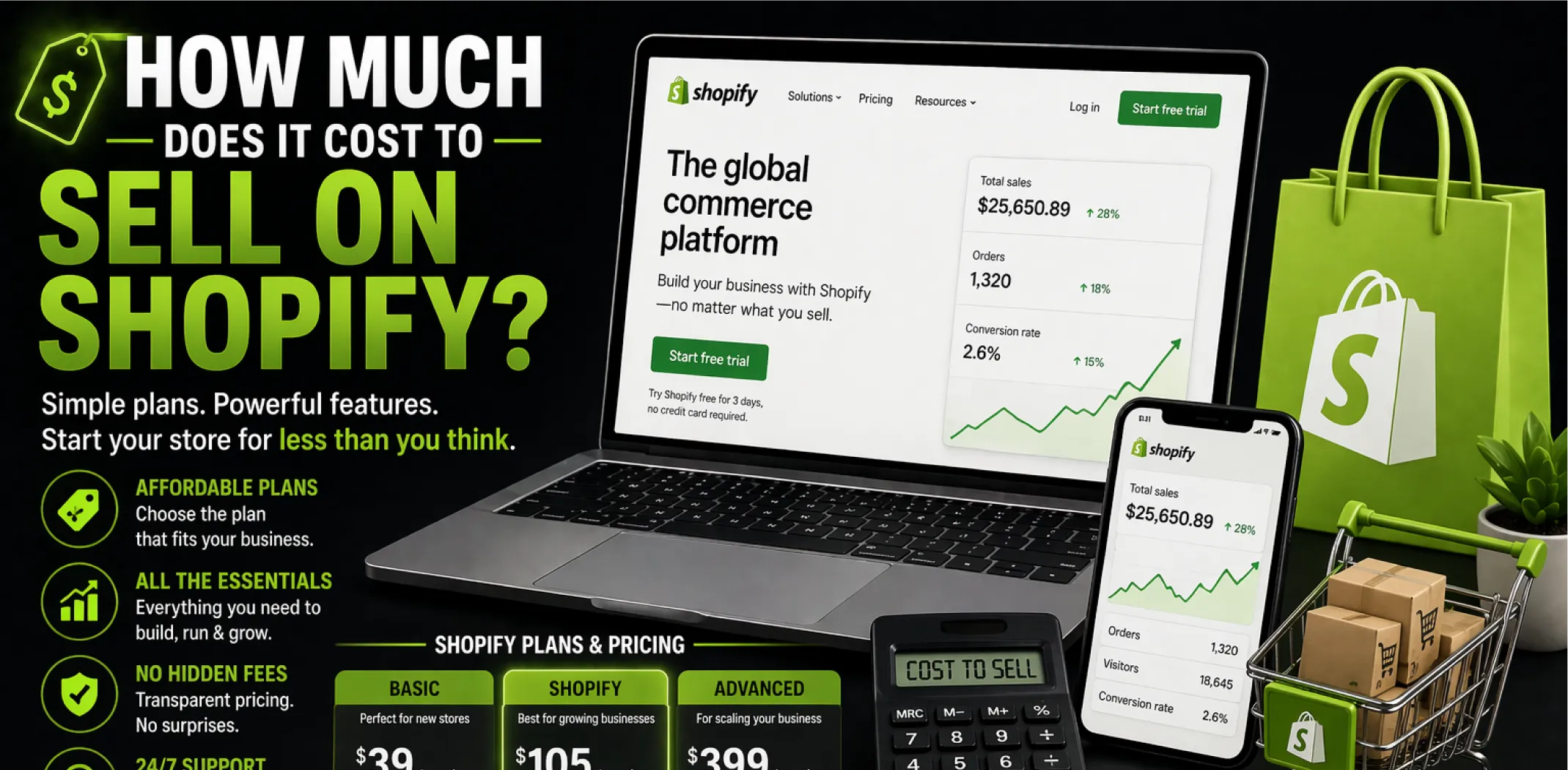
If you are thinking about starting an online store, Shopify is probably the first name that comes up. But before you sign up, you want a straight answer to one question: how much does it cost to sell on Shopify? The honest answer is that it depends on your plan and how you run your store – but the total adds up faster than most beginners expect.
Quick Answer: Selling on Shopify costs between $39 and $399 per month for a standard plan, plus transaction fees of 0.5%–2% on every sale (unless you use Shopify Payments), a domain, and optional app fees. Most new sellers end up spending $60–$90 per month just to keep the lights on – before a single dollar goes toward advertising.
This guide breaks down every Shopify fee you need to know in 2026 – from the base plan pricing to the hidden costs that quietly eat into your margins. By the end, you will know exactly what to budget and whether Shopify is the right fit for where you are right now.
Before we get into the numbers, it helps to understand why these costs matter so much for someone just starting out. If you are working with a limited budget – or none at all – every dollar you spend on platform fees is a dollar that is not going toward growing your business. That framing will make everything that follows more useful.
What is Shopify and why do the costs matter?
Shopify is a hosted ecommerce platform that lets you build and run an online store without needing to code or manage your own web server. You pay a monthly plan fee, and in return Shopify handles hosting, security, checkout, and payment processing. It powers millions of stores around the world and is one of the most recognized names in online selling.
Understanding the full cost of selling on Shopify matters because the advertised plan price is never the whole picture. Transaction fees, card processing rates, app subscriptions, and domain costs all stack on top of your base plan. For a beginner who budgets $39 per month and expects to keep most of their revenue, the reality of total Shopify fees can come as a real surprise.
In 2026, Shopify offers four main pricing tiers: Starter, Basic, Shopify, and Advanced. Each tier comes with different transaction fee rates, staff account limits, and reporting features. Knowing which plan fits your stage of business – and what it actually costs once you add everything up – is the first step to running a store that does not drain your budget before it earns anything.
Shopify pricing plans: What each one costs in 2026
Shopify restructured its pricing in recent years, and in 2026 the lineup looks like this. All prices below are for monthly billing. Paying annually saves you around 25% on each plan, which brings Basic down to roughly $29 per month – the figure you often see quoted in ads.
The Starter plan is limited to selling via social media or buy buttons – you cannot build a full storefront with it. For a proper online store, most beginners start on the Basic plan at $39 per month. The mid-tier plan at $105 per month adds better reporting and lower transaction fees, which starts making sense once your monthly revenue passes around $2,000–$3,000.
One note on the advertised prices: The $29/month figure you often see requires annual billing paid upfront. Budget for the month-to-month rate until you are confident the platform suits you – and factor in that you still have several more cost layers to add on top of the plan price.
Transaction fees are one of the most misunderstood parts of Shopify costs. If you use a third-party payment provider like PayPal or Stripe instead of Shopify Payments, Shopify charges you an extra fee on top of whatever your payment processor charges.
On the Basic plan, that is an additional 2% per sale. On 100 orders at $50 each, that is $100 straight off your revenue every month in platform fees alone – before any processing costs.
Using Shopify Payments (available in most US states and many other countries) eliminates that transaction fee entirely. You still pay a card processing rate – typically 2.9% + $0.30 per online transaction on Basic – but the Shopify-specific fee disappears. For most new sellers, enabling Shopify Payments from day one is the single smartest move to protect your margins.
The full breakdown: Every Shopify fee you need to budget for
The monthly plan price is just the starting point. To get a realistic picture of how much it costs to sell on Shopify, you need to account for every other cost that comes with running a live store. Here is a category-by-category breakdown of what to expect.
Domain and hosting costs
Custom domain
Shopify hosting is included in your plan – there is no separate hosting bill. However, your store will launch on a free subdomain (yourstore.myshopify.com) unless you buy a custom domain. A .com domain through Shopify costs around $14–$16 per year.
You can also buy through a third-party registrar like Namecheap for $10–$12 per year and connect it manually. Either way, budget around $15 per year – or roughly $1.25 per month.
Important: A custom domain is not optional if you want customers to take your store seriously. The .myshopify.com subdomain signals to most shoppers that your store is in test mode.
Theme costs
Free themes
Shopify offers around 12 free themes in its theme store. They are clean, mobile-responsive, and good enough for most new stores. If you are just getting started and want to keep your monthly cost as low as possible, a free theme is a perfectly reasonable choice for the first few months.
Premium themes
Premium Shopify themes cost between $150 and $350 as a one-time purchase. They come with more layout options, built-in conversion features, and dedicated support. Most sellers do not need a premium theme until they are generating consistent revenue – at that point, a small improvement in how the store converts can pay for the theme quickly.
App costs
Essential apps
The Shopify App Store has over 8,000 apps, and many of the most useful ones are paid. Common essential apps include email marketing tools ($10–$30/month), review apps ($15–$30/month), upsell tools ($20–$50/month), and SEO apps ($10–$20/month). It is easy to build a $60–$100 per month app stack without noticing. Add apps one at a time and cut anything that does not show a clear return on what you spent.
Email and marketing costs
Shopify Email
Shopify includes a basic email marketing tool called Shopify Email. The first 10,000 emails per month are free, after which you pay $1 per 1,000 emails. For a small store in its early months, this is enough. Once your list grows past 5,000 subscribers, dedicated tools like Klaviyo or Omnisend offer better automation – but cost $20–$60 per month on top of everything else.
Paid advertising
Paid ads are not technically a Shopify fee, but they are a real cost of selling on the platform for most store owners. Facebook and Instagram ads, Google Shopping campaigns, and TikTok ads are the most common channels.
Realistic starter budgets range from $5–$20 per day, or $150–$600 per month, just for testing. Organic traffic through content and social media takes 60–90 days to build but costs nothing once it is running.
Payment processing fees
Even with Shopify Payments enabled and the transaction fee eliminated, you still pay a card processing rate on every order. On the Basic plan this is 2.9% + $0.30 per online transaction. On the Shopify plan it drops to 2.6% + $0.30, and on Advanced it goes to 2.4% + $0.30.
These rates are competitive with industry standards, but on lower-margin products they are worth factoring carefully into your pricing from the start.
Earning potential: A store generating $3,000 per month in revenue on the Basic Shopify plan will pay roughly $87–$120 per month in card processing fees, plus the $39 plan fee. That is $126–$159 off the top in platform costs alone before product costs or ad spend.
What does Shopify actually cost per month in total?
To give you a realistic total, here is what a typical new seller on the Basic plan actually pays in their first few months – with conservative app usage and Shopify Payments enabled to eliminate the extra transaction fee.
This is the lean version. Sellers who add a premium theme, a full email platform, and paid ad spend can easily hit $250–$500 per month in total costs before making a single sale. That is not unusual – it is just the reality of running a self-managed online store, and something every beginner should budget for before they start.
Hidden Shopify fees beginners often miss
Beyond the obvious plan and app costs, there are a few fees that catch new sellers off guard. Here is what to watch for before you launch.
Currency conversion fees
If you sell to international customers and your store currency differs from your payout currency, Shopify charges a 1.5% currency conversion fee. This is easy to miss during setup and can meaningfully reduce margins on international orders. Check your payout settings early and align currencies where possible.
Chargeback fees
If a customer disputes a charge and files a chargeback through their bank, Shopify charges $15 per chargeback when using Shopify Payments. Clear product descriptions and fraud protection tools reduce the risk, but budget for occasional chargebacks as your order volume grows.
Refund processing costs
When you issue a refund, Shopify does not automatically return the full card processing fee on the original transaction. On Shopify Payments, you get the 2.9% portion back but not the $0.30 flat fee. On stores with frequent returns, this adds up. Build a realistic refund rate into your margin calculations from day one.
Shopify Plus upgrade costs
Shopify Plus is the enterprise tier, starting at $2,000 per month. It is aimed at high-volume brands doing $1M+ in annual revenue. For the vast majority of new sellers, Plus is not relevant – but it is worth knowing that Shopify’s pricing range is much wider than the $39–$399 window most beginners see.
Is Shopify worth the cost? What real sellers say
Looking at genuine seller feedback on Reddit’s r/shopify and on Trustpilot, the picture is nuanced. Shopify scores around 3.5–4 out of 5 on Trustpilot, with most positive reviews praising the ease of setup and the quality of the checkout experience. The most common complaints center on the cumulative cost of apps and the transaction fees when Shopify Payments is not used.
On Reddit, experienced sellers consistently make two points. First, the platform works well once you treat it like a real business with proper cost tracking from day one. Second, sellers who underestimate app costs and ad spend are the ones who end up feeling like the platform is too expensive. The platform is not the problem – the lack of financial planning before launch is.
Why this works in 2026: Shopify’s infrastructure is genuinely solid for fast store setup and payment reliability. For sellers who understand the full fee structure upfront, it remains one of the more capable hosted platforms available. The key is going in with realistic numbers, not the advertised plan price.
How to keep your Shopify costs as low as possible
Once you understand how Shopify pricing and fees work, there are straightforward ways to manage costs without sacrificing the quality of your store.
Use annual billing from the start
If you are confident about committing to Shopify for a full year, annual billing saves around 25% on your plan cost. Basic drops from $39 to approximately $29 per month, and the Shopify plan drops from $105 to around $79 per month. Over 12 months, that is a real saving – especially in the early months when every dollar matters.
Enable Shopify Payments immediately
This is the single most impactful cost decision you can make on the platform. Eliminating the additional transaction fee (2% on Basic) on every sale is immediate and ongoing. If Shopify Payments is available in your state or country, enable it during store setup – not after your first few sales.
Audit your apps every 30 days
App costs are the easiest place for your monthly bill to creep up without noticing. Set a calendar reminder once a month to review every active app, check whether it is earning its keep, and cancel anything that is not directly contributing to revenue or saving meaningful time. Most sellers find at least one redundant app subscription the first time they do this audit.
Start with organic traffic before paid ads
Paid advertising can add $150–$600 per month to your costs immediately. While ads can speed up growth, starting with SEO content, Pinterest, or organic social media gives you time to validate your products and pricing before spending on traffic. Most successful stores that started lean spent their first 60–90 days building organic content before turning on ad spend.
Use free themes until revenue justifies an upgrade
A premium theme at $150–$350 is not a day-one purchase. Shopify’s free themes are clean and conversion-ready for a new store. Once you are generating $2,000–$3,000 per month consistently and have identified your winning products, a theme upgrade becomes worth evaluating. Before that point, the money is better spent on traffic and product testing.
Which Shopify plan is right for you?
The right plan depends entirely on where you are in your business journey. Here is how to think about it by where you are starting from.
Complete beginner
If you have never run an online store before, start on the Basic plan at $39 per month. Enable Shopify Payments, use a free theme, and keep your app stack to two or three tools maximum. Your total monthly cost should land between $60 and $90 before ad spend. Budget for 60–90 days before your first consistent sales, and do not scale ad spend until you have confirmed your products are selling.
Intermediate seller
If you are already generating $2,000–$5,000 per month in revenue, the mid-tier Shopify plan at $105 per month starts to make sense. The lower transaction fee (1% vs 2%) and better analytics justify the extra cost at that revenue level. You are also likely building an email list at this stage, so a dedicated email platform becomes worthwhile.
Advanced or full-time goal
If your goal is a full-time income of $5,000+ per month, the Advanced plan at $399 per month can be justified by the lower 0.5% transaction fee at high volumes. At $50,000 per month in revenue, the difference between a 1% and 0.5% fee saves $250 per month – more than covering the plan upgrade. At this stage, focus on conversion optimization, customer retention, and expanding your product range.
Shopify continues to grow as a platform, with new features, better international support, and a more capable app ecosystem every year. For sellers who plan for the full cost structure upfront, it remains a solid foundation for an online business in 2026 – as long as the numbers work for your margin and budget.
Why Sellvia is a game-changer for your online store 🚀
Sellvia isn’t just another ecommerce tool. We are a trusted name in the industry, recognized by Forbes and even ranked in Inc.’s list of the 5,000 fastest-growing companies in the U.S. So if you’re serious about starting as a solopreneur, this is a smart place to begin.
Starting an online business can feel overwhelming, but that’s exactly where Sellvia steps in. It takes care of the tricky parts, so you can focus on making sales and growing your brand. Let’s break down what makes it such a great choice.
Get a ready-to-go store hassle-free 🎯
Want to start selling but don’t know where to begin? No worries! Just share your ideas, and Sellvia’s team will build a free ecommerce website that’s fully set up and ready to take orders from day one. No coding, no stress – just a store that works right out of the box.
A $100 welcome gift to grow your business faster 🎁
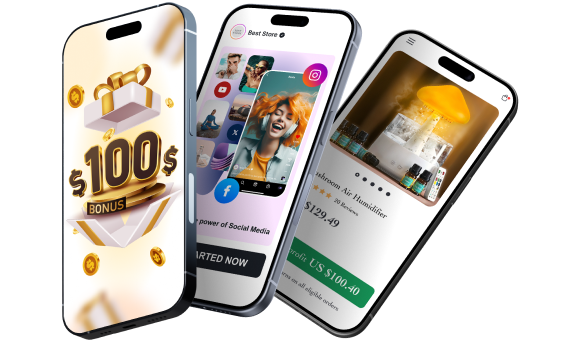
Starting a business takes momentum – and Sellvia gives you a head start. When you claim your free store today, you also get a $100 welcome gift to put toward growing your business. Use it to upgrade your store, boost your marketing, or unlock new tools. It is a real dollar value, handed to you on day one, with no catch and no hoops to jump through.
A massive catalog of digital products to sell 🏆
One of the biggest struggles in starting an online business is figuring out what to sell. Sellvia solves that completely. Your store comes pre-loaded with digital products – guides, courses, checklists, and tools – all created by Sellvia. You keep 50–70% of every sale. No inventory. No shipping. No logistics headaches.
Everything in one easy-to-use platform 🔥
Managing an online store shouldn’t be complicated. With Sellvia, you can handle orders, add new products, and even chat with customers – all from a simple and user-friendly platform. No need to mess with confusing tools or deal with unnecessary tech stuff. It’s all smooth sailing.
No upfront costs, just start selling 💰
A big reason people hesitate to start an online business is the cost. But here’s the good news: With Sellvia, you don’t need to invest in stock, storage, or shipping supplies. You can run your store with no upfront costs, keeping things low-risk while still making money.
Support that’s always got your back 🤝
Running a business comes with questions, but you’re never alone. Sellvia’s dedicated support team is available 24/7 to help with anything you need. Whether it’s a small question or a big challenge, they’ve got you covered.
Understanding how much it costs to sell on Shopify puts the Sellvia opportunity in sharp focus – a free store, digital products loaded and ready, and a built-in ad system that gets you orders without the monthly platform bill. Claim your free store and $100 welcome gift and start your online business today.
How much does it cost to sell on Shopify per month?
What are the Shopify transaction fees in 2026?
Shopify charges two types of transaction fees. The first is a platform fee that applies when you use a third-party payment provider instead of Shopify Payments – this fee is 2 percent on the Basic plan, 1 percent on the mid-tier plan, and 0.5 percent on the Advanced plan. The second is a card processing fee that applies to every sale. With Shopify Payments enabled, the rate is 2.9 percent plus 30 cents per transaction on the Basic plan. Enabling Shopify Payments eliminates the platform fee entirely, which is why most sellers activate it from day one.
Which Shopify pricing plan is best for beginners?
Most beginners should start on the Basic plan at 39 dollars per month on monthly billing. It includes everything needed to launch a full online store, including unlimited products and access to Shopify Payments. The mid-tier plan at 105 dollars per month becomes worth considering once monthly revenue consistently exceeds 2,000 to 3,000 dollars, as the lower transaction fee begins to offset the higher monthly cost at that volume. If you are on a tight budget and not yet sure about committing for a full year, monthly billing gives you more flexibility while you test your products and get your first sales.
Are there hidden fees when selling on Shopify?
Yes, there are several costs that beginners often overlook. Currency conversion fees of 1.5 percent apply when your store currency and payout currency differ. Chargeback fees of 15 dollars per dispute apply when using Shopify Payments. App costs accumulate quickly and can add 50 to 100 dollars or more per month if you are not auditing them regularly. Refund processing also does not return the 30-cent flat fee on the original transaction. Being aware of these before you launch makes budgeting much more accurate and avoids unpleasant surprises in your first months.
How do Shopify costs compare to other ways to sell online?
Shopify is on the higher end for total monthly cost compared to alternatives. A platform like Sellvia, for example, offers a free store with digital products already loaded and a built-in advertising system starting at 10 dollars per day – no separate app fees, no transaction fees on top of your plan, and no coding required. For beginners who want to minimize upfront costs while still running a real online business, this kind of all-in-one setup can be significantly more affordable in the first 90 days than self-managing a Shopify store with separate tools and apps for each function.