If you have been searching for how to start a clothing business, you are asking exactly the right question at exactly the right time. Fashion is one of the most searched income opportunities online every year – and the barriers have never been lower. Global online clothing sales are on track to exceed $1.2 trillion by 2027, and a growing share of that is going to small independent stores, not just the big retailers.
Quick Answer: To start a clothing business online, you choose a niche, pick a business model, set up a store, load it with products, and drive traffic. Most people can be live within 30–60 days and start seeing real sales within 60–90 days of consistent effort.
This guide walks you through every step – from picking your niche and understanding realistic startup costs to the common mistakes that kill most new stores before they ever build momentum.
The good news is that 2026 might be the most accessible year yet to figure out how to start a clothing business. Platforms, products, and built-in advertising tools have all come together in a way that makes it possible for a complete beginner – someone with no tech skills, no warehouse, and no startup cash – to launch a real online store.
You do not need to design products. You do not need to buy inventory. You just need the right platform and the willingness to take the first step.
What is a clothing business, and why start one in 2026?
A clothing business is any venture that sells apparel – t-shirts, activewear, streetwear, accessories, or niche fashion – directly to customers. The business model you choose determines how much money you need upfront, how much risk you carry, and how quickly you can start earning.
The three most common models are selling digital products (like styling guides and fashion courses), print-on-demand physical apparel, and wholesale buying. Each works – but they are not equal in terms of startup cost or how fast you can get to your first sale.
Why this works in 2026: Consumer trust in independent online stores has grown significantly. More than 60% of shoppers now actively seek out smaller or niche brands over mass-market retailers – and that trend is accelerating.
What makes the digital product model so compelling for new store owners is simplicity. There is no inventory to manage, no shipping logistics to figure out, and no warehouse costs.
When a customer buys a fashion guide, a style checklist, or an online course from your store, the product is delivered to them instantly and digitally. You keep 50–70% of every sale. That is a fundamentally different starting point from buying boxes of clothing and hoping they sell.
How much can you realistically earn from an online clothing business?
Most new stores do not hit four figures in month one – and any guide that tells you otherwise is setting you up for disappointment. What a well-run store can do is build a steady, growing income over 60–90 days of consistent effort. Here is an honest breakdown by approach:
Digital products offer the most accessible entry point because there is nothing to store, pack, or ship. Print-on-demand suits creative founders who want unique items. Wholesale carries higher ceiling potential but also the highest financial risk for a first-time business owner.
One note on the higher figures: Those $3,000–$8,000/month outcomes typically take 6–12 months of consistent work and a tested advertising approach. Part-time effort over 60–90 days can realistically generate $30–$80/day once your store finds its footing. The key is treating it like a real business from the start – not a set-it-and-forget-it situation.
The most important early move is focus. One business model, one niche, one traffic source. Spreading yourself thin across three approaches at once is the single most common reason new stores fail to build momentum.
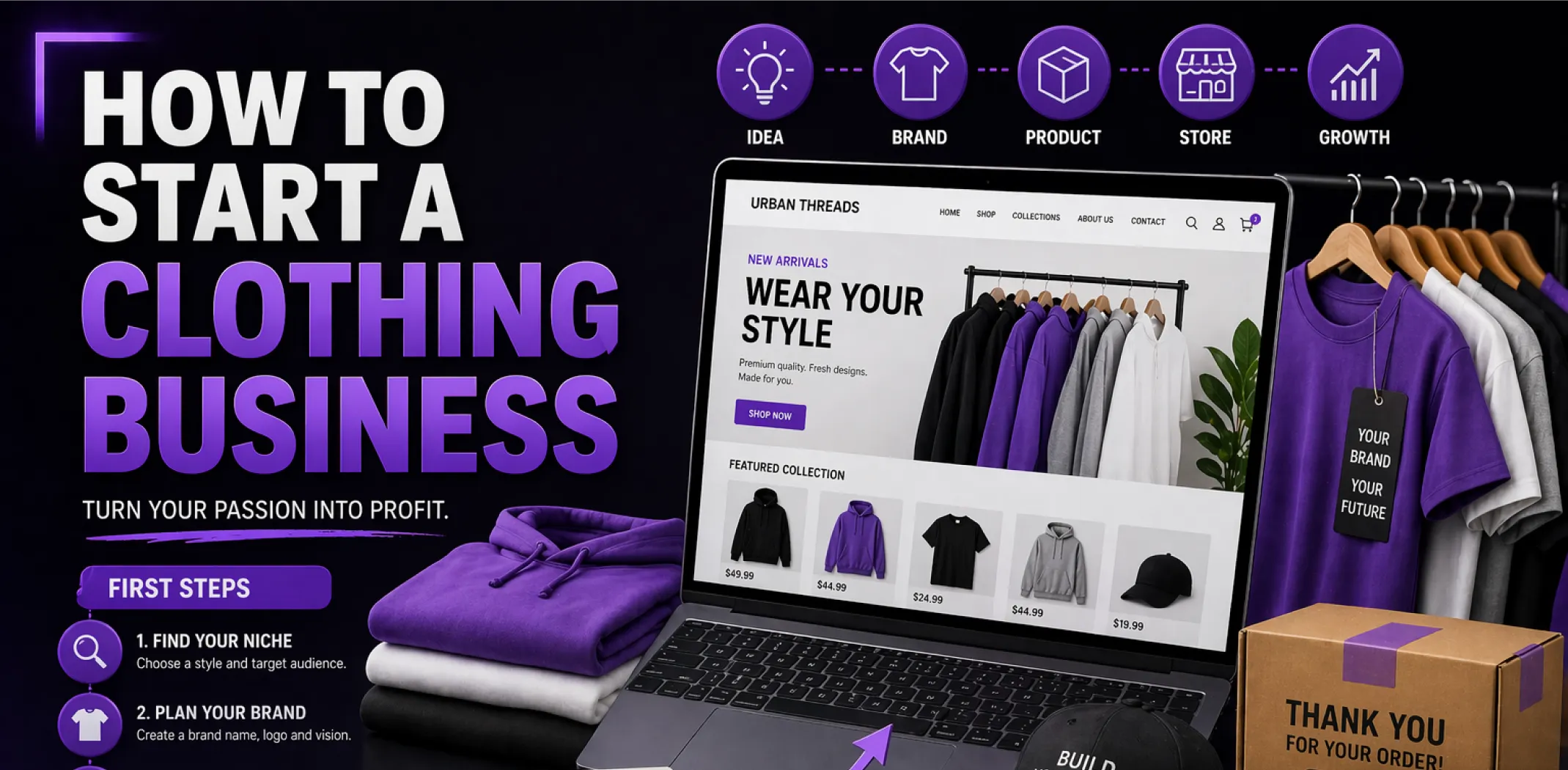
Step-by-step: How to start a clothing business online
Whether you are starting with zero experience or you have dabbled in online selling before, this sequence works. Follow it in order and you will avoid the most expensive beginner mistakes.
Step 1: Choose your niche
Pick a niche, not just “clothing”
“Clothing” is a category, not a niche. The stores that gain traction fastest are the ones that stand for something specific. Think: sustainable fashion guides for women over 40, streetwear styling tips for skaters, or capsule wardrobe courses for working parents. The narrower your focus, the easier it is to market, rank in search, and build a loyal audience.
To validate a niche before committing, use Google Trends, browse Reddit communities in the space, and check what is trending on TikTok search. You are looking for consistent interest, not just a one-week spike.
Earning potential: Niche stores with a defined audience typically convert at 2–4%, compared to 0.5–1.5% for generic fashion stores. That difference compounds significantly once you start running ads.
Choose your business model early
Your model shapes everything: how much capital you need, what your profit looks like per sale, and how fast you can scale. For most first-time store owners, digital products are the most sensible starting point. There is no inventory to buy, no supplier lead time to manage, and no minimum order quantity to worry about.
With a Sellvia store, digital products – fashion guides, style courses, wardrobe checklists, and online tools – are already loaded and ready to sell from day one. Sellvia creates all the products. You handle the marketing and the customer relationships. When a sale is made, the product is delivered to the customer instantly and digitally. You keep 50–70% of every sale.
Step 2: Set up your online store
Register your business
Before your first sale, set up your legal foundation. In the US, this usually means registering as an LLC, which protects your personal finances and costs $50–$500 depending on your state. You will also need an EIN from the IRS, a business bank account, and – depending on your state – a sales tax permit. This process typically takes 1–2 weeks and can largely be done online.
Important: Operating without any legal structure is risky. One dispute or payment chargeback can expose your personal finances if you have no entity separation.
Design a store that converts
Your store design communicates trust within three seconds of a visitor landing on it. A clean, mobile-optimized layout is non-negotiable – most of your traffic will come from phones, not desktop computers. High-quality product images matter even for digital products. Clean thumbnails, clear titles, and benefit-driven descriptions are what turn browsers into buyers.
Write product copy that speaks to the customer’s identity, not just the product features. A wardrobe planning guide is not just “a 40-page PDF” – it is the thing that helps a busy mom stop staring at a full closet and feeling like she has nothing to wear.
Earning potential: Stores with professional product presentation and mobile-optimized layouts see 40% higher conversion rates on average compared to those with default or unpolished designs.
Step 3: Load your store with products
What to sell in a fashion-focused digital store
If you are running a Sellvia store with digital products, your catalog is already handled. Sellvia provides guides, courses, checklists, and online tools across dozens of niches – including fashion, style, personal development, and home. You pick the products that fit your niche and your audience, and they are already there waiting for your first customer.
The advantage here is massive compared to physical clothing. No sizing issues. No returns because an item did not fit. No waiting weeks for a supplier to ship. A customer buys a style guide, it arrives in their inbox instantly, and you have already earned your profit.
Pricing your products for profit
A healthy margin on digital fashion products is typically 50–70% per sale. If a guide sells for $30, you might keep $15–$21 after Sellvia’s cut, depending on the product and your plan. That margin gives you room to cover ad spend and still net meaningful income per sale.
Do not compete on price alone. Stores that win purely on being cheapest are the first ones to lose customers to the next cheaper option. Win on niche specificity, clear branding, and a store that speaks directly to the customer you are trying to reach.
Step 4: Drive traffic to your store
Social media marketing
Instagram and TikTok are the most powerful free channels for fashion-adjacent businesses in 2026. Short video content showing styling tips, product walkthroughs, and honest “here is what I learned” content consistently outperforms static posts. Post 3–5 times per week in the early days, use niche-specific hashtags, and engage genuinely in the comments of accounts your target customer already follows.
Organic growth is slower than paid advertising, but the audience you build organically tends to be more loyal and more likely to buy more than once.
Paid advertising
Sellvia includes a fully built-in advertising system that handles the targeting, the creatives, and the optimization for you. You do not need to set up Facebook Ads or Google Ads yourself – you simply choose your daily budget ($10 to $50 per day), turn the ads on, and the system does the heavy lifting. Most store owners who activate their ads start receiving orders the same day.
During the free 14-day trial, you also receive a $40 ad coupon to put toward your first campaigns. That is real advertising credit handed to you on day one, with no catch.
Important note: Do not launch ads until your store is fully set up and your product pages are polished. Sending traffic to an unfinished store burns budget and produces no useful data.
SEO for your online store
Search engine optimization is a slower burn than social media, but it pays off long after you publish the content. Optimize your product pages around specific search terms relevant to your niche – “capsule wardrobe guide for working women” rather than just “fashion guide.” Write blog content that answers the questions your target customer is already Googling.
A store with 20 well-optimized pages and 10 blog posts can generate hundreds of monthly organic visitors within 6 months – traffic that costs you nothing per click.
Startup costs: What does it actually cost to start a clothing business?
This is the question most guides dance around. Here is a straight answer, broken down by approach:
The digital products model is clearly the most cost-effective starting point. With Sellvia, you can get online for well under $200 total – most of that being your optional ad budget. Wholesale requires $1,000+ before you make your first sale. Both can work, but the risk profile is completely different for someone just starting out.
Tips to grow your clothing business faster
Start with a tightly curated product selection
New store owners often make the mistake of loading every product available and wondering why nothing sells. A focused store with 10–20 carefully chosen products in a clear niche converts far better than a cluttered one trying to serve everyone. Curate ruthlessly. Every product on your store should fit the identity of the specific customer you are trying to reach.
Use email marketing from day one
Email is the highest-return marketing channel in online business, returning an average of $36 for every $1 spent according to Litmus research. Set up a welcome sequence and an abandoned cart follow-up from the moment your store launches. You do not need a big list for this to work – even 100 engaged subscribers can drive consistent sales when your follow-up emails are well-written and timed well.
Leverage content from real customers
Ask customers to share feedback or a review after their purchase, and offer a small discount on their next order in return. Real customer reviews are more trusted than any brand content you can produce – research consistently shows that user-generated social proof influences the majority of purchase decisions. Repost it on your social channels and embed the best reviews on your product pages.
Use free shipping strategically
This tip applies more to physical product stores, but the principle translates: set a threshold that increases the average order value without destroying your margin. For digital product bundles, consider offering a second product free at a higher spend level rather than a straight discount. Customers who feel they are getting more value tend to spend more and come back more often.
Review your data every month
Set a recurring monthly session to look at your store analytics. Which products get the most views but the fewest purchases? That is a pricing or product page problem. Which traffic source is driving the most actual sales? Double down on that channel. The stores that grow from $500/month to $3,000/month are almost always the ones that review their data and iterate – not the ones that set everything up and walk away.
Legal and ethical considerations for your clothing business
Starting a clothing business is exciting. Skipping the legal groundwork creates problems that can shut your store down later. Here is what to know before you launch.
Key principle: Operating a legitimate online business means being honest with customers about what they are buying, how it is delivered, and what your return policy is.
What to avoid absolutely
Do not list or sell counterfeit or replica branded goods. This is illegal in every major market and can result in your payment processor closing your account, your domain being taken down, and civil litigation. Even “inspired by” products that closely mimic luxury brand designs fall into a grey legal area that is not worth the risk.
Avoid using trademarked slogans, logos, or designs without a license – including popular TV show references, sports team names, and band artwork on print-on-demand items. The fine is never worth the short-term sales.
Do not post fake reviews or inflate your ratings with undisclosed incentivized feedback. In the US, the FTC requires disclosure of any material relationship between a reviewer and a brand. Equivalent rules exist in the EU and UK. Authentic trust built over time is worth far more than fabricated social proof.
What to do instead
Write your own product descriptions rather than copying supplier copy word for word – duplicate content also hurts your search rankings. Use a clear, honest returns and delivery policy and make sure customers know what to expect before they pay.
If you are selling digital products through Sellvia, most of these concerns are handled for you. The products are created by Sellvia, delivered instantly, and there are no shipping timelines to misrepresent. Your job is to market honestly and support your customers well.
How to choose your approach: Recommendations by reader profile
The right way to start a clothing business depends on where you are starting from. Here is a breakdown that matches approach to experience level.
Complete beginner
If you have never run an online business before, start with a Sellvia store selling digital products. There is no inventory risk, no technical setup to wrestle with, and you can be live within a week. The built-in advertising system means you do not need to know anything about Facebook Ads or Google Ads to get traffic. Focus on one niche, pick your best 10–15 products, and spend your first 30 days learning how your audience responds before scaling.
Intermediate / part-time
If you have some online marketing or ecommerce experience, you can move faster. Layer in content marketing alongside the built-in ads – a simple blog or TikTok presence that speaks directly to your niche audience. Aim for your first $1,000/month by month three. At this stage, email follow-up and regular product page optimization should become weekly habits rather than afterthoughts.
Advanced / full-time goal
If your goal is to replace a full-time income, digital products through Sellvia are a strong vehicle for getting there faster than physical inventory models. Plan to build a genuine brand identity – a consistent visual style, a clear audience, and a content strategy that keeps people coming back.
At this level, invest in professional-quality creative, explore influencer partnerships within your niche, and consider a virtual assistant to handle customer support as volume grows.
No matter which profile fits you, the principle is the same: start lean, test fast, and scale what actually works. The stores that fail are almost always the ones that over-invest in setup and under-invest in getting real people to their store.
Why Sellvia is a game-changer for your online store 🚀
Sellvia isn’t just another ecommerce tool. We are a trusted name in the industry, recognized by Forbes and even ranked in Inc.’s list of the 5,000 fastest-growing companies in the U.S. So if you’re serious about starting as a solopreneur, this is a smart place to begin.
Starting an online business can feel overwhelming, but that’s exactly where Sellvia steps in. It takes care of the tricky parts, so you can focus on making sales and growing your brand. Let’s break down what makes it such a great choice.
Get a ready-to-go store hassle-free 🎯
Want to start selling but don’t know where to begin? No worries! Just share your ideas, and Sellvia’s team will build a free ecommerce website that’s fully set up and ready to take orders from day one. No coding, no stress – just a store that works right out of the box.
A $100 welcome gift to grow your business faster 🎁
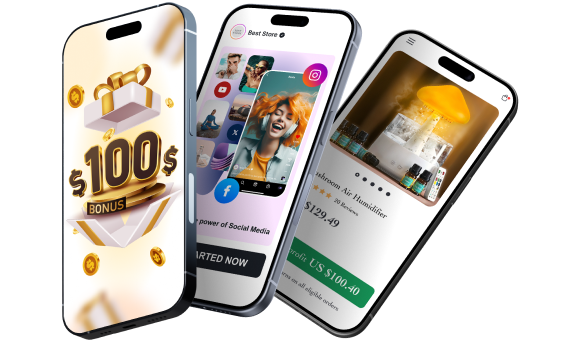
Starting a business takes momentum – and Sellvia gives you a head start. When you claim your free store today, you also get a $100 welcome gift to put toward growing your business. Use it to upgrade your store, boost your marketing, or unlock new tools. It is a real dollar value, handed to you on day one, with no catch and no hoops to jump through.
A massive catalog of digital products to sell 🏆
One of the biggest struggles in starting an online business is figuring out what to sell. Sellvia solves that completely. Your store comes pre-loaded with digital products – guides, courses, checklists, and tools – all created by Sellvia. You keep 50–70% of every sale. No inventory. No shipping. No logistics headaches.
Everything in one easy-to-use platform 🔥
Managing an online store shouldn’t be complicated. With Sellvia, you can handle orders, add new products, and even chat with customers – all from a simple and user-friendly platform. No need to mess with confusing tools or deal with unnecessary tech stuff. It’s all smooth sailing.
No upfront costs, just start selling 💰
A big reason people hesitate to start an online business is the cost. But here’s the good news: With Sellvia, you don’t need to invest in stock, storage, or shipping supplies. You can run your store with no upfront costs, keeping things low-risk while still making money.
Support that’s always got your back 🤝
Running a business comes with questions, but you’re never alone. Sellvia’s dedicated support team is available 24/7 to help with anything you need. Whether it’s a small question or a big challenge, they’ve got you covered.
Starting a clothing business has never been more accessible – and Sellvia gives you everything you need to do it right, without the upfront cost or complexity. Claim your free store and $100 discount and start earning today.
How to start a clothing business with no money?
How much does it cost to start an online clothing business?
The startup cost for a Sellvia digital products store can be as low as 50 to 100 dollars, covering business registration and any optional initial marketing spend. There is no inventory to buy and no platform subscription cost during the 14-day free trial. After the trial, the monthly plan is 39 dollars per month, which works out to about 1 dollar and 30 cents per day. A wholesale or print-on-demand clothing business typically requires 500 to 5000 dollars in setup and inventory before your first sale. For most beginners, the digital products model through Sellvia is the most financially accessible route to starting an online clothing business.
Is selling digital fashion products profitable in 2026?
Yes, selling digital fashion products is profitable in 2026 for stores that focus on a specific niche and market consistently. Profit margins of 50 to 70 percent per sale are standard, and there are no inventory, shipping, or logistics costs to eat into your earnings. Sellers who activate the built-in Sellvia advertising system often see their first orders on the same day they launch. Stores that combine a clear niche identity with consistent marketing can reach 500 to 2000 dollars per month within 60 to 90 days. Results vary depending on effort, niche selection, and how actively the store owner drives traffic.
What is the fastest way to get your first clothing business sale?
The fastest way to get your first sale is to launch a Sellvia store, activate the built-in advertising system, and let it start driving traffic from day one. Most store owners who turn on ads see their first orders within 24 hours. Organic social media content on TikTok or Instagram is a slower but free alternative for those who want to test before spending on ads. Having a focused niche, a clean store, and clear product descriptions significantly improves the chances of converting that first visitor into a buyer. The 40 dollar ad coupon included with the free trial means you can start advertising without any upfront ad spend of your own.
How long does it take to make money from a clothing business?
Most Sellvia store owners see their first sale within the first 1 to 2 weeks when using the built-in advertising system. Building to a consistent 500 to 1000 dollars per month typically takes 60 to 90 days of daily effort, a tested ad campaign, and a focused niche. Organic-only strategies using social media generally take 3 to 6 months to generate meaningful recurring income. Treating the business seriously – engaging with your audience, iterating on your products, and reviewing your data monthly – significantly shortens the time to consistent profitability. Realistic expectations and consistent daily action matter far more than any single tactic.