More than half of all small businesses in the United States are run from home. That number has only grown as online tools have made it easier than ever to earn real income without a commercial lease, a warehouse, or a business degree. If you have been searching for how to start a small business at home, you are in the right place.
Quick answer: The most accessible ways to start a small business at home in 2026 include freelancing, selling digital products, online tutoring, service-based businesses, and running an online store. For beginners who want real scalability with low startup costs, an online store powered by Sellvia stands out – you get a fully built store, digital products to sell, and a built-in advertising system, all included in a free 14-day trial.
This guide covers each major option honestly – what it takes, what it realistically pays, and who it suits best. Whether you want a modest side income or a full-time income replacement, one of these paths will match where you are right now.
What is a home-based small business?
A home-based small business is any income-generating venture you run primarily from your residence. It covers everything from a one-person freelance operation to a fully automated online store that processes orders while you sleep – without you ever touching inventory or dealing with shipping logistics.
What all home businesses share is low overhead. No commercial rent. No commute. Startup costs that can stay under a few hundred dollars – or even zero, depending on the model you choose.
In 2026, three trends are accelerating home business growth. First, consumer comfort with buying from small independent online stores has never been higher. Second, freelance platforms now connect skilled individuals with clients globally in hours, not weeks. Third, AI-assisted tools have dramatically cut the time needed to build, market, and run a business solo – even with no technical background.
Important note: “Small business” does not mean small ambition. Many home-based businesses grow into full-time incomes and beyond. The U.S. Census Bureau consistently shows that home-based businesses represent a meaningful share of all employer firms in the country.
How much can you realistically earn from a home business?
Income from a home-based small business varies widely depending on the model, the time you invest, and how quickly you find your first customers. The table below gives an honest overview of the most practical options available right now.
These ranges reflect real-world outcomes, not best-case scenarios. An online store run consistently for 60–90 days can reach $500–$1,500 per month; experienced store owners pushing toward full-time income typically cross the $3,000–$5,000 mark after six months. Freelancers and tutors are limited by available hours, which caps their ceiling unless they productize their services.
One note on the upper figures: the $5,000+ column reflects stores or freelance practices that have been running for several months with active marketing. First-month results for any new home business are typically modest – plan for a 60–90 day ramp-up before judging whether a model is working for you.
The model with the highest ceiling for a beginner is an online store. Unlike freelancing or tutoring, which trade your time for dollars, a well-run online store processes orders whether you are working or not. Sellvia gives you that store – fully built, pre-loaded with digital products, and equipped with a built-in advertising system – all for a 14-day free trial that includes a $40 ad coupon.
Best small business ideas to start at home in 2026
The options below are assessed honestly by scalability and startup simplicity – the two factors that matter most when you are starting from scratch. Each one is a legitimate path to income from home in 2026.
Online store
Running an online store is the standout home business idea for one core reason: it does not trade time for money the way every other option on this list does. Once your store is set up and your ads are running, sales can happen at any hour without additional effort from you.
The model that removes the most friction for beginners is selling digital products through Sellvia. Your store comes pre-loaded with guides, courses, checklists, and tools – all created by Sellvia, so you never have to make anything yourself. You keep 50–70% of every sale. No inventory. No shipping. No logistics. When a customer buys, the product is delivered to them instantly and digitally.
Why an online store beats most home business ideas
Most home business models are capped by the hours in your day. You write a freelance article, you get paid. You tutor a student for an hour, you earn for that hour. An online store breaks that equation. One store, properly set up, can serve dozens of customers in the time it takes you to tutor a single student.
Startup costs are also lower than most people assume. Sellvia gives you a fully built, product-stocked store as part of a free 14-day trial. Most customers who activate the built-in ad system start receiving orders the same day – and a $40 ad coupon is included free during the trial period.
Earning potential: $500–$5,000+ per month after a 60–90 day ramp-up, depending on your ad budget and product selection.
How to get started
- Sign up for Sellvia’s free 14-day trial – your store is built and loaded with digital products for you.
- Activate the built-in advertising system – set a daily budget between $10 and $50.
- Use your free $40 ad coupon to get your first orders at zero cost to you.
- Monitor which products perform best and let the platform handle the rest.
- Pay $39 per month (roughly $1.30 per day) to continue once the trial ends.
Why this works in 2026: Consumer comfort with buying digital products online has never been higher, and Sellvia’s built-in ad system puts your store in front of buyers without requiring any marketing expertise on your part.
Freelancing
Freelancing is the fastest way to earn from home if you already have a marketable skill. Writing, graphic design, web development, video editing, social media management, bookkeeping – any of these can generate income within days of creating a profile on Upwork, Fiverr, or Toptal.
Writing and content creation
Content demand is enormous in 2026. Businesses, blogs, and brands need articles, product descriptions, email sequences, and social captions on an ongoing basis. A writer with a niche focus – finance, health, tech, parenting – can charge $0.10–$0.25 per word as a beginner and significantly more with a solid portfolio. At 20 hours per week, that translates to $800–$2,500 per month without a single commute.
Earning potential: $300–$2,500 per month depending on niche, rate, and client volume.
Graphic design and creative services
Designers with skills in Canva, Adobe Illustrator, or Figma can build a steady freelance income from home. Logo design, brand kits, social media templates, and presentation design are all in high demand from small businesses that cannot afford agency rates. Entry-level designers on Fiverr charge $30–$80 per project; experienced designers working directly with clients can charge $500–$2,000 per project.
Earning potential: $400–$3,000 per month depending on skill level and how quickly you build a client base.
Virtual assistance
Virtual assistants handle tasks like email management, calendar scheduling, data entry, customer support, and research for business owners who need to delegate. The barrier to entry is low, demand is consistent, and rates typically run $15–$35 per hour for general roles and $35–$60+ per hour for specialized positions like executive assistance or operations support.
Earning potential: $600–$2,500 per month at 20–30 hours per week.
Selling digital products
Digital products – ebooks, templates, courses, presets, printables – are created once and sold repeatedly with no additional effort per sale. That makes them one of the few genuinely scalable small business ideas from home that does not require ongoing client work or physical inventory.
Ebooks and guides
If you have expertise in a specific area – personal finance, fitness, parenting, cooking, professional skills – an ebook priced at $9–$29 can earn consistently through platforms like Gumroad, Payhip, or Amazon KDP. Creators with an existing social following or email list can earn $300–$1,500 per month from a single well-positioned ebook.
Earning potential: $100–$1,500 per month depending on pricing, niche, and traffic source.
Templates and printables
Canva templates, Excel spreadsheets, Notion dashboards, resume templates, and printable planners are among the best-selling digital products on Etsy and Creative Market. A well-designed resume template priced at $7–$15 can sell hundreds of copies per month with almost no ongoing work. Top sellers in popular categories report $1,000–$3,000 per month from template shops with 20+ listings.
Earning potential: $200–$2,000 per month for established shops with a strong product catalog.
Online tutoring and coaching
If you have knowledge in an academic subject, language, instrument, fitness, or professional field, online tutoring is one of the most immediately monetizable work-from-home business ideas available. Platforms like Preply, Wyzant, Superprof, and iTalki connect tutors with paying students around the world.
Academic and language tutoring
English tutors working with non-native speakers can charge $15–$40 per hour on platforms like Preply, and established tutors with strong reviews often move to private clients at $50–$80 per hour. Math, science, and test-prep tutors in the US market typically charge $30–$70 per hour depending on the level and subject. At 15 sessions per week, that is a realistic $1,500–$3,000 per month from home.
Earning potential: $500–$2,500 per month depending on subject, platform, and session volume.
Online coaching
Business coaching, life coaching, fitness coaching, and career coaching are all viable home-based businesses in 2026 – provided you have demonstrable results or credentials. Coaches typically charge $100–$500 per session or package services at $500–$3,000 per month for ongoing clients. Building a client base takes 3–6 months of consistent outreach, but the income per hour is among the highest of any home business model.
Earning potential: $1,000–$5,000 per month for coaches with 5–10 active clients.
Home-based service businesses
Not every home business is purely online. Service businesses that you manage and market from home – but deliver locally – remain strong options, especially for people who prefer in-person work or want a reliable supplemental income alongside an online store.
Pet care services
Dog walking, pet sitting, and grooming are consistently in demand in suburban and urban areas. Platforms like Rover and Wag connect local carers with clients quickly. Dog walkers in mid-sized US cities typically charge $18–$30 per 30-minute walk; pet sitters offering overnight care can earn $50–$80 per night. A full schedule of four to six walks per day generates $1,500–$2,500 per month.
Earning potential: $800–$2,500 per month depending on location, schedule, and services offered.
Cleaning and home organization
Residential cleaning is one of the most reliably profitable local service businesses you can run from home. You market online, schedule from home, and deliver locally. Independent cleaners in the US typically charge $25–$50 per hour or $100–$200 per session. A base of 15–20 regular clients generates $2,000–$4,000 per month. The main challenge is building that client base in the first 60–90 days.
Earning potential: $1,000–$3,500 per month for an operator with a steady client list.
Legal and practical considerations for home businesses
Starting a small business at home is straightforward in most states, but a few legal and practical steps are worth handling early to avoid problems later.
Important note: The specifics vary by state and business type – always check your local regulations or consult a professional if you are unsure.
- Business registration: Most home businesses benefit from registering as a sole proprietor or LLC. An LLC provides liability protection that a sole proprietorship does not, and in the US it typically costs $50–$500 depending on the state.
- Tax obligations: Self-employed income is taxable. Set aside 25–30% of net earnings from the start and consider quarterly estimated tax payments to avoid a large bill at year-end.
- Zoning and permits: Some residential areas restrict commercial activity from home addresses. Check local zoning rules if you plan to have clients visit or operate equipment that could affect neighbors.
- Business banking: Open a separate bank account for business income and expenses from day one. It simplifies tax time and makes your business look more professional to clients.
- Insurance: Depending on your business type, general liability or professional indemnity insurance may be worth the cost – especially for service businesses or anyone giving advice professionally.
Key principle: Run your home business transparently from the start – honest records, proper registration, and clear marketing are the foundation of a business that grows without legal headaches.
How to choose the right home business for you
There is no single best answer when it comes to how to start a small business at home – the right choice depends entirely on your starting point. Here is a practical breakdown by reader profile.
Complete beginner with no existing skills or capital
Start with Sellvia. You get a fully built online store, a catalog of digital products ready to sell, and a built-in advertising system – all included in a free 14-day trial with a $40 ad coupon. No coding, no experience, no upfront costs. Virtual assistance is another zero-cost option if you prefer immediate client work, but it is capped by hours in a way that an online store is not.
Intermediate – you have a skill and some free time
Freelancing is the fastest path to income if you have a marketable skill. Use it to generate cash flow in the short term while building a more scalable asset – like a Sellvia store – in parallel. Many successful home business owners start freelancing to cover their first month of expenses while their online store finds its footing.
Advanced – you want a full-time income replacement
If your goal is replacing a full-time salary from home, an online store and online coaching are the two models with the highest earning ceiling. A Sellvia store scales with your ad budget and does not require more of your time as it grows. Coaching scales with your reputation and rate increases. Both can reach $5,000+ per month with 6–12 months of consistent effort.
Side income only – you have limited hours
Digital products and tutoring suit people who want a reliable side income without building a full business. A well-positioned Etsy template shop or a part-time tutoring schedule can generate $300–$800 per month with 5–10 hours of work per week once it is established. A Sellvia store also works well here – once ads are running, it requires minimal daily management.
Whatever your profile, the common thread among successful home business owners is consistency in the first 90 days. Most people quit before the business has had time to work. The models described in this guide all have documented track records – the variable is execution.
A smarter way to start your home business in 2026
Every method on this list is a legitimate path to income from home. But if you are weighing them against each other, one thing stands out: most of these models require either a marketable skill you may not have yet, a client base that takes months to build, or hours of your day that are already spoken for.
Sellvia was built specifically for people who want to start an online business without any of those prerequisites. No experience needed. No products to create. No shipping or logistics to manage. Your store is built for you, stocked with digital products, and connected to a built-in advertising system that can have your first orders coming in on day one. Over 1,500,000 stores have been launched on the platform, and store owners have collectively earned more than $1.5 billion – numbers verified by Forbes, who officially recognized Sellvia as a member of the Forbes Communications Council in 2026.
The 14-day free trial includes everything: a ready store, digital products to sell, a $40 ad coupon, and 24/7 support. It is the lowest-friction way to start a small business at home that exists right now.
Why Sellvia is a game-changer for your online store 🚀
Sellvia isn’t just another ecommerce tool. We are a trusted name in the industry, recognized by Forbes and even ranked in Inc.’s list of the 5,000 fastest-growing companies in the U.S. So if you’re serious about starting as a solopreneur, this is a smart place to begin.
Starting an online business can feel overwhelming, but that’s exactly where Sellvia steps in. It takes care of the tricky parts, so you can focus on making sales and growing your brand. Let’s break down what makes it such a great choice.
Get a ready-to-go store hassle-free 🎯
Want to start selling but don’t know where to begin? No worries! Just share your ideas, and Sellvia’s team will build a free ecommerce website that’s fully set up and ready to take orders from day one. No coding, no stress – just a store that works right out of the box.
A $100 welcome gift to grow your business faster 🎁
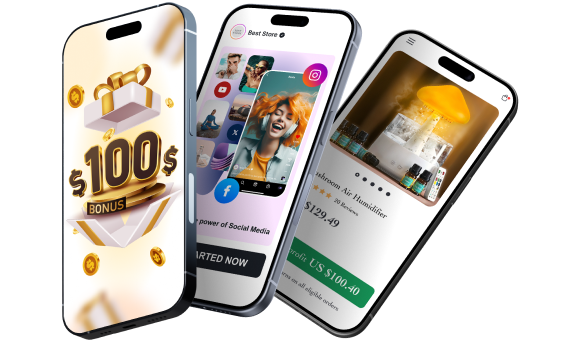
Starting a business takes momentum – and Sellvia gives you a head start. When you claim your free store today, you also get a $100 welcome gift to put toward growing your business. Use it to upgrade your store, boost your marketing, or unlock new tools. It is a real dollar value, handed to you on day one, with no catch and no hoops to jump through.
A massive catalog of digital products to sell 🏆
One of the biggest struggles in starting an online business is figuring out what to sell. Sellvia solves that completely. Your store comes pre-loaded with digital products – guides, courses, checklists, and tools – all created by Sellvia. You keep 50–70% of every sale. No inventory. No shipping. No logistics headaches.
Everything in one easy-to-use platform 🔥
Managing an online store shouldn’t be complicated. With Sellvia, you can handle orders, add new products, and even chat with customers – all from a simple and user-friendly platform. No need to mess with confusing tools or deal with unnecessary tech stuff. It’s all smooth sailing.
No upfront costs, just start selling 💰
A big reason people hesitate to start an online business is the cost. But here’s the good news: With Sellvia, you don’t need to invest in stock, storage, or shipping supplies. You can run your store with no upfront costs, keeping things low-risk while still making money.
Support that’s always got your back 🤝
Running a business comes with questions, but you’re never alone. Sellvia’s dedicated support team is available 24/7 to help with anything you need. Whether it’s a small question or a big challenge, they’ve got you covered.
Of all the ways to start a small business at home in 2026, Sellvia gives you the most complete foundation – store, products, and advertising all in one place. Claim your free store and $100 welcome gift and take the first step today.