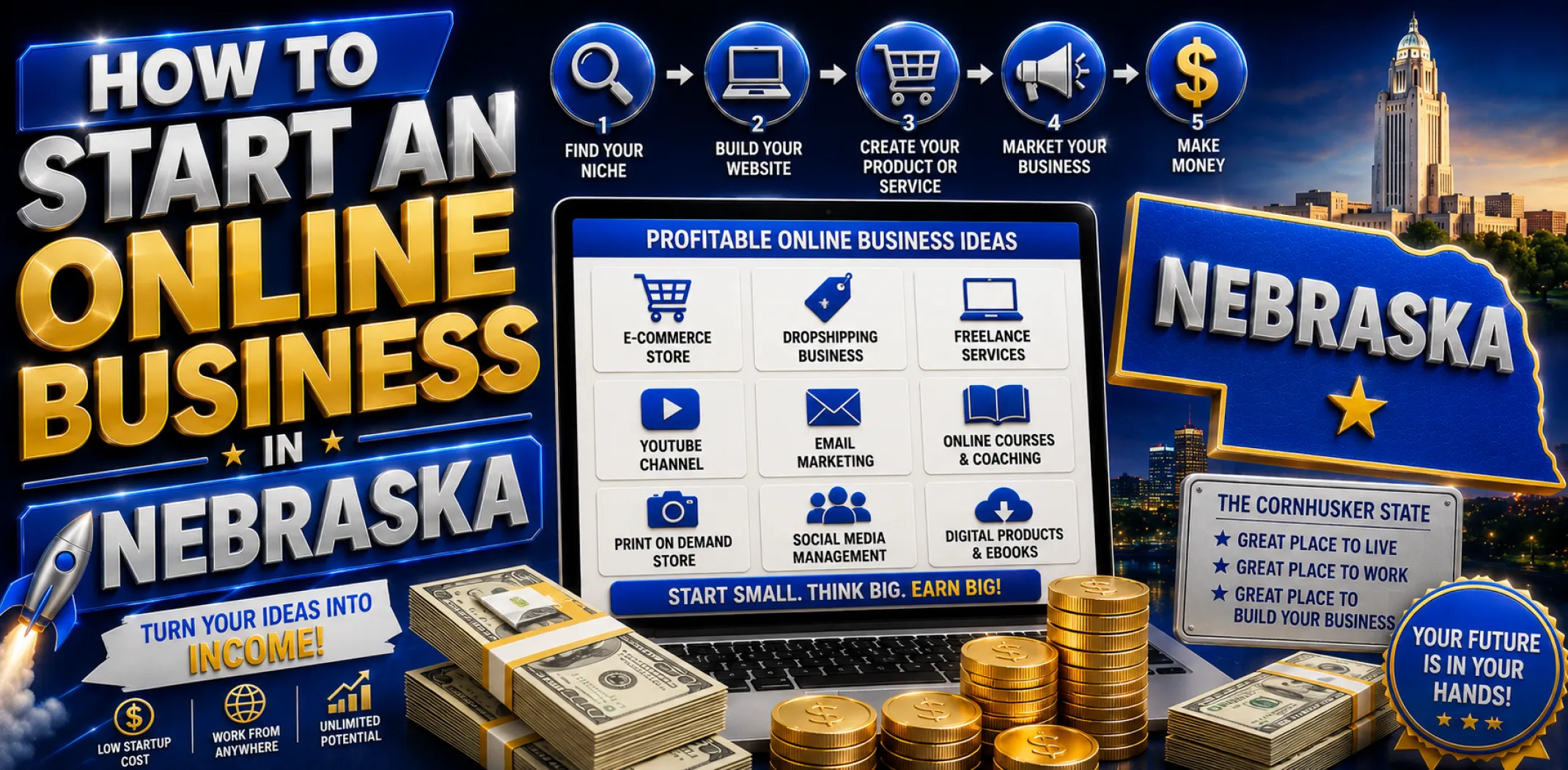
Nebraska is changing. The state has added over 40,000 residents since 2020, its metro areas are growing, and its rural counties are quietly losing people and jobs every year. If you live outside Omaha or Lincoln, you already know what that looks like: fewer local employers, longer commutes, and a job market that moves slower than the cost of living.
The question a lot of Nebraskans are asking right now is not whether they need extra income. The question is how to find it.
Quick Answer: You can start an online business in Nebraska today with no prior experience, no technical skills, and very little upfront money. The fastest path is a digital product store – a pre-built online store loaded with products you can sell immediately, with no physical goods to manage. This guide walks through every step: choosing your model, registering your business in Nebraska, handling Nebraska taxes, and making your first sales.
Nebraska has a population of just over 2 million people and a median household income of $66,644, according to US Census data. Most Nebraskans are connected – the state has been actively expanding broadband access through its Nebraska Broadband Office and BEAD funding, targeting 100% coverage of currently unserved and underserved locations.
That connectivity matters, because an online business works from anywhere in the state, whether you are in Omaha, Grand Island, Norfolk, or a county with one stoplight.
Why Nebraska is a good place to start an online business
Nebraska is not usually the first state people think of when they hear “online business.” But the numbers tell a different story. The state has a labor force of over 1 million people, and while unemployment remains relatively low at around 3%, the Federal Reserve Bank of Kansas City reported in late 2025 that Nebraska’s job market has cooled.
Hiring has slowed, mass layoffs hit a post-pandemic high in 2025 with 14 announced company layoffs, and young Nebraskans are leaving for other states at an accelerating rate. That is a lot of pressure on households that depend on a single employer.
At the same time, the national online retail market hit $1.19 trillion in sales in 2025, and about 80% of Americans now shop online. Nebraska residents are part of that market as buyers – and there is no reason they cannot be on the selling side too.
You do not need to be in a major city to run an online store. You need an internet connection and a product people want. Nebraska’s growing broadband infrastructure makes that more achievable every year.
The state’s agricultural and services-focused economy also creates real demand for practical digital content – guides, tools, and resources that help people with farming, home maintenance, financial planning, cooking, and family care. Nebraska residents who understand their own community often have a built-in advantage when choosing what to sell online.
Best online business models for Nebraska residents
Not every online business model fits every person. Below are the most realistic options for Nebraska residents – especially those starting with limited time, limited money, and no prior online business experience.
One note: how to start dropshipping in Nebraska is a search a lot of Nebraskans do, and it leads to a model that requires suppliers, logistics, and margins that are often too thin to survive on. This section gives you a fuller picture.
Digital product stores
A digital product store sells guides, courses, checklists, and tools that customers download instantly. There is no physical product, no packaging, no delivery cost, and no limit on how many you can sell. You set up once and your store works around the clock.
Platforms like Sellvia give you a pre-built store already loaded with 1,000 ready-made digital products – so you skip the product creation stage entirely and go straight to selling. Margins are 50–70% per sale, and many store owners see their first orders within the first few days of launching ads.
Why this works in Nebraska: rural Nebraskans with limited local job options can run a full store from home with just a smartphone or laptop – no commute, no boss, no schedule.
Freelancing
If you have a marketable skill – writing, graphic design, bookkeeping, video editing, social media management – freelancing lets you earn from clients anywhere in the country. Platforms like Upwork and Fiverr connect you with buyers. You can start with no upfront cost. The ceiling, though, is real: you earn when you work, and every hour you sell is an hour you cannot scale.
Why this works in Nebraska: Nebraska’s lower cost of living means you can be competitive on price while still earning a meaningful income. The tradeoff is that growth is slow and income is unpredictable.
Content creation
YouTube channels, blogs, and newsletters can earn through advertising, sponsorships, and affiliate links. This is a legitimate long-term model, but it typically takes 12–18 months before meaningful income arrives. It is best suited to people who enjoy creating content regularly and are not depending on quick results.
Why this works in Nebraska: Nebraska’s outdoor culture, farming communities, and food traditions give content creators a ready-made niche that national audiences find genuinely interesting.
Affiliate marketing
Affiliate marketing pays you a commission every time someone buys a product through your unique link. You do not handle the product or the customer – you just drive traffic. The challenge is that building enough traffic to earn reliably takes time and often requires existing content or an audience. Beginners tend to underestimate how long this takes.
Why this works in Nebraska: it pairs well with content creation, especially if you already have a local following on social media or a niche you know deeply.
Coaching and online tutoring
If you have professional expertise or are strong in a school subject, you can charge for one-on-one coaching or tutoring sessions online. This requires no platform fees to start – just a video call tool and a way to collect payment. Hourly rates for online tutors typically run $25–$80 depending on subject and level.
Why this works in Nebraska: parents in rural areas often struggle to find quality in-person tutors, and remote coaching fills that gap.
Skip the slow start
You compared the models. One of them gives you a complete store with 1,000 products on day one.
Most models require months of building before you see your first dollar. Sellvia gives Nebraska residents a fully built store, 1,000 ready-made digital products, and one-click ads – so you start selling, not building.
How to start an online business in Nebraska – step by step
Step 1: Choose your business model
Start with the model that fits your current situation. If you have no experience, no product, and limited time, a pre-built digital product store removes the most obstacles. If you have a specific skill, freelancing or coaching may be faster. Be honest about how much time you have each week and how long you can wait before earning. Most models other than a pre-built store take 60–180 days before any real income arrives.
Step 2: Register your business in Nebraska
You have two main options: a sole proprietorship or an LLC.
A sole proprietorship requires no formal registration in Nebraska unless you are operating under a name other than your own. If you use a business name, you file a Trade Name Registration with the Nebraska Secretary of State. This costs $100 online. It is the simplest and cheapest option, but it offers no personal liability protection.
An LLC costs $100 to file your Certificate of Organization online (or $110 by mail), and processing takes about 10 business days. Nebraska has a unique requirement: after your LLC is approved, you must publish a notice in a local newspaper for three consecutive weeks, then file an Affidavit of Publication with the Secretary of State for $25 online.
Budget $75–$275 for the newspaper publication, depending on your county’s rates. You also file a biennial report every odd-numbered year by April 1, which costs $28 online.
Most solo online business owners in Nebraska start as sole proprietors to keep costs down, then form an LLC once income is consistent. Either way, get a free Employer Identification Number (EIN) directly from the IRS at irs.gov – you will need it to open a business bank account.
Step 3: Handle Nebraska taxes
Nebraska has a progressive state income tax with four brackets ranging from 2.46% to 5.20% for the 2025 tax year. The top rate applies to taxable income over $34,000 for single filers. Nebraska is actively reducing this rate – the top bracket drops to 4.55% in 2026 and 3.99% by 2027.
Nebraska’s state sales tax rate is 5.5%, and cities can add up to 2% on top of that. If you sell digital products online and your Nebraska-based annual sales exceed $100,000 or 200 separate transactions, you trigger economic nexus and must collect and remit sales tax.
Nebraska taxes specified digital products, so if your store sells downloadable guides and tools to Nebraska customers, you may need to register for a sales tax permit through the Nebraska Department of Revenue. Registration is free and takes about two weeks.
As a self-employed business owner, you will pay federal self-employment tax (15.3%) on net earnings. Most online business owners pay quarterly estimated taxes to avoid underpayment penalties. A simple rule: set aside 25–30% of every dollar you earn for taxes until you know your actual rate.
Step 4: Set up your online presence
Your core asset is your store. If you use a platform like Sellvia, this step is already done – your store arrives built, designed, and loaded with products. You log in, customize your store name and branding, and you are ready. If you are building from scratch on Shopify or WooCommerce, expect to spend several weeks on setup before you are ready to sell. The difference matters if you need income this month, not next quarter.
Step 5: Start marketing and making sales
The fastest way to get your first sales is paid advertising. A $10–$50 daily ad budget on Facebook or Instagram can drive real traffic to a well-configured store within hours. Sellvia’s built-in one-click advertising system handles the setup for you – no marketing experience needed.
Organic methods (social media posts, search engine optimization, email lists) take longer but cost nothing and build sustainable traffic over time. Most successful store owners use both: paid ads for early momentum, organic methods for long-term growth.
Tax and legal basics for Nebraska online businesses
Getting your taxes right from the start saves you from a painful surprise at the end of the year. Here is what Nebraska online business owners need to know.
State income tax: Nebraska taxes personal income on a progressive scale of 2.46%–5.20% (2025 rates). Business income from a sole proprietorship or single-member LLC passes through to your personal return, so you pay tax at your individual rate. The rate is scheduled to drop to 3.99% by 2027, which is good news for anyone building a business now.
Sales tax: Nebraska’s base rate is 5.5%, with local additions up to 7.5% in some cities. Digital products are taxable in Nebraska. If your store sells to Nebraska customers, monitor your sales closely. Economic nexus kicks in at $100,000 in sales or 200 transactions in a calendar year – exceed either threshold and you must register and collect. Below those thresholds, no registration is needed for remote sellers.
LLC vs. sole proprietorship: An LLC costs more to set up (around $200–$400 all-in with the publication requirement) but protects your personal assets if something goes wrong. A sole proprietorship costs almost nothing but puts your personal finances at risk. Most financial advisors suggest forming an LLC once your monthly revenue is consistent.
Key principle: Pay estimated quarterly taxes on April 15, June 15, September 15, and January 15. If you expect to owe more than $500 in Nebraska state income tax for the year, you are required to make quarterly payments. Keep a simple spreadsheet of every dollar you earn and every business expense you pay – both matter at tax time.
You can register your LLC or trade name through the Nebraska Secretary of State’s business services portal. The whole process can be completed online in under an hour.
See your state tax breakdown at a glance
Simply enter your annual net profit, select your state, and the calculator will instantly generate a detailed tax breakdown while showing how your state’s tax burden compares to others.
Resources for Nebraska entrepreneurs
Nebraska has a solid network of free and low-cost resources for people starting a business. Use them – they are specifically designed to help people at the beginning.
The SBA Nebraska District Office is based in Omaha at 10675 Bedford Ave., Suite 100, and serves all 93 counties in the state. They offer access to SBA loan programs, free counseling referrals, and connections to other state resources. They also run free workshops and virtual events throughout the year.
The Nebraska Business Development Center (NBDC) is Nebraska’s SBDC network, housed at the University of Nebraska Omaha. NBDC advisors offer free confidential consulting to small business owners and pre-launch entrepreneurs across the state. They have locations in Omaha, Lincoln, Kearney, Wayne, and other cities, so there is likely a consultant within reach regardless of where you live.
SCORE Nebraska provides free mentorship from retired business executives. You can meet with a mentor virtually, which makes this resource fully accessible to Nebraskans in rural areas. Visit score.org to find your nearest chapter and request a free session.
The Center for Rural Affairs Women’s Business Center (for greater Nebraska) and the GROW Nebraska Women’s Business Center (for the Omaha area) both offer free resources specifically for women-owned businesses, including coaching, workshops, and funding guidance.
The math on starting in Nebraska
A job in Nebraska has a fixed ceiling. A Sellvia store does not.
Sellvia gives you a prebuilt store loaded with 1,000 digital products, 50–70% margin on every sale, and one-click ads to drive traffic from day one. Results vary based on effort and ad spend, but many store owners see their first sales within 24 hours of launching their campaign.
Common challenges for Nebraska online business owners
Rural broadband gaps
Nebraska’s broadband expansion is ongoing, but coverage is still uneven in the state’s more remote western and north-central counties. If your home connection is slow or unreliable, running a video-heavy business model will be frustrating.
A digital product store is one of the lowest-bandwidth online business types – once it is set up and running, it does not require you to be online constantly. Orders process automatically. This makes it a good fit for Nebraskans in areas where connectivity is still improving.
Starting without any business knowledge
Most Nebraskans searching for how to start an online business have never run a business before. The learning curve is real, but it is shorter than it used to be. Platforms built specifically for beginners – like Sellvia, which does the store setup and product loading for you – eliminate the most complex parts.
The remaining learning curve is mostly about understanding your customers and how to reach them, which anyone can develop with time and effort. Free resources from NBDC and SCORE can help fill the gaps without costing you anything.
Staying consistent when results are slow
This is the challenge that ends most online businesses before they have a chance to work. The first 30–60 days are the hardest – you are learning, testing, and often not seeing much income yet. A qualified, honest expectation: with consistent daily effort and a small ad budget of $10–$20 per day, many store owners begin seeing regular sales by weeks 3–6.
Results vary based on niche, ad performance, and effort. The people who succeed are the ones who do not quit during the slow start. Set a 90-day window as your first milestone and treat it like a part-time job.
Final thoughts
Nebraska’s job market is tighter than the headlines suggest. Layoffs are up, young people are leaving, and rural counties are losing employers they will not get back. None of that is a reason to panic – it is a reason to think differently about income. An online business does not care where you live. It does not require a commute or a degree. It works whether you are in Omaha, Hastings, or a town of 800 people in the Sandhills.
If you are a beginner with no experience and limited time, the simplest starting point is a pre-built digital product store. You skip months of building and go straight to selling. If you have a skill you can market, freelancing or coaching may be the right first move. If you are ready to build something long-term, content creation or affiliate marketing can grow into a meaningful income stream over 12–18 months.
Whatever path you choose, start small, set honest expectations, and use Nebraska’s free business resources – NBDC, SCORE, and the SBA district office are all available at no cost and can help you avoid expensive early mistakes. If you want to learn more about the lowest-cost entry point, read our guide on how to start an online business in Nebraska for free for a full breakdown of what “free” actually covers and what it does not.
Why Sellvia is the smartest way to start an online business in Nebraska
Sellvia is the only platform built specifically for people who want to start earning online without building anything from scratch. Nebraska residents get a fully designed store pre-loaded with 1,000 digital products, instant delivery on every sale, and a built-in advertising system – everything you need to go from zero to your first sale without any technical knowledge. Here is what it includes.
Free turnkey store – built, designed, and ready to earn
Your store arrives professionally designed, pre-loaded with digital products, and fully optimized to convert. No setup fees, no coding, no design time. You start at the sales stage – not the store-building stage. Hosting, SSL, and payment gateway are all included.
1,000 digital products – ready to sell from day one
Your store comes pre-loaded with 1,000 ready-made guides, courses, checklists, and tools – all created by Sellvia. No writing, no recording, no product creation needed. Pick your niche and the products are already there waiting for your first customer.
Instant delivery – no warehouse, no physical handling
Every product in your store is digital. When a customer buys, delivery is instant and automatic. No packing, no logistics. You keep 50–70% of every sale with zero fulfillment overhead.
Built-in advertising – one click to launch your first campaign
One-click ads let you launch campaigns with a $10–$50 daily budget – no marketing expertise required. Most customers who activate ads receive orders the same day. No agency, no guesswork, no prior experience needed.
Beginner-friendly – no coding, no learning curve
An intuitive dashboard walks you through every step. Adding products, running campaigns, and growing your store require no technical knowledge. As your business grows, the platform scales with you – adding features without adding complexity.
Everything in one place – store, products, and ads
Sellvia combines your storefront, product catalog, and advertising system in a single platform. No third-party tools, no subscriptions to stack, no integrations to manage. Everything you need to earn online is already there when you log in.
1,000 digital products · No setup needed · Built for Nebraska
Your Nebraska online business starts today – not next month.
Get a fully built store with 1,000 ready-made digital products, instant delivery, and one-click ads. No experience needed. No products to create.
Store setup usually costs $299+
Free
Get My Free Store With 1,000 Products
14-day free trial · $39/month after · Cancel anytime · $40 ad coupon included
✓ Store built for you · ✓ 1,000 digital products included · ✓ Instant digital delivery
What is the best online business to start in Nebraska?
Do I need a business license to sell online in Nebraska?
Nebraska does not require a general statewide business license, but specific requirements depend on your city, county, and industry. If you operate under a business name other than your own, you must register a trade name with the Nebraska Secretary of State for 100 dollars online. If you form an LLC, you file a Certificate of Organization for 100 dollars and must publish a notice in a local newspaper for three consecutive weeks. Some cities and counties have their own licensing requirements, so check with your local government before launching.
How much does it cost to start an online business in Nebraska?
Starting an online business in Nebraska can cost very little if you choose a low-barrier model. A sole proprietorship with a trade name registration costs 100 dollars. An LLC costs 100 dollars for the Certificate of Organization, 25 dollars for the Affidavit of Publication, plus 75 to 275 dollars for newspaper publication. A digital product store platform like Sellvia offers a 14-day free trial with no credit card required and costs 39 dollars per month after that. You can start testing your business with less than 200 dollars total out of pocket.
Do I pay sales tax on online sales in Nebraska?
Nebraska imposes a 5.5 percent state sales tax on most sales, with local rates adding up to 2 percent in some cities. Digital products are taxable in Nebraska. If you sell online and your annual sales to Nebraska customers exceed 100,000 dollars or 200 separate transactions in a calendar year, you must register with the Nebraska Department of Revenue and begin collecting sales tax. Below those thresholds, remote sellers do not need to register. Check with a tax professional if you are unsure whether your products are taxable under Nebraska law.
Can I start an online business in Nebraska with no money?
Yes, it is possible to start an online business in Nebraska with very little money. Freelancing and affiliate marketing can be started at essentially zero cost using free tools. A digital product store through Sellvia has a 14-day free trial with no credit card required, which gives you enough time to set up your store and test your first campaign. The main unavoidable cost is a small daily ad budget – even 10 to 15 dollars per day can generate early traffic. Many Nebraska residents begin without forming an LLC, using a sole proprietorship instead, which keeps initial costs near zero until income is consistent.


