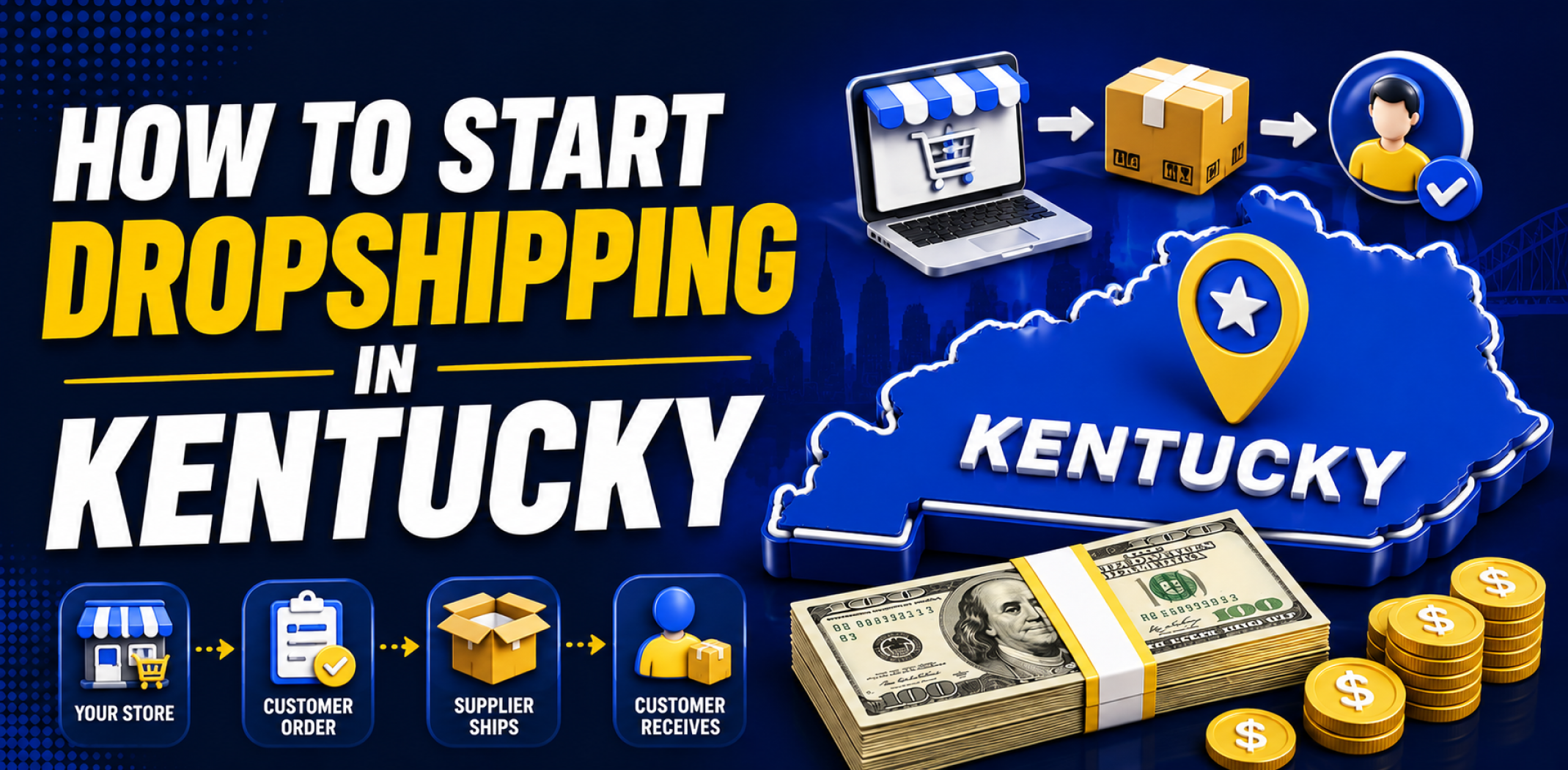
A lot of Kentucky residents are searching for ways to start selling online from home. Whether you are in Louisville, Lexington, Bowling Green, or a small town in the eastern coalfields, the idea of running your own online product business is more achievable than ever. And if you have been looking into how to start dropshipping in Kentucky, you are asking exactly the right question – even if the answer turns out to be a little different than you expected.
Quick Answer: Traditional models of selling physical products online come with real barriers – supplier relationships, inventory costs, fulfillment logistics, and slim margins. For Kentucky residents who want to start making money online with no experience and a limited budget, selling digital products from a ready-built store is a faster, lower-risk path. This article walks you through how online selling actually works in Kentucky in 2026, what your real options are, and how to get started today.
Why Online Selling Works In Kentucky Right Now
Kentucky has a population of approximately 4.59 million people, according to the 2024 American Community Survey. The state’s median household income sits at around $64,526 – about 20% below the national median of $81,604. That gap tells an important story. Tens of thousands of Kentucky families are looking for ways to earn more, and many of them are already doing it online.
Broadband access in Kentucky has grown significantly in recent years. According to recent state data, 92.2% of Kentucky households now have access to high-speed internet services, up sharply from pre-2020 levels. Rural expansion efforts have extended coverage to thousands of previously underserved homes across counties like Warren, Barren, and eastern Kentucky regions. More Kentucky residents than ever can build and run an online business from home.
On the national level, US ecommerce sales reached approximately $1.234 trillion in 2025 – and online retail now accounts for roughly 23% of total retail sales. That share keeps growing. Kentucky residents are buying and selling online at increasing rates, and the infrastructure to support a digital-first business is already in place across most of the state.
Rural and smaller-town Kentucky residents in particular stand to benefit from online selling. When local job options are limited and commuting adds costs to an already tight budget, a home-based online income source becomes genuinely valuable – not just a nice idea.
Online Business Models For Kentucky Residents – A Real Comparison
Before you commit to any path, it helps to see the options laid out honestly. There are a few common ways Kentucky residents try to earn money online, and each one has real trade-offs. Here is how they compare.
Physical product selling online is the model most people picture when they hear about selling from home. The reality is that it requires finding reliable suppliers, managing stock, coordinating shipping, and handling returns. Those are legitimate businesses – but they are not low-barrier starting points for someone with no budget and no experience.
Affiliate marketing and freelancing both have their place, but neither gives you something you truly own. Affiliate income depends on someone else’s product and platform. Freelancing trades your hours for money – when you stop working, income stops too.
A digital product store works differently. Your store is built for you, pre-loaded with ready-made products. When a customer buys, delivery is instant and automatic. There is no inventory to manage and no logistics to figure out. You keep 50–70% of every sale. This model suits Kentucky residents who want to start with zero experience and a limited budget – and it is the foundation of how Sellvia works. You can read more about getting started in our guide on how to start an online business in Kentucky.
Skip the hard part
You compared the models. One of them requires nothing to start but a decision.
Most online selling models stack barrier after barrier – suppliers, inventory, shipping, months of setup. Sellvia gives you a store built for you, with digital products already inside, ready to earn from day one.
Tax Considerations For Online Sellers In Kentucky
Getting your taxes right from the start protects your business and keeps everything above board. Here is what you need to know as a Kentucky-based online seller.
Kentucky Income Tax
Kentucky uses a flat income tax rate. For the 2025 tax year, that rate is 4% on all taxable income, applied after a standard deduction of $3,270. As of January 1, 2026, the rate dropped to 3.5% following the passage of House Bill 1 – so if you are starting your business this year, you are operating in a lower-tax environment than just one year ago. Every dollar of profit your online store earns is subject to this flat rate.
Key principle: Kentucky’s flat income tax means no bracket confusion – you pay 3.5% on your taxable online income regardless of how much you earn.
Kentucky Sales Tax
Kentucky’s sales tax rate is a flat 6% statewide – no local additions, no county variations. That consistency makes compliance simpler than in many other states. If you are selling to Kentucky customers and you cross either $100,000 in gross sales or 200 transactions in a calendar year, you are required to register for a Kentucky sales tax permit and begin collecting. This is called economic nexus, and it applies to remote online sellers too.
Important note: Since 2023, Kentucky’s HB 8 expanded the list of taxable services and digital products significantly – SaaS tools, digital downloads, and similar products are now taxable in Kentucky.
Marketplace Facilitator Rules
If you sell through a marketplace that collects and remits sales tax on your behalf, you may not need to register separately for those marketplace sales. However, if you also sell directly – through your own store – you are responsible for collecting and remitting sales tax on those direct sales once your nexus thresholds are met.
Quarterly Estimated Taxes
As a self-employed online seller, you will likely owe quarterly estimated taxes to both the IRS and the Kentucky Department of Revenue. The general rule is to pay quarterly if you expect to owe $500 or more in Kentucky income tax for the year. Tracking your revenue and setting aside a portion each month makes this much more manageable than scrambling at year end.
See your state tax breakdown at a glance
Simply enter your annual net profit, select your state, and the calculator will instantly generate a detailed tax breakdown while showing how your state’s tax burden compares to others.
How To Register Your Online Business In Kentucky
Registering your business is a straightforward process in Kentucky – and the state is one of the most affordable in the country for LLC formation.
Forming an LLC
To form a Limited Liability Company (LLC) in Kentucky, you file Articles of Organization (Form KLC) with the Kentucky Secretary of State. The filing fee is just $40 – one of the lowest in the nation. Online filings are typically processed in 1–2 business days. After formation, you file an annual report each year at a cost of $15. You can register through the Kentucky Secretary of State’s Business Filings portal.
An LLC is worth considering because it separates your personal assets from your business – meaning if something goes wrong with the business, your personal savings, home, and car are generally protected.
Sole Proprietorship
If you want to start even more simply, a sole proprietorship requires no formal filing with the state. You operate under your own name, report business income on your personal tax return (Schedule C), and there are no formation fees. The downside is that your personal and business finances are not legally separated – your personal assets could be at risk if the business faces legal problems.
Key principle: Most new online sellers start as sole proprietors and transition to an LLC once they are generating consistent revenue.
Getting an EIN
Even as a sole proprietor, applying for a free Employer Identification Number (EIN) from the IRS is a smart move. It keeps your Social Security Number off your business paperwork and is required if you ever hire employees or open a business bank account.
The math is simple
Registration takes one afternoon. Your Sellvia store starts earning the same week.
While other Kentucky sellers are still sourcing products and setting up stores, Sellvia gives you a complete, ready-to-earn online business – store built, products loaded, advertising ready to activate.
Step-By-Step Guide To Starting An Online Product Business In Kentucky
Once you understand your options and the basics of taxes and registration, getting started is simpler than most people expect. Here is a practical guide for Kentucky residents starting from zero.
Step 1: Choose What To Sell
For beginners, digital products are the clearest starting point. They require no manufacturing, no inventory, and no physical shipping. Guides, courses, templates, checklists – these are products people buy online every day. If you are not sure where to start, a platform like Sellvia solves this by providing your entire product catalog for you. You do not need to create anything. If you want to explore broader options first, our guide on online business ideas in Kentucky walks through the full range of possibilities.
Step 2: Register Your Business In Kentucky
Decide between a sole proprietorship (no filing needed, simpler) or an LLC ($40 filing fee through the Kentucky Secretary of State, stronger legal protection). Get a free EIN from the IRS website. Open a separate business bank account – keeping business and personal finances separate from day one makes tax time far less stressful.
Step 3: Set Up Your Store
If you are building from scratch, this step can take weeks – choosing a platform, designing your site, adding products, writing descriptions, setting up payments. If you use Sellvia’s 14-day free trial, the store is built for you and arrives pre-loaded with digital products. Most Kentucky residents starting with Sellvia are selling within days of signing up, not months.
Step 4: Handle Kentucky Taxes
Register with the Kentucky Department of Revenue for a sales tax permit once you approach the $100,000 / 200-transaction nexus threshold. Keep a record of every sale from day one. Set aside 3.5% of your net profit for Kentucky income tax and a separate amount for federal self-employment tax (15.3%). Consider working with a local Kentucky CPA once your revenue is consistent – the investment pays for itself.
Step 5: Start Marketing And Making Sales
You do not need to be a marketing expert to get your first sales. Social media posts, short videos on TikTok or Instagram, and paid ads through platforms like Facebook or Google can all drive traffic to your store. Sellvia includes a one-click advertising system that lets you launch campaigns with a $10–$50 daily budget – no marketing background required. Many customers who activate ads see their first orders the same day, though results vary based on effort, ad spend, and consistency.
Best Niches For Kentucky Online Sellers
Kentucky has a distinct culture and economy that shapes what online products resonate with local buyers – and what types of content and digital guides sell well to broader audiences when marketed from a Kentucky home base.
Home Improvement and DIY
Kentucky has a high rate of homeownership – 68.3% as of 2024, well above the national average. Homeowners look for practical guides on repairs, upgrades, landscaping, and cost-cutting projects. Digital guides in this niche sell consistently year-round.
Personal Finance and Budgeting
With a median household income significantly below the national average, Kentucky residents are actively seeking budgeting tools, debt-payoff guides, and financial planning resources. This is one of the most consistently purchased digital product categories nationwide.
Health, Wellness, and Self-Care
Demand for accessible health and wellness guides has grown steadily, particularly in states where healthcare access can be limited. Nutrition guides, fitness plans, and mental wellness resources all perform well as digital products.
Parenting and Family Resources
Kentucky has a younger median demographic in many rural counties, with many households raising children on a single income. Parenting guides, homeschooling resources, and family budgeting tools have strong appeal in this market.
Career and Skills Development
Kentucky residents are looking for practical ways to improve their earning potential. Resume guides, interview preparation, remote work skills, and certification prep materials are in demand – especially in areas where traditional workforce development resources are limited.
Common Challenges For Kentucky Online Sellers
Limited Local Support Networks
Many Kentucky residents – especially those in rural counties – do not have access to local entrepreneur networks, coworking spaces, or startup communities. The good news is that most of the support you need is online. Kentucky SBDC coaches offer free remote consultations, and SCORE mentors operate virtually across the state. You do not need to live in Louisville or Lexington to get high-quality business guidance.
Getting The First Sale
The biggest psychological barrier for new online sellers is not the technical setup – it is the uncertainty before the first sale arrives. Many Kentucky sellers report that activating a paid advertising campaign through their store’s built-in tools was the thing that moved them from “set up but waiting” to “actually selling.” Starting with a small daily budget of $10–$20 gives you real data fast without risking significant money. Our guide on how to make money online in Kentucky covers more strategies for building early momentum.
Separating Scams From Real Opportunities
Kentucky residents who search for online income options encounter a lot of noise – MLM schemes, get-rich-quick promises, and platforms that charge upfront fees before delivering anything. The safest starting point is always a platform with verifiable credentials, a free trial, honest expectations, and a track record. Skepticism is healthy here. If a program promises guaranteed income or asks you to pay before showing you what you are getting, walk away.
Resources For Kentucky Online Sellers
These are real, established resources that offer free or low-cost support to Kentucky entrepreneurs.
SBA Kentucky District Office
The Kentucky SBA District Office serves all 120 counties in the state. It offers free guidance on business planning, financing options, and starting a business. Located at 600 Dr. Martin Luther King Jr. Place, Suite 188, Louisville, KY 40202 – but resources and appointments are available statewide, including virtually. Visit sba.gov/district/kentucky.
Kentucky Small Business Development Center (SBDC)
The Kentucky SBDC provides free, confidential business coaching, business planning help, access to capital guidance, and marketing assistance through a network of centers across the state. Services are available in person and remotely. Visit kentuckysbdc.com to find your nearest location and book a free session.
SCORE Kentucky
SCORE connects you with volunteer business mentors – experienced entrepreneurs and executives who offer free advice on starting and growing a business. Mentoring is available in person or virtually. Visit score.org to find a Kentucky mentor.
Kentucky Secretary of State – Business Filings
For LLC formation, business name searches, and annual report filings, visit the Kentucky Secretary of State Business Filings portal. Online filing for an LLC costs $40 and is typically processed in 1–2 business days.
Kentucky Department of Revenue
For sales tax registration, income tax guidance, and the MyTaxes online filing system, visit revenue.ky.gov. As of May 2025, electronic filing and payment of Kentucky sales and excise taxes is mandatory through the MyTaxes portal.
Why Sellvia Is The Smartest Way To Start Selling Online In Kentucky
If you are a Kentucky resident who wants to start an online business without the complexity of sourcing products, building a store from scratch, or figuring out advertising on your own, Sellvia was built for exactly that situation. Here is what it includes.
Free turnkey store – built, designed, and ready to earn
Your store arrives professionally designed, pre-loaded with digital products, and fully optimized to convert. No setup fees, no coding, no design time. You start at the sales stage – not the store-building stage. Hosting, SSL, and payment gateway are all included.
1,000 digital products – ready to sell from day one
Your store comes pre-loaded with 1,000 ready-made guides, courses, checklists, and tools – all created by Sellvia. No writing, no recording, no product creation needed. Pick your niche and the products are already there waiting for your first customer.
Instant delivery – no warehouse, no shipping
Every product in your store is digital. When a customer buys, delivery is instant and automatic. No warehouse, no packing, no logistics. You keep 50–70% of every sale with zero fulfillment overhead.
Built-in advertising – one click to launch your first campaign
One-click ads let you launch campaigns with a $10–$50 daily budget – no marketing expertise required. Most customers who activate ads receive orders the same day. No agency, no guesswork, no prior experience needed.
Beginner-friendly – no coding, no learning curve
An intuitive dashboard walks you through every step. Adding products, running campaigns, and growing your store require no technical knowledge. As your business grows, the platform scales with you – adding features without adding complexity.
Everything in one place – store, products, and ads
Sellvia combines your storefront, product catalog, and advertising system in a single platform. No third-party tools, no subscriptions to stack, no integrations to manage. Everything you need to earn online is already there when you log in.
Sellvia has helped more than 1,500,000 people launch online stores, with over $1.5 billion earned by store owners collectively. It is ranked on the Inc. 5000 list of America’s fastest-growing private companies and has earned a Gold Hermes Creative Award and Platinum MarCom Award for its platform. If you want to understand the full picture before taking a step, our article on how to start an online business in Kentucky for free covers the zero-cost starting options in detail.
No inventory · No shipping · Built for you
Your Kentucky online store is ready. Are you?
Claim your free Sellvia store today – pre-loaded with 1,000 digital products, built-in advertising, and a $100 welcome gift to help you grow from day one.
Store setup usually costs $299+
Free
14-day free trial · $39/month after · Cancel anytime · $40 ad coupon included
✓ Store built for you · ✓ No inventory · ✓ Instant digital delivery