Working from home used to mean a side hustle at best. In 2026, it means something much bigger. Over 38% of the global workforce now does some form of remote or location-independent work – and a growing share of those people are running their own online businesses, not just clocking in for a remote employer.
So what are the best online business ideas from home for someone starting with limited funds and zero prior experience? That is exactly what this guide covers. You will find 12 beginner-friendly ideas, realistic earning ranges for each, and a clear breakdown of what it actually takes to get started.
Quick Answer: The best online business ideas from home for beginners include selling digital products, freelance writing, print-on-demand, online tutoring, and starting your own online store. Most require under $100 to start and can generate $500–$3,000/month with consistent effort over 60–120 days.
Whether you want to replace your 9-to-5 or build a reliable second income stream, the options below are sorted by how approachable they are for someone starting from scratch. Each one can be launched from a laptop, from home, with no office and no large upfront investment.
What are online business ideas from home?
An online business idea from home is any income-generating activity you can run entirely over the internet – no physical storefront, no office space, no large startup investment required. Your laptop and a reliable internet connection are your entire workspace.
In 2026, this category has expanded far beyond blogging or selling handmade goods on Etsy. It now includes online stores, digital product shops, freelance service businesses, content monetization, tutoring, and much more. The barrier to entry has dropped dramatically. Platforms and tools have made it possible to launch a real business in a single afternoon, even if you have never done anything like this before.
What makes these ideas especially relevant right now is that consumer behavior has fully normalized around buying online. Global ecommerce sales passed $6.3 trillion in 2024 and continue to climb. There has never been a better time to put yourself on the selling side of that transaction.
How much can you realistically earn from a home-based online business?
Earnings vary widely depending on the model you choose, how much time you invest, and how quickly you learn what works. Here is a realistic snapshot across the most popular options for beginners:
Most beginners see their first $100–$500/month within 60–90 days of consistent effort. Reaching $2,000–$5,000/month typically takes 4–8 months of focused work, depending on the model and niche.
One note on ceiling figures: The upper ranges above represent what experienced operators earn – not what you should expect in month one. Any business model that promises fast five-figure months with minimal effort is overselling. Treat the figures above as 3–6 month targets, not launch-week guarantees.
The best online business ideas from home for beginners in 2026
The ideas below are grouped by type. Each one requires minimal startup investment – most under $100 – and can be run from anywhere with a laptop and internet connection. Start with whichever model fits your existing skills and available time.
Ecommerce and product-based businesses
1. Starting an online store with digital products
Selling digital products through your own online store is one of the most beginner-friendly online business ideas from home available right now. You set up a store, list products – guides, courses, checklists, tools – and when a customer buys, the product is delivered instantly and digitally. No inventory. No shipping. No warehouse.
Why this works in 2026: The creator economy hit $250 billion in 2024. Buyers are increasingly comfortable paying for well-designed digital tools that save them time or teach a specific skill. Platforms like Sellvia pre-load your store with ready-made digital products so you do not have to create anything yourself.
Getting started is straightforward. With a platform like Sellvia, your store is built for you and comes pre-stocked with digital products. You keep 50–70% of every sale, and customers receive their purchases the moment they check out.
Earning potential: $500–$5,000+/month within 3–6 months, depending on how actively you promote your store.
2. Print-on-demand
Print-on-demand (POD) lets you sell custom-designed products – t-shirts, mugs, phone cases, tote bags – without holding any stock. When a customer orders, a third-party fulfillment service prints and ships the item. Platforms like Printful and Printify handle the logistics entirely.
The startup cost is essentially zero if you design your own graphics using free tools like Canva. The main investment is your time: researching trending niches, creating designs that connect with a specific audience, and building a small marketing presence on Pinterest or Instagram.
Important note: POD margins are thinner than digital product stores – typically $5–$15 per sale. Volume and a clearly defined niche audience are what make this model profitable over time.
Earning potential: $200–$2,000/month once you have 20–50 strong designs in a focused niche.
3. Selling digital products on marketplaces
You can also sell digital products through established marketplaces like Etsy (for digital downloads) and Gumroad, rather than running your own store. Ebooks, templates, Lightroom presets, Notion dashboards, and Excel trackers are all popular. These platforms have built-in traffic, which removes the need to build your own audience from scratch.
The downside is platform dependency – changes to algorithms or fee structures can affect your income overnight. Many successful marketplace sellers eventually migrate to their own stores to own the customer relationship directly.
Earning potential: $100–$3,000/month depending on product quality, pricing, and how well your listing ranks.
Service-based businesses you can run from home
4. Freelance writing and copywriting
If you can write clearly, freelance writing is one of the fastest ways to generate income from home. Businesses, blogs, and marketing agencies constantly need content – articles, product descriptions, email sequences, ad copy, and social media posts. You can start on platforms like Upwork, Fiverr, or ProBlogger with no portfolio by offering discounted rates to your first two or three clients in exchange for testimonials.
Copywriting – writing with a persuasion goal, like sales pages or email funnels – pays significantly more than general content writing. A skilled copywriter can charge $75–$200/hour or $500–$3,000 per project.
Earning potential: $300–$3,000/month for content writers; $1,000–$5,000+/month for experienced copywriters.
5. Social media management
Many small businesses know they need a social media presence but have no time to manage it. As a social media manager, you handle content creation, scheduling, engagement, and basic analytics for clients – usually on a monthly retainer.
You do not need a marketing degree to start. A working knowledge of two or three platforms (Instagram, Facebook, and LinkedIn are the most in-demand) and the ability to produce consistent, on-brand posts is enough. Tools like Buffer, Later, and Canva make the workflow manageable even with multiple clients.
Landing your first client is typically the hardest part. Start by offering a free 30-day trial to a local business you trust, document the results, and use that as your case study for paid outreach.
Earning potential: $500–$2,500/month per client; most managers handle 3–5 clients simultaneously once established.
6. Online tutoring and coaching
Online tutoring is one of the most consistent home business ideas from home for people with subject-matter expertise. K–12 tutoring on platforms like Tutor.com and Wyzant, language teaching on iTalki or Preply, and test prep (SAT, IELTS, GMAT) are all high-demand categories with steady student pipelines.
Coaching is the higher-end version of this model. A business coach, fitness coach, or career coach typically charges $100–$300/session and builds a client base through content marketing, LinkedIn, or referrals.
Important: You do not need a formal teaching certification to start tutoring on most platforms – subject proficiency and strong communication skills are the real requirements.
Earning potential: $400–$2,500/month for tutors working 15–25 hours per week.
7. Virtual assistant services
Virtual assistants (VAs) handle administrative, operational, and creative tasks for entrepreneurs and small businesses remotely. Common tasks include inbox management, calendar scheduling, data entry, research, customer service, and basic bookkeeping. It is one of the most accessible online business ideas from home because the required skills are ones most people already have.
General VAs typically earn $15–$25/hour to start. Specialized VAs – those who focus on a specific platform like Pinterest or podcast production – can charge $40–$75/hour within a few months of building a track record.
Earning potential: $800–$2,500/month working part-time; $2,500–$4,000/month for full-time specialized VAs.
Content and audience-based businesses
8. Affiliate marketing
Affiliate marketing means promoting other companies products and earning a commission when someone buys through your referral link. You do not create or ship anything – your job is to build an audience and direct them toward products they already want.
The most beginner-friendly entry point is a niche blog or YouTube channel. Pick a specific topic (home coffee brewing, budget travel, beginner photography), create genuinely useful content, and weave in affiliate links naturally. Amazon Associates, ShareASale, and individual brand programs are good starting points.
Why this works in 2026: Affiliate marketing global spend reached $17 billion in 2024. Commission rates range from 3–8% on physical products to 20–50% on software and digital subscriptions – the latter is where serious income builds.
Earning potential: $100–$1,000/month within 6 months for most beginners; $3,000–$10,000+/month for established content sites in strong niches.
9. YouTube channel or podcast
Building a content channel is a longer-play strategy, but it compounds over time. A YouTube channel monetized through AdSense, sponsorships, and affiliate links can generate $1,000–$10,000+/month once it crosses 10,000–50,000 monthly views. A podcast with 5,000–10,000 downloads per episode becomes attractive to sponsors paying $25–$50 per thousand listeners.
The key insight most beginners miss: you do not need a large audience to monetize. A small, highly engaged audience in a specific niche is more valuable to relevant sponsors than a huge passive following on a general channel.
Earning potential: Minimal in the first 6–12 months; $500–$5,000+/month once you have 12–18 months of consistent content and a clear niche.
10. Selling on Etsy or eBay
Etsy and eBay remain excellent platforms for testing product-based home businesses with minimal risk. Etsy rewards handmade goods, vintage items, and digital downloads. eBay works well for flipping – buying underpriced items at thrift stores or garage sales and reselling at a markup.
Both platforms have built-in traffic, which removes the need to build your own audience from scratch. The downside is platform dependency – algorithm changes or fee increases can affect your income overnight. Many successful sellers eventually migrate their best products to their own store to own the customer relationship directly.
Earning potential: $300–$2,000/month for part-time Etsy sellers; $500–$3,000/month for active eBay flippers with a reliable sourcing pipeline.
Specialized and niche ideas
11. Bookkeeping and accounting services
If you have a background in finance or accounting, remote bookkeeping is one of the highest-paid home business ideas on this list. Small businesses, freelancers, and independent contractors consistently need help with expense tracking, invoicing, and tax prep – and most of them cannot afford a full-time CFO.
Platforms like Bookkeeper Launch and direct LinkedIn outreach are reliable ways to find clients. Certified bookkeepers using QuickBooks or Xero typically charge $30–$60/hour. Even without a formal certification, many states allow you to offer general bookkeeping services after completing an accredited online course.
Earning potential: $1,500–$4,000/month working part-time with 5–8 steady small business clients.
12. Niche website or newsletter
A niche website – a content site built around a highly specific topic – generates income through display ads, affiliate commissions, and sponsorships. A niche newsletter serves a similar purpose but distributes via email, often commanding higher sponsorship rates due to audience quality.
Examples of profitable niches: personal finance for nurses, budget travel in Southeast Asia, strength training for women over 40. The more specific the audience, the easier it is to monetize – even with a relatively small readership of 2,000–5,000.
Important note: This is a 12–18 month game. Expect little revenue in the first 6 months while you build content and traffic. After that, a well-positioned niche site can sell for 30–40x its monthly revenue if you ever want to exit.
Earning potential: $200–$500/month in months 6–12; $1,000–$5,000+/month for established sites in year 2 and beyond.
What to watch out for when starting an online business from home
Not every opportunity in the work-from-home space is legitimate. A few categories to approach with caution – and what to do instead.
Key principle: Any business model that charges you money upfront to access customers, requires you to recruit others to earn, or promises daily income with no skill requirement is not a real business. It is either MLM, a pyramid scheme, or a subscription trap.
MLM and network marketing are often framed as home business ideas, but these structures make income dependent on recruitment rather than genuine product sales. The FTC has documented that over 99% of MLM participants lose money. Avoid them entirely.
Paid survey sites are real but pay $1–$5/hour at best. They are not a business model – treat them as minor supplemental income at most, not a path to financial freedom.
Drop-service scams are another red flag. Some platforms charge $200–$500 to set you up as a reseller without delivering real clients or infrastructure. Always verify testimonials on independent review sites like Trustpilot before paying for any business system.
Fake freelance job postings on Craigslist, Facebook groups, and some job boards sometimes ask you to process payments or send equipment. These are fraud schemes. Walk away from any offer that sends you money before you have done any real work.
What to do instead: stick to platforms with documented payout histories, real user communities on Reddit (r/freelance, r/juststart), and business models where your income is tied to real products or services delivered to real customers.
How to choose the right online business idea for your situation
There is no single best answer – the right model depends on your starting point, available time, and income goals. Here is how to think about it by reader profile.
Complete beginner with limited time (under 10 hours a week)
Start with a single low-complexity model. Print-on-demand or selling digital products on Etsy are good entry points because they require no customer service calls, no complex ad setup, and minimal ongoing management. Do not try to run two models simultaneously at the beginning – focus creates momentum.
Beginner with 15–20 hours per week available
An online store with ready-made digital products is worth your attention here. With 15–20 hours a week, you can properly set up your store, explore the product catalog, test a few promotions, and optimize based on early results. Most beginners who put in this level of effort start seeing consistent orders within 60–90 days.
Someone with an existing skill (writing, design, finance, languages)
Monetize your existing skill first – it is the fastest path to income. Freelance writing, bookkeeping, tutoring, or social media management will generate money within weeks rather than months. Then use that income to fund a more scalable model like an online store or a niche content site.
Someone aiming for full-time income replacement
Think in systems, not side hustles. An online store with a built-in advertising system and a catalog of digital products is one of the most commonly cited paths for people who successfully replaced their salary. Realistically, plan for 6–12 months of consistent effort before hitting $3,000–$5,000/month. That timeline can shrink significantly if you are willing to learn from proven communities and invest in tested strategies.
Whatever your profile, the worst thing you can do is stall at the research phase. Every week you spend comparing options instead of launching is a week of compounding growth you do not get back.
Why Sellvia is a game-changer for your online store 🚀
Sellvia isn’t just another ecommerce tool. We are a trusted name in the industry, recognized by Forbes and even ranked in Inc.’s list of the 5,000 fastest-growing companies in the U.S. So if you’re serious about starting as a solopreneur, this is a smart place to begin.
Starting an online business can feel overwhelming, but that’s exactly where Sellvia steps in. It takes care of the tricky parts, so you can focus on making sales and growing your brand. Let’s break down what makes it such a great choice.
Get a ready-to-go store hassle-free 🎯
Want to start selling but don’t know where to begin? No worries! Just share your ideas, and Sellvia’s team will build a free ecommerce website that’s fully set up and ready to take orders from day one. No coding, no stress – just a store that works right out of the box.
A $100 welcome gift to grow your business faster 🎁
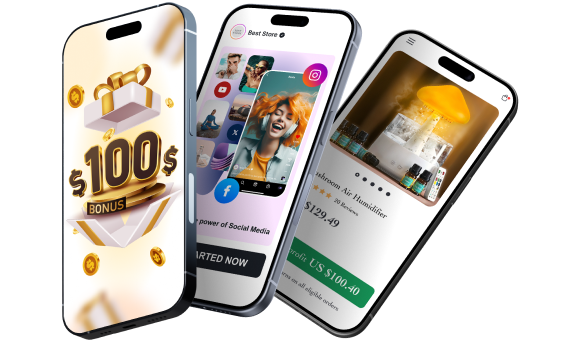
Starting a business takes momentum – and Sellvia gives you a head start. When you claim your free store today, you also get a $100 welcome gift to put toward growing your business. Use it to upgrade your store, boost your marketing, or unlock new tools. It is a real dollar value, handed to you on day one, with no catch and no hoops to jump through.
A massive catalog of digital products to sell 🏆
One of the biggest struggles in starting an online business is figuring out what to sell. Sellvia solves that completely. Your store comes pre-loaded with digital products – guides, courses, checklists, and tools – all created by Sellvia. You keep 50–70% of every sale. No inventory. No shipping. No logistics headaches.
Everything in one easy-to-use platform 🔥
Managing an online store shouldn’t be complicated. With Sellvia, you can handle orders, add new products, and even chat with customers – all from a simple and user-friendly platform. No need to mess with confusing tools or deal with unnecessary tech stuff. It’s all smooth sailing.
No upfront costs, just start selling 💰
A big reason people hesitate to start an online business is the cost. But here’s the good news: With Sellvia, you don’t need to invest in stock, storage, or shipping supplies. You can run your store with no upfront costs, keeping things low-risk while still making money.
Support that’s always got your back 🤝
Running a business comes with questions, but you’re never alone. Sellvia’s dedicated support team is available 24/7 to help with anything you need. Whether it’s a small question or a big challenge, they’ve got you covered.
Of all the online business ideas from home covered in this guide, Sellvia stands out as the most complete beginner package – a real store, real products, and a built-in ad system in one place. Get your free store today and launch the business you have been planning.