There are more ways to earn money online in 2026 than ever before – and that is exactly what makes it confusing. Browse any forum and you will find someone swearing by affiliate marketing, someone else pushing content creation, and a third person saying a digital products store is the only model worth building. Who is right? Probably all of them – for different people, with different skills, different budgets, and different goals.
This guide cuts through the noise. It covers every major type of online business operating today, explains how each one actually works, and gives you an honest breakdown of the effort, startup cost, and income potential involved. By the end, you will know which model fits where you are right now – and which one is worth building toward.
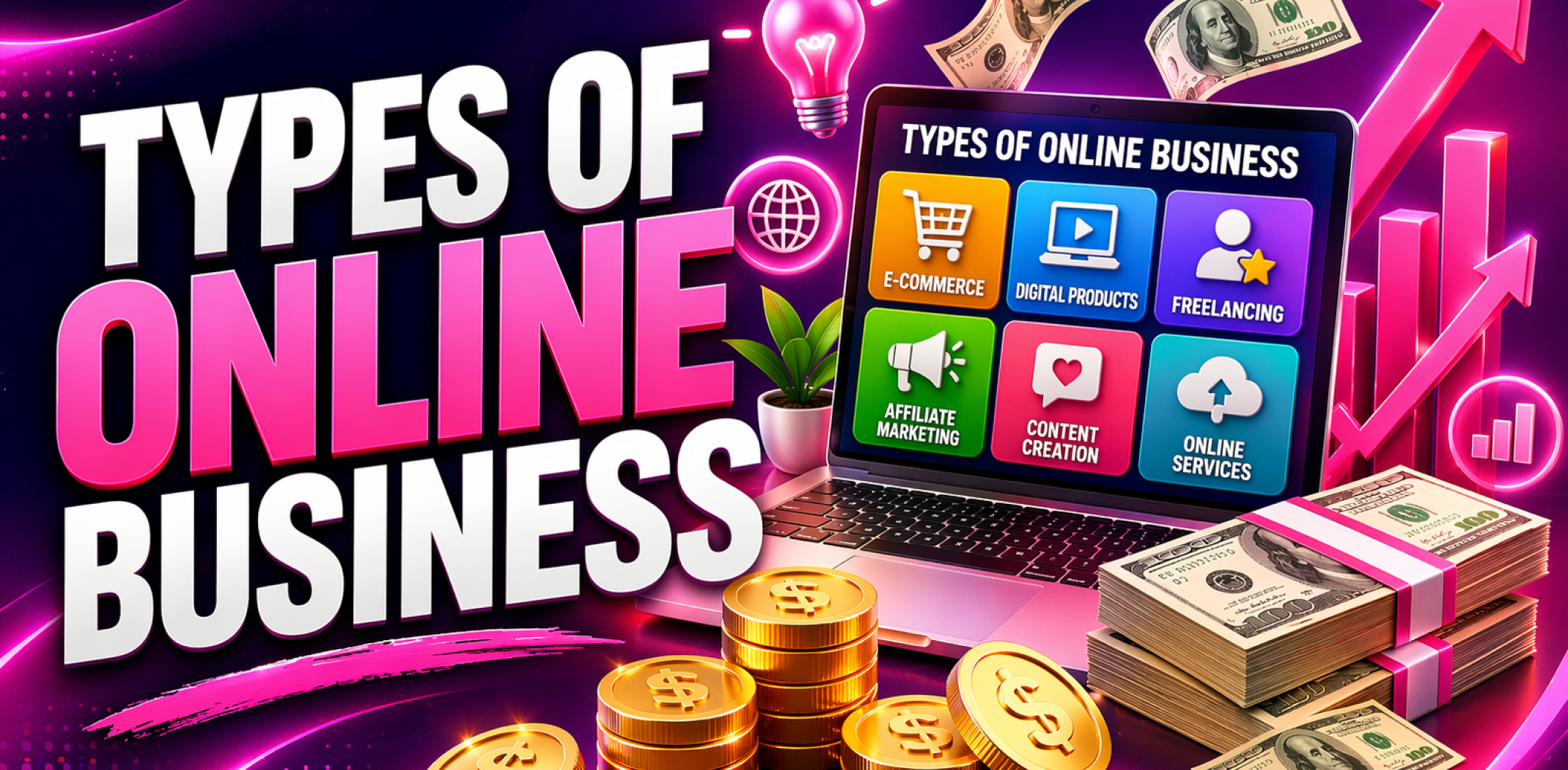
Quick Answer: The main types of online business include ecommerce, freelancing, content creation, affiliate marketing, digital education, digital products, and service agencies. Each requires a different level of skill, starting budget, and time commitment – the right one for you depends on your situation right now.
Before diving into each model, it helps to understand one thing: most online businesses fall into one of two categories. Either you are selling something – a product, a service, or access to content – or you are building an audience and monetizing attention. A few models do both. Knowing which category you are in shapes every decision that follows, from how you market to how you scale.
Most people searching for types of online business are not casual browsers. They are looking for something real – a way to stop worrying about money, earn from home, or finally be their own boss. That is exactly what this guide is built for.
What are the main types of online business?
An online business is any commercial activity conducted primarily through the internet – where customers find you online, transactions happen digitally, and delivery is managed through online systems. What separates the different types is their core model: what you sell, how you source or create it, and how revenue is generated.
In 2026, the landscape includes ecommerce stores run without physical locations, solo service providers earning six figures from laptops, digital educators selling courses to thousands of students, and creators monetizing audiences in multiple ways simultaneously. The variety is real, and so is the opportunity.
What most online businesses share: low barriers to entry compared to traditional business, the ability to serve customers anywhere in the world from day one, and income potential that scales without proportional increases in effort – once the fundamentals are in place.
How much can you realistically earn?
Honest answer: it varies enormously – and anyone who gives you a single number without context is oversimplifying. Income potential depends on the model, how much time you invest, how quickly you learn, and whether you are treating it as a side project or a serious business. The table below gives a realistic range for each major type.
These figures reflect realistic outcomes for people putting in consistent part-time to full-time effort. The higher ends of each range typically take 12–24 months to reach and require treating the business seriously. Full-time income from most models is achievable within 6–18 months with focused work, but it is not guaranteed by the model alone.
One note on ceiling figures: The top-end numbers above represent what experienced operators earn – not what beginners earn in month one. Start with realistic targets: $500–$1,500 per month is a healthy 90-day goal for most models, scaling from there as your systems and traffic mature.
With that context in place, here is a detailed breakdown of every major type of online business – how each works, what it costs to start, and what makes it worth considering in 2026.
Ecommerce and digital product stores
Selling products through an online store is one of the most established types of online business and still one of the most accessible entry points for beginners. Within ecommerce, digital product stores have become especially popular because they remove the complexity of physical logistics: you list products, customers place orders, and delivery happens instantly online. No warehouses. No shipping. No inventory headaches.
Traditional ecommerce
Physical product stores
You source or manufacture products, store them, and handle order fulfillment yourself or through a partner. Higher margins, more control, more upfront cost. Best suited to people with a specific product idea and some startup capital – typically $1,000–$5,000 to begin comfortably.
Earning potential: $1,000–$10,000 per month within 12 months with a winning product and consistent marketing.
Digital product stores
You build a storefront, load it with digital products – guides, courses, checklists, tools – and make sales while delivering everything instantly online. Startup cost is low, margins are high, and there is no physical logistics involved. In 2026, the most successful digital store owners differentiate through strong branding, smart product selection, and a great customer experience.
Why this works in 2026: Global ecommerce revenue continues to climb past $6 trillion annually. Consumers are comfortable buying from online stores they have never heard of – if the product page looks trustworthy and the checkout is smooth.
Earning potential: $500–$5,000 per month within 60–90 days of launching a well-chosen niche store, scaling further with built-in advertising and repeat customers.
Print-on-demand
A variation of physical ecommerce where designs are printed onto products – t-shirts, mugs, phone cases – only when an order is placed. No inventory, no upfront product cost. Revenue depends heavily on design quality and marketing. A solid print-on-demand store with 50 or more listings can generate $800–$2,500 per month with consistent promotion.
Earning potential: $800–$2,500 per month with regular listings and consistent SEO.
Freelancing and remote services
Freelancing is the fastest way to generate income online because you are monetizing skills you already have. Writers, designers, developers, marketers, video editors, virtual assistants – all of these are in consistent demand from businesses that need expertise without hiring full-time staff. Platforms like Upwork, Fiverr, and Toptal connect freelancers to clients worldwide.
How freelancing works as a type of online business
You create a profile, build a portfolio, and pitch clients or respond to job postings. As you accumulate reviews and results, you raise your rates. Many experienced freelancers move off platforms entirely and work directly with clients at significantly higher rates.
The ceiling is real, though. Freelancing is fundamentally trading time for money. A developer billing $75 per hour working 30 hours a week earns well – but is capped by hours in the week. Scaling requires either raising rates aggressively or transitioning to an agency model.
Highest-demand freelance skills in 2026
Web development and design
Still among the best-paid freelance skills. Full-stack developers can charge $60–$150 per hour. UI/UX designers earn $40–$100 per hour. Specializing in a specific platform – Shopify, WordPress, Webflow – accelerates client acquisition.
Copywriting and content writing
Demand for quality written content – blog posts, landing pages, email sequences, ad copy – has not diminished despite AI tools. Writers who understand SEO and conversion earn $0.10–$0.30 per word for standard content, and $500–$2,000 per project for high-stakes copy like sales pages.
Video editing and production
Short-form video dominates in 2026 and editors who can produce high-retention content for YouTube, TikTok, and Instagram Reels are consistently in demand. Rates range from $25–$80 per hour, with experienced editors charging per video at $100–$500 or more depending on complexity.
Digital marketing and paid advertising
Businesses consistently need help running Google Ads, Meta campaigns, and SEO. Specialists with proven results charge $50–$150 per hour or take a percentage of ad spend. This skill also transitions naturally into agency ownership.
Earning potential: $1,500–$6,000 per month part-time; $4,000–$10,000 per month full-time for experienced freelancers in high-demand niches. Most freelancers reach consistent $2,000–$3,000 per month within the first 6 months if actively pitching.
Content creation and monetized publishing
Content creation – building an audience through blogs, YouTube channels, podcasts, newsletters, or social media – is one of the most compelling types of online business because it can generate income from multiple streams simultaneously: ads, sponsorships, affiliate links, and product sales. The catch is the runway: most content businesses take 12–24 months to become meaningfully profitable.
The main content business models
Blogging and SEO content sites
You publish articles targeting search terms, build organic traffic, and monetize through display ads, affiliate commissions, or digital product sales. A site generating 50,000 monthly sessions can earn $1,500–$5,000 per month from ads alone, with affiliate links adding considerably more in the right niche.
YouTube channels
YouTube pays creators through its Partner Program once a channel reaches 1,000 subscribers and 4,000 watch hours. CPMs vary widely: finance channels earn $15–$40 per 1,000 views, lifestyle channels earn $2–$8. Top earners supplement ad revenue with sponsorships worth $1,000–$20,000 per integration on mid-size channels.
Newsletter publishing
Email newsletters monetize through paid subscriptions or sponsorships. A newsletter with 10,000 engaged subscribers can command $500–$2,000 per sponsored issue. Newsletters with unique insight in finance, tech, or business niches have reached over $1 million in annual revenue with under 50,000 subscribers.
Podcasting
Podcasts monetize primarily through sponsorships and listener support. A podcast with 5,000 downloads per episode can earn $500–$2,000 per month in sponsorships. Niche business or industry podcasts often earn more with smaller audiences than entertainment shows because of advertiser demand.
Earning potential: $200–$2,000 per month in year one for most creators; $3,000–$15,000 per month by year two or three for consistent, well-positioned creators. The variance is high and depends heavily on niche, consistency, and how you distribute your content.
Affiliate marketing
Affiliate marketing is one of the most popular types of online business among people just starting out – and for good reason. You do not create a product. You do not handle customer service. You promote other companies products and earn a commission when someone buys through your link. Amazon Associates, ShareASale, CJ Affiliate, and individual brand programs are the main access points.
How affiliate marketing actually works
You build content – a review blog, a comparison site, a YouTube channel, a social media page – around a niche where purchase decisions are common. You embed affiliate links. When visitors click and convert, you earn a percentage: typically 3–8% for physical products, and 20–50% for digital products and software. The math gets interesting when traffic scales.
The most successful affiliate marketers pick niches with high buyer intent – personal finance, health, software tools, home improvement – and build content that genuinely helps people make decisions. Thin lists with no real insight struggle to rank and convert in 2026. Depth and credibility are what Google and readers reward.
Important note: Combine affiliate marketing with your own store to capture buyers already researching, then convert a portion to your own higher-margin offerings.
Earning potential: $300–$2,000 per month within 9–12 months for a focused niche site; $5,000–$20,000 per month for established authority sites in competitive niches.
Online courses, coaching, and digital education
If you have expertise in something people want to learn – marketing, fitness, cooking, language learning, investing, creative skills – you can package that knowledge into a course or coaching program and sell it online. Platforms like Teachable, Kajabi, and Podia make course hosting straightforward. Coaching can be delivered entirely through video calls with zero tech overhead.
Why digital education is one of the highest-earning online business types
The economics are compelling: you create a course once and sell it indefinitely. A $297 course sold to 100 students generates $29,700. Scale that with ads, an email list, or affiliates and the numbers grow quickly. High-ticket coaching programs at $1,000–$5,000 per client can generate $10,000 or more per month with just 5–10 clients.
The challenge is credibility and distribution. Without an existing audience or strong marketing, getting your first students takes real effort. Most successful course creators build an audience first – through content, a newsletter, or social media – and then launch to warm followers rather than cold traffic.
Earning potential: $500–$5,000 per month for most creators with a validated course and basic marketing; $10,000–$50,000 or more per month for established educators with large audiences and premium programs.
SaaS and digital products
Software as a Service businesses sell access to web-based tools on a subscription basis. Standalone digital products – guides, templates, Notion dashboards, Lightroom presets, stock photos – are sold once and delivered instantly. Both models benefit from extremely high margins and the ability to generate revenue without ongoing manual effort per sale.
SaaS: high ceiling, high bar
Building a SaaS product requires either development skills or the budget to hire them. Micro-SaaS tools – single-function apps solving one specific problem – have become viable for solo founders. Niche scheduling tools, browser extensions, and API wrappers have been known to generate $2,000–$20,000 per month from small user bases. The key is finding an underserved workflow problem and solving it cleanly.
Important: SaaS takes 12–24 months to build and validate before meaningful revenue appears for most founders.
Digital products: low barrier, scalable income
Anyone can create a digital product. A well-designed budget spreadsheet template on Etsy earns $500–$3,000 per month for some creators. A professional template pack sells for $15–$50 and requires no ongoing work after creation. Platforms like Gumroad, Etsy Digital, and Payhip make selling digital products accessible without technical overhead.
Why this works in 2026: Digital product marketplaces continue to grow, and consumers are increasingly comfortable paying for well-designed tools that save them time. The zero cost-of-goods model means every sale is nearly pure profit after platform fees.
Agencies and online consulting
An agency is the logical next step after freelancing – instead of doing all the work yourself, you build a team and deliver services at scale. Digital marketing agencies, SEO agencies, social media management firms, and web design studios all follow this model. Consulting is the knowledge-first version: you advise businesses on strategy without necessarily executing the work.
The agency model requires strong client acquisition skills and the ability to manage people and projects. But the economics are significantly better than solo freelancing. A three-person agency with 10 clients paying $2,000 per month generates $20,000 per month in revenue, with profit margins of 40–60% after team costs.
Earning potential: $3,000–$8,000 per month in the first year; $10,000–$30,000 or more per month for established agencies with recurring retainer clients. Consulting rates for senior strategists range from $150–$500 per hour.
Legal and ethical considerations for online business owners
Every type of online business operates within legal and regulatory frameworks you need to understand before you scale. Ignoring these does not make them go away – it creates liability down the road.
What to take seriously from day one
Register your business properly – even a sole trader or LLC registration provides legal separation and is often required to open a business bank account or use payment processors. Tax obligations vary by country and business structure, but income from an online business is taxable income everywhere. Keep records from day one.
Privacy and consumer law matters especially for ecommerce businesses and email marketers. GDPR applies to any business collecting data from EU residents, regardless of where you are based. CAN-SPAM and similar laws govern email marketing. Use double opt-in for email lists and have a real privacy policy on your site.
Key principle: Build a business you would be comfortable explaining in full detail to a regulator or a journalist. That standard tends to produce both ethical and durable businesses.
What to avoid absolutely
Do not buy fake reviews or use review-gating practices. Both violate platform terms and FTC guidelines. Do not make income claims you cannot substantiate – content used to sell courses or programs without proper disclaimers is regulated in most markets.
For affiliate marketers and content creators: disclose relationships. The FTC requires clear disclosure when you have a material connection to a product you are recommending – affiliate links, gifted products, and paid partnerships all require disclosure. This applies in some form across most major markets globally.
How to choose the right type of online business for you
With so many types of online business available, the question is not which one is “best” in the abstract – it is which one fits your current situation. Here is a practical framework by reader profile.
Complete beginner with limited budget
Start with a digital product store or a simple standalone digital product. Both have the lowest financial barriers to entry. A digital store gives you real products to sell from day one without creating anything yourself. Standalone digital products like templates or guides can be created in a weekend. Avoid freelancing initially if you have no portfolio – spend the first month building one.
Intermediate – working a full-time job, building on the side
Freelancing or affiliate marketing works well here because both can be built in 10–15 hours a week. A niche affiliate site or a part-time freelance practice can reach $1,000–$2,000 per month within 6 months without quitting your job. A digital product store with built-in advertising also fits this profile – the store handles sales while you focus on marketing in evenings and weekends.
Advanced – ready to go full-time or already earning online
At this stage, the move is to either productize what you do – turn freelancing into an agency, turn expertise into a course – or double down on ecommerce with built-in advertising and brand building. Full-time digital store operators with solid niche stores and active ad systems regularly earn $5,000–$20,000 or more per month.
Whatever path you choose, the pattern that works is consistent: pick one model, commit to it for at least 90 days before evaluating results, and focus on the fundamentals – traffic, conversion, and repeat customers – before layering in complexity.
Why Sellvia is a game-changer for your online store 🚀
Sellvia isn’t just another ecommerce tool. We are a trusted name in the industry, recognized by Forbes and even ranked in Inc.’s list of the 5,000 fastest-growing companies in the U.S. So if you’re serious about starting as a solopreneur, this is a smart place to begin.
Starting an online business can feel overwhelming, but that’s exactly where Sellvia steps in. It takes care of the tricky parts, so you can focus on making sales and growing your brand. Let’s break down what makes it such a great choice.
Get a ready-to-go store hassle-free 🎯
Want to start selling but don’t know where to begin? No worries! Just share your ideas, and Sellvia’s team will build a free ecommerce website that’s fully set up and ready to take orders from day one. No coding, no stress – just a store that works right out of the box.
A $100 welcome gift to grow your business faster 🎁
Starting a business takes momentum – and Sellvia gives you a head start. When you claim your free store today, you also get a $100 welcome gift to put toward growing your business. Use it to upgrade your store, boost your marketing, or unlock new tools. It is a real dollar value, handed to you on day one, with no catch and no hoops to jump through.
A massive catalog of digital products to sell 🏆
One of the biggest struggles in starting an online business is figuring out what to sell. Sellvia solves that completely. Your store comes pre-loaded with digital products – guides, courses, checklists, and tools – all created by Sellvia. You keep 50–70% of every sale. No inventory. No shipping. No logistics headaches.
Everything in one easy-to-use platform 🔥
Managing an online store shouldn’t be complicated. With Sellvia, you can handle orders, add new products, and even chat with customers – all from a simple and user-friendly platform. No need to mess with confusing tools or deal with unnecessary tech stuff. It’s all smooth sailing.
No upfront costs, just start selling 💰
A big reason people hesitate to start an online business is the cost. But here’s the good news: With Sellvia, you don’t need to invest in stock, storage, or shipping supplies. You can run your store with no upfront costs, keeping things low-risk while still making money.
Support that’s always got your back 🤝
Running a business comes with questions, but you’re never alone. Sellvia’s dedicated support team is available 24/7 to help with anything you need. Whether it’s a small question or a big challenge, they’ve got you covered.
Of all the types of online business available today, a digital product store with built-in advertising is one of the fastest ways to go from zero to your first sale. Claim your free Sellvia store and start building your online income today.