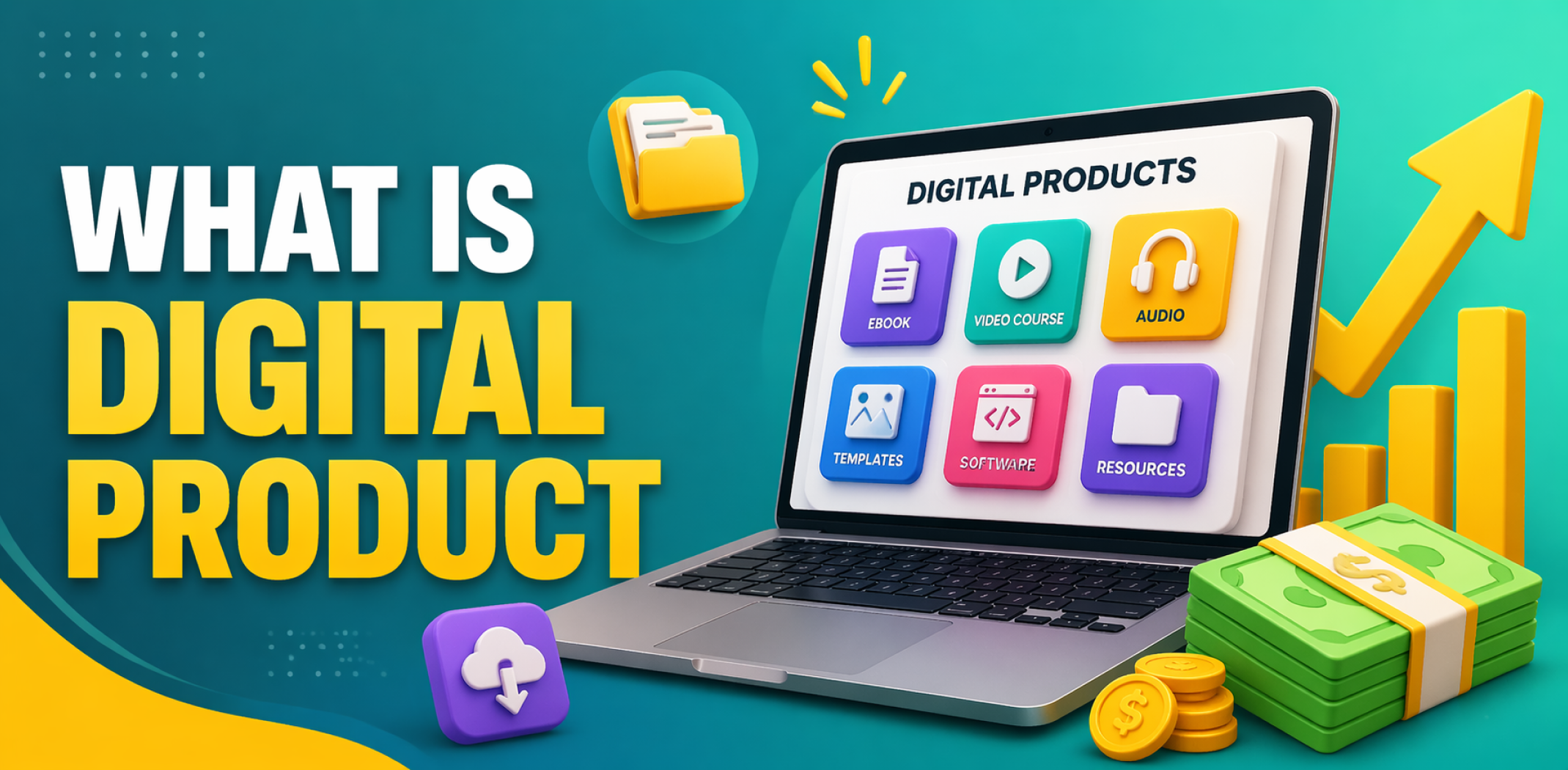
More people are making money online in 2026 than at any point in history – and most of them are not shipping boxes. Digital products have quietly become one of the most powerful income models available, and the barrier to getting started has never been lower. Whether you are trying to escape a paycheck-to-paycheck cycle, build something on the side while the kids are asleep, or replace your 9-to-5 entirely, understanding what a digital product is – and how you can sell them – is worth a few minutes of your time.
Quick Answer: A digital product is any item that is delivered electronically rather than physically. Think guides, courses, templates, tools, and downloadable content. Once created, the same product can be sold thousands of times with no extra cost per sale – and no inventory, no shipping, and no storage required.
This article walks through the full definition, the main types and real-world examples, and an honest side-by-side comparison of digital versus physical products. By the end, you will know which model fits your goals – and exactly how to get started.
What is a digital product?
A digital product is anything that exists in a digital format and is delivered to the buyer electronically – through a download link, a members-only portal, an email attachment, or instant online access. There is nothing physical to hold, pack, or ship. The value is entirely in the content, the functionality, or the access the product provides.
Here are the most common types of digital products being sold right now:
- Guides and ebooks – downloadable PDFs covering a topic in depth, from personal finance to home improvement
- Online courses – structured learning delivered through video, audio, or text modules
- Software and apps – tools, plugins, mobile applications, and browser extensions
- Templates and design assets – resume packs, Notion dashboards, Canva templates, Lightroom presets
- Music and audio files – licensed tracks, beats, and royalty-free sound libraries
- Stock photography and illustrations – images licensed for personal or commercial use
- Digital memberships – recurring access to exclusive content, tools, or communities
- Printables – calendars, planners, worksheets, and activity sheets buyers print at home
- Checklists and toolkits – condensed, actionable resources built around a specific goal or problem
What ties all of these together is the absence of a physical component. Once a digital product is created, the same file can be sold again and again with near-zero cost per additional sale. That is the scalability that draws so many people to this model.
Why this works in 2026: Consumer comfort with digital purchases is at an all-time high. From streaming services to software subscriptions, people are completely comfortable paying for things they never physically touch – and that behavior makes the market for digital products extremely receptive right now.
How much can you realistically earn selling digital products?
This is the question most people have but rarely get a straight answer to. Here is an honest breakdown based on where most sellers actually land.
These figures reflect realistic ranges, not outliers. Most beginners with no existing audience land in the $50–$300 range in their first couple of months. Sellers who activate built-in advertising and stay consistent can reach $500–$2,000 within three to six months. Top performers running full-time operations typically land between $5,000 and $15,000 per month after 12–24 months of steady effort.
One note on the upper figures: The $5,000+ range represents consistent, active sellers – not a guarantee. What you earn depends on your niche, your marketing effort, and how quickly you learn from your data. The built-in advertising system Sellvia provides is one of the fastest ways to close that gap for someone starting from zero.
The most important thing to understand is the structure of the income. Digital products have high profit margins – you keep 50–70% of every sale through Sellvia. That means fewer sales are needed to hit a meaningful income target compared to a lower-margin physical product business.
The real advantages of selling digital products
If you have been wondering why so many people are moving toward digital products, these reasons explain it clearly.
Profit margins are genuinely high
Once a digital product is created, the cost to deliver it is essentially zero. No raw materials, no packaging, no storage fees. A guide that took a weekend to write can generate income for years. The math is straightforward: high price, near-zero cost per unit equals very strong margins. With Sellvia, you keep 50–70% of every sale – which is significantly better than the 20–35% typical of physical product businesses.
Earning potential: $500–$5,000/month is realistic for established digital product sellers with consistent traffic and active advertising. Beginners with a ready-made catalog and built-in ads can start seeing their first sales within days.
Instant delivery and global reach
A buyer in Texas can purchase a digital guide at midnight and have it in their inbox within seconds. There are no shipping delays, no customs complications, no international courier fees. Your store is global from day one. Compare that to a physical product business where international shipping alone can eat into margins and frustrate customers with long wait times.
No inventory, no storage, no logistics
This is one of the most practical advantages for anyone starting out. You are never sitting on unsold stock. You never need to calculate reorder points or manage storage logistics. Every sale is a clean, automated transaction. For someone who wants to run a lean online business without the operational headaches, this is a major draw.
Low barrier to entry
Getting started with digital products does not require a large upfront investment. With a platform like Sellvia, you do not need to create products yourself, build a website from scratch, or set up complex payment systems. The store is built for you, the products are already loaded, and the advertising system handles promotion. The main thing you need is the willingness to start.
Digital products vs physical products: how do they actually compare?
This is the core question for anyone thinking about starting an online store. Both models have real advantages and real drawbacks. Here is an honest look at how they stack up.
Neither model is universally better. They suit different goals, risk tolerances, and starting points. Digital products reward people who want lean, high-margin businesses. Physical products can be easier to validate and trust-build early on. The key is matching the model to where you are right now.
What makes digital products difficult
Creating a digital product from scratch takes real time and skill. A great online course can take weeks or months to film, edit, and structure properly. Templates require creative expertise. And once you have built the product, you still need to drive traffic to it – because even the best guide sits unnoticed without marketing behind it.
This is exactly why the Sellvia model is such a practical starting point. The creation phase is already done. Sellvia builds and provides all the products, and the built-in advertising system handles promotion. You skip the hardest parts and get straight to selling.
What makes physical products difficult
Physical products involve supplier dependency, shipping timelines, and quality control – all of which you have limited control over. Margins are also lower after supplier costs and transaction fees. That said, physical product demand is broad and easy to validate, which is why many experienced sellers run both models together for diversified income.
Which model is right for you?
The honest answer is: it depends on where you are starting from. Here is a breakdown by reader profile.
Complete beginner with no audience or product
If you are starting from zero – no email list, no existing platform, no product of your own – Sellvia’s 1,000 digital guides store is one of the fastest paths available. You skip the product creation phase entirely. The catalog is already built, delivery is automated, and the store is ready to take orders. You can start generating real sales data within weeks of launching without writing a single word yourself.
Important note: Sellvia offers a 14-day free trial with a $40 ad coupon included. Most people who activate their ads start receiving orders on the same day.
Creator or expert with existing knowledge
If you have genuine expertise in any area – fitness, design, finance, cooking, personal development – digital products are a strong match for what you already know. You are packaging knowledge you have into a format people will pay for. The creation investment is real, but the long-term margin potential is hard to match with any physical product business.
Intermediate seller looking to diversify
If you already have an online business or a functioning store of any kind, adding digital products is a smart move. Many sellers add downloadable guides, checklists, or how-to resources as upsells or complementary products. This increases average order value without adding any fulfillment complexity – a clean, high-margin layer on top of what you already have running.
Advanced seller with full-time income goal
If your goal is to build a full-time online income, the strongest businesses typically combine multiple revenue streams. Digital products with high margins, supported by a built-in advertising system that drives daily sales, create a reliable income engine. Aim for $5,000–$15,000 per month as a realistic full-time benchmark – which typically requires 12–24 months of consistent effort and reinvestment. The Sellvia platform gives you everything needed to pursue that goal from day one.
Why Sellvia is a game-changer for your online store 🚀
Sellvia isn’t just another ecommerce tool. We are a trusted name in the industry, recognized by Forbes and even ranked in Inc.’s list of the 5,000 fastest-growing companies in the U.S. So if you’re serious about starting as a solopreneur, this is a smart place to begin.
Starting an online business can feel overwhelming, but that’s exactly where Sellvia steps in. It takes care of the tricky parts, so you can focus on making sales and growing your brand. Let’s break down what makes it such a great choice.
Get a ready-to-go store hassle-free 🎯
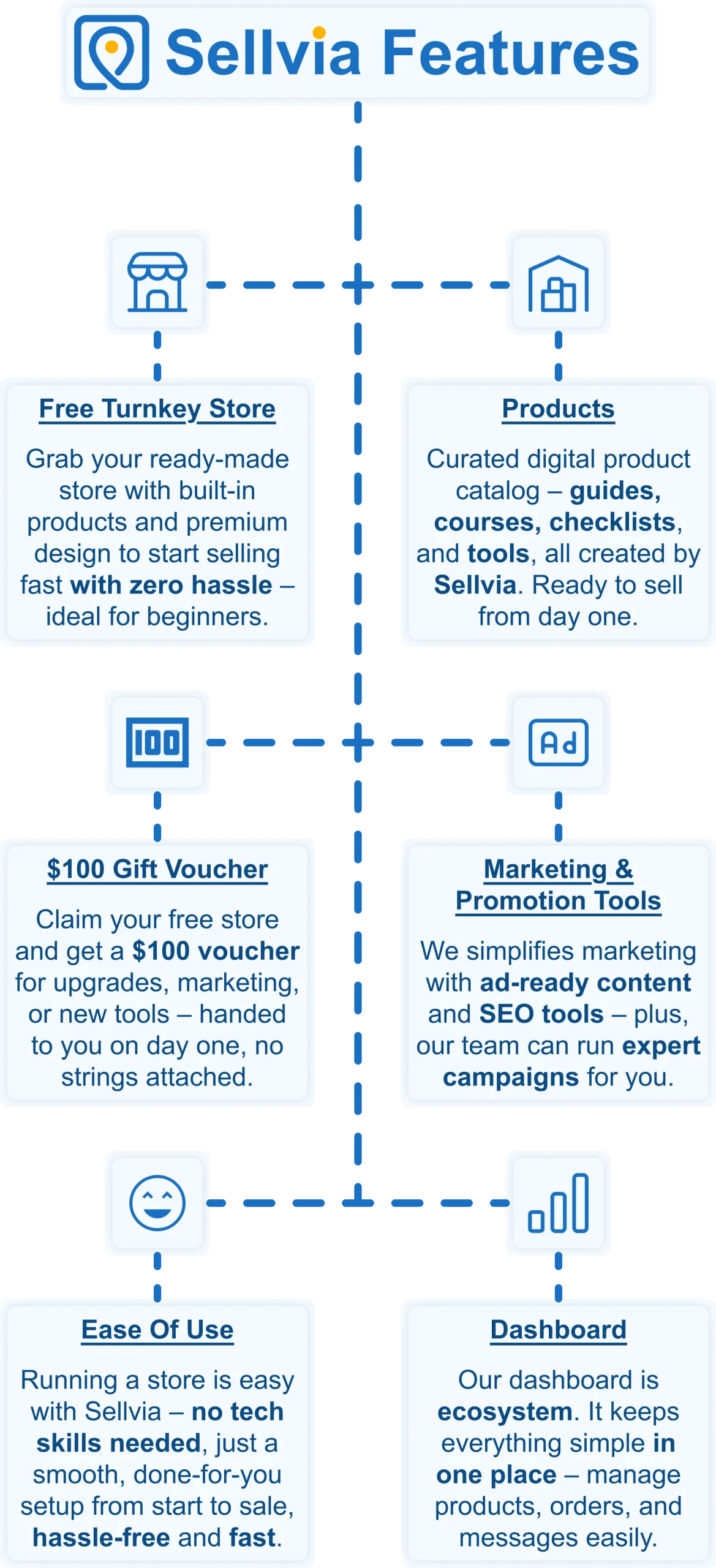
Want to start selling but don’t know where to begin? No worries! Just share your ideas, and Sellvia’s team will build a free ecommerce website that’s fully set up and ready to take orders from day one. No coding, no stress – just a store that works right out of the box.
1,000 digital products ready to sell from day one 🎁
Not sure what to sell? Sellvia solves that instantly. Your store comes pre-loaded with 1,000 ready-made digital products – guides, courses, checklists, and tools – all created by Sellvia. No writing, no recording, no product creation needed. Just pick your niche, and the products are already there waiting for your first customer.
A massive catalog of digital products to sell 🏆
One of the biggest struggles in starting an online business is figuring out what to sell. Sellvia solves that completely. Your store comes pre-loaded with digital products – guides, courses, checklists, and tools – all created by Sellvia. You keep 50–70% of every sale. No inventory. No shipping. No logistics headaches.
Everything in one easy-to-use platform 🔥
Managing an online store shouldn’t be complicated. With Sellvia, you can handle orders, add new products, and even chat with customers – all from a simple and user-friendly platform. No need to mess with confusing tools or deal with unnecessary tech stuff. It’s all smooth sailing.
No upfront costs, just start selling 💰
A big reason people hesitate to start an online business is the cost. But here’s the good news: With Sellvia, you don’t need to invest in stock, storage, or shipping supplies. You can run your store with no upfront costs, keeping things low-risk while still making money.
Support that’s always got your back 🤝
Running a business comes with questions, but you’re never alone. Sellvia’s dedicated support team is available 24/7 to help with anything you need. Whether it’s a small question or a big challenge, they’ve got you covered.
Selling digital products online has never been more accessible – and Sellvia gives you everything you need to start today, for free. Get your free store with 1,000 digital products and start earning on your own terms.


