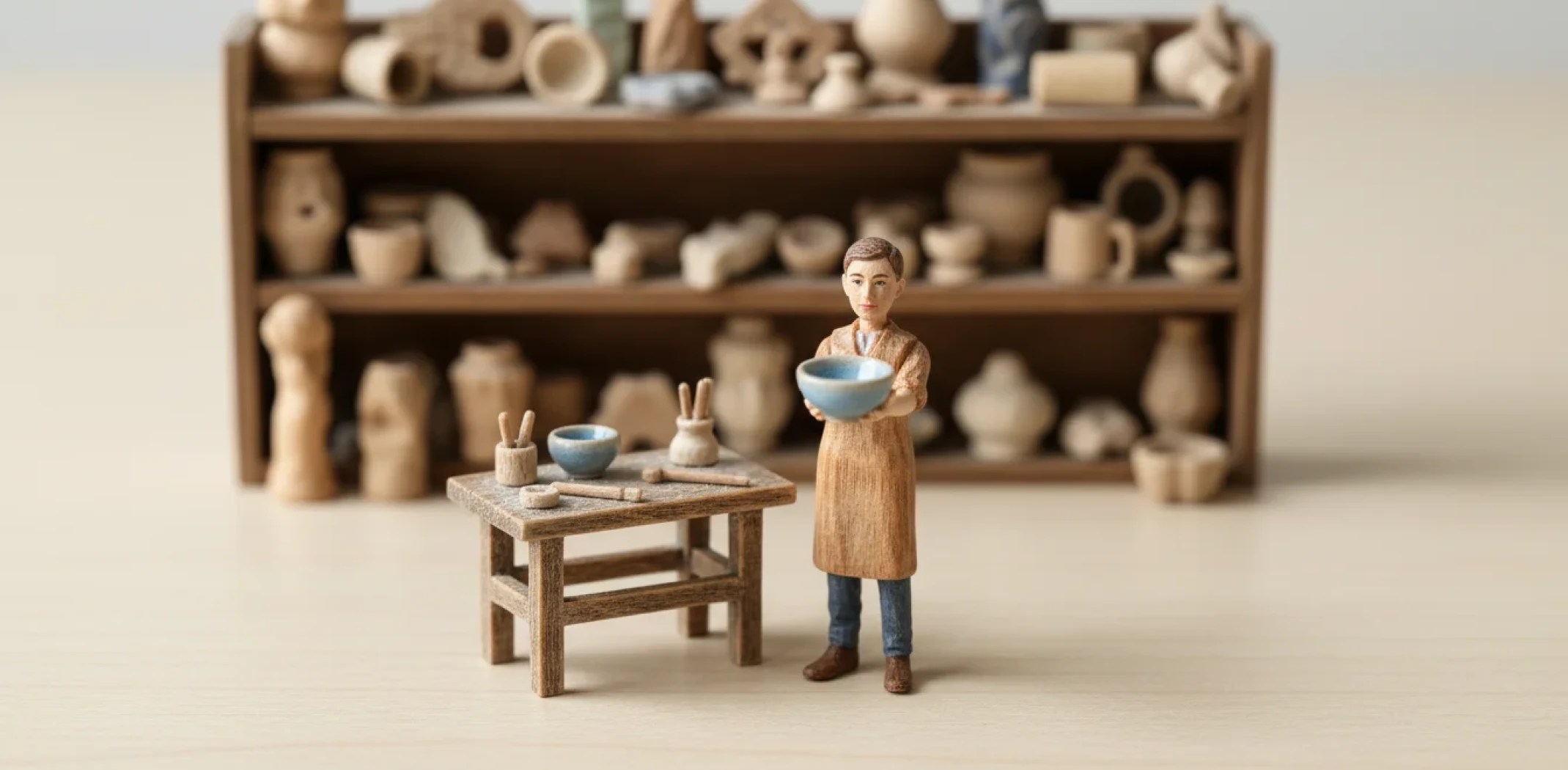
The money question gets asked and then immediately regretted. The thing has been a refuge for years, and every available answer sounds like the end of that: a shop, a schedule, orders waiting, the thing you did to get away from obligation quietly becoming another obligation. So it stays free, and the question returns a year later still unanswered – which is where a small version mapped from what you already make interrupts the loop.
The quick answer
The plain answer: none of this is all or nothing. What destroys the pleasure is selling everything you make rather than selling anything at all. The version that lasts sells a single narrow slice, picked on purpose, while everything else stays unsold and largely unseen. Drawing that line before the first sale takes minutes and is the whole difference between a small income and a job you did not apply for.
Coming up: how this belief took hold, the point where it falls apart, what genuinely protects the pleasure, and the price of keeping it free.
How “it becomes a business” took hold
Because the only stories anybody bothers telling are the large ones. Somebody left their job for the craft, or built it into a company, and that is what gets written up. Nobody writes about the woman who sells four things a month and gives the rest away, so the small version stays invisible and the leap looks compulsory, which is precisely what seeing the narrow version written down corrects.
Two quiet fears sustain it. The first says money contaminates the thing, which only holds once every hour of it is already promised to someone. The second is more practical and almost never voiced aloud: pricing something invites judgement, whereas an unpriced hobby can never be found wanting. Both are real enough, and deciding what stays unsold first takes most of the sting out of them.

Which means the honest question was never “should I monetise this?” but “which narrow part could earn, and what am I holding back?” That answer fits on a single line.
The point where the belief falls apart
Examine the people who managed to keep both and the belief comes apart. Hardly any of them sell everything. One sells a single repeatable item and never accepts commissions. Another teaches the craft and sells nothing they produce. A third accepts four orders a month and then shuts the list. In every case there is a boundary somebody drew on purpose, and naming your own boundary in advance is the step people skip and later regret.
| What you are told | What actually works |
|---|---|
| Sell it and it turns into work | Sell one slice and everything else stays yours |
| Accept whatever orders turn up | Fix the number before you open at all |
| Say yes while it still flatters | That flattering yes is the one that costs you |
| Grow it if it goes well | Growth is a choice, not a consequence |
There sits the trap inside the phrase “turn it into a business”. It names a scale, and scale was never the only option available. Most of the pleasure that goes is lost to volume and obligation rather than to money changing hands, and capping both in advance is what keeps it.
So what genuinely protects it?
This is the part most people miss: the protection is not restraint once orders start arriving. By then refusing has become a small social act you will quietly dodge. The protection is three lines drawn before anybody asks, and setting those three before the first sale is what makes the small version stable rather than a phase.
Three decisions, taken while nobody is waiting on you.
Three lines · before anybody asks
Whatever you sell. A single repeatable thing rather than the full range. Repeatable is the crucial word, because a hobby reinvented for every buyer has become a job by the second month.
Whatever you never sell. Whatever the hobby genuinely exists for. The experiments, the pieces for family, the entire category you adore and nobody buys. That is the line keeping it a refuge.
How many, and where you stop. A monthly order count with a definite end. A list that closes is what converts demand into a compliment rather than a debt.
One thing sold, one thing kept, one figure. Settled in advance, because nobody draws a line while somebody is waiting on them.
Notice that none of this asks you to be a business. It asks you to be specific about which corner is for sale, which is the opposite of the leap everybody fears – and naming that corner is a fifteen-minute job.
The real price of keeping it free
It costs rather more than the money, though the money is real enough. Work given away piles up in cupboards and on hard drives, and whoever made it gradually learns that what they produce carries no value, since nothing in the world has ever suggested otherwise. That first payment was never really about the payment.

A second cost arrives quietly. Free work still comes with expectations, deadlines and visible disappointment when you decline, so the obligation people dread from selling turns up regardless, unpaid and harder to refuse. A boundary that exists in writing works whether or not money is involved, and results vary with what you make and who wants it.
Giving it away vs going all in vs one slice
You can work this out yourself, for free, with an honest look at what you actually make. Here is how the usual routes compare with defining a narrow version deliberately.
| Way to plan it | Cost | Dated milestones for you? | Time |
|---|---|---|---|
| Keep giving it away | Free | No – obligation arrives regardless | Ongoing |
| Open a shop and scale | Time and stock | No – the leap nobody asked you to take | Months |
| A craft business course | $100–400 | Sometimes – assumes you want to scale | Weeks |
| Hobby-to-Income Roadmap | $39 | Yes – one slice, one number, one boundary | About 15 min |
“Does money not alter how it feels either way?” It alters something, and claiming otherwise would be dishonest. A commissioned piece is not the same experience as one made for nobody, and some people try selling and genuinely prefer the version where they did not. That is a legitimate outcome rather than a failure, which is exactly why the third line exists: a small, bounded version can be stopped without dismantling anything. What is worth avoiding is the unbounded version, where the answer arrives after the hobby has already gone. This is general educational guidance rather than business or tax advice, and rules on selling handmade goods and declaring income differ by country.
If that still sounds like a compromise, two people landed on very different sizes and both kept the thing itself.
Two people who kept both, differently
One of them sells a single item and declines everything else. The other stopped after a year and was grateful he had made stopping easy.
“I sell one bowl design and nothing else, and I turn down commissions every month without feeling bad about it. Everything strange I make still goes on the shelf where it always went.”
Ottilie M. · woodturner, Bemidji MN

“I tried it for a year and found I liked it better before, so I stopped. Because it was four orders a month and nothing else, stopping took one afternoon and cost me nothing.”
Fenwick J. · retired printer, Wheeling WV
If money does start arriving, the part that catches people out is what it costs to make each piece, and the Side Hustle Expense Tracker is built for keeping that straight from the first sale. Results vary; this is general guidance and not a promise of income.
Five short answers, and the narrow version of your own hobby lands the same day: the single repeatable thing worth selling, a number of orders that fits your week, and the part you are holding back entirely. Everything works from what you already make rather than from whatever sells well for somebody else, and the whole thing is built to be stopped easily should you decide you preferred it unpriced. That is why the lines come first.
*Individual results may vary.