Every year, millions of people search for a simple way to start earning money online without spending a fortune upfront. Two models keep coming up: print on demand and selling digital products. They look similar on the surface – no warehouse, no upfront inventory, no shipping headaches on your end. But dig a little deeper and they are very different businesses with different skill requirements, income ceilings, and long-term potential.
So what is print on demand, exactly? And how does it compare to running an online store that sells digital products – the model that platforms like Sellvia have helped over 1,500,000 store owners build into real income? This guide breaks it all down without the hype.
Quick answer: Print on demand is a model where products – typically apparel, mugs, or posters – are custom-printed only after a customer places an order. Selling digital products, by contrast, lets you offer guides, courses, and tools that are delivered instantly with no production delay. Both eliminate upfront stock costs, but they suit very different types of sellers – and one of them is significantly easier to start and scale.
What is print on demand?
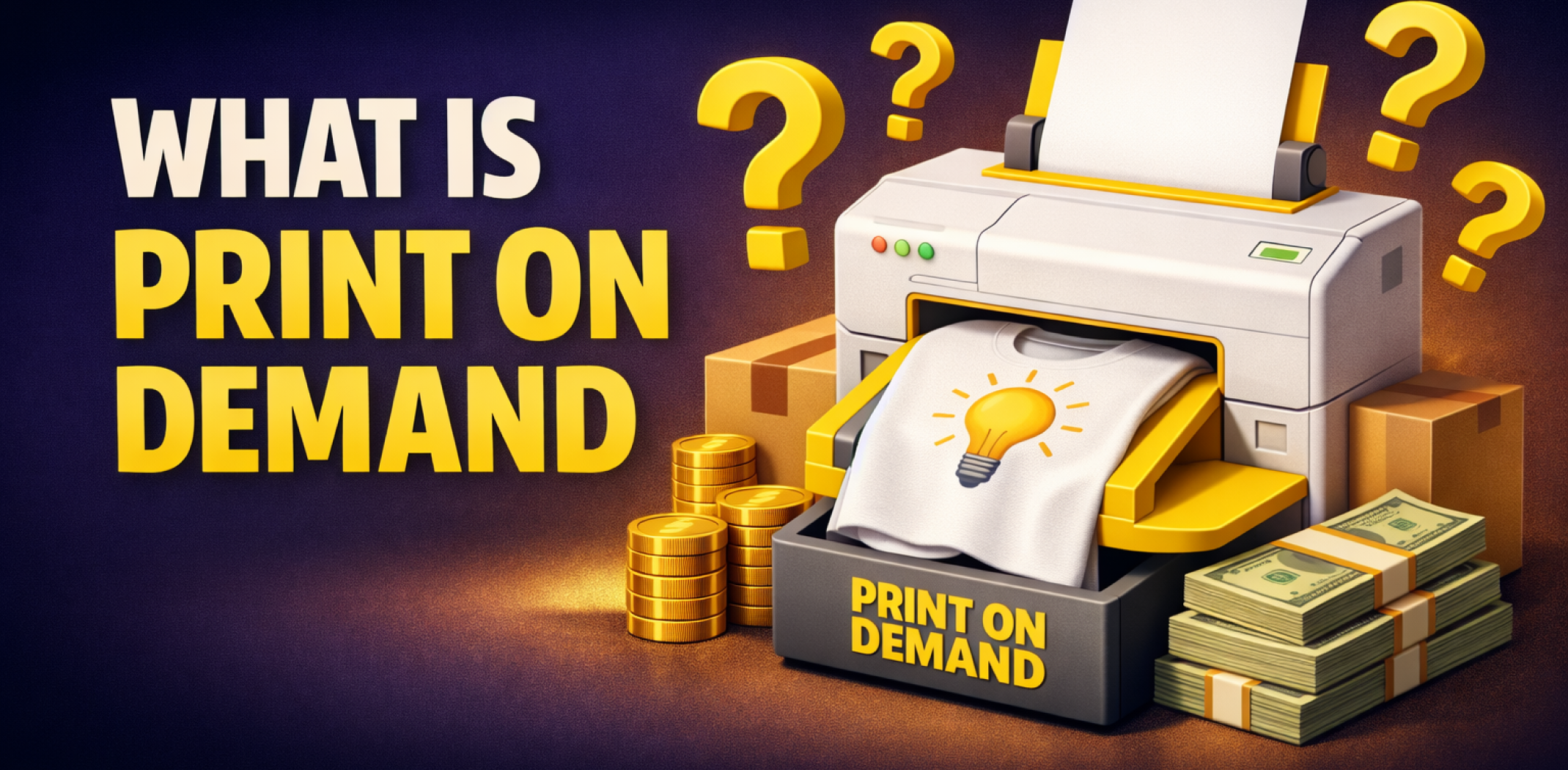
Print on demand – often shortened to POD – is a fulfillment model where products are created individually, only after a customer buys one. You upload a design, apply it to a blank product (a t-shirt, hoodie, tote bag, mug, poster, or phone case), and a third-party supplier handles the printing and shipping. You never touch the product, never prepay for stock, and never deal with unsold inventory sitting in a warehouse.
The most popular POD platforms today include Printful, Printify, Gelato, and Gooten. You connect them to a storefront – usually on Etsy, Shopify, or Amazon – and every order flows from the customer directly to the printer. The supplier ships the item, the customer receives their order, and you keep the margin between your retail price and the printing cost.
Why this works in 2026: Buyers increasingly want personalized, unique products. The global print on demand market was valued at around $13 billion in 2025 and is projected to grow at roughly 26% per year through 2034. Custom-printed products are no longer a niche – they are a mainstream retail category.
That said, POD requires real creative work. You need to design products, write listings, build traffic organically, and wait for designs to gain traction – often over several months. It is a legitimate model, but it is not the fastest or easiest path to earning income online. Understanding where POD works well and where other models outperform it is crucial before you decide which path to take.
How much can you realistically earn?
Both models have real earning potential, but the ceilings – and the paths to get there – are very different. Here is an honest look at how the numbers typically play out:
These figures are realistic ranges, not guarantees. Every model requires real work, a clear niche, and consistent effort to reach the upper end of any range.
One note on these figures: The top earners in any model typically spent 60–90 days testing and refining before hitting consistent monthly revenue. Most print on demand beginners earn $50–$200 in their first month. Most Sellvia store owners who activate the built-in ad system start seeing orders within their first few days – many report sales on day one. Growth accelerates once you find what resonates with your audience and let the system run.
Profit margins also differ significantly. POD products often carry margins of 20–40% after printing fees and platform commissions – and those margins can shrink further when you factor in Etsy listing fees and promoted placements. Sellvia store owners keep 50–70% of every sale on digital products, with no production costs and no shipping to manage. The product is delivered to the customer instantly and digitally the moment a sale is made.
Print on demand vs selling digital products: The core differences
Both models remove physical inventory from the equation. Beyond that shared foundation, they work very differently. Here is how each one performs across the factors that matter most to someone starting out.
What you sell and how you get started
Print on demand
With print on demand, your catalog is limited to what a printer can put a design on – t-shirts, mugs, tote bags, posters, phone cases, hoodies, and a handful of other printable products. That is a meaningful selection, but it comes with a major requirement: you need original designs. Whether you create them yourself or hire a designer, the quality and originality of your artwork is central to whether your products sell.
Getting started also involves setting up an Etsy shop or Shopify store, connecting a POD supplier, writing SEO-optimized product listings, and building organic traffic over time. Most new POD sellers spend weeks setting everything up before they make their first sale.
Selling digital products with Sellvia
Sellvia takes a completely different approach. Your store comes pre-loaded with digital products – guides, courses, checklists, and online tools – all created by Sellvia and ready to sell from day one. You do not need design skills, product research experience, or any technical background. The store is built for you, the products are already in it, and the built-in advertising system handles your marketing.
From the moment your store is live, you can activate the ad system – which costs between $10 and $50 per day depending on your budget – and start reaching customers. Many store owners receive their first orders on the same day they launch. There is no production queue, no waiting for a printer, and no shipping delays. When a sale is made, the digital product is delivered to the customer instantly.
Startup costs and what you actually risk
Print on demand startup costs
POD platforms like Printful and Printify charge nothing until you make a sale, which makes the entry cost low in theory. But the real costs show up quickly. Design tools, Etsy listing fees, promoted listing spend, and the time you invest in creating dozens of designs before finding winners – all of that adds up. Many POD sellers spend 3–6 months before they have a design that earns consistently.
Sellvia startup costs
Sellvia offers a 14-day free trial with full platform access. During the trial, your store is set up and ready to take orders, your digital products are already loaded, and you receive a $40 ad coupon to put toward your first ad spend. After the trial, the monthly plan is $39 – roughly $1.30 per day. There is no inventory to buy, no products to design, and no fulfillment to manage. The only ongoing cost is your ad budget, which you control entirely.
Important note: The only charge during the trial period is order processing fees – and those only apply if you actually get sales, which many store owners do within their first few days.
How long it takes to see results
This is where the two models diverge most clearly. Print on demand is a slow-build business. Most beginners make their first sale within 2–6 weeks of launching – assuming they have active listings on Etsy and have done keyword research. Reaching consistent monthly earnings of $500 or more typically takes 3–6 months of steady effort, including publishing new designs regularly, refining listings, and building organic traffic.
Sellvia is designed for faster results. The built-in ad system – which handles targeting, creatives, and optimization for you – means you do not need months of organic traffic building before you see your first order. Sellvia reports that most customers who activate the ad system start receiving orders on the same day. Over 1,500,000 stores have been launched on the platform, with store owners collectively earning over $1.5 billion.
Scaling potential
Scaling a POD business means creating more designs, listing across more platforms, and growing organic traffic. That is a slow, iterative process. Revenue grows steadily, but hitting four or five figures per month requires a large design library and significant, consistent traffic – often from multiple sources like Etsy SEO, Pinterest, and TikTok content creation.
Sellvia scales differently. Because the products, the store, and the ad system are already built, you focus on increasing your ad budget as your revenue grows. There is no creative bottleneck, no listing management queue, and no organic traffic strategy required. The platform is structured so that what worked for one store can work for yours – because the same system is already running successfully across millions of stores.
A side-by-side comparison: What is print on demand vs selling digital products
The comparison above is not about which model is “better” in an abstract sense. It is about which model fits where you are right now. If you have strong design skills, an existing audience, and the patience to build organic traffic over months, print on demand can work. If you want a faster path to earning income online – without designing products, managing fulfillment, or learning paid advertising from scratch – a Sellvia store is the more direct route.
Tips for making your online store work in 2026
Whether you are exploring print on demand or building a digital product store, a few principles apply across both. Use these to avoid the most common beginner mistakes and build something that lasts.
Pick your audience before your products
The biggest mistake new sellers make is starting with the platform rather than the person they want to serve. Your audience determines everything – your marketing channels, your product selection, your pricing, and your ability to build repeat buyers. Go as specific as you can. “Home office workers” is better than “people who work.” “Gifts for new dog moms” is better than “pet gifts.” Specificity is what turns a store into a brand.
Treat traffic as an ongoing skill
POD sellers rely on Etsy SEO, Pinterest, and TikTok content. Sellvia store owners use the built-in ad system, which handles targeting and optimization automatically. In either case, getting consistent traffic to your store is an ongoing practice. With Sellvia, the heavy lifting is done for you – the platform manages your ad creatives and targeting, so you do not need marketing expertise to start. But understanding what is working in your store and adjusting your daily ad budget accordingly is worth learning over time.
Test before you scale
In print on demand, testing means launching 20–30 designs and watching which ones get organic traction before investing in promoted listings. In a digital product store, Sellvia handles the testing side of advertising for you – the system is already optimized based on what works across the platform. Your job is to start, let the system run, and reinvest in what is generating results. The fastest way to fail in any model is spending big on something that has not been validated yet.
Do not overlook trust signals
A store that looks professional converts significantly better than one that looks rushed. Clear product descriptions, a clean layout, and visible credibility markers make buyers feel safe. This is true for both POD and digital product stores. Sellvia handles the store design and setup entirely – your store looks polished and trustworthy from day one, which means you are not losing sales to a bad first impression.
Focus on building your own customer relationship
One limitation of selling purely through Etsy or Amazon is that the platform owns the customer relationship, not you. You do not always have direct access to your buyer’s contact information, and you are dependent on that platform’s algorithm and policies. With a Sellvia store, you own your store and have direct access to your customer data. That is a meaningful long-term advantage as you grow.
What to avoid in either model
Both print on demand and digital product selling have pitfalls that trip up new sellers regularly. Here is what to steer clear of:
Key principle: Build a real business – one that could survive a platform policy change, a competitor entering your niche, or a slow month. That means building your own customer relationships, your own brand, and diversifying your traffic sources over time.
In print on demand, the most common mistakes are uploading designs that closely resemble trademarked logos or characters (a fast path to account suspension and legal exposure), copying competitor designs rather than creating original work, and setting prices so low that there is no margin left after printing fees and platform commissions. Always verify that your designs are original, and price for profit – not just for sales volume.
In any online business, the main traps are: overpromising results to yourself without putting in the work, ignoring customer service until negative reviews accumulate, and spending money on tools or ads before you understand what you are measuring. Start simple, track what is happening in your store, and respond to customers quickly. Your reputation is your most valuable long-term asset in ecommerce.
Important: Avoid any platform or program that promises guaranteed earnings with zero effort. Legitimate online businesses – whether POD or digital products – require time, consistency, and willingness to learn. Sellvia does not promise overnight wealth. It gives you the tools, products, and support to build something real.
Which model is right for you?
The honest answer depends on who you are and what you want from this. Here is a quick breakdown by seller profile:
Complete beginner with no design experience
A Sellvia digital product store is the easier entry point. You do not need to create anything – your store is built for you, pre-loaded with products, and connected to a built-in ad system that handles your marketing. You do not need a design portfolio, an Etsy shop, or months of SEO work before you see your first order. You just need to start.
Creative person with an existing audience
Print on demand may be worth exploring if you already have an engaged following – even a small one – that is enthusiastic about a specific topic or aesthetic. If you have 500 followers who love your illustration style or your niche interest, a POD store is a natural extension. Your existing audience becomes your first traffic source, which is the hardest part of starting a POD business.
Part-time seller with limited hours per week
Sellvia is the better fit for limited time. Once your store is live and your ads are running, the platform handles targeting, fulfillment, and product delivery automatically. POD requires ongoing design work, listing updates, and active traffic building to maintain momentum – which is harder to sustain with limited weekly hours. Sellvia is built to run with minimal daily management once it is set up.
Someone who wants full-time income within 12 months
If your goal is replacing a full-time salary – which typically means clearing $3,000–$5,000+ per month – Sellvia offers a more structured path at scale. The built-in ad system, proven product catalog, and 24/7 support team give you the infrastructure that most solo sellers spend years building on their own. Most full-time POD sellers spend 2–3 years reaching that income level; Sellvia store owners who commit fully and use the platform as designed can reach meaningful income milestones significantly faster.
Why Sellvia is a game-changer for your online store 🚀
Sellvia isn’t just another ecommerce tool. We are a trusted name in the industry, recognized by Forbes and even ranked in Inc.’s list of the 5,000 fastest-growing companies in the U.S. So if you’re serious about starting as a solopreneur, this is a smart place to begin.
Starting an online business can feel overwhelming, but that’s exactly where Sellvia steps in. It takes care of the tricky parts, so you can focus on making sales and growing your brand. Let’s break down what makes it such a great choice.
Get a ready-to-go store hassle-free 🎯
Want to start selling but don’t know where to begin? No worries! Just share your ideas, and Sellvia’s team will build a free ecommerce website that’s fully set up and ready to take orders from day one. No coding, no stress – just a store that works right out of the box.
A $100 welcome gift to grow your business faster 🎁
Starting a business takes momentum – and Sellvia gives you a head start. When you claim your free store today, you also get a $100 welcome gift to put toward growing your business. Use it to upgrade your store, boost your marketing, or unlock new tools. It is a real dollar value, handed to you on day one, with no catch and no hoops to jump through.
A massive catalog of digital products to sell 🏆
One of the biggest struggles in starting an online business is figuring out what to sell. Sellvia solves that completely. Your store comes pre-loaded with digital products – guides, courses, checklists, and tools – all created by Sellvia. You keep 50–70% of every sale. No inventory. No shipping. No logistics headaches.
Everything in one easy-to-use platform 🔥
Managing an online store shouldn’t be complicated. With Sellvia, you can handle orders, add new products, and even chat with customers – all from a simple and user-friendly platform. No need to mess with confusing tools or deal with unnecessary tech stuff. It’s all smooth sailing.
No upfront costs, just start selling 💰
A big reason people hesitate to start an online business is the cost. But here’s the good news: With Sellvia, you don’t need to invest in stock, storage, or shipping supplies. You can run your store with no upfront costs, keeping things low-risk while still making money.
Support that’s always got your back 🤝
Running a business comes with questions, but you’re never alone. Sellvia’s dedicated support team is available 24/7 to help with anything you need. Whether it’s a small question or a big challenge, they’ve got you covered.
Understanding what is print on demand is the first step – choosing a model that actually fits your life is the next one. Claim your free Sellvia store and see what a ready-to-earn online business looks like.