Two business models come up constantly in “how to make money online” conversations in 2026 – affiliate marketing and online selling. Both are legitimate. Both are accessible to people with no prior experience. But they work very differently, and picking the wrong one for your situation can cost you months of effort that goes nowhere.
This guide breaks down affiliate marketing vs dropshipping honestly – what each model actually involves, how much you can realistically earn, and which one gives you more long-term control over your income. If you are weighing both options right now, you are in the right place.
Quick Answer: Affiliate marketing is simpler to start but limits your earning ceiling and gives you no real ownership. Running your own online store requires a bit more setup but puts you in control of your brand, your customers, and your profits – making it the stronger long-term path for most people.
Before diving into the comparison, it helps to understand what you are actually choosing between. These two models share some surface-level similarities – both happen online, both can be run solo, both do not require you to make physical products – but the mechanics underneath are completely different.
What is affiliate marketing vs dropshipping?
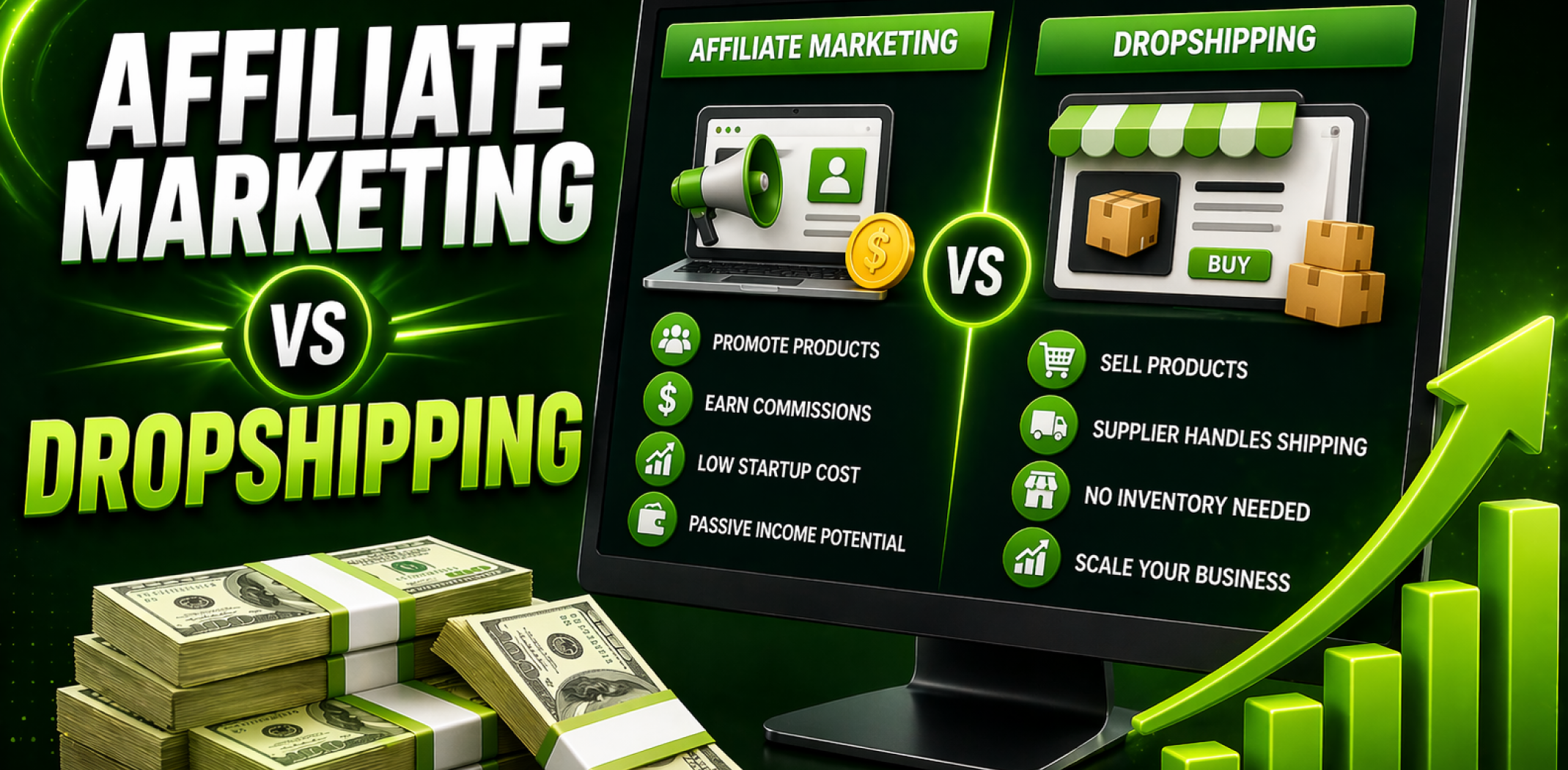
Affiliate marketing means promoting someone else’s products or services in exchange for a commission. You sign up for an affiliate program – Amazon Associates, ShareASale, individual brand programs – get a unique tracking link, and earn a cut every time someone clicks your link and makes a purchase. You never handle the product, never deal with the customer, and never touch the transaction. Your job is traffic – getting the right people in front of the right offer.
Running your own online store means you own the storefront, set the prices, and keep the margin between what the customer pays and what your products cost. You own the customer relationship, the brand, and the entire experience. With platforms like Sellvia, your store comes pre-loaded with digital products – guides, courses, checklists, and tools – that are ready to sell from day one. No inventory, no shipping, no logistics. When a sale is made, the product is delivered instantly and digitally.
The core difference: affiliate marketing makes you a promoter working for someone else’s business. Running your own store makes you a business owner. That distinction matters more than almost anything else when you are deciding which path to take.
How much can you realistically earn?
Income claims in this space are all over the place, so let us put some real numbers on the table. The comparison below looks at both models across three factors that actually matter – effort level, startup cost, and realistic earning potential.
Affiliate marketing has a lower barrier to entry, but the earning ceiling is directly tied to your traffic volume and the commission rates set by the brands you promote – rates you have no control over. Running your own store requires more initial setup, but every sale goes through your storefront, at your price, with your margin.
One note on these figures: Both models require consistent effort over 60–90 days before you see meaningful income. Anyone promising $1,000 in your first week is selling a course, not running a real business. Full-time income from either model typically takes 4–6 months of genuine work.
The gap between the two models widens significantly as you scale. An affiliate marketer earning $3,000/month is likely driving enormous traffic volumes and managing multiple content channels. A store earning $3,000/month in profit might be running on a few hundred orders at a healthy margin – a much more sustainable position per unit of effort.
Affiliate marketing vs dropshipping: a direct comparison across what matters most
Let us go category by category and see how both models stack up on the factors that will actually affect your day-to-day experience running a business.
Ownership and control
This is where the two models diverge most sharply – and it is arguably the most important factor for anyone thinking long-term.
With affiliate marketing, you own nothing. You own your content – a blog, a YouTube channel, a newsletter – but the product, the brand, the checkout experience, and the customer relationship all belong to someone else. If the brand changes its commission structure, your income drops overnight. If the affiliate program shuts down, your revenue stream disappears with it. Amazon Associates cut commission rates dramatically in 2020, and affiliates who had built entire businesses around it lost 30–70% of their income in a single announcement.
With your own online store, you own the storefront. You own the brand, the product listings, the customer data, and the pricing. You can change your product selection, run promotions, and make business decisions without asking anyone’s permission. That ownership is the foundation of a real business – not just a traffic-dependent side hustle.
Startup cost and technical barrier
Affiliate marketing wins on pure accessibility. You can sign up for Amazon Associates in 10 minutes, write a review post, and have a live affiliate link the same afternoon. There is no storefront to build, no product catalog to set up. For someone with zero budget and zero experience, that low friction is genuinely appealing.
Running your own online store has a slightly higher setup threshold – but the gap has narrowed significantly. Platforms like Sellvia provide a free ready-to-go store built and stocked with digital products, which removes the main technical barrier that used to make this feel intimidating. The practical startup cost for a properly set up store in 2026 is lower than most people assume. You can get started for free, with no inventory and no upfront product costs.
Important note: “Low barrier to entry” in affiliate marketing also means high competition. The niches with the best commission rates – finance, software, health – are saturated with established content sites that have been building authority for years. Breaking in as a newcomer takes longer than most people expect.
Profit margins and revenue structure
Affiliate marketing commissions typically range from 3–10% on physical products and up to 20–40% on digital products and software tools. Your revenue is a percentage of someone else’s sale price – and that percentage is set by them, not you.
With your own online store selling digital products, you keep 50–70% of every sale. More importantly, you set the retail price. You can also build in upsells and loyalty programs that increase order value – none of which are available to an affiliate marketer who earns a fixed cut and moves on.
Earning potential: $500–$3,000/month for a beginner store within 60–90 days of launch; $10,000+/month for scaled operations with proven products.
Customer relationships and data
Affiliate marketing puts a wall between you and the buyer. Once someone clicks your link and lands on the merchant’s site, that customer belongs to the merchant. You get a commission notification – the merchant gets an email address, purchase history, and the ability to market to that person for years. You are essentially doing the acquisition work for someone else’s customer database.
With your own store, every customer who buys from you is your customer. Their email, their order history, their preferences – all of it lives in your store’s backend. That means you can run email marketing, retarget past buyers, offer loyalty discounts, and build a repeat-purchase business over time. Repeat customers cost significantly less to convert than new ones, and that compound effect is a major driver of long-term profitability that affiliate marketing simply cannot replicate.
Scalability
Affiliate marketing scales through content volume – more articles, more videos, more channels, more traffic. That is a legitimate path, but it is slow, requires constant content production, and is heavily dependent on search engine algorithm changes outside your control. Many affiliate marketers saw major income drops after Google’s core updates in 2023 and 2024 because their sites were deranked overnight.
Your own online store scales through advertising, product expansion, and platform growth. Sellvia includes a built-in advertising system – customers choose a daily budget between $10 and $50, and the targeting, creatives, and optimization are all handled for them. Many store owners who activate ads start receiving orders the same day. Store-level optimizations compound over time and benefit every sale going forward.
Where affiliate marketing has a genuine edge
This is an honest comparison, which means acknowledging where affiliate marketing legitimately wins. There are a few real scenarios where it makes sense.
If you already have an established audience – a blog with real traffic, a YouTube channel with subscribers, a newsletter list – affiliate marketing can monetize that audience with almost no additional work. Recommending products you genuinely use and inserting affiliate links into existing content is low effort for incremental income. For creators, it can be an excellent supplementary revenue stream layered on top of their main business.
Affiliate marketing is also genuinely easier for complete beginners who are not ready to commit to building a brand. If you want to understand how online sales funnels work and how traffic converts before investing more, affiliate marketing is a useful learning ground with minimal financial risk.
And for high-value digital products – software subscriptions, online courses, financial services – affiliate commissions can be substantial. A single SaaS affiliate sale paying $200–$500 in recurring commission changes the math considerably compared to Amazon’s 4% on a $30 product.
But even with those advantages in mind, the structural limitations remain. You are building on rented land. Commission rates change. Programs shut down. Traffic algorithms shift. None of those risks exist in the same way when you own your store and your customer relationships outright.
Can you combine affiliate marketing and an online store?
Yes – and it is worth addressing because a lot of people ask this question. The two models are not mutually exclusive.
Some store owners use affiliate marketing as an additional monetization layer – adding affiliate links in blog content that drives organic traffic to their store, or recommending complementary products through an email list. Conversely, affiliate marketers sometimes use their own store as a way to transition from promoting other people’s products to selling their own once they have built an audience.
The more common and more effective sequence, though, is to start with your own store – build it, learn the product and customer side of ecommerce – and then layer in content marketing and SEO over time to reduce your dependence on paid ads. That combination gives you owned infrastructure with compounding organic traffic working together.
Trying to run both from scratch simultaneously is not recommended. Each model has its own learning curve, and splitting your focus early tends to produce two mediocre efforts instead of one solid foundation. Pick the one that matches your situation and goals, build it to profitability, then expand.
Which model is right for you? A guide by reader profile
The honest answer is that it depends on where you are starting from and what you are trying to build. Here is a straightforward breakdown by situation.
Complete beginner with no audience and no budget
Starting your own online store is the better path here. With a free ready-to-go store available through Sellvia, the financial barrier is essentially zero. You get a real business with real products and a real storefront – not just a collection of affiliate links hoping someone clicks. The learning curve is manageable, the feedback loop is faster (you see real sales data quickly), and you are building something with long-term value from day one.
Intermediate – part-time, some online experience
If you have been dabbling in online income for a while – maybe you have tried affiliate marketing and hit the traffic wall – your own store is the logical next step. You already understand how online sales work, you know how to write product-focused content, and you are ready to own the full transaction. The skills transfer directly. Your content experience becomes an asset that drives organic traffic to your store rather than to someone else’s checkout page.
Advanced – full-time income goal within 12 months
If you are serious about replacing a full-time income within a year, your own online store is the only model of the two that gives you the tools to realistically get there. The scaling mechanics – built-in ads, product expansion, email marketing – allow for geometric income growth in a way that affiliate marketing’s content-volume model does not. A well-run Sellvia store can reach $5,000–$15,000/month in revenue within 12 months of focused effort. Reaching that figure through affiliate marketing alone, starting from scratch, is considerably harder and takes longer for most people.
Creator with an existing audience
If you already have a significant following – 10,000+ real subscribers, readers, or followers – affiliate marketing is worth exploring as an additional income layer. But even here, launching your own store to sell digital products directly to your audience is almost always more profitable per sale than a commission link. Creators with existing audiences who pivot to direct sales consistently outperform the affiliate revenue they were earning from the same audience.
Why Sellvia is a game-changer for your online store 🚀
Sellvia isn’t just another ecommerce tool. We are a trusted name in the industry, recognized by Forbes and even ranked in Inc.’s list of the 5,000 fastest-growing companies in the U.S. So if you’re serious about starting as a solopreneur, this is a smart place to begin.
Starting an online business can feel overwhelming, but that’s exactly where Sellvia steps in. It takes care of the tricky parts, so you can focus on making sales and growing your brand. Let’s break down what makes it such a great choice.
Get a ready-to-go store hassle-free 🎯
Want to start selling but don’t know where to begin? No worries! Just share your ideas, and Sellvia’s team will build a free ecommerce website that’s fully set up and ready to take orders from day one. No coding, no stress – just a store that works right out of the box.
A $100 welcome gift to grow your business faster 🎁
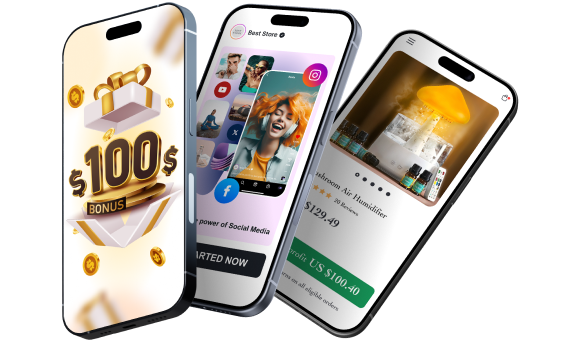
Starting a business takes momentum – and Sellvia gives you a head start. When you claim your free store today, you also get a $100 welcome gift to put toward growing your business. Use it to upgrade your store, boost your marketing, or unlock new tools. It is a real dollar value, handed to you on day one, with no catch and no hoops to jump through.
A massive catalog of digital products to sell 🏆
One of the biggest struggles in starting an online business is figuring out what to sell. Sellvia solves that completely. Your store comes pre-loaded with digital products – guides, courses, checklists, and tools – all created by Sellvia. You keep 50–70% of every sale. No inventory. No shipping. No logistics headaches.
Everything in one easy-to-use platform 🔥
Managing an online store shouldn’t be complicated. With Sellvia, you can handle orders, add new products, and even chat with customers – all from a simple and user-friendly platform. No need to mess with confusing tools or deal with unnecessary tech stuff. It’s all smooth sailing.
No upfront costs, just start selling 💰
A big reason people hesitate to start an online business is the cost. But here’s the good news: With Sellvia, you don’t need to invest in stock, storage, or shipping supplies. You can run your store with no upfront costs, keeping things low-risk while still making money.
Support that’s always got your back 🤝
Running a business comes with questions, but you’re never alone. Sellvia’s dedicated support team is available 24/7 to help with anything you need. Whether it’s a small question or a big challenge, they’ve got you covered.
When you compare affiliate marketing vs dropshipping side by side, running your own store gives you something affiliate marketing never can – real ownership, customers who come back, and margins you control. Get your free Sellvia store today and start building on a foundation that is actually yours.