
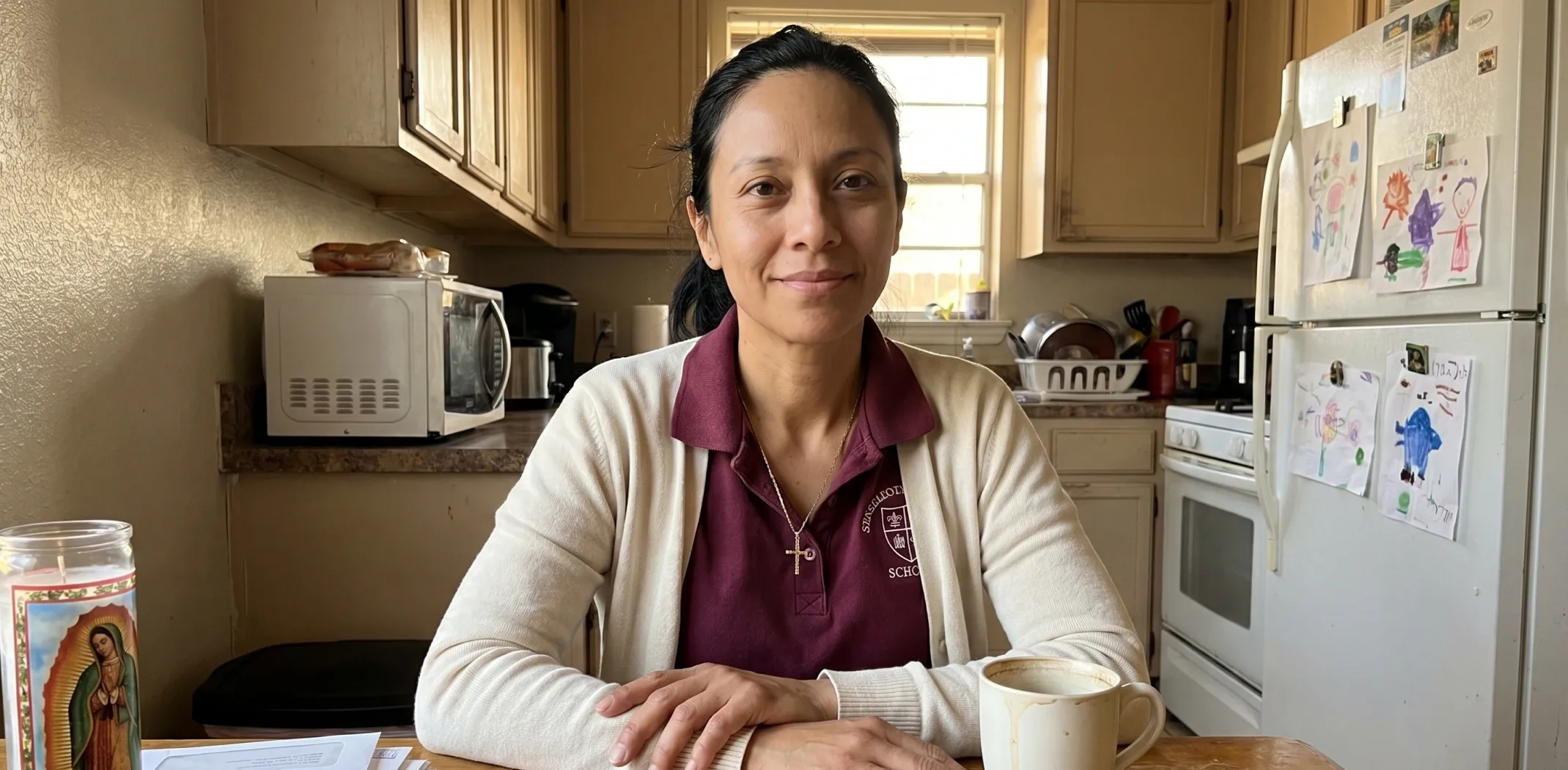
The morning her seven-year-old’s homework asked “what is interest?”, Marisol froze – she had no answer to give. Learning how to budget on a low income grew out of that small, sharp moment, and 30 days later it had surfaced $340 a month she did not know she had.
She is 38, serves lunches in a San Antonio school cafeteria, and supports Diego (11) and Sofia (7) on a $32,400 salary. There was $4,800 riding on a card at 24.99% APR she had only ever minimum-paid, nothing at all in savings, and $124 disappearing into overdraft charges each month. Nobody had ever sat her down and explained how any of it functioned.
What turned it around was not a pricey seminar or a thick finance book. It was a quick assessment that shaped a 30-day course around the exact things she did not know – 15 minutes a day, worked through with numbers from her own life. This is the order she followed.
Why “just budget better” never fixes financial confusion
Urging someone to “be smarter with money” almost never works, because the issue is not discipline – it is missing information. You cannot use APR, a credit score, compound interest or an employer match if no one ever explained them. That is not a character flaw; it is a hole in an education the schools quietly left out.
The message is not “feel ashamed” – it is “this gap closes.” Money is a handful of concrete ideas anyone can pick up in plain language, using examples from their own paycheck. The moment Marisol could see how a budget and APR really worked, the wins came quickly.
Marisol was not reckless or hopeless with money. She had simply never been handed the rulebook – and no one wins a game whose rules were never explained.
Like plenty of hard-working people, Marisol did not need a lecture about her debt. She needed someone to say, in plain words, what APR meant and what to do about it – beginning with the card in her own wallet.
What Marisol tried first – and why none of it stuck
Before the course that worked, she ran through the usual attempts:
Scrolling finance clips on TikTok
A torrent of crypto hot takes and meme-stock noise, none of it tuned to her life. Fun to watch, contradictory, and worthless to a single mom on a 24.99% card.
Wading into a 400-page money book
Plenty of theory, never a single instruction for her own money. She gave up around chapter three, exactly as lost as before.
Telling herself she would “handle it later”
Later kept not arriving while the interest quietly compounded against her. Looking away felt easier, and it cost her a little more every month.
One was too scattered, one too abstract, one too easy to keep putting off. Not one of them did the thing that actually works: take a single concept, explain it plainly, and use it on her own money right away.
I did not need a finance degree. I needed someone to spell out APR in plain words and tell me what to do with my card – 15 minutes at a time.
The 4 things the Course built from Marisol’s answers
A five-minute assessment asked what she knew, what she earned, and where she felt lost. Minutes later, a course shaped for her, in four parts:
It never lectured me. It taught me one thing, had me use it on my own account that same day, then checked I had it – and money finally clicked.
Her first real-money task was the one she had been avoiding: genuinely reading her credit-card statement. Once she grasped what a 24.99% APR was costing her, the next task – calling to ask for a lower rate – no longer felt out of reach.
From “what is APR?” to $340 a month: Marisol’s 30 days
The course took 15 minutes a day – a lesson, a quiz, a real task – and the wins compounded week on week.
Built a budget she could read · +$340/mo found
Money that had been leaking out, now visible and redirected on purpose.
One 8-minute call · 24.99% → 16.99% APR
A scripted phone call cut the rate on the card she had carried for years.
Claimed the 401(k) match · +$972/yr
Free employer money she had been walking past, finally captured.
Automatic saving · $50 every week
A standing transfer that built a buffer without her having to think about it.
Nothing here was drastic. A budget she could finally read, one phone call, one enrolment form and one automatic transfer – and roughly $340 a month surfaced that had been quietly slipping away.

The proof was tiny and enormous at the same time. Last week she covered Sofia’s $165 bounce-house birthday in cash – her first debt-free birthday in three years. That is what this learning really delivers: not a windfall, but control.
Why “money is just common sense” is a myth
There is a reason sharp, capable people stay stuck. It is not a lack of common sense – it is that money obeys specific rules (APR, compounding, tax-advantaged accounts) that are never obvious and were never taught. Without them you are guessing, and the guesses are expensive. Explained in plain English, those same rules go from intimidating to usable in a few weeks.
A finance seminar
$200–$500 · a weekend · theory, not your actual situation.
A money book
$15–$30 · hours · no quizzes, no tasks, easy to abandon.
Random social-media tips
Free · endless · contradictory, and often plain risky.
Financial Literacy Course
$19 · 15 min/day · built to your gaps, with real tasks on your own money.
Concepts are easy to find in a seminar or a book; what is missing is a lesson tuned to your paycheck and a hand walking you through real tasks on your own accounts. Bridging that distance – from “I know what APR is” to “I just called and lowered mine” – is the entire point.
I am hopeless with numbers – will I really understand this?
That is precisely who it is for. It opens with a knowledge check and explains everything in plain English with examples from your own paycheck – no jargon, no assumptions. Marisol began not knowing what APR meant. This is financial education, not personalized advice; for complex tax or investment calls, check with a licensed professional.
What other people learned with the same course
Marisol’s story is a common one: capable people who were never taught the rules – until someone finally laid them out plainly.

“Daycare worker, mom of three. I used the script on a call and they wiped a $39 late fee. The budget audit turned up $218 a month. Two weeks in and I felt like a new person.”
Elena R. · daycare worker, Phoenix AZ

“Warehouse worker. Turns out my employer matches up to 6%, not 3% – I had left $2,400 a year on the floor for four years. The course paid for itself many times over.”
Darnelle H. · warehouse worker, Memphis TN
Alongside the daily lessons, Financial Literacy Course bundles in weekly progress reviews, a quiz after every lesson, and a graduation scorecard with a 90-day action plan – so the learning hardens into habits instead of fading after one read.
Different jobs, different gaps, the same opening move: stop guessing, learn one rule in plain English, and put it to work on your own money.
How to budget on a low income: the 5-step playbook
If money on a tight income has always felt confusing, here is the order that changes it – the same one the Course walks you through:
Name what you genuinely do not get
Own up to the blanks – maybe APR, maybe compounding, maybe the match at work. Putting words to what you are missing is the thing that unlocks a plan.
Take it one concept at a time
Leave the doorstop on the shelf. A single 15-minute lesson you actually finish does more than chapters of theory you abandon halfway.
Use it on your own money that day
Application is what locks it in: look up your own score, open your own statement, crunch your own figures – not some example from a book.
Grab the quick wins first
A budget, a lower-APR call, an employer match – the fast, low-effort moves that free real money and build momentum early.
Carry it forward with a plan
A month lays the foundation; a 90-day plan grows it into credit, saving and investing, one manageable step after another.
There was no windfall and no raise. Marisol simply picked up the rules no one had ever taught her and put them to work on her own money, a quarter-hour at a time. That same education is within reach of anyone who was pushed into adulthood without it.
That is the heart of it: you are not bad with money – you were never taught the rules. Learn them in plain English, put them to work on your own accounts, and confusion becomes control.
Learn how to budget on a low income – the same 15-minute-a-day course Marisol used to go from “what is APR?” to $340 a month found in 30 days.
*Individual results may vary.