7 Money Lessons For Kids That Actually Stick (Real-Life Guide)
×
Category:
Money hacks
Side hustle starter pack with a $100 bonus voucher inside
Claim a free store with a head-start voucher today!
Get for free

7 Money Lessons For Kids That Survive Real Life (Not Just Worksheets)

by Anna V.
15 min read
how-to-teach-kids-about-money-mteam

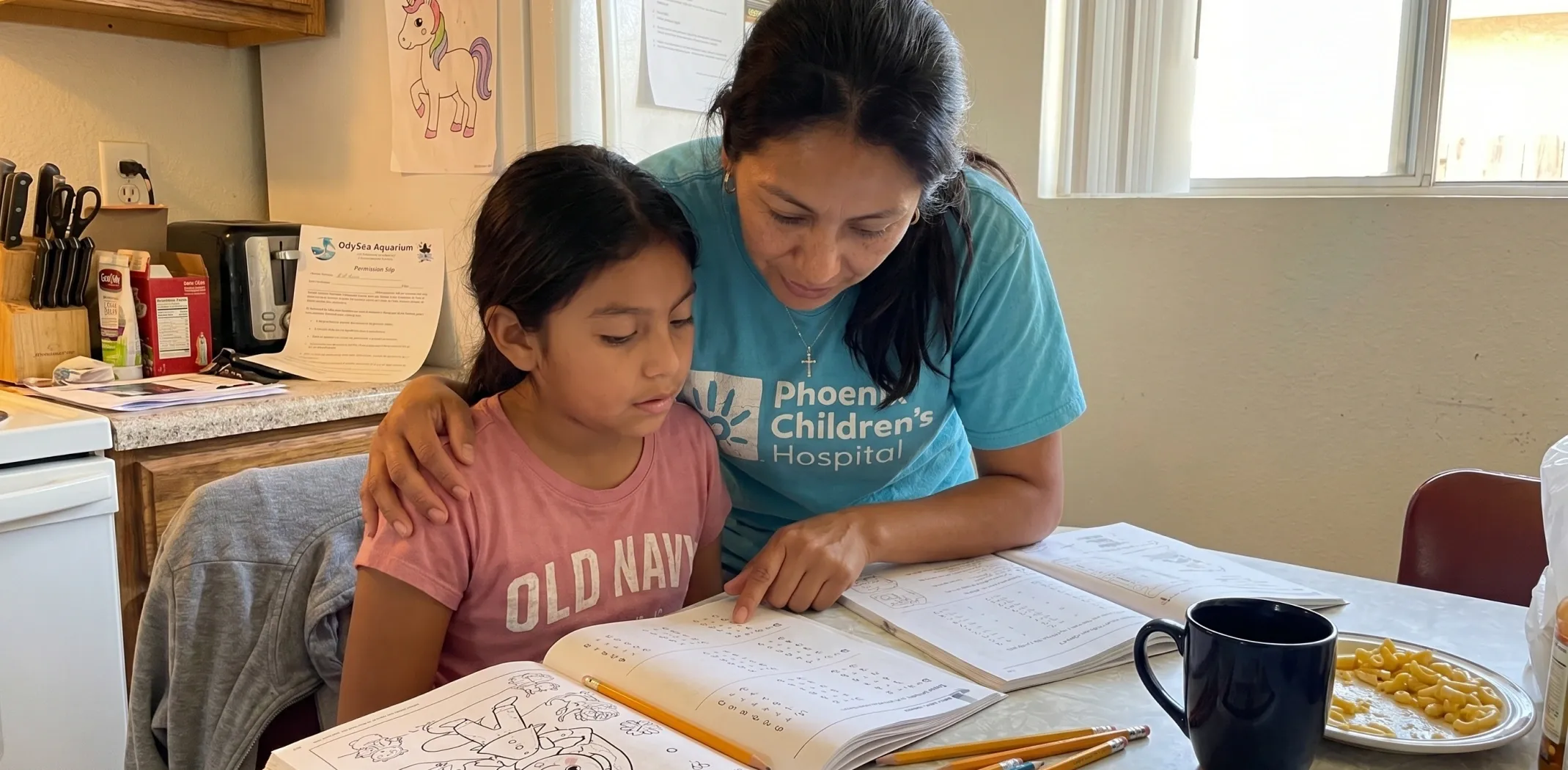
Looking for money lessons for kids that don’t need a 529 account, a calm Sunday evening, or a parenting book you have not finished? Mari taught her 9-year-old to save twenty-four dollars in coins for her own school field trip in eleven weeks – without an allowance app, without an envelope system from a finance YouTuber, and without the lecture.

Most online articles about teaching kids money assume the family has a Vanguard account and a quiet Sunday night. Mari has neither. She works as a teacher’s aide at a Title-I elementary school in Phoenix, raises Camila alone, earns thirty-two thousand four hundred dollars a year, and on the 28th of the month there is $214 in checking and a Capital One card that has not moved in two years.

For four years Mari ran the same kitchen-table math after Camila went to bed. Then one Thursday her nine-year-old said five words at dinner that Mari could not unhear. A teacher at the school handed her a $19 link the next morning. Fourteen minutes of questions gave her something she had never had before. Here is the play-by-play.

Why money lessons for kids are no longer a luxury – especially for working families

For four years Mari sat at her kitchen table after Camila was asleep and ran the same numbers on the back of a #10 envelope. Rent. Car. Childcare. Groceries. The minimum on the Capital One. Same answer every month: $214 in checking on the 28th, nothing for an iPhone Camila’s best friend Sofia just got, and a school field trip slip for $24 that Mari had quietly thrown in the trash.

60%
of American adults cannot pass a basic financial literacy test (FINRA)
7
is the age by which kids’ core money habits are forming (Cambridge University)
0
U.S. states require personal finance education before the 4th grade

Those numbers describe the corner Mari was in – not unusual, just underserved by the parenting advice most working moms find online. Generic guidance for generic families. Hers wasn’t generic.

Expert tips:
Kids learn money habits by watching, not by being lectured. The simplest thing a parent can do this Saturday is put three jars on a kitchen counter and let the kid watch them make one money decision out loud. The Kids Financial Literacy Course takes the 4-week plan and personalizes it to your kid’s age and the specific money behavior you want to change.

Mari’s situation wasn’t catastrophic. The rent went out on the first. The lights stayed on. But there was no room for anything to bend – no flat tire, no after-school program raising its rate, no $24 OdySea Aquarium permission slip her daughter could come home asking about.

money lessons for kids

Mari is 34. She drives a 2013 Toyota Corolla with 158,000 miles on it. Her daughter Camila is 9 – long dark hair in a low ponytail, mismatched socks most days, and the unbothered nine-year-old voice every parent recognizes when the topic actually matters to the kid.

Like a lot of working moms, Mari wasn’t hunting for money lessons for kids in an aspirational, raising-the-next-Warren-Buffett sense. She was hunting for the right sentences to say when Camila asked “why don’t we have what Sofia has,” and a kid-level system Camila could run on three dollars a week.

What Mari tried first – and why none of it stuck

Before the 4-week plan, here is what Mari spent two years trying:

Bedtime “why money is important” talks

Camila listened politely and asked for a $42 LOL Surprise the next afternoon. The talks did not stick because nothing physical was attached to them.

A free chore-chart app from the App Store

Gamified screens, virtual stars, a leaderboard. Camila lost interest in week two. Mari spent more time onboarding the app than actually teaching anything.

A finance book for parents

Two hundred and forty pages. Chapter four assumed the family had a 529 plan. Mari did not finish chapter five. The book sat next to her bed for a year.

Every option assumed Mari was a parent she wasn’t. The advice was always written for somebody with more time, more money, or more patience than she had at 9pm. None of them said: given who you are right now, here is what makes sense for Camila.

That is the gap Mari walked into on a Friday morning when a fourth-grade teacher at her school sent her a link to a real system for money lessons for kids.

I thought: this is one of those things where you pay nineteen bucks and they send you a PDF that says ‘teach your kid the value of a dollar.’ I have seen a hundred of those.

She paid the $19 anyway. The tool asked about Camila’s actual situation – her age, the specific behavior, time available, what had already failed – and matched her with three pieces of a 4-week plan ranked for her specific kid. Not generic “teach your child the value of saving.” Three things, scored against the constraints of a working single mom with a 9-year-old.

The 3 pieces of the 4-week plan the tool ranked for Camila

Fourteen minutes later, Mari had a list. Three items. Not “teach kids about money” in general – three specific things, ranked, with timelines and a script for each.

KIDS FINANCIAL LITERACY COURSE · 3 PIECES RANKED FOR CAMILA
14 MIN · MATCHED
Inputs: Camila is 9 · $3/week allowance · 10 min/Sunday family meeting
3
★ BEST FIT
Built-in · starts day 1

Piece 1 · Three jars on a counter (spend, save, share)

$3/week allowance, $1 in each jar · setup: one Saturday morning · maintenance: 10 min/Sunday · first real behavior shift: 4–6 weeks

SLOWER RAMP
3–6 months

Piece 2 · Abstract “saving for college” talks

Important eventually · does not stick at 9 · nothing physical to practice on · revisit when she is 12

WRONG TOOL FOR GOAL
~$8/month

Piece 3 · A gamified allowance app subscription

Replaces money with stars on a screen · teaches the app, not the dollar · Camila already lost interest in two of these

The thing that got me was the plan did not pretend everything was for everyone. It told me the college talks would not land at 9. It told me the allowance app was the wrong tool for what I actually wanted. And it told me the three jars would work – but only if I read the scripts out loud, even when I felt ridiculous.

Kids Financial Literacy Course
Kids’ core money habits form whether you teach them or not. Most habits set by age 7. Mari started Camila at 9 and still had time. The window narrows fast.

60% of American adults can’t pass a basic money test. Will your kid?

Answer fourteen minutes of questions about your kid – age, the specific money behavior, what you want them to learn. The plan gives you a personalized 4-week schedule, three jar scripts you read out loud, and a printable practice pack. Works for ages 5 to 17.

A family financial counselor charges $200+/hr

$19

Build My Kid’s Plan Now →

One-time · Instant access · 30-day refund, no questions · Private

That Saturday morning, Mari and Camila sat on the kitchen floor in their pajamas with three jars from the Goodwill on Camelback Road (eighty-nine cents each), white masking tape, and a black Sharpie. Camila wrote “SPEND” on one. “SAVE” on another. The third she labeled “SHARE” with the “A” backwards. She would not let Mari fix it.

From $0 to $24 in 11 weeks: Camila’s timeline

The first Sunday Mari read the family-meeting script word for word from the printable pack. She felt ridiculous. Camila looked at her like she was finally speaking her language. Week 1 ended with $1 in each jar and a unicorn sticker Camila put on the “week 1” box of the goal tracker.

Week 4, Camila started doing extra chores around the apartment without being asked. Real ones – mopping the bathroom floor on a Saturday morning. She told me she was “adding to save.” I had to leave the room.

11-Week Timeline · Camila, age 9
Week 1
Three jars labeled and on the counter. First Sunday family meeting. $1 in each jar.
Week 2
Camila asked who the “share” jar was for. Mari read the “why we share” script. Total: $6.
Week 4
Camila started doing chores unprompted. “Adding to save.” Save jar at $7.
Week 6
Spent the entire spend jar on a $2.99 Hello Kitty pencil set at Walgreens. Mari held back the lecture. Save jar at $11.
Week 9
Field trip slip came home. $24 for OdySea Aquarium. Camila pinned it to the fridge. Save jar at $19.
Week 11
Camila poured a small pile of quarters, dimes, and crumpled bills on the table. $24 in coins. Asked to pay for her own field trip.

Twenty-four dollars is not life-changing money. But it bought back something Mari did not know she was missing. The bedtime guilt about not doing enough for her daughter. The 9pm kitchen-table panic about whether Camila would grow up thinking the family was poor or thinking the family was solid. The fear that Mari was about to lose her three-year window before middle school changed everything.

It was not about the twenty-four dollars. It was about her asking to pay for it. She had never asked to pay for anything before. She did not know it was supposed to be impossible at nine.

Why most parents never teach kids about money – and why that’s the whole trap

There is a reason most parents stay stuck running the same bedtime money speech year after year. It is not laziness. It is not a lack of love. It is that the parenting advice they encounter is built for a family they aren’t.

teach-money-kids.webp

Parenting books assume monthly 529 contributions. Allowance apps assume the parent will run the app, not the kid. YouTube finance gurus assume the family already has $50,000 saved for college. Every option whispers the same lie: your family needs to be more like ours before this works.

Option
Cost
Time
Personalized to your kid
Family financial counselor
$200+/hr
Weeks of sessions
Yes, but pricey
Parenting book + workbook
$28–$45
240 pages
Generic, no scripts
Allowance app subscription
$8–$15/mo
Many onboarding hours
Replaces money with stars
Kids Financial Literacy Course
$19
~14 minutes
✓ Yes, by age + behavior

The other options aren’t bad. They are just built for a parent with more time, more money, or more uninterrupted evenings than most working moms have. Price isn’t the only thing that matters – the fit is.

🤔

What if none of the three pieces of the plan fit my kid?

The plan only outputs pieces your kid can actually start with at the age and attention span you typed in. If you tell it your kid is 5 and easily distracted, it will not hand you a budgeting spreadsheet. If you tell it your kid is 14 and on TikTok, the jars become a digital tracker and the scripts become a single conversation per month. And because it is a one-time payment with unlimited re-runs, you can come back in three months when your kid changes – same $19 still works.

That flexibility matters more than parents expect. Kids change a lot between 7 and 12. The match you get today won’t be the same match in six months, and that is the point.

What other parents are doing with the same approach

Mari isn’t unusual. Working-class parents are finding small but real money-habit shifts in their kids by starting with three jars and a script – not what parenting books or apps prescribe.

WEBP-Jessica-P.-Compressify.io_.webp

★★★★★

“My twins are 7 and they fight about money. The plan came back with two different versions because they have different personalities. I cried. Twin 1 stopped asking for stuff in the Target checkout line by week 5.

Jessica P. · mom of twins, Tampa FL

WEBP-Monica-R-Compressify.io_.webp

★★★★★

“My son asked why our family doesn’t have what his cousin’s family has. I used to freeze on that one. The script in the plan gave me the actual sentence. It worked the first time I used it.

Monica R. · single mom of one, El Paso TX

ALSO INCLUDED

Beyond the 4-week plan – Kids Financial Literacy Course also includes a printable practice pack, twelve conversation scripts by scenario (the “Sofia got an iPhone” one is most-used), and unlimited re-runs as your kid grows. One purchase, every kid in the family.

Whether your starting point looks like Mari’s or nothing like it, the same approach applies. You bring what you already know about your kid. The tool matches the rest.

How to start money lessons for kids when you were never taught yourself

If you’re in the same place Mari was four years ago – running the same bedtime guilt every Sunday, hoping your kid does not become an adult who can’t handle a credit card – here’s the 5-step playbook:

1

Buy three glass jars this weekend

Goodwill, eighty-nine cents each. Label SPEND, SAVE, SHARE with masking tape. Put them on the counter where the kid will see. Do not explain anything yet.

2

Pick an allowance number that doesn’t scare you

Three dollars a week for a 9-year-old is plenty. The amount matters less than the consistency. Sunday afternoon, every Sunday.

3

Use a script the first time, even if you feel ridiculous

Reading the script word for word is not weak. The Kids Financial Literacy Course gives you 12 of them. By week 3 you’ll be improvising.

4

When the kid spends the spend jar on something silly, hold the lecture

The whole point is the kid gets to practice making small bad choices on a budget that does not hurt anyone. The Hello Kitty pencil set teaches more than three lectures.

5

Give it 8 to 12 weeks before you judge it

Camila was at $1 after week 1. She was at $24 by week 11. The difference was that Mari kept going through the awkward middle.

Mari didn’t have any of the typical advantages – no monthly 529 contribution, no co-parent to share the load, no evenings free, no parenting book finished. She just had a 9-year-old, fourteen minutes, and the willingness to read scripts out loud until they stopped sounding awkward. The same is true for almost every parent reading this.

⏱ Most parents see their kid’s first jar-money decision inside 14 days

Tired of bedtime money guilt?
Build something with your kid instead.

Answer fourteen minutes of questions about your kid. Get a 4-week personalized plan, twelve conversation scripts, a printable practice pack, and a Sunday-meeting structure that takes ten minutes. Works for ages 5 to 17.

A family financial counselor charges $200+/hr

$19

Build My Kid’s Plan Now →

One-time payment · Unlimited re-runs · Instant access · Every kid in the family

✓ 30-day money-back guarantee

Find your kid’s own 4-week money plan – try the same 14-minute tool Mari used, get a personalized schedule, twelve scripts, the printable pack, and a Sunday meeting structure that actually fits a working family.

BUILD MY KID’S PLAN

FAQ

What is the best way to start money lessons for kids?

The fastest, most evidence-based way to start money lessons for kids is the three-jar system – spend, save, share – combined with a 10-minute weekly family money meeting and age-specific conversation scripts. The lecture never works on its own. Putting one dollar in three jars on a Saturday morning does.

At what age should I start money lessons for my kid?

Research from Cambridge University shows core money habits form by age 7, but most parents wait until 13 or 14 because that is when school-related money requests get bigger. The Kids Financial Literacy Course is built for ages 5 to 17, with the plan auto-adapting to whichever age you enter. If your kid is under 5, start with one jar and the “wait one sleep” rule.

How long does it take to see real money habits in a kid?

The first real behavior shift – the kid putting money in the save jar without being asked, or doing a chore unprompted – usually happens between week 4 and week 6. Mari saw the first unprompted chore at week 4. Camila’s “can I pay for my own field trip” moment was week 11. The trick is sticking with the scripts through the awkward middle weeks 2 and 3 when nothing visible is happening.

Is the Kids Financial Literacy Course just another allowance app?

No. Allowance apps gamify spending and replace money with stars on a screen. The Kids Financial Literacy Course makes money physical – real coins, real jars, real scripts you read out loud. Most kids who use allowance apps still spend their birthday money in 48 hours because the app never taught them to wait. Jars do, because the wait is happening on the counter where the kid can see it.

What if my kid is older than 9 already?

The plan reshapes. For ages 13 to 17 the jars become a digital tracker, the games are replaced with early-earning paths (babysitting rates, first checking account, simple investing basics), and the scripts cover harder conversations – cars, college, credit cards. Same $19, same one-time payment, same lifetime access.

Can I use the tool more than once?

Yes – the tool can be re-run unlimited times. Most parents come back after 6–12 months when their kid changes (new school, new friends, new ask) and the plan surfaces a different version for the new context. One purchase, every kid in the family, unlimited re-runs.
avatar
by Anna V.
They say you can't do too many tasks at once and achieve great results. But they most likely don't know Ann! She's, first of all, a mother and a wife, then, a marketing expert, and... a proud creator of multiple 6-figure stores. Can you keep up? Learn from her experience and you'll achieve success!
Keep up with the latest from Sellvia
Subscribe to our blog and get free ecommerce tips, inspiration, and resources delivered directly to your inbox.
Unsubscribe anytime. By entering your email, you agree to receive email updates from Sellvia.
Free online store + $100!
Get a turnkey ecommerce site and a gift voucher!

A free store with extra cash already inside – one click to launch

Start strong with a financial boost!