The 3D printing market is on track to surpass $44 billion globally by 2026 — and a growing slice of that is landing in the hands of everyday entrepreneurs running small, home-based operations. If you already own a printer, or you are seriously thinking about picking one up, you are sitting on more business potential than most people realize. The real question is not whether a 3D printing business can make money. It is which model fits your skills, your time, and your income goal.
Quick answer: The most profitable 3D printing business ideas in 2026 include selling custom products on Etsy and Amazon, offering local print-on-demand services, producing niche replacement parts, and building a product line around a specific hobby community. Most solo operators earn $500–$3,000/month part-time, with full-time focused sellers reaching $5,000–$10,000/month or more.
This guide breaks down the best 3D printing business ideas by effort level and earning potential — plus what you need to know before you start. Before diving into the ideas themselves, it helps to understand what makes 3D printing such an attractive business model right now. Material costs have dropped sharply, desktop printers are more reliable than ever, and buyer demand for personalized, hard-to-find products continues to grow on every major marketplace.
What is a 3D printing business?
A 3D printing business uses additive manufacturing technology to produce physical items — either for direct sale, on-demand for customers, or as part of a broader product or service offering. Unlike traditional manufacturing, you do not need a large upfront investment or a team. A single printer, a spool of filament, and a reliable design file are enough to produce sellable goods from a spare room.
In practice, a 3D printing business can take many forms. You might sell finished products through an online store, offer custom printing as a service, license digital design files, or combine multiple approaches to build a diversified income stream. The business model you choose determines your working hours, your margins, and how quickly you can scale.
What sets 3D printing apart from most other home businesses is the ability to serve hyper-specific niches. A customer looking for a custom miniature base for a tabletop game, a replacement clip for a vintage camera strap, or a personalized desk organizer in a specific color is unlikely to find it at a big-box retailer. That gap is exactly where small 3D printing businesses win.
How much can you realistically earn from a 3D printing business?
Earnings vary significantly based on what you sell, where you sell it, and how much time you invest. Here is an honest breakdown of common approaches:
The figures above reflect realistic ranges for solo operators in their first 12 months. Marketplace sellers on Etsy typically earn $300–$2,500/month once their shop has reviews and traction. Operators running their own niche store with consistent SEO and social traffic can push well past $5,000/month after 6–12 months of focused effort.
One note on the higher figures: The $8,000–$10,000/month ceiling generally requires multiple printers running simultaneously, an established customer base, and a product line that has been tested and refined over time. These are achievable targets — but they are 12–24 month goals, not week-one outcomes.
If you are looking for a faster path to consistent online income while you build your 3D printing business, a ready-made online store is worth considering. More on that at the end of this guide.
Best 3D printing business ideas to start in 2026
The ideas below are organized by business model type. Each one is realistic for a solo operator starting with one or two printers and a modest budget. Pick the model that matches your existing skills and available time — or combine two or three for a more diversified income stream.
Selling physical 3D printed products online
This is the most common entry point — and for good reason. You design or source STL files, print the items, and list them for sale on Etsy, Amazon Handmade, eBay, or your own online store. Margins are typically strong because material costs are low and the perceived value of custom, handcrafted items is high.
Custom home décor and gifts
Personalized home décor is one of the top-selling categories for 3D printed products. Think custom nameplates, geometric wall art, planters, candle holders, and decorative storage boxes. Gift items — personalized keychains, wedding favors, baby shower tokens — sell especially well in the lead-up to holidays and events. The appeal is simple: buyers want something that looks custom-made but does not cost a fortune.
To compete, focus on a specific aesthetic — minimalist, Scandinavian, or cottagecore — rather than trying to make everything for everyone. A tightly themed shop converts better and builds repeat customers faster.
Earning potential: $400–$2,000/month from a focused Etsy shop with 20–40 active listings and consistent 5-star reviews.
Tabletop gaming miniatures and accessories
The tabletop gaming community — Dungeons and Dragons, Warhammer, and similar games — is one of the most loyal and high-spending buyer groups for 3D printed products. Custom miniatures, terrain pieces, dice towers, card holders, and storage solutions are in constant demand. Many buyers do not own a printer themselves and are happy to pay $15–$60 for quality printed pieces.
The key advantage here is community-driven reach. Post your work on Reddit, Discord servers, or Facebook groups and you will generate organic interest with zero ad spend. Sellers who build a presence in these communities report steady repeat orders and strong word-of-mouth referrals.
Earning potential: $600–$3,000/month for sellers who specialize in one game system and build a loyal community following.
Functional replacement parts and organizers
One of the most underrated 3D printing business ideas is solving real practical problems. Replacement parts for discontinued appliances, custom brackets, cable management clips, drawer organizers, and tool holders are all high-intent purchases — meaning buyers are actively searching for them and willing to pay a fair price to solve a specific problem.
This model works particularly well on platforms like eBay and Amazon, where buyers search by function rather than aesthetics. A well-listed replacement part for a specific appliance model can generate consistent sales for months with minimal effort once listed.
Earning potential: $300–$1,500/month from a portfolio of 30–50 functional products across one or two platforms.
Service-based 3D printing business ideas
If you would rather work with clients than manage a product catalog, a service model gives you direct income without the need to maintain stock. Service-based models also tend to command higher per-order rates.
Local print-on-demand service
Many small businesses, schools, architects, and product designers need one-off or small-batch prints but do not own a 3D printer. Offering a local print-on-demand service — where customers submit their own STL files and you handle the printing — is a low-friction way to generate steady income. Charge per gram of filament used plus a time or setup fee, and you can comfortably earn $30–$80 per job.
Market your service through local Facebook groups, community boards, LinkedIn, and platforms like Treatstock or 3DHubs, which connect print service providers with buyers. Local clients who are happy with your work tend to become repeat customers, especially product designers and small manufacturers.
Earning potential: $500–$2,500/month depending on local demand and how many jobs you take per week.
Prototyping and product development for small businesses
Startups, inventors, and small product companies regularly need physical prototypes before committing to expensive tooling. A 3D printing business that positions itself as a rapid prototyping partner can charge $50–$300 per project depending on complexity, with ongoing arrangements for clients who iterate frequently.
This is the highest-earning service model in the 3D printing space, but it also requires the most technical skill — both in operating higher-end printers and in communicating with clients about tolerances, materials, and design adjustments. If you have an engineering or industrial design background, this is a natural fit.
Earning potential: $2,000–$10,000+/month for established operators with a B2B client base and a portfolio of completed projects.
Educational workshops and training
As schools, makerspaces, and community centers increasingly adopt 3D printing, there is growing demand for people who can teach others how to use the technology. Running workshops — in person or via Zoom — on topics like getting started with FDM printing, designing for print with Tinkercad, or starting a 3D printing side hustle can generate $200–$800 per session.
Pair workshops with a recorded course on Teachable or Gumroad for additional income on top of your live session fees. This model works especially well if you are already active on YouTube or social media, where tutorial content drives organic workshop inquiries.
Earning potential: $300–$2,000/month from a mix of live workshops and recorded course sales.
Digital and hybrid 3D printing business ideas
Not every 3D printing business requires you to print everything yourself. Digital and hybrid models let you earn from your designs and expertise without scaling your printer fleet one machine at a time.
Selling STL design files
If you are skilled with CAD or design software like Fusion 360, Blender, or Tinkercad, selling digital STL files is one of the most scalable 3D printing business ideas available. Platforms like Cults3D, MyMiniFactory, Gumroad, and Etsy’s digital downloads section let you upload once and sell indefinitely. A popular file can generate $50–$500/month in recurring income on its own — and a catalog of 50–100 quality files can build into a meaningful revenue stream.
The key to success here is niche specificity. Generic geometric shapes sell poorly. Files designed for a specific hobbyist community — cosplay prop makers, aquarium enthusiasts, RC car modders — command better prices and attract more loyal buyers.
Earning potential: $200–$2,000/month from a catalog of 30–80 niche-specific files with consistent new releases.
Branded niche product store
The most scalable of all 3D printing business ideas is building a branded store around a specific product category — not just a general shop. This means committing to a niche, such as pet accessories, cosplay props, gardening tools, or desk setups, and developing a coherent product line with consistent branding, professional photography, and a clear value proposition.
Branded niche stores outperform generic shops on every metric: conversion rate, repeat purchase rate, and average order value. Once you have validated a product line, you can expand by outsourcing production to a print farm or transitioning some products to other manufacturing methods for higher margins at scale.
Earning potential: $1,500–$8,000/month for a focused niche store with 6–12 months of SEO and social traffic development behind it.
Legal and ethical considerations for a 3D printing business
3D printing opens up a lot of creative and commercial possibilities — but it also comes with a set of legal responsibilities that every operator should understand before they start selling.
Key principle: If a design is not yours, assume it is protected. Always verify the license of any STL file before printing and selling items based on it.
Intellectual property and design licenses
The biggest legal risk in the 3D printing business space is inadvertently selling items based on copyrighted or trademarked designs. Fan art of popular characters, replica props from films or games, and knockoffs of branded products are all legally problematic — regardless of how widely similar items appear on certain platforms.
Stick to original designs, Creative Commons-licensed files (check the specific license terms — some prohibit commercial use), or files where you have purchased a commercial license from the designer. Platforms like MyMiniFactory and Patreon offer commercial licensing options for popular designer catalogs.
Business registration and taxes
Once your 3D printing business generates consistent revenue, you will likely need to register it as a sole proprietorship or LLC depending on your state. In the US, the threshold for reporting self-employment income to the IRS is $400/year — well below what most active sellers earn. Keep records of material costs, printer depreciation, electricity, and platform fees, as these are all deductible business expenses.
Important note: Marketplaces like Etsy issue a 1099-K once your annual sales exceed $600 in the US. Do not treat marketplace income as informal cash — report it properly from day one.
How to choose the right 3D printing business model for you
Not every 3D printing business idea is the right fit for every person. Here is a practical breakdown by experience level and goal to help you choose your starting point.
Complete beginner
Start with custom home décor or gift items on Etsy. The barrier to entry is low, the feedback loop is fast, and you will learn what sells — and what does not — within your first 30–60 days. Focus on 10–15 tightly themed listings rather than a broad catalog, and invest time in product photography and listing copy before worrying about paid promotion.
Intermediate / part-time operator
If you have been printing and selling for 3–6 months, consider expanding into STL file sales alongside your physical product shop. This creates a second revenue stream that earns while your printer is busy or offline. Simultaneously, start building a social media presence — Instagram, TikTok, or Pinterest — around your niche to reduce dependence on marketplace search traffic.
Advanced / full-time goal
Operators aiming for full-time income ($5,000–$10,000+/month) should focus on one of two paths: building a branded niche product store with its own domain and SEO strategy, or developing a B2B prototyping service with a clear client acquisition system. Both paths require 12–18 months of consistent effort, but both are well-documented by operators who have achieved them — communities like Reddit regularly feature detailed income reports from full-time makers.
Why this works in 2026: Consumer demand for personalized and hard-to-find products continues to grow, while printer hardware costs have dropped enough to make solo operation genuinely profitable at small scale.
How to scale your 3D printing business beyond the printer
One of the most common growth ceilings for 3D printing businesses is physical capacity — you can only run so many printers in a spare room before logistics become unmanageable. Here is how experienced operators scale past that ceiling.
Outsource printing to a print farm
Print farms — large-scale printing operations that accept wholesale orders — let you scale volume without buying more equipment. Once your product designs are validated and your margins are clear, outsourcing production frees you to focus on reaching customers, handling orders, and developing new products instead of babysitting machines.
Add digital products alongside physical ones
Selling the STL files for your most popular physical products is a zero-marginal-cost addition. Buyers who want to print the item themselves — or who are outside your area — become customers through the digital file. This is a particularly effective strategy for tabletop gaming and cosplay product lines.
Build content around your niche
A YouTube channel, blog, or TikTok account that documents your 3D printing process builds organic reach, authority, and community simultaneously. Content creators in the maker space regularly earn through affiliate links to printer hardware and filament, memberships, sponsored content, and direct traffic to their own stores. Content is slow to build — but once it gains traction, it drives customers to your store at effectively zero cost.
Transition top products to other manufacturing methods
When a specific product consistently outsells the rest of your catalog, it may be worth exploring injection molding or cast resin manufacturing for that item. The per-unit cost drops significantly at volume, and your margins improve. This is a long-term play — typically relevant once a single product is selling 200+ units per month — but it is the path many successful 3D printing entrepreneurs take when moving from side hustle to full business.
Why Sellvia is a game-changer for your online store 🚀
Sellvia isn’t just another ecommerce tool. We are a trusted name in the industry, recognized by Forbes and even ranked in Inc.’s list of the 5,000 fastest-growing companies in the U.S. So if you’re serious about starting as a solopreneur, this is a smart place to begin.
Starting an online business can feel overwhelming, but that’s exactly where Sellvia steps in. It takes care of the tricky parts, so you can focus on making sales and growing your brand. Let’s break down what makes it such a great choice.
Get a ready-to-go store hassle-free 🎯
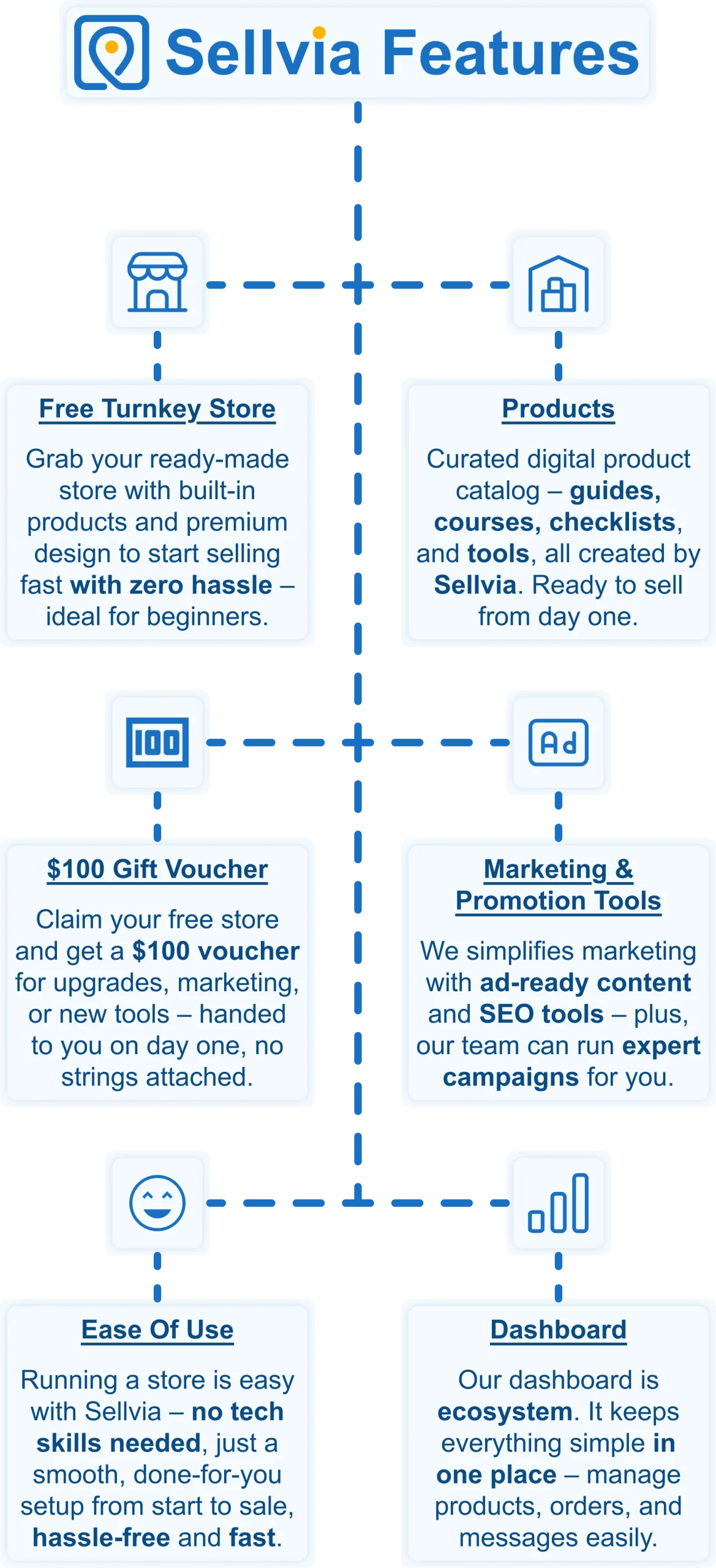
Want to start selling but don’t know where to begin? No worries! Just share your ideas, and Sellvia’s team will build a free ecommerce website that’s fully set up and ready to take orders from day one. No coding, no stress – just a store that works right out of the box.
A $100 gift voucher to grow your business faster 🎁
Starting a business takes momentum – and Sellvia gives you a head start. When you claim your free store today, you also get a $100 gift voucher to put toward growing your business. Use it to upgrade your store, boost your marketing, or unlock new tools. It is a real dollar value, handed to you on day one, with no catch and no hoops to jump through.
A massive catalog of digital products to sell 🏆
One of the biggest struggles in starting an online business is figuring out what to sell. Sellvia solves that completely. Your store comes pre-loaded with digital products – guides, courses, checklists, and tools – all created by Sellvia. You keep 50–70% of every sale. No inventory. No shipping. No logistics headaches.
Everything in one easy-to-use platform 🔥
Managing an online store shouldn’t be complicated. With Sellvia, you can handle orders, add new products, and even chat with customers – all from a simple and user-friendly platform. No need to mess with confusing tools or deal with unnecessary tech stuff. It’s all smooth sailing.
No upfront costs, just start selling 💰
A big reason people hesitate to start an online business is the cost. But here’s the good news: With Sellvia, you don’t need to invest in stock, storage, or shipping supplies. You can run your store with no upfront costs, keeping things low-risk while still making money.
Support that’s always got your back 🤝
Running a business comes with questions, but you’re never alone. Sellvia’s dedicated support team is available 24/7 to help with anything you need. Whether it’s a small question or a big challenge, they’ve got you covered.
If your 3D printing business ideas are pointing you toward physical products and niche markets, a Sellvia store is a natural next step — one that earns without tying you to a printer. Claim your free store and start building your online income today.