Most people who want to start an online business already know ecommerce is the right direction — but they get stuck on the same question: which idea is actually worth pursuing? Global ecommerce is on track to surpass $6 trillion in total sales in 2026, which means the market is large enough for new entrants at every level, whether you have $500 to invest or practically nothing at all.
Quick answer: The best ecommerce business ideas in 2026 include digital product stores, online course businesses, and niche knowledge-based stores. Digital products offer the highest margins because there is no inventory, no fulfillment cost, and no logistics to manage after setup. Your actual results depend on your niche, your consistency, and how quickly you turn early traffic into paying customers.
This guide covers 15 real ecommerce business ideas — what each one involves, why it works right now, and a realistic earning range so you can compare your options with actual data rather than vague promises. Whether you are completely new or looking to grow something part-time into a full operation, you will find a clear and honest path forward here.
Ecommerce has never been more accessible. You do not need a team, a large budget, or any technical background to build an online business that earns real income. What you need is the right idea, a clear starting point, and a platform that handles the heavy lifting for you.
What are ecommerce business ideas?
An ecommerce business idea is any model that lets you sell products or services through an online store. That covers more ground than most people initially think — from digital guides and online courses delivered instantly, to niche subscription services and knowledge-based products built around a specific audience. What every ecommerce business idea has in common is that it runs online, which means lower overhead, no physical location required, and the ability to earn from anywhere with an internet connection.
The key distinction to understand early is between product-based models — where you sell a specific type of product — and service-based models — where your store acts as a front for a skill or ongoing service. Both can work, but product-based ecommerce is easier to start and scale because you are not limited by the number of hours you can personally work. In 2026, the most popular and profitable models are digital product stores, online education businesses, and subscription-based content — all covered in detail below.
Why this works in 2026: Online consumer spending continues to grow year over year. First-time buyers are purchasing everything from budgeting tools to wellness programs — and the barrier to launching your own store has never been lower.
The 15 ideas below cover the full range — from high-margin digital product stores to subscription models and trend-driven niches. Each comes with real earning data so you can compare and choose with confidence.
How much can you realistically earn from an ecommerce business?
Earnings in ecommerce vary considerably depending on your niche, marketing approach, and how consistently you work on growing the store. That said, there are realistic benchmarks worth understanding before you commit to a model.
Digital product stores consistently deliver strong margins because there is no fulfillment cost per sale — once a product exists, each additional sale is nearly pure profit. Online courses and subscription models take more upfront effort but generate higher earnings per customer over time.
One note on ceiling figures: The top-end numbers in the table reflect sellers who treat their store like a real business — marketing consistently, testing what works, and reinvesting early profits. A realistic first-year target for a part-time beginner is $500–$2,000 per month, reachable within 60–90 days of consistent effort. Full-time income levels typically require 6–12 months of focused work to reach.
Best ecommerce business ideas in 2026
Below you will find 15 proven ecommerce business ideas organized into four categories. Each entry covers what the model involves, why it works right now, and a realistic earning range so you can compare options with actual data rather than vague promises.
Digital product niches
Digital products are the highest-margin ecommerce model available to independent sellers in 2026. When a customer purchases a digital product — a guide, a course, a checklist, or a toolkit — the product is delivered instantly with no additional cost on your end. You keep 50–70% of every sale, and the same product can be sold an unlimited number of times. These five niches carry the strongest demand right now.
Health and wellness programs
The health and wellness market is one of the most searched and most purchased categories in digital ecommerce. Workout programs, meal plans, stress management resources, sleep improvement guides, and habit-building toolkits all perform strongly because the need is ongoing — buyers return for more once they see results. Content in this niche also has strong organic discovery potential, particularly through Pinterest, YouTube, and Google search, which means traffic can grow without a large ad budget.
Earning potential: $500–$4,000/month with a focused product line and consistent social media content.
Personal finance and budgeting tools
Financial anxiety is one of the primary reasons people search for online business solutions — and it is also one of the best-performing digital product niches. Budgeting templates, savings guides, debt payoff trackers, and financial literacy resources appeal to a broad and highly motivated audience. Buyers in this niche are actively seeking solutions, which means conversion rates tend to run higher than in less urgent categories. The niche performs especially well during economic uncertainty, when searches for money management tools spike sharply.
Earning potential: $300–$3,500/month with strong keyword-driven organic traffic and a focused product catalog.
Personal development resources
Self-improvement is a perennially strong content category and an equally strong ecommerce niche. Habit trackers, goal-setting workbooks, productivity courses, confidence-building guides, and journaling templates sell consistently to an engaged audience. The niche benefits from strong word-of-mouth — buyers who get results share what worked for them, which drives organic referrals without additional ad spend. Stores in this space with a library of 15 or more well-optimized products regularly earn $1,000 or more per month from search traffic alone.
Earning potential: $200–$3,000/month with a quality product library and consistent blog or social presence.
Home and lifestyle guides
Home lifestyle content is one of the most search-driven niches in digital ecommerce. Room planning guides, interior decorating checklists, home organization systems, cleaning schedules, and home improvement tutorials all carry steady, evergreen demand. The target customer — someone redecorating, moving, or simply wanting a more organized home — often purchases multiple products in a single session, which increases your average order value without requiring additional traffic volume to achieve it.
Earning potential: $300–$3,000/month with a focused digital catalog and SEO-driven content strategy.
Family and parenting resources
Parents are among the most motivated buyers in any ecommerce category. Parenting guides, children’s activity packs, educational worksheets, family planning tools, and back-to-school resources all carry strong purchase intent. The niche also benefits from gifting behavior — grandparents, relatives, and friends regularly shop in this space — which adds a meaningful secondary customer layer on top of the core parent audience and expands your reach without additional targeting effort.
Earning potential: $400–$3,500/month for stores with strong product curation and seasonal marketing around school periods and holidays.
Online education and knowledge businesses
The global e-learning market continues to grow year after year, and independent sellers are capturing an increasing share of that revenue through their own stores. These five models let you build an online business around knowledge and practical skills — sourced through a platform like Sellvia so you never need to create the products yourself.
Online courses and training programs
Selling online courses through your own store remains one of the highest-income digital product models available in 2026. Courses covering practical, outcome-focused topics — financial planning, productivity, career skills, wellness coaching, and language learning — regularly sell between $30 and $300 per unit. The key is choosing a topic where demand is clearly documented and the course delivers a measurable outcome for the buyer. With the right product and consistent marketing, a small course catalog can generate significant monthly income.
Earning potential: $500–$6,000/month depending on course price, audience size, and marketing consistency.
Printables and planning tools
Printable products — budget planners, daily schedules, wedding checklists, business trackers, and home organization worksheets — have minimal creation costs and sell instantly with no logistics required. A single well-designed printable pack created once can generate income for years. Many sellers choose to run their own store for this rather than relying on third-party marketplaces, which gives them full control over pricing, branding, and customer data. Stores with a library of 20–50 well-optimized products regularly earn $1,000–$3,000 per month.
Earning potential: $200–$3,000/month with a quality product catalog and consistent organic search traffic.
Ebooks and how-to guides
Ebooks remain one of the most accessible digital product formats for building a profitable online store. A well-researched guide covering a topic with strong search demand — home buying, weight management, managing anxiety, starting a business, or building better habits — delivers real value to the reader and strong margins to the seller. Pricing between $10 and $50 keeps the purchase decision low-friction, and bundles of multiple guides can push average order values considerably higher without requiring new traffic to do it.
Earning potential: $200–$2,500/month with strong product descriptions and consistent keyword-targeted traffic.
Business and career templates
Professional templates — resume packs, cover letter kits, business plan frameworks, pitch deck outlines, and freelancer contract bundles — serve a buyer who is motivated, time-sensitive, and willing to pay for quality. This niche performs especially well during economic uncertainty, when more people are job-hunting or exploring self-employment for the first time. Templates also carry a high perceived value relative to their creation cost, making prices of $20–$80 per pack highly achievable with the right positioning.
Earning potential: $300–$3,500/month for stores with a focused template library targeting job seekers and first-time entrepreneurs.
Creative and hobby resources
Creative enthusiasts are highly engaged buyers who spend consistently on content that supports their interests. Knitting patterns, digital art guides, photography tutorials, craft project instructions, and music lesson resources all perform well because the buyer has strong passion-driven motivation behind every purchase. Niche stores targeting one creative category tend to build loyal repeat audiences faster than general interest stores — and loyal audiences refer others, which compounds your traffic without compounding your ad spend.
Earning potential: $200–$3,000/month for stores with a focused creative catalog and an active community presence.
Subscription and recurring income models
Subscription-based ecommerce offers one thing standard one-time-purchase stores cannot match: predictable, recurring revenue. Once a customer subscribes or signs up for a content membership, their lifetime value increases substantially compared to one-off buyers — and your monthly income becomes more stable with each new subscriber added.
Subscription-based digital content
Digital subscription services — where members receive new guides, tools, templates, or mini-courses on a regular cadence — carry a recurring revenue structure that grows more predictable over time. Niches with the highest subscriber retention include personal finance, wellness, and career development, where the need for ongoing support is built into the lifestyle. Monthly subscription pricing between $9 and $29 keeps the commitment low enough for easy signup while delivering meaningful monthly income at scale once your base grows.
Earning potential: $800–$6,000/month once a reliable subscriber base is established.
Personalized digital products
Personalization is one of the strongest differentiators in modern ecommerce. Buyers are willing to pay significantly more for digital products tailored to their specific situation — personalized budget plans, customized goal trackers, curated learning paths, and situation-specific guides all command higher prices than generic alternatives. Gift occasions — birthdays, graduations, and the new year — drive sharp seasonal traffic spikes in this category with minimal additional marketing effort required to capture them.
Earning potential: $400–$4,000/month with strong seasonal peaks around major gifting periods.
Niche community membership model
Niche community memberships — where customers pay monthly for access to exclusive digital content, a private group, and regular new resources — deliver the highest long-term customer value of any digital product model. Once you build even a modest base of 100–200 paying members, monthly revenue becomes predictable and the community itself becomes a marketing asset that attracts new members organically. The strongest niches for this model are personal finance, wellness, parenting, and creative skills development.
Earning potential: $1,000–$7,000/month once a reliable base of 100 or more paying members is established.
Trend-driven online business ideas
Some of the fastest-growing ecommerce opportunities in 2026 are built around emerging consumer trends — areas where demand is rising rapidly but the market is not yet crowded with established competitors. Getting into a trend-driven niche early is one of the fastest ways to build organic momentum without a large advertising budget.
AI tools and productivity guides
Consumer interest in AI productivity tools is accelerating across every income level and profession. Guides showing how to use AI for work, prompt libraries, AI-powered workflow templates, and step-by-step tutorials on automating daily tasks are in high demand from office workers, freelancers, and small business owners. Products in this category typically sell for $20–$60 and carry very low creation costs, making them one of the highest-margin digital niches available to new sellers in 2026.
Earning potential: $300–$4,000/month for stores targeting AI-curious professionals and self-employed buyers.
Side hustle and financial freedom guides
Guides that show people how to start a side hustle, build supplemental income, or transition from a traditional job to a home-based business are among the most searched and most purchased digital products online today. This niche aligns directly with the financial anxiety driving millions of people online every month. Stores with a focused library of practical, outcome-oriented guides in this space consistently attract high-intent buyers who are ready to invest in their own future — and who share what helped them when it works.
Earning potential: $300–$3,500/month with consistent content marketing and a targeted social media presence.
These 15 ecommerce business ideas span a wide range of commitment levels, startup costs, and income ceilings. What they all share is this: success comes from choosing one model, going deep, and marketing consistently rather than spreading attention across too many options at once.
Tips for making your ecommerce business idea actually work
Choosing the right idea is only step one. What separates online stores that generate consistent income from those that stall after a few weeks usually comes down to a small number of execution habits done consistently well.
Start narrow, then expand
A store that sells everything to everyone competes with major platforms and wins almost never. A store focused on one audience — budget-conscious families, people building their first side hustle, or beginners learning to manage money — can build a real brand, earn organic search traction, and convert visitors at a much higher rate. Start with one niche, go deep rather than wide, and expand only once you have proof of consistent sales behind you.
Build trust before you scale your budget
The single biggest conversion driver in ecommerce is social proof. Before investing heavily in paid traffic, make sure your store has real reviews, clear product descriptions, a visible refund policy, and a professional appearance throughout. A well-built store with 20 authentic reviews will consistently outperform a weak store with ten times the ad budget. Trust is what turns a visitor into a buyer — and no amount of traffic fixes a store that people do not believe in.
Focus on repeat buyers from the start
Acquiring a new customer costs significantly more than keeping an existing one. Building an email list from day one and running post-purchase follow-up sequences is one of the highest-return activities in ecommerce. Loyalty discounts, product bundles, and exclusive offers for returning customers all increase your average order value and lifetime customer value without requiring additional ad spend to generate that incremental revenue. Most stores that stall do so because they focus entirely on new traffic instead of nurturing what they already have.
Lean on automation from the start
Automation is what turns a side project into a scalable business. Platforms that handle digital product delivery, email sequences, and customer updates automatically let you focus on growth rather than daily admin. Sellvia, for example, handles digital product delivery, built-in advertising, and store management from a single dashboard — removing the manual bottlenecks that slow most beginners down and making it possible to grow without adding more hours to your week.
Track what is working and cut what is not
Most successful online stores launch with a range of products and find that a small number drive the majority of their revenue. Reviewing your analytics weekly and removing underperforming products early keeps your marketing focus sharp and your budget on what actually converts. Resist the urge to keep products listed that have received genuine traffic but no sales after 30 days — the data is telling you something worth acting on. The fastest-growing stores are not the ones with the most products; they are the ones that doubled down on what was already working.
Which ecommerce business idea is right for you?
The best ecommerce business idea for you depends on your starting budget, available time, and long-term goals. Here is a clear breakdown by reader profile to help you cut through the options and land on a starting point that actually fits your life.
Complete beginner
If you are brand new to online business and working with a limited budget, a digital product store is your best starting point. It requires no upfront investment in inventory, no technical background, and no fulfillment management. With a platform like Sellvia, your store comes pre-loaded with digital products already created for you — so your first 30 days are focused entirely on driving traffic and making sales. Your first milestone should be your first five sales, not your first $10,000 month.
Intermediate / part-time seller
If you already have some experience with online income and want to grow a part-time store into something more serious, consider adding subscription-based products or a niche knowledge library to your existing setup. At this stage, testing paid advertising with a daily budget of $10–$30 is worth exploring, and building an email list in parallel is equally important. The built-in advertising system inside Sellvia makes this stage significantly easier — targeting, creatives, and campaign optimization are all handled for you from day one.
Advanced / full-time goal
If your goal is to replace a full-time income within 12 months, treat your ecommerce business like a business from day one — not a side project you check on occasionally. That means a defined niche, a documented marketing plan, a consistent content schedule, and a reinvestment strategy for early profits. The models with the highest full-time income ceiling in 2026 are digital product stores with 50 or more products generating compounding search traffic, subscription memberships with strong retention, and online education stores with multiple course tiers serving the same core audience.
Whatever stage you are at, the principle is the same: start with the model that fits your current resources, execute it consistently for 60–90 days, and use your results to decide where to invest next. Most stores that fail do so because the owner switched models too early — not because the original idea was wrong.
Why Sellvia is a game-changer for your online store 🚀
Sellvia isn’t just another ecommerce tool. We are a trusted name in the industry, recognized by Forbes and even ranked in Inc.’s list of the 5,000 fastest-growing companies in the U.S. So if you’re serious about starting as a solopreneur, this is a smart place to begin.
Starting an online business can feel overwhelming, but that’s exactly where Sellvia steps in. It takes care of the tricky parts, so you can focus on making sales and growing your brand. Let’s break down what makes it such a great choice.
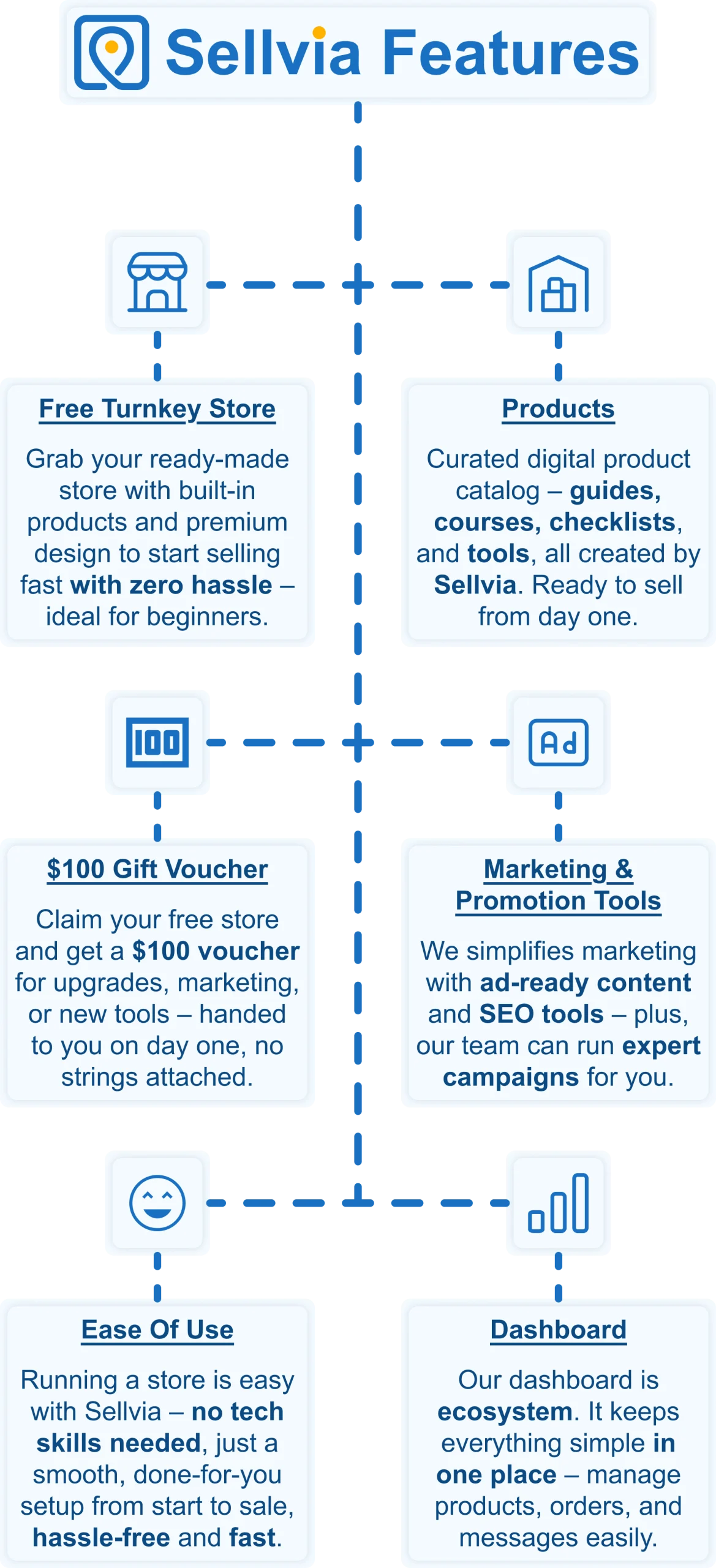
Get a ready-to-go store hassle-free 🎯
Want to start selling but don’t know where to begin? No worries! Just share your ideas, and Sellvia’s team will build a free ecommerce website that’s fully set up and ready to take orders from day one. No coding, no stress – just a store that works right out of the box.
A $100 gift voucher to grow your business faster 🎁
Starting a business takes momentum – and Sellvia gives you a head start. When you claim your free store today, you also get a $100 gift voucher to put toward growing your business. Use it to upgrade your store, boost your marketing, or unlock new tools. It is a real dollar value, handed to you on day one, with no catch and no hoops to jump through.
A massive catalog of digital products to sell 🏆
One of the biggest struggles in starting an online business is figuring out what to sell. Sellvia solves that completely. Your store comes pre-loaded with digital products – guides, courses, checklists, and tools – all created by Sellvia. You keep 50–70% of every sale. No inventory. No shipping. No logistics headaches.
Everything in one easy-to-use platform 🔥
Managing an online store shouldn’t be complicated. With Sellvia, you can handle orders, add new products, and even chat with customers – all from a simple and user-friendly platform. No need to mess with confusing tools or deal with unnecessary tech stuff. It’s all smooth sailing.
No upfront costs, just start selling 💰
A big reason people hesitate to start an online business is the cost. But here’s the good news: With Sellvia, you don’t need to invest in stock, storage, or shipping supplies. You can run your store with no upfront costs, keeping things low-risk while still making money.
Support that’s always got your back 🤝
Running a business comes with questions, but you’re never alone. Sellvia’s dedicated support team is available 24/7 to help with anything you need. Whether it’s a small question or a big challenge, they’ve got you covered.
Whatever ecommerce business idea you choose, having the right platform underneath you is what separates a store that earns from one that stalls. Claim your free Sellvia store today and start turning your best idea into real income.