



If you’ve spent any time researching how to buy an online business for beginners, you’ve probably seen these three names come up. They keep appearing in forums, comparison articles, YouTube videos, Reddit threads. And if you’re a first-time buyer trying to make sense of it all, the noise doesn’t really help.
So let’s cut through it. Here’s an honest look at how all three platforms actually work – what each one is good at, where each one falls short, and which one makes the most sense if you’re buying your first online business and would rather not spend the next three months figuring out what you got yourself into.

What you’re actually choosing between
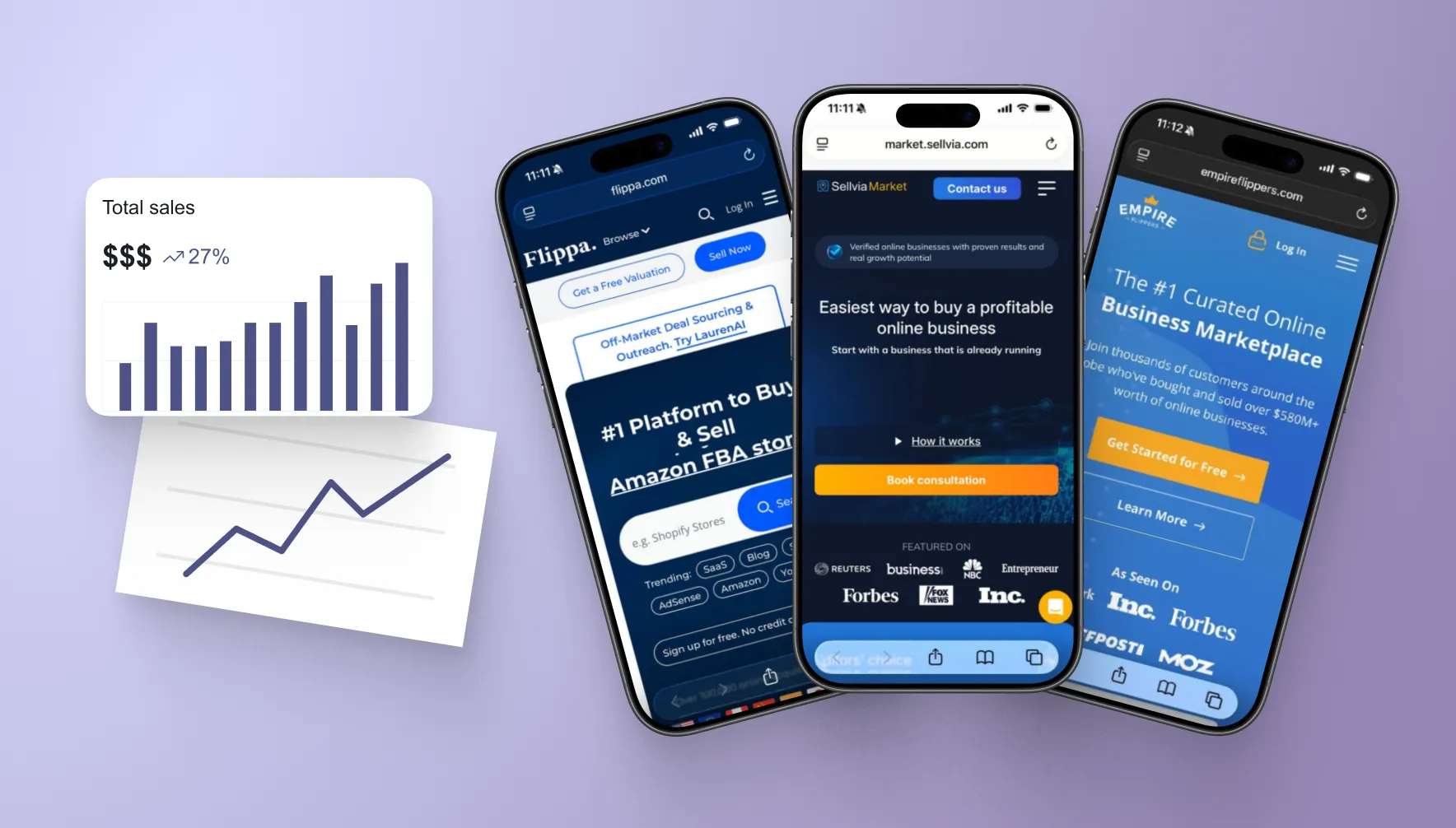
These three platforms are not the same thing. They serve different audiences, operate on different models, and have genuinely different strengths. The mistake most first-time buyers make is treating them as interchangeable – as if the only variable is which one has a lower price tag or a better-looking website.
The real question is: which one was built for someone like you?
Flippa: the open market
Flippa launched in 2009 and is, by a significant margin, the largest marketplace for buying and selling online businesses. Thousands of active listings at any given time – ecommerce stores, content sites, SaaS products, mobile apps, Amazon businesses, newsletters, domains. If it exists as a digital asset, someone has probably listed it on Flippa.
That breadth is Flippa’s biggest strength. You can browse an enormous range of businesses at almost any price point, from a few hundred dollars all the way up to seven figures. The auction format on many listings means you can sometimes pick up something undervalued if you know what you’re looking for.
Here’s the honest part, though: knowing what you’re looking for is the thing Flippa assumes you already do. The platform is largely self-service. Anyone can list a business, which means quality varies a lot. There are genuinely good deals on Flippa – experienced buyers find them regularly – but finding them requires real due diligence skills. You’re checking traffic data yourself, verifying revenue claims yourself, evaluating whether the numbers actually add up. For a first-time buyer, that learning curve is steep and the cost of a mistake is real.
Flippa has improved significantly in recent years with better verification tools and optional due diligence services. But those services cost extra, and the core marketplace is still an open one. You get access to a lot. You’re also on your own, more than the other two options.
Best for: Experienced buyers comfortable with independent research, or buyers with a low budget willing to take on more risk in exchange for more options.

Empire Flippers: the premium broker
Empire Flippers is essentially the opposite of Flippa in almost every way. It launched in 2013 as a curated marketplace and operates more like a traditional business broker than an open platform.
Every listing on Empire Flippers goes through a rigorous vetting process before it’s published. Revenue is verified, traffic is confirmed, ownership is checked. Businesses have to average at least $2,000 per month in net profit and have at least 12 months of operating history just to qualify for listing. Most of what you’ll find is in the six-figure range, and many deals run into seven figures.
The quality shows. Buyers on Empire Flippers generally report fewer surprises and more reliable data compared to open marketplaces. The platform has a dedicated migration team that handles the technical handover, and a broker manages the transaction from initial inquiry through close. It’s a genuinely professional experience.
The tradeoffs are equally real, though. The minimum price point rules out most first-time buyers. Commission fees start at 15% and scale from there. The approval process for listings can take weeks. And the audience skews toward experienced investors and private equity – not necessarily the environment a first-time buyer wants to navigate while trying to figure out how any of this works.
Best for: Experienced buyers with significant capital looking for vetted, high-value businesses and willing to pay a premium for quality and broker support.

Sellvia Market: built for ecommerce
Sellvia Market is a different kind of platform – and it’s worth being specific about why, because the differences matter for a first-time buyer.
Every store on Sellvia Market runs on the Sellvia platform. That sounds like a detail, but it is the thing that makes verification genuinely unique. Because every store uses the same dashboard, Sellvia has direct access to all performance data – revenue, orders, traffic, expenses – without needing documents from the seller or third-party audits. The numbers come directly from the store’s operating data. No other marketplace in this comparison offers that.
What makes Sellvia Market accessible
Price range and accessibility. Stores range from entry-level to established, higher-value businesses. That puts first-time buyers in the same room as real, proven businesses without requiring a six-figure budget. Most listings offer flexible installment plans, which means you can get into an earning business without paying the full amount on day one.
Immediate access. When you buy on Sellvia Market, you get access to the store right away. It’s live and operational from day one – not after a weeks-long migration process or a handover period where you’re waiting around. A dedicated growth manager is assigned within 24 hours and stays with you through the transition and beyond.
Ecommerce only – but that focus is a feature, not a limitation. Flippa lists everything from SaaS businesses to newsletters to mobile apps. Empire Flippers includes Amazon FBA, affiliate sites, content businesses, and more. Sellvia Market lists ecommerce stores. That’s the whole menu. If you want to buy a blog or a SaaS tool, this isn’t the place. But if you want an online store that sells products to real customers – which is what most first-time buyers are actually looking for – the focus means every listing is the same type of business, explained in the same way, with the same support structure behind it. There’s no learning curve specific to understanding what you bought.

Purchase protection. Every transaction is backed by a Purchase Protection Program. If the store cannot be transferred to your account, you receive a 100% refund. That kind of guarantee doesn’t exist on Flippa and isn’t part of the standard experience at Empire Flippers.
Best for: First-time buyers who want a verified ecommerce business, personal support throughout the process, immediate access, and a payment structure that doesn’t require a large lump sum upfront.
The honest comparison
Here is the part most comparison articles skip, so let’s be direct about it.
If you have $200K to invest, years of experience buying and selling online businesses, and the skills to evaluate a SaaS company or Amazon FBA operation independently – Empire Flippers is excellent and probably the right choice.
If you are a sophisticated buyer who enjoys research, understands due diligence, and wants access to the widest possible range of listings at every price point – Flippa has more raw inventory than anyone else.
But if you are buying your first online business, you want real data you can trust without having to verify it yourself, you want someone in your corner throughout the process, and you want to start earning without a months-long setup period – Sellvia Market was built for exactly that situation.
The verified data comes directly from the platform. The installment plan keeps entry accessible. The growth manager means you are not alone. And the purchase protection means you are not taking a leap of faith.

Sellvia Market is featured by Forbes and Inc., with Sitejabber ratings of 4.78, Facebook reviews at 4.9, and over 500,000 entrepreneurs helped. If the “is this legit?” question is sitting in the back of your mind — that’s the answer.