



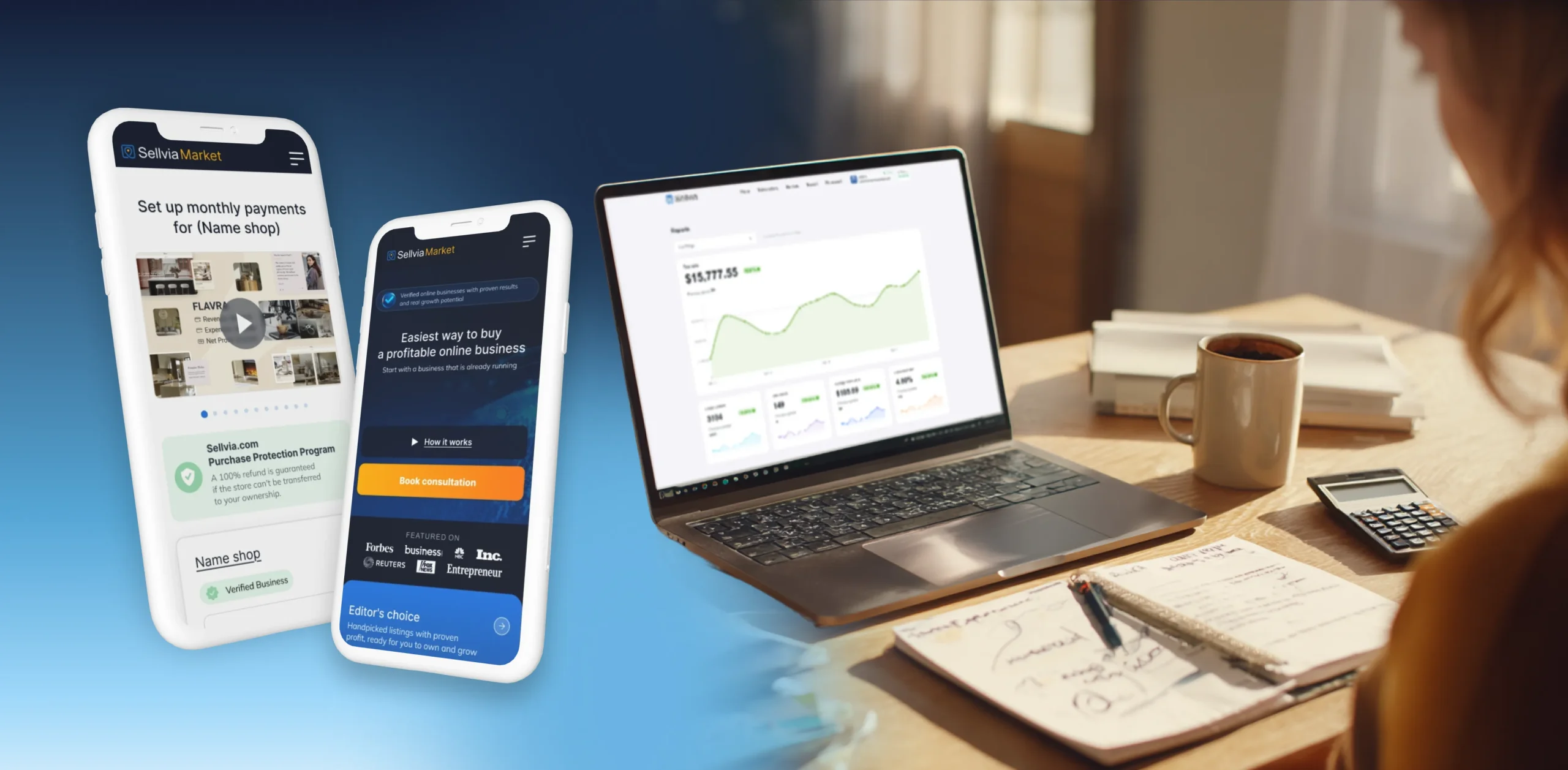
When it comes toor most beginners, the hardest part of buying an online store is the upfront price. You can be ready to work, ready to learn, excited to check dashboards, and still feel stuck because dropping a big lump sum all at once is a lot. That’s exactly why installments come up so often when people look at Sellvia Market.
If you’re planning to buy a store through Sellvia Market, an installment option can make the whole thing feel less like a giant leap and more like a series of small steps. You get access to the business faster, the entry cost feels lighter, and in many cases the store’s own monthly revenue can help cover the payments while still leaving you with profit.

In this article, we’ll break down how Sellvia Market installments actually work in real life. We’ll talk about how to buy an online business effectively with installment plan, what numbers to check before you commit, and how to think about payments so you’re not constantly dipping into your personal budget.
What installments look like at Sellvia Market
In practice, installment-based acquisition is simple: instead of paying the full store price in one hit, you split it into smaller payments and choose a timeline that feels realistic for you. Want to move fast and close it in 6 months? You can do that. Or you can stretch it to 12, 24, 36, or even 48 months if you need more breathing room.
The longer the plan, the smaller each monthly payment gets.
And the entry point is much easier too, because you only pay the first part upfront, then continue with monthly payments.
That’s the basic idea. Now here’s where it gets really good.
First, Sellvia Market doesn’t add extra fees just because you choose installments. There’s no “convenience penalty.” You’re not paying more just for wanting a schedule that fits your life.

Second, and this one is probably the most important, you get full access to the store from day one. Not a demo or a limited access. When you purchase, it’s your store: you can manage it, improve it, and start building momentum immediately.
Third, your installment payments stay fixed for the whole term you choose. Inflation happens, prices move, but your payment amount doesn’t change. And if the store’s price increases later, we won’t ask you to “catch up.”
Finally, Sellvia gives you flexibility in how you pay: from your personal card, from the store balance, or a mix of both. You can change your preferred payment method anytime. That gives you real control over the process, including how much comes from your own pocket and how much the store is effectively paying for itself.
That said, flexibility only helps if the numbers make sense. A smaller monthly payment can look comfortable at first glance, but the real question is whether your store’s actual monthly revenue can cover that payment and still leave room for profit, ads, and regular operating expenses.
And that’s exactly what we’ll break down next.
How installment length affects profit, risk, and growth
Here’s the rule of thumb we mentioned earlier: on Sellvia Market, a store’s cost is often roughly equal to 18–24 months of its current monthly profit. That means, in theory, if you split the purchase into 24 installments, you’re giving the store a realistic chance to pay for itself. If you go longer than that, you may have more room to keep part of the profit while still covering the installment plan to buy an online business.
Now, that idea is still a simplification mostly because real stores are alive, and the numbers move. Yes, you’ll have variables like ad costs, seasonality, and slower months. But there are also variables that can improve profit over time: better conversion rates, stronger product mix, repeat customers, and just plain store maturity. So it helps to think of each installment period as a strategy:

6–12 months
This option usually work best if you’re okay adding some of your own resources, especially in the beginning. They’re also a strong option if you have an aggressive growth plan. If you know what you’re doing, the store can start covering itself very quickly, sometimes within the first 1–2 months. Shorter terms are also strong if your strategy is to improve the asset and sell it later for profit.
24 months
This is the middle ground. And splitting the price into 24 parts doesn’t mean you’re doomed to zero profit the whole time. Stores tend to grow naturally over time: more age, more trust, more returning visitors. In practice, the “tight” period is often limited to the first months, not the full term.
36–48 months
This is the “play it safe” strategy, and for beginners that can be a very smart move. These longer terms lower your monthly payment, which gives you a much better chance that the store can cover installments from day one. Just as important, they let you learn the business without panic. You get time to study how the store behaves, understand its traffic patterns, see what products move well, test ideas carefully, and build confidence before making big changes.
And there’s yet another benefit: if you keep the store for 36–48 months, by the end of that period it’s usually a very different asset from the one you bought. It’s older, more mature, more stable, and typically more predictable.
Example: what different installment terms look like on a real store
Now let’s make this practical, because numbers are where things get real.

Take Cornellio.com: a lifestyle-oriented store with a strong mid-tier profile and over $92,500 in annual revenue. It has good “everyday niche” appeal, solid earning history, and the kind of store a beginner can actually imagine running. Let’s say you like the niche, like the vibe, and decide to move forward.
Now the question becomes: how do you want to structure the deal?
This is exactly where people start comparing options and figuring out how to use an installment plan to buy an online business in a way that matches their budget, risk tolerance, and goals.
Option 1: fast, but demanding

If you choose a 12-month term, your upfront payment and each following monthly payment would be $6,728.
That’s a serious monthly commitment. With the current listed annual net profit of $50,036, the store’s average monthly profit is roughly $4,170, so there’s a decent chance you’ll need to add some of your own money to cover the gap, especially early on.
But that doesn’t automatically make this a bad choice.
If your plan is to actively grow the store, then this path can still make a lot of sense. A shorter plan puts more pressure on you, but it also pushes you to move faster.
Option 2: balanced and very practical
Now let’s look at 24 months. Your payment drops to $3,364 per month.
That changes the picture quite a bit.
At this level, the installment amount fits comfortably within the store’s current monthly profit range, so you likely won’t need to add personal funds just to keep up with payments. You still need to manage the business properly, of course, but the numbers are much less stressful from day one.
This is why 24 months often feels like the middle ground: enough speed to finish in a reasonable timeframe, but enough breathing room to operate like a sane person.
There’s also a long-term asset angle here. By the end of a 24-month plan, Cornellio.com would be 39 months old. That’s a respectable age for an online store and a strong signal of resilience and consistency.
Option 3: stable, lower pressure, beginner-friendly
If you choose the longest term, 48 months, the payment becomes $1,682 per month.
Still real money, obviously, but much more manageable.

At that level, Cornellio.com’s current profit can not only cover the installment, but also leave room for additional income. In other words, you’re keeping a cash cushion and giving yourself space to learn the store without constantly worrying about next month’s bill. That’s a big deal, especially if you’re new.
So, which path is “best”?
The answer depends on your style.
If you’re confident, hands-on, and ready to push aggressive growth, a shorter term may be worth it. t a balanced mix of speed and stability, 24 months is hard to beat. If you prefer lower stress, safer margins, and a smoother learning curve, 48 months is a very smart play.
There’s no gold star for choosing the hardest option. The best installment plan to buy an online business is the one you can sustain and use well.
Who this model is for
Before we wrap this up, let’s talk about the real-world upside of installments and the stuff you should keep an eye on so this stays a smart move.
First, this model is a great fit for people who don’t want to drop a huge amount of money upfront and would rather enter the market carefully. And as we saw earlier, if you choose one of the safer terms (especially 24–48 months), even a mid-tier store can often cover the payment from day one or close to it. You pay the first portion, then the next ones are realistically covered by the store while still leaving you some income. Will that income feel life-changing in month one? Maybe not. But compared to parking your money in a savings account and hoping for the best, you’re holding a real business with actual growth potential.
Second, installments are excellent for people who want to learn at their own pace. Buying a store on Sellvia Market is a bit like starting college: yes, you spend some money upfront, but then you’re learning while the system helps carry part of the load. The funny part is, a store can be even better than a scholarship, because you can improve it. You can’t optimize a scholarship with better product pages, smarter ads, or Sellvia marketing services. But you can do that with a store. That’s why, for many beginners, an installment plan to buy an online business is a great way to create a lower-stress learning curve while still building something that belongs to you.
Third, this model also makes sense for people who don’t want a “project” that eats their entire week. Some buyers want a business they can actively scale. Others want something quieter: a stable income source they check in the browser every evening. That’s also valid. If you choose a longer term and the store is automated enough, you can often treat it as a relatively calm asset: monitor performance, make small adjustments, collect profit, repeat.

What should you be aware of?
Mainly this: don’t choose an installment term based on ambition alone. Choose it based on your cash flow, risk tolerance, and how much time you can realistically give the store. A shorter term can be powerful, but only if you’re ready for the pressure. Also, don’t assume every month will look the same. Some months will dip. Keep a small reserve, track profit, and review your numbers monthly.
So who is this model for? Beginners who want a safer entry point. Learners who want room to grow. Busy people who prefer stability. And ambitious operators who want leverage instead of delay.
At the end of the day, buying an online business on an installment plan can be one of the most practical ways to start. We covered how the model works, how different installment lengths affect profit and risk, and what the numbers can look like in a real example.
Now the next step is simple: browse Sellvia Market listings, compare stores you actually like, and choose a payment strategy that fits your pace.