The global digital content market is on track to surpass $1 trillion by 2030. That is not a typo. And the best part? You do not need a warehouse, a shipping department, or a big budget to get a piece of it. If you have been looking for a real way to earn money online, digital products to sell are one of the most accessible opportunities available right now.
Unlike physical goods, digital products cost almost nothing to deliver. You sell a guide, a course, a checklist, or an online tool, and it lands in your customer’s inbox instantly. No packing. No postage. No returns headache. The profit margins are high, the setup is simple, and the demand keeps growing year after year.
Quick Answer: The best digital products to sell online in 2026 include guides, courses, checklists, and tools in high-demand niches like wellness, financial education, parenting, and AI. These products can be sold with no inventory, no shipping, and margins of 50–70% or more per sale.
This guide covers everything you need: what digital products actually are, which niches are performing best right now, how much you can realistically earn, and how to start selling without any prior experience. Whether you are exploring this for the first time or looking to level up an existing side hustle, there is a lot here to work with.
What are digital products – and why sell them?
A digital product is anything intangible that is delivered and consumed online. Think downloadable guides, video courses, templates, checklists, and tools. There is no physical stock, no packing materials, no delivery driver. Just a file or an access link that goes straight to the buyer the moment they pay.
What makes digital products to sell genuinely attractive is the combination of low overhead and high scalability. You – or a platform like Sellvia – creates a product once, and it can be sold to ten people or ten thousand without any extra production cost. That kind of leverage is almost impossible to replicate with physical goods.
The profit margins reflect this well. Most digital product businesses operate at 50–70% margins or higher, compared to the thinner margins typical of physical retail. Add instant global delivery and no fulfillment headaches, and it is easy to understand why so many people are moving into this space in 2026.
How much can you realistically earn?
This is the question everyone asks first, and it deserves an honest answer. Earnings from digital products online vary a lot depending on how much effort you put in, which niche you choose, and how you drive traffic. The table below gives you a realistic snapshot across three common approaches.
These ranges are realistic for people who stay consistent and treat this like a real business. Most new store owners see their first sales within the first week of activating ads – but reaching four-figure monthly income typically takes 60–90 days of steady effort.
One note on ceiling figures: The upper ranges assume full-time effort, a well-chosen niche, and consistent use of a paid traffic strategy. Start with realistic expectations and build from there.
The best digital products to sell right now
Not every niche performs equally well. The categories below are consistently among the strongest performers for people selling digital products online in 2026 – whether you are just starting out or looking to expand an existing store.
Wellness and mindset
Wellness is one of the most consistent top performers in the entire digital product space. People are always searching for ways to feel better, think more clearly, and build better habits – and they are willing to pay for practical, well-packaged guidance to help them do it.
What sells well
Meditation guides, stress management workbooks, habit-tracking templates, journaling prompts, sleep improvement guides, and fitness plans all perform strongly here. These products attract motivated buyers and work well as both one-time purchases and content subscriptions.
Earning potential: $400–$1,500/month with consistent traffic to a well-stocked wellness store.
Financial education
Financial education is one of the highest-value categories in the digital product world, because the perceived value of the content is enormous. People invest seriously in anything that promises to improve their financial situation – and they will pay premium prices for it.
What sells well
Budgeting templates, investment starter guides, savings challenge workbooks, debt payoff planners, and financial literacy courses all convert well here. If you are thinking about how to sell digital products in a high-ticket niche, financial education is one of the strongest starting points available.
Earning potential: $600–$2,500/month for stores with strong financial education content.
Why this works in 2026: Economic uncertainty keeps financial anxiety high, which means demand for practical money guidance never really dips. Buyers in this niche are motivated and willing to pay for quality.
Parenting and family
Parents are some of the most emotionally motivated buyers online. They want to do right by their kids, they are actively searching for guidance, and they respond extremely well to practical, actionable content that fits into a busy family life.
What sells well
Child development milestone trackers, educational activity packs, kids’ safety checklists, parenting guides, screen time management tools, and family organization systems all perform well in this niche.
Earning potential: $300–$1,200/month for a parenting-focused digital product store with steady traffic.
Home and lifestyle
Home and lifestyle products tend to fly under the radar, but they perform remarkably well – especially on visual platforms like Pinterest and Instagram where well-designed content drives a significant share of purchasing decisions.
What sells well
Decluttering checklists, room design guides, interior mood boards, plant care guides, moving-day planners, and home management systems are all strong sellers. These are practical tools that people use immediately after purchase, which leads to strong reviews and repeat buyers.
Earning potential: $250–$900/month for a home-focused digital product store.
Travel and adventure
Travel buyers are planners by nature. They actively search for tools that help them organize and get more from their experiences – which makes them some of the best customers for well-crafted digital products to sell.
What sells well
Destination guides, packing list templates, travel budget planners, road trip itineraries, city-specific travel workbooks, and AI-powered packing guides all sell consistently in this niche. Travel content also performs very well on Pinterest and Instagram, giving you natural marketing channels.
Earning potential: $300–$1,000/month for a travel-focused digital store with active social promotion.
AI and technology
This is one of the fastest-growing niches for digital products online right now. Curiosity about AI is at an all-time high, and people are actively willing to pay for practical guidance on how to use it in their everyday lives and businesses.
What sells well
AI prompt packs, beginner guides to AI tools, AI-powered business guides, tech setup tutorials, and smart home planning resources are all strong performers. Buyers in this niche are forward-thinking and tend to have slightly higher spending power.
Earning potential: $400–$1,800/month for a well-positioned AI and technology digital store.
Why this works in 2026: AI adoption is accelerating across every industry, but most people still do not know where to start. Practical, accessible guides fill a real gap in the market.
Hobbies and creative skills
Hobby buyers are enthusiastic, loyal, and genuinely willing to spend on content that helps them do what they love better. Because hobby communities tend to share recommendations freely, word-of-mouth can be a surprisingly effective distribution channel for digital products in this category.
What sells well
Pattern downloads, skill-building guides, project planners, tutorial collections, beginner instrument guides, and creative challenge workbooks all convert well. The breadth of this category is actually an advantage – almost any interest can be served with the right digital product.
Earning potential: $200–$800/month for a hobby-focused digital product store with an active niche audience.
Where to sell your digital products
Choosing where to list your digital products to sell matters as much as what you sell. Each platform has its own audience, fee structure, and traffic patterns. Here is a quick overview of the main options.
If you are just starting out, owning your own store is the strongest long-term play. You keep more of your earnings, you are not subject to platform rule changes, and you can build a real brand rather than just a listing inside someone else’s marketplace.
How to actually market your digital products and get sales
Having great products is only half the equation. You also need people to find them. Here is what works consistently for selling digital products online in 2026.
Use a built-in advertising system
The biggest barrier most new sellers face is not the product – it is getting traffic. Running your own ads from scratch on Google or Facebook requires time, expertise, and a lot of trial and error. Sellvia removes this entirely with a fully built-in advertising system. You set a daily budget between $10 and $50, turn it on, and Sellvia handles the targeting, the creatives, and the optimization. Most people who activate ads see their first orders on the same day.
Use Pinterest and Instagram for organic reach
Visual platforms are excellent free traffic sources for digital products in niches like home, travel, wellness, and hobbies. Create clean, eye-catching pins or posts that showcase the value of your product, and link directly to your store. Pinterest in particular has strong long-tail discovery – a single well-optimized pin can drive traffic for months.
Build an email list from day one
An email list is one of the most valuable things you can build as a digital product seller. Offer a free checklist or mini guide in exchange for an email address, then follow up with your paid products. Email consistently outperforms social media for conversion rates, and it is an audience you own outright.
Let your customers do some of the talking
Reviews and testimonials drive purchasing decisions more than almost anything else. After each sale, follow up and ask for a quick review. Even three or four genuine positive reviews on a product page can significantly lift your conversion rate. Buyers want social proof before spending money on something they cannot physically hold.
Common mistakes worth avoiding
A few missteps trip up almost every new digital product seller. Knowing them in advance puts you a step ahead.
Choosing the wrong niche
Many first-timers chase the trendiest category instead of one that matches real, proven demand. Before you invest time in any niche, use Google Trends or search volume tools to confirm people are actively looking for that type of content. If you are selling through Sellvia, this research is already done for you – the catalog is built around niches with documented demand.
Underpricing out of fear
Digital product buyers associate price with quality. If your guide is priced at $3, it signals to the buyer that it is probably not worth much. Most well-positioned digital guides sell at $15–$50 without resistance, especially in high-value niches like financial education and AI. Price your products to reflect the transformation or result they deliver.
Waiting until everything is perfect
Perfectionism is the most common reason people never launch. Your first store does not need to be flawless – it needs to be live. You learn far more from real customer behavior than from endless preparation. The people who succeed with digital products are the ones who start, then improve as they go.
Relying on a single traffic source
If all your traffic comes from one place – say, a single social media platform – you are one algorithm change away from losing it all. Build redundancy early: combine paid ads with at least one organic channel, and start building your email list from the moment your first visitor lands on your store.
Which approach is right for you
The best way to sell digital products depends entirely on where you are starting from. Here is a straightforward breakdown by experience level.
Complete beginner
If you have never run an online business before, the priority is simplicity. You want a ready-made store with products already loaded, so you can focus on learning how to drive traffic rather than figuring out product creation and technical setup at the same time. Sellvia is built specifically for this scenario – your store is set up for you, the digital products are already in your catalog, and the ad system handles the marketing side.
Intermediate – building a side income
If you already have some experience online and are looking to add a scalable income stream, digital products give you high margins without the inventory and fulfillment challenges of physical goods. Focus on a niche you understand, build your email list consistently, and use paid traffic to accelerate growth once you have found products that convert.
Full-time goal
If your goal is a full-time online income, the path is clear: own your store, diversify across at least two or three niches, use a combination of paid ads and organic content, and prioritize your email list above everything else. The digital product market is only growing – $1 trillion by 2030 is a lot of runway for anyone willing to build something real.
Why Sellvia is a game-changer for your online store 🚀
Sellvia isn’t just another ecommerce tool. We are a trusted name in the industry, recognized by Forbes and even ranked in Inc.’s list of the 5,000 fastest-growing companies in the U.S. So if you’re serious about starting as a solopreneur, this is a smart place to begin.
Starting an online business can feel overwhelming, but that’s exactly where Sellvia steps in. It takes care of the tricky parts, so you can focus on making sales and growing your brand. Let’s break down what makes it such a great choice.
Get a ready-to-go store hassle-free 🎯
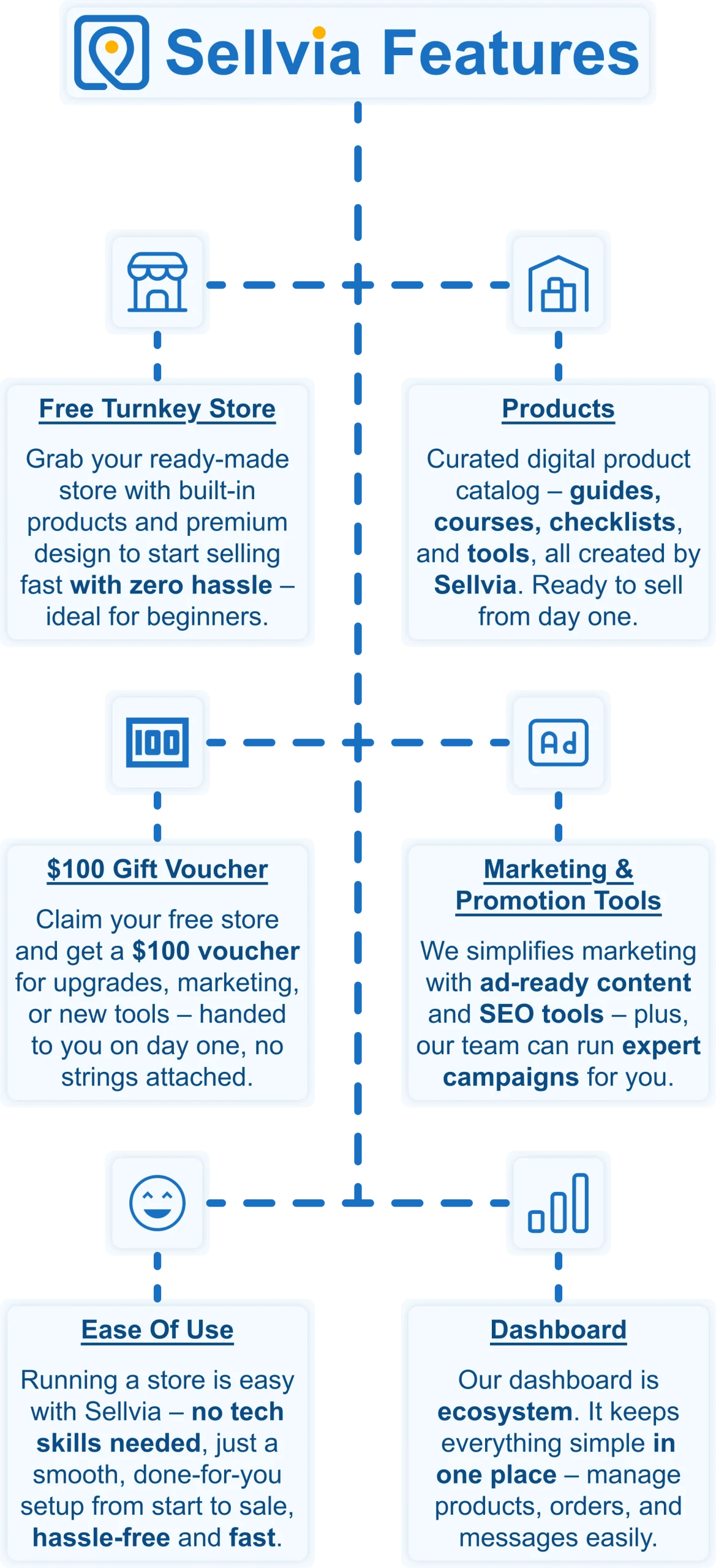
Want to start selling but don’t know where to begin? No worries! Just share your ideas, and Sellvia’s team will build a free ecommerce website that’s fully set up and ready to take orders from day one. No coding, no stress – just a store that works right out of the box.
A $100 gift voucher to grow your business faster 🎁
Starting a business takes momentum – and Sellvia gives you a head start. When you claim your free store today, you also get a $100 gift voucher to put toward growing your business. Use it to upgrade your store, boost your marketing, or unlock new tools. It is a real dollar value, handed to you on day one, with no catch and no hoops to jump through.
A massive catalog of digital products to sell 🏆
One of the biggest struggles in starting an online business is figuring out what to sell. Sellvia solves that completely. Your store comes pre-loaded with digital products – guides, courses, checklists, and tools – all created by Sellvia. You keep 50–70% of every sale. No inventory. No shipping. No logistics headaches.
Everything in one easy-to-use platform 🔥
Managing an online store shouldn’t be complicated. With Sellvia, you can handle orders, add new products, and even chat with customers – all from a simple and user-friendly platform. No need to mess with confusing tools or deal with unnecessary tech stuff. It’s all smooth sailing.
No upfront costs, just start selling 💰
A big reason people hesitate to start an online business is the cost. But here’s the good news: With Sellvia, you don’t need to invest in stock, storage, or shipping supplies. You can run your store with no upfront costs, keeping things low-risk while still making money.
Support that’s always got your back 🤝
Running a business comes with questions, but you’re never alone. Sellvia’s dedicated support team is available 24/7 to help with anything you need. Whether it’s a small question or a big challenge, they’ve got you covered.
The demand for digital products online is only growing – and with Sellvia, you do not need to create a single thing to start selling them. Claim your free store today and see your first sales sooner than you think.
What are the best digital products to sell online in 2026?
How do you sell digital products with no experience?
Selling digital products with no experience is genuinely accessible in 2026 thanks to platforms that handle the technical setup for you. Sellvia builds your store from scratch, loads it with digital products across proven niches, and provides a built-in advertising system so you do not need to set up your own ads. Most new sellers see their first orders within the first few days of activating the ad system. No coding skills, no prior business experience, and no product creation are required to get started.
How much can you earn selling digital products online?
Earnings from selling digital products online vary based on effort, niche choice, and traffic strategy. Part-time sellers typically earn between 200 and 800 dollars per month, while those running a full store consistently can reach 1,000 to 3,000 dollars per month. Sellers who scale with paid ads and multiple niches have reported earning 3,000 to 8,000 dollars or more per month. Most new store owners reach consistent income within 60 to 90 days of staying active.
What digital products to sell to make the most profit?
The most profitable digital products to sell tend to be in high-value niches where buyers associate the content with a meaningful result. Financial education, AI and technology guides, and wellness products consistently deliver strong margins because buyers in these categories are motivated and willing to invest in quality content. Sellvia store owners keep 50 to 70 percent of every sale, and because there is no inventory or shipping, almost all of that goes directly to profit. Choosing a niche with proven search demand rather than chasing trends is one of the most reliable ways to maximize earnings.
Do you need to create digital products to sell them?
No, you do not need to create digital products yourself to sell them. Platforms like Sellvia provide a ready-made catalog of digital products including guides, courses, checklists, and tools, all produced by their in-house team. You sell the products through your own store and keep 50 to 70 percent of every sale. This model means you can focus entirely on driving traffic and growing your income rather than spending months on product creation.