Most online stores do not fail because the products are bad. They fail because nobody finds them. That is the core problem ecommerce marketing solves – and in 2026, getting it right has never been more important or more accessible for people starting an online business from scratch.
Whether you are launching your first store or trying to grow an existing one, having a clear ecommerce marketing strategy is what separates stores that grow from stores that stall. This guide covers the main channels, how much effort each one realistically requires, and how to build a system that builds momentum over time.
Quick answer: Ecommerce marketing is the process of driving traffic, converting visitors, and bringing customers back to an online store. The most effective approach in 2026 combines ecommerce SEO, social media marketing, email automation, and paid advertising – each reinforcing the others.
Before diving into individual channels, it helps to understand why a strategy-first mindset matters. Most new store owners pick one or two tactics at random, get inconsistent results, and give up. A structured approach to digital marketing for ecommerce means every channel you add strengthens the ones already working.
What is ecommerce marketing?
Ecommerce marketing is the full set of activities used to attract people to an online store, turn them into buyers, and bring them back for more. It covers everything from how your store shows up on Google to how you follow up with someone who added a product to their cart and walked away.
Unlike traditional retail, ecommerce marketing is almost entirely measurable. Every click, email open, and organic visit can be tracked – which means you can cut what is not working and double down on what is. That data-driven loop is one of the biggest advantages independent online store owners have in 2026.
Ecommerce marketing also means competing in a world where consumer attention is spread across more platforms than ever. TikTok, Instagram Reels, Google Shopping, Pinterest, and YouTube all serve as discovery channels for products and digital content. The stores that win are not necessarily spending the most – they are showing up consistently in the right places with the right message.
How much can you realistically earn from a well-marketed online store?
This is one of the most commonly asked questions around ecommerce – and one worth answering honestly. Results vary significantly depending on niche, channel mix, and how consistently you show up. Here is a realistic breakdown by approach:
These figures represent realistic ranges for stores that are actively working a strategy – not hands-off results. Paid advertising can move faster but requires budget. SEO and email take 60–90 days to build momentum but compound in value over time. Most stores earning $3,000–$8,000 per month are running at least three of these channels at once.
One note on ceiling figures: The upper ranges above reflect stores with optimized funnels, tested creatives, and established audiences. A brand-new store in its first 90 days should set realistic expectations of $500–$1,500 per month while building its foundation.
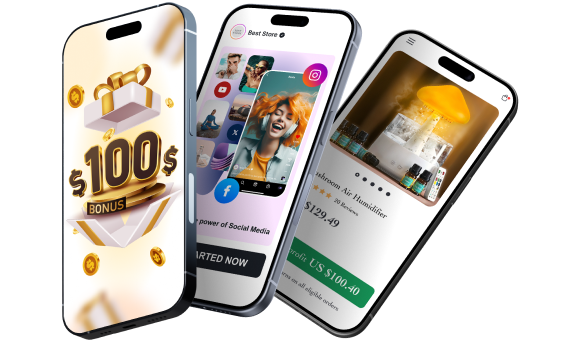
The good news is that you do not need to master every channel before you can start earning. Sellvia’s built-in advertising system handles targeting, creatives, and optimization for you – so you can focus on the business side while the platform handles the marketing heavy lifting.
The core ecommerce marketing channels explained
A solid online store marketing plan does not require mastering every channel at once. Start with one or two, build systems, and expand from there. Here is what each channel involves and what you can realistically expect from it in 2026.
Search engine optimization for ecommerce
Ecommerce SEO is the process of optimizing your store so it appears in organic search results when people look for products or information related to your niche. It is one of the highest-return channels over the long term because traffic does not stop the moment you stop paying for it.
On-page SEO
On-page SEO for online stores covers product titles, meta descriptions, image alt text, and URL structures. Each product page should target a specific keyword phrase that reflects how real customers search – for example, “lightweight waterproof backpack for travel” rather than just “backpack.” Use your primary keyword naturally in the first 100 words of each product description, and avoid duplicating content across similar product variants.
Earning potential: $500–$3,000 per month from organic product page traffic alone, within 4–6 months of consistent optimization.
Content marketing and blogging
Publishing helpful blog content is one of the most underused tools in ecommerce marketing. A blog lets you rank for informational keywords – “best gifts for runners,” “how to choose a standing desk” – that attract buyers earlier in their research phase. These readers are warmer than cold ad traffic because they arrived looking for help, not just a deal.
Aim for at least two well-researched posts per month targeting mid-funnel keywords in your niche. Internal links from blog posts to product pages also help build your store’s authority over time.
Why this works in 2026: Google continues to reward depth and genuine usefulness over keyword stuffing. Stores with strong content libraries are increasingly outranking pure product pages in competitive niches.
Technical SEO basics
Technical SEO covers the behind-the-scenes factors that affect how search engines crawl and index your store – page speed, mobile responsiveness, structured data, and clean URL architecture. A store that loads in under 2 seconds on mobile has a measurable advantage over a slower competitor. Use Google Search Console to monitor crawl errors and PageSpeed Insights to identify load time issues.
Important note: Most beginners skip technical SEO entirely and wonder why their content is not ranking. Even small fixes – compressing images, enabling caching, removing broken links – can produce noticeable improvements within 30 days.
Social media marketing for ecommerce
Social media marketing for ecommerce in 2026 means far more than posting product photos. The platforms that drive the most store revenue – TikTok, Instagram, Pinterest, and Facebook – each have distinct content formats, audience behaviors, and advertising ecosystems worth understanding before you invest time in any one of them.
TikTok and short-form video
TikTok has become one of the most powerful product discovery platforms available to independent store owners. Short-form video showing products in real use – unboxings, before-and-after demos, problem-solution formats – consistently outperforms static image ads for conversion. Stores in home, beauty, fashion, and digital product niches are particularly well-positioned here.
You do not need a professional studio. Authentic, lo-fi content filmed on a smartphone regularly outperforms polished creative because it feels native to the platform. Aim for 3–5 videos per week during the growth phase, and use TikTok’s built-in analytics to identify which hooks drive the most profile visits.
Earning potential: $300–$2,500 per month in attributable store revenue from organic TikTok alone, scaling faster once you find a format that resonates.
Instagram and Pinterest
Instagram remains a strong channel for lifestyle and visual product niches. Reels get the widest organic reach, but Stories and product tags in feed posts drive direct click-throughs to your store. Pinterest is particularly valuable for evergreen product categories – home décor, wellness, food, personal finance – where content continues to drive traffic for months or even years after posting.
For both platforms, consistency beats volume. Posting three times a week with strong visual branding and keyword-optimized captions will outperform posting daily with inconsistent quality.
Facebook and community-based marketing
Facebook Groups remain a surprisingly effective organic marketing channel for niche stores. Building or participating in communities around your product category – parenting, fitness, personal finance, home improvement – lets you establish authority and introduce your store to engaged, targeted audiences without ad spend. Facebook Marketplace is also an underused channel for store owners looking for local or national visibility at zero cost.
Email marketing for ecommerce
Email marketing consistently delivers among the highest return of any digital marketing for ecommerce channel. The reason is simple: you own your email list. Unlike social media followers or ad audiences, your list cannot be taken away by an algorithm change or a platform policy update.
Automated flows that drive revenue
The three email automations every online store needs are: a welcome series (3–5 emails introducing your brand and best sellers), an abandoned cart sequence (2–3 emails recovering lost purchases), and a post-purchase flow (thank you, review request, cross-sell). These three flows alone can recover 10–15% of would-be lost revenue with minimal ongoing effort once they are live.
Earning potential: $500–$3,000 per month from automated email flows in a store with a list of 1,000–5,000 subscribers.
Broadcast campaigns and segmentation
Beyond automations, regular broadcast emails – product launches, seasonal promotions, curated roundups – keep your audience engaged and buying. Segmenting your list by purchase history or browsing behavior means you can send relevant offers rather than generic blasts, which significantly improves open rates and reduces unsubscribes. Most email platforms offer ecommerce-specific segmentation tools built for exactly this purpose.
Paid advertising for ecommerce
Paid advertising is the fastest way to generate traffic to a new store – but also the easiest way to burn through a budget without a clear strategy. The two dominant paid channels for ecommerce are Google Shopping ads and Meta (Facebook and Instagram) ads, each with a distinct role in the marketing funnel.
Google Shopping ads
Google Shopping campaigns place your products directly in front of people who are actively searching to buy. Because the intent is already there, conversion rates are typically higher than social ads – often 2–4% versus 0.5–1.5% for cold social traffic. The tradeoff is cost: competitive niches can have cost-per-click rates of $1–$4, so having a solid average order value and healthy margin is essential before scaling.
Important note: Google Shopping requires a well-optimized product feed through Google Merchant Center. Errors in your feed – missing product identifiers, vague titles, policy violations – will limit your ad visibility significantly.
Meta ads and retargeting
Meta ads – across Facebook and Instagram – excel at top-of-funnel awareness and retargeting. Cold audiences respond well to video creative and problem-solution angles, while warm retargeting audiences (site visitors, cart abandoners, past buyers) can be served with direct-response ads at significantly lower cost per purchase. Even a modest retargeting budget of $5–$10 per day can recover meaningful revenue from visitors who did not convert on their first visit.
Influencer marketing and user-generated content
Influencer marketing has matured considerably. In 2026, micro-influencers – creators with 5,000–50,000 followers in a specific niche – consistently outperform mega-influencers for ecommerce conversion because their audiences are more engaged and their recommendations feel more genuine.
Finding the right influencers
Start by searching hashtags related to your product niche on Instagram and TikTok. Look for creators whose content style matches your store, whose engagement rate (likes plus comments divided by followers) is above 3%, and who have a history of sharing product recommendations. Reach out directly with a brief, personalized message offering your product in exchange for an honest review. Many micro-influencers at this level work on a gifting-only basis, making it one of the most cost-effective channels available to new store owners.
Earning potential: $500–$4,000 per month in attributable revenue from a consistent micro-influencer gifting program with 5–10 active partners.
User-generated content as a marketing asset
Every piece of genuine customer content – a review photo, an unboxing video, a tagged Story – is a marketing asset. Encourage user content by including a card in packaging asking customers to share their purchase with a branded hashtag, and offer a small discount on their next order in exchange. Reposting this content on your own channels builds social proof while cutting your content creation workload.
Legal and ethical considerations in ecommerce marketing
As online advertising regulation tightens, understanding the legal boundaries of ecommerce marketing is no longer optional. The following areas carry real risk for store owners who cut corners.
Key principle: Transparency builds long-term customer trust and protects you from regulatory action – always disclose paid partnerships, honor refund policies, and represent your products accurately.
Here are the four areas every store owner needs to understand:
- FTC disclosure rules: In the US, any paid promotion or gifted product review must be clearly disclosed. Influencers must state when content is sponsored or when they received a free product. Failure to disclose is an FTC violation that can result in fines for both the brand and the creator.
- Email marketing compliance: All marketing emails must include a clear unsubscribe option and your business mailing address under CAN-SPAM (US) and GDPR (EU). Never add people to your list without explicit opt-in consent.
- Fake reviews: Posting fake reviews on your own products – or paying for them – violates platform terms of service and, in many jurisdictions, consumer protection laws. Focus on generating genuine reviews through post-purchase email flows instead.
- Ad creative accuracy: Your ads must accurately represent your products. Misleading before-and-after claims, false scarcity tactics, and exaggerated results all violate Meta and Google advertising policies and can get your account suspended.
How to choose your ecommerce marketing strategy by experience level
Not every channel makes sense at every stage. Here is an honest breakdown of where to focus depending on where you are right now.
Complete beginner
If you are launching your first store and have a limited budget, start with organic social – specifically TikTok or Instagram Reels – combined with basic on-page SEO for your product pages. These two channels cost nothing to start, build skills that compound over time, and give you real audience feedback on your products before you spend on ads. Set up your abandoned cart email automation from day one – it is a one-time setup that recovers revenue from people who were close to buying.
Intermediate / part-time seller
If you have an existing store generating some revenue – $500–$2,000 per month – and you are ready to accelerate, add a content marketing blog targeting mid-funnel keywords in your niche, and launch small retargeting campaigns ($5–$10 per day) to capture visitors who did not convert. At this stage, start segmenting your email list and expanding your automated flows beyond the basics.
Advanced / full-time goal
If your goal is a full-time income – $5,000 or more per month – you need all five channels working in coordination: SEO-driven content feeding organic traffic, social media maintaining brand awareness, email retaining and monetizing your existing customers, paid ads scaling your best-performing products, and an influencer program generating ongoing user content. At this level, the biggest lever is usually improving your conversion rate rather than adding more traffic – a 1% improvement in your store’s conversion rate is worth more than doubling your ad spend.
Store owner with a product focus
If you already know your winning products and want to double down on what is working, Google Shopping is your fastest path to scalable, intent-based traffic. Combine it with a strong email list to reduce your dependence on paid channels over time. Pinterest is also worth adding for evergreen digital product categories – content posted today can still drive traffic two years from now.
Why Sellvia is a game-changer for your online store 🚀
Sellvia isn’t just another ecommerce tool. We are a trusted name in the industry, recognized by Forbes and even ranked in Inc.’s list of the 5,000 fastest-growing companies in the U.S. So if you’re serious about starting as a solopreneur, this is a smart place to begin.
Starting an online business can feel overwhelming, but that’s exactly where Sellvia steps in. It takes care of the tricky parts, so you can focus on making sales and growing your brand. Let’s break down what makes it such a great choice.
Get a ready-to-go store hassle-free 🎯
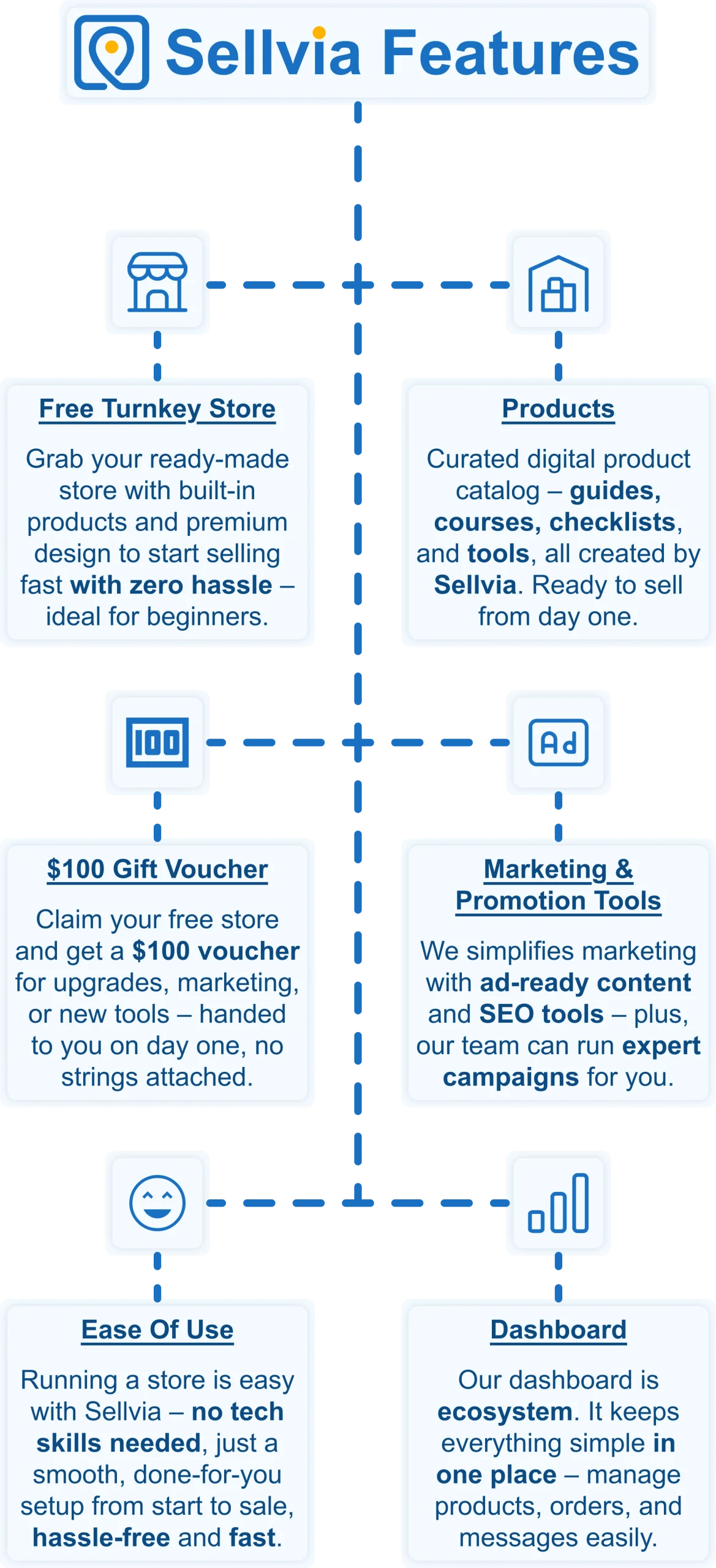
Want to start selling but don’t know where to begin? No worries! Just share your ideas, and Sellvia’s team will build a free ecommerce website that’s fully set up and ready to take orders from day one. No coding, no stress – just a store that works right out of the box.
A $100 gift voucher to grow your business faster 🎁
Starting a business takes momentum – and Sellvia gives you a head start. When you claim your free store today, you also get a $100 gift voucher to put toward growing your business. Use it to upgrade your store, boost your marketing, or unlock new tools. It is a real dollar value, handed to you on day one, with no catch and no hoops to jump through.
A massive catalog of digital products to sell 🏆
One of the biggest struggles in starting an online business is figuring out what to sell. Sellvia solves that completely. Your store comes pre-loaded with digital products – guides, courses, checklists, and tools – all created by Sellvia. You keep 50–70% of every sale. No inventory. No shipping. No logistics headaches.
Everything in one easy-to-use platform 🔥
Managing an online store shouldn’t be complicated. With Sellvia, you can handle orders, add new products, and even chat with customers – all from a simple and user-friendly platform. No need to mess with confusing tools or deal with unnecessary tech stuff. It’s all smooth sailing.
No upfront costs, just start selling 💰
A big reason people hesitate to start an online business is the cost. But here’s the good news: With Sellvia, you don’t need to invest in stock, storage, or shipping supplies. You can run your store with no upfront costs, keeping things low-risk while still making money.
Support that’s always got your back 🤝
Running a business comes with questions, but you’re never alone. Sellvia’s dedicated support team is available 24/7 to help with anything you need. Whether it’s a small question or a big challenge, they’ve got you covered.
Every ecommerce marketing strategy in this guide works best when it is backed by a store built to convert. Get your free store today and start putting these strategies to work.