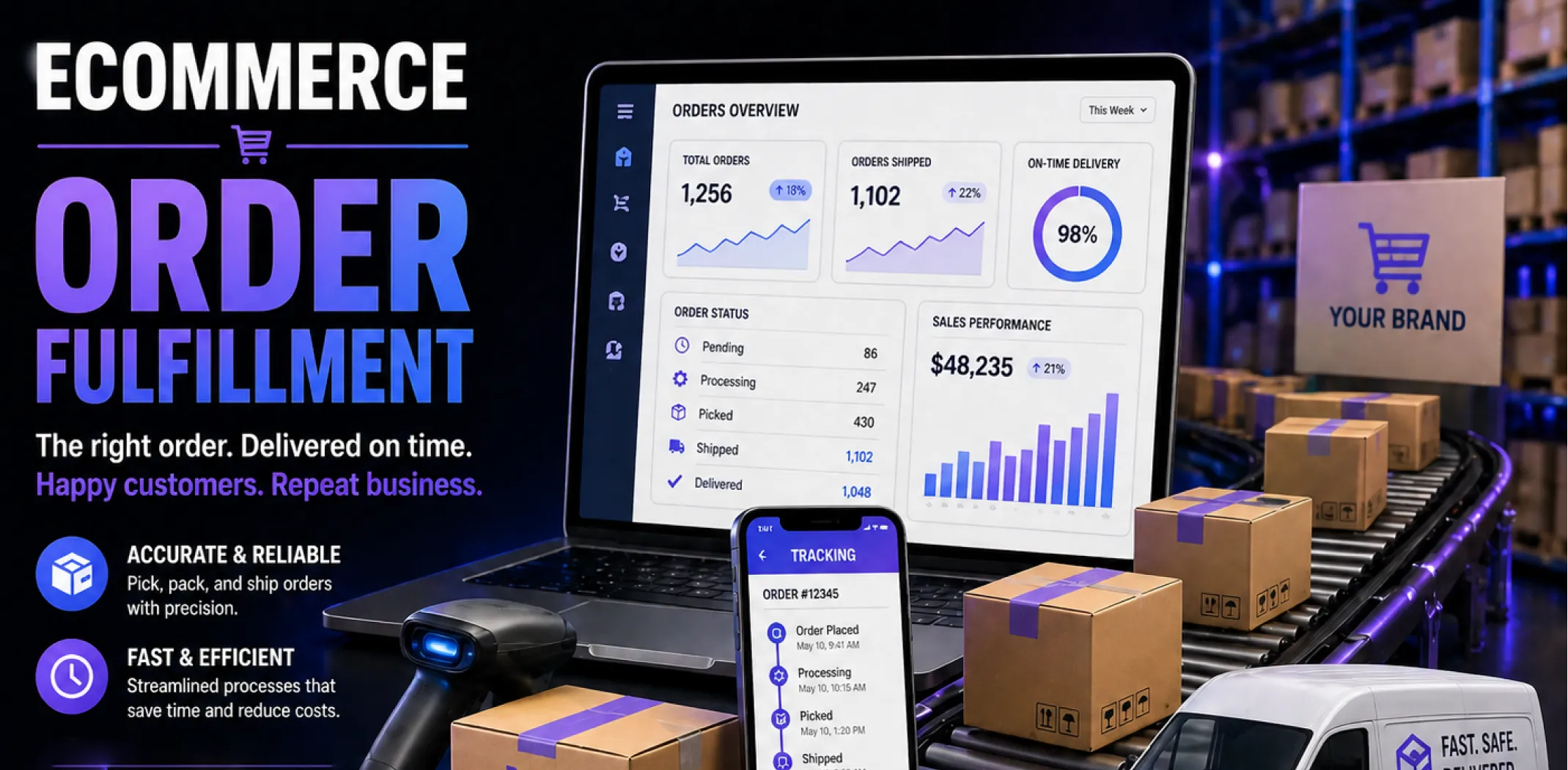
Every time someone buys something online, a whole chain of events kicks off behind the scenes. That chain is called ecommerce order fulfillment – and if you are running or thinking about starting an online store, understanding it could be the difference between a business that grows and one that stalls.
Get it right and customers come back. Get it wrong and you are drowning in complaints, refund requests, and one-star reviews.
Quick Answer: Ecommerce order fulfillment is the complete process of receiving a customer order, getting the product to them, and handling any returns. It covers everything from the moment someone clicks “buy” to the moment the product lands at their door. For most people starting out, an automated setup – where a supplier handles all the physical side – is the most realistic and affordable way to begin.
This guide walks you through every fulfillment method, what each one costs in time and money, and which approach makes the most sense depending on where you are right now.
Whether you are brand new to selling online or already running a small store and looking to scale, the fulfillment decisions you make early on will shape how much time you spend working in your business versus working on it.
What is ecommerce order fulfillment?
Ecommerce order fulfillment refers to the full sequence of steps that happen after a customer places an order. It starts the second a purchase is confirmed and ends when the product reaches the buyer – or is returned if something goes wrong.
The core stages of any order fulfillment process look like this:
- Receiving inventory – products arrive at a storage location and are logged into your system.
- Storage – products are organised so they can be located and picked quickly when an order comes in.
- Order processing – the order is confirmed, payment is verified, and picking instructions are triggered.
- Picking and packing – the right items are pulled from storage, packaged securely, and labelled for shipping.
- Shipping – the package is handed to a carrier and tracked to the customer’s address.
- Returns and exchanges – any items sent back are inspected, restocked, or written off.
In 2026, ecommerce order fulfillment has become significantly more automated. Even solo entrepreneurs now have access to tools that handle most of these steps without manual input – meaning you can run a store serving hundreds of customers a month without ever touching a product.
Why this works in 2026: Consumer expectations for fast, tracked, reliable delivery have risen sharply – and the tools to meet those expectations are now affordable for stores of every size, not just big retailers.
How much can you realistically earn from an online store in 2026?
Before diving into the mechanics of fulfillment for online stores, it is worth grounding the income conversation in reality. The figures you see in ads and YouTube thumbnails are almost always ceiling numbers – not averages. Here is a more honest picture:
These ranges reflect what consistent, active store owners report across communities like Reddit’s r/ecommerce. Results vary based on niche, marketing effort, and how much time you put in. None of these are guaranteed from day one.
One note on the ceiling figures: The top-end numbers above represent stores that are already optimized, well-marketed, and generating repeat customers. If you are in your first 60 days, expect to be in test-and-learn mode – not hitting maximum revenue. That is completely normal and does not mean you picked the wrong model.
Automated fulfillment – where a platform handles product delivery on your behalf the moment a sale comes in – consistently attracts people starting out because the startup cost and operational overhead are the lowest of any method. You do not buy stock upfront. You do not rent warehouse space. And you do not spend your evenings driving to the post office.
The main ecommerce order fulfillment methods explained
There is no single right answer when it comes to fulfillment for online stores. The best approach depends on your budget, your product type, your order volume, and how involved you want to be day to day. Here is a detailed look at each option.
Self-fulfillment
Self-fulfillment means you personally handle every stage of the ecommerce order fulfillment process. You source the stock, store it, pick and pack each order, print labels, and take packages to the carrier. For very early-stage stores or people selling handmade goods, this can make sense. You keep full control over packaging quality and can add personalised touches that third parties cannot replicate.
How to get started with self-fulfillment
Set up a dedicated storage area – even a section of a spare room works at the start. Use a basic spreadsheet or low-cost inventory management software to track stock. Connect your store to a label printing service to reduce the time and cost of printing shipping labels by hand. Batch your shipping runs to specific days of the week rather than making daily post office trips.
Earning potential: $500–$2,500/month once you have steady traffic, but your time cost is significant – expect to spend 10–20 hours per week on fulfillment tasks alone at moderate order volumes.
When self-fulfillment stops making sense
Most store owners hit a wall around 20–40 orders per day. At that volume, packing and shipping consumes most of the working day and leaves no time to grow the business. That is usually the point where people move to a 3PL or shift to a more automated model entirely.
Third-party logistics (3PL)
A 3PL warehouse receives your inventory in bulk, stores it, and fulfills orders on your behalf as they come in. You pay for storage space and a per-order processing fee, but you outsource the physical labor entirely. Well-known providers include ShipBob and Deliverr.
How the 3PL order fulfillment process works
You send a batch of stock to the 3PL facility. When a customer orders, your store sends the order data to the 3PL automatically. They pick, pack, and ship within the agreed timeframe – often same day or next day for US-based warehouses. Tracking information is fed back to your store and directly to the customer without you lifting a finger.
Important note: 3PL pricing structures vary widely. Always factor in inbound receiving fees, monthly storage fees, pick-and-pack fees, and return processing fees before comparing costs across providers.
When 3PL works well – and when it does not
3PLs make sense when you have proven products, predictable order volume, and enough margin to absorb the per-order fees. They are less practical for new store owners because you need to buy and ship inventory before you have validated whether a product will actually sell. If it does not move, you are paying storage fees on dead stock every month.
Automated digital fulfillment
This is the model that has changed everything for people starting an online business with limited capital. Instead of holding physical inventory, your store sells digital products – guides, courses, checklists, and tools – that are delivered to customers instantly the moment a sale is made. No packing. No shipping. No logistics at all.
How automated fulfillment works with digital products
With a properly set-up store, the entire ecommerce order fulfillment process runs on autopilot. A customer places an order. Payment is processed. The digital product is delivered to them instantly by email or download link. You receive your profit – 50–70% of the sale price – without manually doing anything. There is no carrier involved, no tracking number to chase, and no physical product to handle.
Platforms like Sellvia make this entire process seamless. Your store comes pre-loaded with ready-made digital products created by Sellvia, so you are not writing, recording, or building anything from scratch. The fulfillment layer is already there before you launch.
Earning potential: $30–$80/day is a realistic target within 60–90 days for an actively marketed store. Established stores with consistent ad spend and optimised product pages regularly reach $200–$500/day or more.
Why this works in 2026: Digital product demand is growing faster than physical ecommerce in most categories. There are no supply chain delays, no shipping costs eating into your margin, and no customer complaints about delivery times because the product arrives in seconds.
Hybrid fulfillment
Some store owners combine methods as they grow. They start with a fully automated digital store to build income and validate demand, then explore adding other product lines or models once revenue is consistent. This is a smart growth path because you are working from data rather than guesswork.
For example, a store might launch 100% automated in month one. By month six, they have identified which product categories perform best and can make informed decisions about expanding. The digital model runs on autopilot while they test new angles – without the risk of sitting on unsold physical inventory.
How to get the most out of your online store fulfillment setup
Whichever method you use, a few consistent practices make a real difference to customer satisfaction, review ratings, and how often people come back to buy again.
Set accurate delivery expectations upfront
Most customer complaints about orders are not actually about speed. They are about surprise. A customer who expects delivery in 14 days and gets it in 12 is happy. A customer who expected 5 days and got it in 12 is leaving a negative review.
For digital products, this problem disappears entirely – delivery is instant. But whatever you sell, be specific and honest about what the buyer should expect from the moment they click “buy.”
Automate your customer communications
Customers want to know their order went through and is on its way. Set up automated confirmation emails at the key moments: order placed, payment received, product delivered. For digital products, the delivery confirmation is instant and automatic. Reducing “did my order go through?” messages saves you time and signals professionalism without you doing anything manually.
Build a clear returns policy
A visible, easy-to-understand returns policy actually increases sales. Customers are more likely to buy when they know they are not stuck with something if it does not work out. For digital products, most stores offer a straightforward satisfaction guarantee rather than a traditional returns process – since there is nothing physical to send back. Keep the language simple and reassuring.
Track your key numbers monthly
At a minimum, monitor: how quickly orders are processed and delivered, your refund or dispute rate, and customer satisfaction signals like reviews and repeat purchase rate. If something in your setup starts underperforming, you want to catch it early – before it compounds into a bigger problem.
Use your platform’s built-in tools
As your store grows, trying to manage everything manually becomes unsustainable fast. Good ecommerce platforms centralise everything – order status, customer communications, delivery tracking, and product management – in one place. This is what makes going from 10 orders a month to 1,000 orders a month manageable without needing to hire a team.
Pro Tip: Before you scale your ad spend, run your fulfillment process end to end with a small number of real orders. Find any gaps in automation or communication before volume turns small issues into big ones.
Legal and ethical considerations in ecommerce order fulfillment
Running a legitimate online store means being upfront about what you sell, how it gets to the customer, and what your policies are. The fulfillment process has a few specific areas where new store owners can cross into grey territory – usually without realising it.
What to avoid
Key principle: Never misrepresent delivery timelines, product availability, or what the customer is actually buying in order to close a sale you cannot fulfill as described.
Common issues to watch out for:
- Listing a product as “in stock” when it is actually unavailable or delayed.
- Copying competitor product descriptions that include claims you cannot verify or back up.
- Making vague promises about delivery speed without knowing your actual fulfillment timeline.
- Using misleading income claims in your own marketing – the same standard applies to how you describe your store to potential customers.
What to do instead
Build your store around clear, specific communication. If you sell digital products that are delivered instantly, say that clearly on your product pages and at checkout – it is a competitive advantage, not something to hide. Include a simple FAQ on your store addressing what happens after purchase, how the customer receives their product, and what to do if something goes wrong.
Important: For stores targeting EU customers, you are legally required to provide a 14-day right of withdrawal under EU consumer law. This applies to most digital goods sold online in the EU, so check the specific rules for your product type before launching in that market.
How to choose the right fulfillment approach for your situation
The right ecommerce order fulfillment method depends on where you are now, not where you hope to be in two years. Here is a practical breakdown by situation.
Complete beginner
If you have never run an online store before, an automated digital fulfillment setup is the correct starting point – full stop. You do not need startup capital for inventory. You do not need a warehouse or a logistics partner. You do not need to understand carrier rates or label printing.
You set up your store, the products are already there, and you focus entirely on getting eyes on your store and making sales. The fulfillment layer runs automatically in the background. The learning curve is about running a business, not about packing boxes.
Intermediate – part-time seller
If you have been running a store for 3–6 months and have consistent revenue, start looking at what is driving most of your sales. Double down on what is working, refine your marketing, and use the data you have built up to make smarter decisions about which products or offers to push harder. The foundation is already there – this phase is about optimising, not overhauling.
Advanced – full-time goal
If your goal is to build a business generating $5,000–$20,000/month, your fulfillment for online stores strategy needs to evolve as your revenue grows. At that level, you should be working closely with your platform’s support team, testing new product categories, and using your ad performance data to scale what works.
The automated fulfillment model scales with you – there is no physical bottleneck because digital delivery does not require more staff or warehouse space as volume increases.
Budget-constrained starter
If budget is the primary constraint, an automated digital store removes the biggest barrier entirely. You start selling before spending a dollar on inventory. Revenue funds growth rather than the other way around.
This is why automated digital fulfillment is the most common entry point to online business in 2026 – not because it is perfect, but because it lets you learn how to run and grow a store while generating real income from day one.
Why Sellvia is a game-changer for your online store 🚀
Sellvia isn’t just another ecommerce tool. We are a trusted name in the industry, recognized by Forbes and even ranked in Inc.’s list of the 5,000 fastest-growing companies in the U.S. So if you’re serious about starting as a solopreneur, this is a smart place to begin.
Starting an online business can feel overwhelming, but that’s exactly where Sellvia steps in. It takes care of the tricky parts, so you can focus on making sales and growing your brand. Let’s break down what makes it such a great choice.
Get a ready-to-go store hassle-free 🎯
Want to start selling but don’t know where to begin? No worries! Just share your ideas, and Sellvia’s team will build a free ecommerce website that’s fully set up and ready to take orders from day one. No coding, no stress – just a store that works right out of the box.
A $100 welcome gift to grow your business faster 🎁
Starting a business takes momentum – and Sellvia gives you a head start. When you claim your free store today, you also get a $100 welcome gift to put toward growing your business. Use it to upgrade your store, boost your marketing, or unlock new tools. It is a real dollar value, handed to you on day one, with no catch and no hoops to jump through.
A massive catalog of digital products to sell 🏆
One of the biggest struggles in starting an online business is figuring out what to sell. Sellvia solves that completely. Your store comes pre-loaded with digital products – guides, courses, checklists, and tools – all created by Sellvia. You keep 50–70% of every sale. No inventory. No shipping. No logistics headaches.
Everything in one easy-to-use platform 🔥
Managing an online store shouldn’t be complicated. With Sellvia, you can handle orders, add new products, and even chat with customers – all from a simple and user-friendly platform. No need to mess with confusing tools or deal with unnecessary tech stuff. It’s all smooth sailing.
No upfront costs, just start selling 💰
A big reason people hesitate to start an online business is the cost. But here’s the good news: With Sellvia, you don’t need to invest in stock, storage, or shipping supplies. You can run your store with no upfront costs, keeping things low-risk while still making money.
Support that’s always got your back 🤝
Running a business comes with questions, but you’re never alone. Sellvia’s dedicated support team is available 24/7 to help with anything you need. Whether it’s a small question or a big challenge, they’ve got you covered.
Ecommerce order fulfillment does not have to be complicated – with the right platform, the entire process runs automatically from the moment a customer buys. Get your free store today and start earning without touching a single package.
What is ecommerce order fulfillment?
What is the difference between self-fulfillment and automated digital fulfillment?
Self-fulfillment means the store owner personally stores, packs, and ships each order – which gives full control but requires 10 to 20 hours per week at moderate order volumes. Automated digital fulfillment removes the need for any physical handling entirely. When a customer buys a digital product, it is delivered to them instantly without the store owner doing anything. There is no inventory to buy, no packaging to manage, and no shipping costs eating into the profit. Most people starting an online store in 2026 choose the automated model because it lets them focus on growing the business rather than managing logistics.
How long does the ecommerce order fulfillment process take?
The total ecommerce order fulfillment time varies significantly by method. Self-fulfilled physical stores typically ship within 1 to 2 business days, with domestic delivery taking 3 to 7 days. Third-party logistics providers often process orders the same day with 2 to 5 day domestic delivery. For stores selling digital products, fulfillment is effectively instant – the customer receives their purchase within seconds of payment confirmation, regardless of time zone or day of the week.
Can I automate ecommerce order fulfillment for my store?
Yes – and most modern ecommerce platforms make substantial automation available even to first-time store owners. For digital product stores, the entire fulfillment process is automated by default. Order confirmation, product delivery, and customer notification all happen without any manual input. This means store owners can process hundreds of orders per month without spending time on fulfillment tasks, which frees up time to focus on marketing and growing the customer base.
What is the most cost-effective fulfillment for online stores starting out?
For most people starting out, automated digital fulfillment offers the lowest barrier to entry because it requires no upfront inventory investment and no warehousing costs. A beginner can launch a fully operational store pre-loaded with digital products and keep 50 to 70 percent of every sale without buying a single item in advance. Revenue from sales funds any future growth rather than requiring capital up front. Third-party logistics becomes more cost-effective once a store has consistent volume and proven bestsellers, making digital fulfillment the smarter starting point for the vast majority of new store owners.