If you are setting up an online store in 2026, one of the first real decisions you will face is which ecommerce payment gateway to use. It sounds technical, but the choice you make here directly affects how much you earn, how many customers complete their purchase, and how smoothly your business runs day to day.
Get it wrong and you lose sales to high fees, clunky checkout flows, or blocked regions. Get it right and payments just work – invisibly, reliably, every time.
Quick Answer: The best ecommerce payment gateway for most beginners in 2026 is Stripe or PayPal. Both support 40+ currencies, charge around 2.9% + $0.30 per transaction, and connect to almost every major store platform with minimal setup.
So which option is actually right for you? It depends on where you sell, what you sell, and how much volume you expect. Stripe leads for flexibility and global reach. Shopify Payments wins if you are already on Shopify. And for anyone who wants everything handled from day one – store, products, and a built-in advertising system – Sellvia bundles it all into one simple setup.
What is an ecommerce payment gateway?
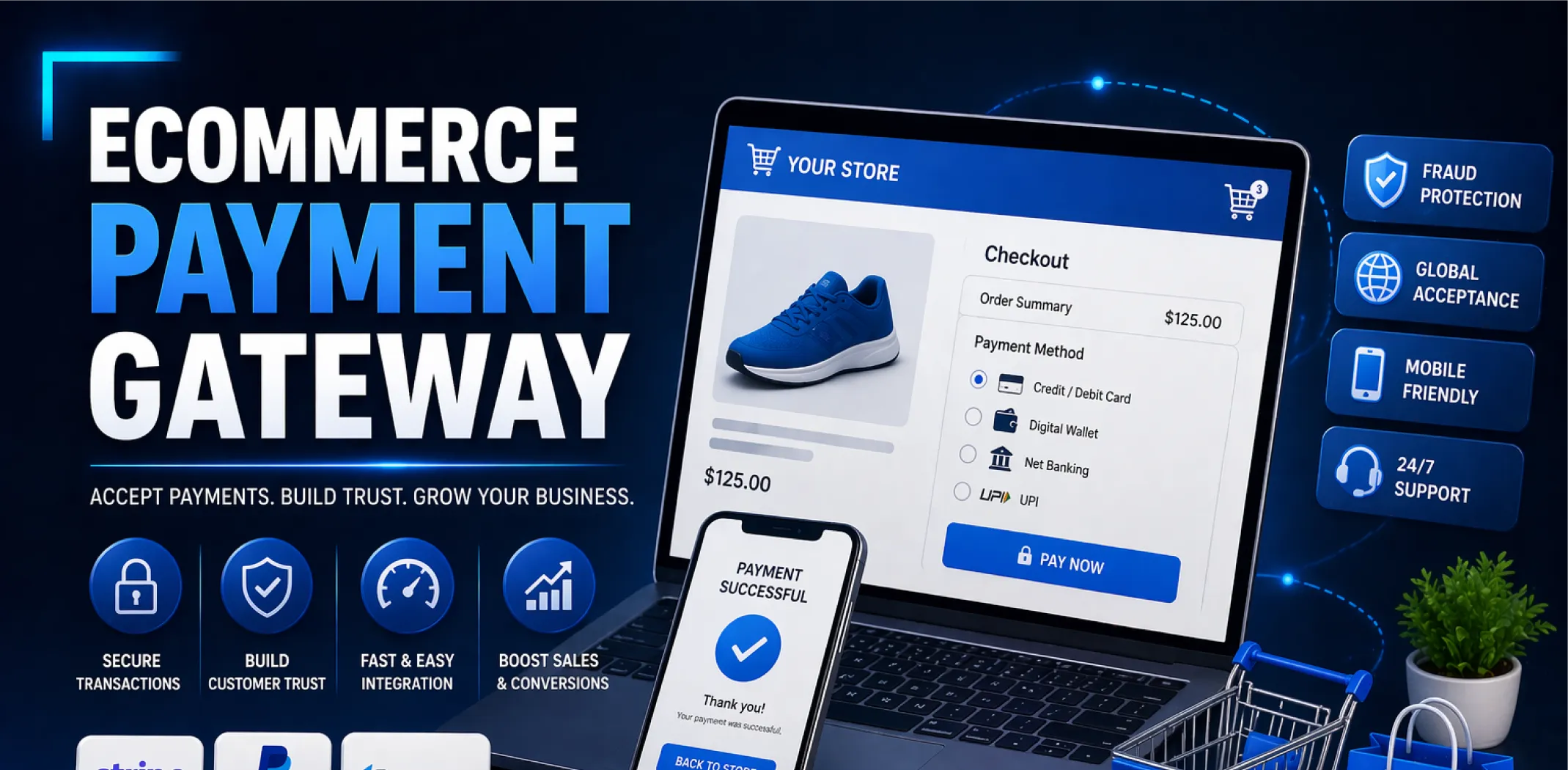
An ecommerce payment gateway is the technology that securely processes customer payments on your online store. When a shopper enters their card details and clicks “buy,” the gateway encrypts that data, sends it to the card network for authorization, and confirms the transaction back to your store – all within a few seconds. Without a gateway, there is no way to accept online payments at all.
Think of it as the digital equivalent of a card reader in a physical shop. The customer never sees the gateway itself – they just experience a smooth checkout. But what happens under the hood has a huge impact on your earnings, your fees, and how fast money lands in your bank account.
In 2026, payment gateways do a lot more than just process cards. The best ones handle fraud detection, support buy-now-pay-later options, offer multi-currency checkout, and connect to platforms like WooCommerce and Shopify with minimal setup. Choosing the right one from the start saves you significant hassle as you grow.
It is also worth knowing that a payment gateway is slightly different from a payment processor and a merchant account – though most modern providers bundle all three together. When people say “ecommerce payment gateway,” they usually mean the full package: the interface, the processing engine, and the account that holds your funds.
How much does a payment gateway actually cost?
Fees are the part most new sellers underestimate. Every transaction runs through at least one fee layer, and those percentages add up fast once you have real volume. Here is a realistic breakdown of what the major ecommerce payment gateway options charge and what you can expect for payout speed.
Most beginner stores will land between 2.9% and 3.5% per transaction. On a $50 sale, that is roughly $1.45–$1.75 per order. At 100 orders a month that is $145–$175 in gateway fees alone – before you factor in any ad spend. Understanding this early helps you price your products correctly from the start.
One note on fee comparisons: The cheapest gateway is not always the best choice. Payout speed, fraud protection, currency support, and how well the gateway connects to your store platform all factor into the real cost of doing business.
Payout schedules vary significantly. Stripe settles in 2 business days by default. PayPal can be instant to your PayPal balance. Shopify Payments typically settles in 1–3 business days. If you need cash moving quickly to reinvest in your business, payout speed matters just as much as the fee rate.
The best ecommerce payment gateway options compared
There is no single winner – the right ecommerce payment gateway depends on your store setup, your target customers, and how technical you are willing to get. Below are the strongest options available in 2026, organized by use case so you can match the right one to your situation.
Best all-round options for new stores
Stripe
Stripe is the most flexible payment gateway available in 2026, and it has become genuinely beginner-accessible through no-code integrations with WooCommerce, Squarespace, Wix, and most other major platforms. It supports 135+ currencies, handles subscriptions natively, and includes some of the best fraud detection tools in the industry.
Setup takes under an hour for most store platforms. Payouts land in 2 business days. Stripe is available in 46+ countries. If you are in a market where Stripe is not available, you will need an alternative. The standard transaction fee is 2.9% + $0.30 for card payments, with slightly higher rates for international cards.
Earning potential: Stores with optimized Stripe checkouts report 10–15% higher purchase completion rates compared to redirect-based payment flows – which translates directly into more income per visitor.
PayPal
PayPal remains one of the most recognized checkout options in the world, which is its biggest advantage. Studies consistently show that displaying the PayPal button at checkout increases completed purchases – particularly among buyers aged 35 and over who associate PayPal with purchase protection and trust.
On the downside, PayPal fees are higher than Stripe at 3.49% + $0.49 per standard transaction in 2026. PayPal is best used as a secondary payment option alongside your main gateway. Pair it with Stripe or Shopify Payments for full coverage.
Why this works in 2026: PayPal has over 400 million active accounts globally. Even if just 20% of your customers prefer it, not offering it means losing those sales to checkout friction.
Shopify Payments
If your store is on Shopify, using Shopify Payments is a straightforward choice. It removes the extra transaction fee that Shopify charges when you use a third-party gateway – 0.5% to 2% depending on your plan – which alone makes it worth using. The checkout is natively integrated, so customers pay without ever leaving your store page.
Shopify Payments runs on Stripe on the back end, so reliability and fraud tools are solid. It is available in around 20 countries as of 2026. If you are based outside those markets, you will need a third-party gateway and will need to budget for the extra Shopify transaction fee in your pricing.
Strong options for specific situations
Authorize.Net
Authorize.Net has been operating since 1996 and remains a trusted choice for established stores that process high volumes. The monthly fee of $25 makes it uneconomical for stores doing fewer than 200–300 orders per month, but at scale the per-transaction costs become very competitive. It connects well with WooCommerce and offers strong recurring billing tools for subscription-based businesses.
Important: Authorize.Net requires a separate merchant account, which adds setup time of 3–5 business days for approval. It is not the right choice if you need to start selling this week.
Klarna and Afterpay
Buy-now-pay-later options are not full replacements for a standard payment gateway, but they are increasingly important add-ons. Klarna, Afterpay, and similar services allow customers to split purchases into installments – and stores offering this option report average order value increases of 20–45% according to merchant data from Klarna’s platform documentation.
The gateway takes on the credit risk. You get paid in full upfront. These work best on stores selling products priced at $50 and above, where the installment option meaningfully lowers the psychological barrier to purchase. Most buy-now-pay-later providers integrate as an additional method inside Stripe or Shopify Payments rather than as a standalone gateway.
Earning potential: Adding a buy-now-pay-later option to an existing store can increase monthly income by $200–$800 for stores already doing $2,000–$5,000 per month in sales, simply by lifting purchase rates on higher-priced items.
2Checkout (now Verifone)
2Checkout – rebranded as Verifone in recent years – is worth knowing about if you are selling to customers in regions where Stripe is not available. It supports 87 currencies and 200+ countries, making it one of the widest-reaching options for international sellers. The fees are higher at 3.5% + $0.35 per transaction on the base plan, but for markets where alternatives are limited, it fills an important gap.
Payoneer
Payoneer is less of a traditional checkout gateway and more of a receiving and payment tool. It comes up frequently in online business circles because it works well for receiving marketplace payouts and paying overseas suppliers.
If your store earns through Amazon, Walmart, or similar platforms, Payoneer is worth setting up alongside your main gateway to simplify supplier payments and currency conversion.
How to choose the right payment gateway for your store
With so many options available, narrowing it down comes down to four practical filters. Run your situation through each one and the answer usually becomes clear.
1. Where are you and where are your customers?
Your location determines what gateways you can even sign up for. Stripe is available in 46+ countries but not everywhere. PayPal is more widely accessible but has restrictions in certain markets too. Before you commit to any gateway, check its supported countries page for both merchant signup and customer payment – those are sometimes different lists.
If you are targeting customers in Europe, SEPA bank transfers and iDEAL (popular in the Netherlands) are worth supporting. In Southeast Asia, local digital wallets often outperform cards for purchase completion rates.
2. What platform is your store on?
Some gateways connect natively with certain platforms and not others. Shopify Payments only works on Shopify. Many WooCommerce-specific gateways do not support Shopify at all. Check the integration library of any gateway before signing up – a gateway that requires custom API work to connect to your store is a significant time and money cost for most beginners.
3. What is your expected monthly volume?
At low volumes – under $5,000 per month – the difference between 2.9% and 3.5% is relatively small in dollar terms. Focus on ease of setup, payout speed, and how trustworthy the checkout looks to customers. At higher volumes of $10,000 or more per month, every 0.1% in fees becomes worth optimizing.
That is when it makes sense to explore negotiated rates with Stripe or consider a dedicated merchant account through Authorize.Net.
4. Do you need multi-currency support?
If you are running a store targeting customers in multiple countries, multi-currency checkout is a meaningful income booster. Research cited in Stripe’s official documentation shows shoppers are around 70% more likely to complete a purchase when prices appear in their local currency.
Both Stripe and Shopify Payments handle this well. PayPal does it automatically through currency conversion, though it takes a conversion fee in the process.
What to watch out for: Security, fraud, and compliance
Payment gateways operate in a heavily regulated space. As a store owner, you have legal and practical obligations that go beyond just picking a low-fee provider. Here is what matters most.
PCI DSS compliance
Any store that accepts card payments needs to be PCI DSS compliant – a set of security standards designed to protect cardholder data. The good news is that modern hosted gateways like Stripe and PayPal handle PCI compliance on their end, so you are not storing raw card data on your own server.
If you use a self-hosted checkout, the compliance burden is significantly higher. Stick to hosted or embedded checkout forms unless you have a developer who understands PCI requirements in detail.
Key principle: Never store raw card numbers on your own server. Use a gateway that tokenizes card data – Stripe, PayPal, and Shopify Payments all do this by default.
Fraud prevention
Chargebacks are one of the most common and costly problems for online stores. A chargeback happens when a customer disputes a transaction with their bank – the funds are reversed and you often pay a fee of $15–$25 per incident on top.
Stripe uses machine learning to flag suspicious orders before they are processed. Shopify has its own fraud analysis built into the order dashboard. Use these tools from day one rather than approving every order manually and hoping for the best.
Important: A chargeback rate above 1% can result in your merchant account being suspended by your gateway provider. Monitor this number monthly from the start.
What to avoid
Some practices might seem like smart shortcuts but can get your gateway account permanently banned.
Do not process test orders through your live account to generate fake sales history. Do not use someone else’s business identity to open a gateway account. Do not use a gateway to process payments for products that are prohibited under its terms of service – this varies by provider but commonly includes certain supplements, adult content, and high-risk financial products.
Read the acceptable use policy before you commit to any provider.
Which payment gateway should you pick? Recommendations by profile
Here is a practical summary based on where you are right now.
Complete beginner
If you are starting your first online store and have never touched a payment gateway before, go with Stripe or Shopify Payments. Both have excellent documentation, beginner-friendly dashboards, and are supported natively by every major store platform.
Stripe is slightly more flexible if you plan to grow beyond a single platform. Shopify Payments wins if you are already committed to Shopify. Add PayPal as a secondary option to capture the buyers who prefer it. Do not overthink this – get started, and adjust or add providers later as your needs evolve.
Intermediate / part-time seller
If you are already selling and doing $2,000–$8,000 per month, the focus shifts to optimization. Review your current chargeback rate, payout speed, and whether multi-currency checkout would help you expand into new markets.
Consider adding a buy-now-pay-later option like Klarna or Afterpay if your average order is above $50. If you are on WooCommerce, make sure you are using a gateway with native integration rather than a redirect-based checkout, which typically drops purchase completion by 10–20%.
Advanced / full-time goal
At $15,000 or more per month in income, gateway fees become a meaningful line item. At this point it is worth contacting Stripe directly about negotiated rates – this becomes possible once you are processing above $80,000–$100,000 per month.
It is also worth separating your payment processing from your fraud management, using a dedicated tool like Signifyd alongside your main gateway for more granular control. For stores with international reach, a multi-gateway setup – where different payment methods route to the most appropriate provider for each market – can add 5–10% to net income.
The ecommerce payment gateway market is evolving fast in 2026, with embedded finance, instant payouts, and AI-powered fraud detection becoming standard features even in entry-level plans. Starting with a solid foundation now puts you in a strong position to take advantage of those tools as they roll out.
Why Sellvia is a game-changer for your online store 🚀
Sellvia isn’t just another ecommerce tool. We are a trusted name in the industry, recognized by Forbes and even ranked in Inc.’s list of the 5,000 fastest-growing companies in the U.S. So if you’re serious about starting as a solopreneur, this is a smart place to begin.
Starting an online business can feel overwhelming, but that’s exactly where Sellvia steps in. It takes care of the tricky parts, so you can focus on making sales and growing your brand. Let’s break down what makes it such a great choice.
Get a ready-to-go store hassle-free 🎯
Want to start selling but don’t know where to begin? No worries! Just share your ideas, and Sellvia’s team will build a free ecommerce website that’s fully set up and ready to take orders from day one. No coding, no stress – just a store that works right out of the box.
A $100 welcome gift to grow your business faster 🎁
Starting a business takes momentum – and Sellvia gives you a head start. When you claim your free store today, you also get a $100 welcome gift to put toward growing your business. Use it to upgrade your store, boost your marketing, or unlock new tools. It is a real dollar value, handed to you on day one, with no catch and no hoops to jump through.
A massive catalog of digital products to sell 🏆
One of the biggest struggles in starting an online business is figuring out what to sell. Sellvia solves that completely. Your store comes pre-loaded with digital products – guides, courses, checklists, and tools – all created by Sellvia. You keep 50–70% of every sale. No inventory. No logistics headaches. When a sale is made, the product is delivered instantly and digitally.
Everything in one easy-to-use platform 🔥
Managing an online store shouldn’t be complicated. With Sellvia, you can handle orders, add new products, and even chat with customers – all from a simple and user-friendly platform. No need to mess with confusing tools or deal with unnecessary tech stuff. It’s all smooth sailing.
No upfront costs, just start selling 💰
A big reason people hesitate to start an online business is the cost. But here’s the good news: With Sellvia, you don’t need to invest in stock, storage, or logistics. You can run your store with no upfront costs, keeping things low-risk while still making money.
Support that’s always got your back 🤝
Running a business comes with questions, but you’re never alone. Sellvia’s dedicated support team is available 24/7 to help with anything you need. Whether it’s a small question or a big challenge, they’ve got you covered.
Picking the right ecommerce payment gateway is important – but it is only one piece of starting a successful online business. Get your free Sellvia store today and launch with the store, the products, and the advertising system already in place.
What is the best ecommerce payment gateway for beginners?
How much does an ecommerce payment gateway cost?
Most payment gateways charge a percentage of each transaction plus a fixed fee. Stripe and Square both charge 2.9% plus 30 cents per transaction. PayPal charges slightly more at 3.49% plus 49 cents for standard transactions in 2026. Authorize.Net charges a similar per-transaction rate but also requires a 25 dollar monthly fee, which only becomes cost-effective at volumes above 200 to 300 orders per month. On a 50 dollar sale processed through Stripe, the gateway fee works out to roughly 1.75 dollars – a meaningful cost to factor in when pricing your products.
What is the difference between a payment gateway and a payment processor?
A payment gateway is the technology that securely transmits card data from the customer to the card network and back. A payment processor is the service that actually moves the money between the customer bank and your account. In practice, most modern providers like Stripe and PayPal bundle both functions together, so the distinction rarely matters for new store owners. What matters most is that the provider handles both roles reliably, supports your target markets, and connects cleanly with your store platform.
Which ecommerce payment gateway is best for online stores selling digital products?
For online stores selling digital products, Stripe is the most flexible option because it integrates with WooCommerce, Shopify, and most other platforms while supporting global currencies. Shopify Payments is the strongest choice for Shopify-based stores specifically, as it avoids the extra transaction fee and offers a fully native checkout experience. PayPal is worth adding as a secondary option since many buyers prefer its purchase protection guarantee. Stores targeting markets where Stripe is not available should look at 2Checkout, which supports 87 currencies and 200 or more countries.
Can you use multiple payment gateways on one ecommerce store?
Yes, and for most stores it is recommended to offer at least 2 payment options. Using Stripe as the primary card gateway and PayPal as a secondary option captures buyers who prefer one method over the other and can increase overall purchase completion rates by 8 to 15 percent. The setup is straightforward on platforms like Shopify and WooCommerce, which support multiple active payment providers simultaneously. The main thing to avoid is creating a confusing checkout experience by offering too many options at once – 2 to 3 methods is the right balance for most online stores.