An Etsy side hustle is one of the most popular ways people try to earn extra money online in 2026 – and for good reason. Etsy has tens of millions of active buyers, low startup costs, and no technical skills required to open a shop. If you have a creative idea, a digital skill, or even just a few hours to spare each week, it is worth understanding how this platform actually works.
But there is a gap between what people expect and what most sellers actually experience. This guide gives you the honest picture – what you can realistically earn, the smartest product types to sell, common mistakes to skip, and a step-by-step path to getting started. And if Etsy feels like too slow a climb, we will also show you a faster alternative worth knowing about.
Quick Answer: An Etsy side hustle can earn you $200–$1,500 a month once your shop is established, depending on what you sell and how consistently you market it. Digital downloads and print-on-demand products tend to scale the most efficiently because there is nothing to ship.
What is an Etsy side hustle?
An Etsy side hustle means running a shop on Etsy’s marketplace to earn income alongside your regular job or daily life. Etsy is not a gig platform – you are not completing tasks for someone else. You are building your own small store, choosing your own products, and selling directly to customers who find you through Etsy’s search engine.
That distinction matters. Because you own the shop, there is real earning upside. There is also real work involved. Sellers who treat it like a passive lottery ticket burn out quickly. Sellers who treat it like a small business – even just a few hours a week – see real, steady growth.
In 2026, Etsy hosts over 9 million active sellers worldwide and processes hundreds of millions in sales every year. The platform has grown well beyond handmade crafts. Today it is home to digital planners, printable wall art, online templates, vintage collectibles, and everything in between. That breadth means the barrier to entry is low – but standing out takes some thought.
How much can you realistically earn from an Etsy side hustle?
Let us get straight to the number most people want before anything else. Etsy income is real – but it is not instant, and it depends heavily on what you sell and how you promote it.
Part-time sellers with 10 to 30 well-optimized listings typically see $500 to $1,500 a month once their shop has been active for 60 to 90 days. Most new sellers start closer to the hobby tier and build from there.
One note on the higher figures: Shops earning $3,000 or more per month usually have hundreds of listings, strong SEO, a recognizable brand, and months of consistent effort behind them. That is achievable – but it is not the starting point.
What to sell: The best Etsy side hustle ideas in 2026
Not all Etsy product types are created equal. Some require significant time and physical materials. Others can be set up once and sold indefinitely. Here is a breakdown of the most viable options in 2026, sorted by how well they work for someone starting part-time.
Digital downloads – the highest-leverage starting point
Digital products are the single best Etsy side hustle category for most beginners. You design a file once – a planner, a printable calendar, a resume template, a set of social media graphics – and sell it an unlimited number of times. There is nothing to print, pack, or ship. When a customer buys, the file is delivered automatically.
Printable planners and organizers
Productivity planners, budget trackers, meal planners, and habit trackers are perennial bestsellers. They are easy to design in Canva, appeal to a broad audience, and require zero ongoing effort after the listing goes live.
Earning potential: $200–$800 per month with 15–30 well-targeted listings and consistent keyword optimization.
SVG files and design assets
Crafters and small business owners buy SVG files to use with cutting machines like Cricut. If you have any design ability, this niche is consistently in demand. Seasonal collections – Christmas, Halloween, graduation – can generate significant spikes in sales at the right time of year.
Earning potential: $150–$600 per month depending on niche specificity and volume of designs.
Editable templates and business tools
Canva templates for small business owners – business cards, Instagram posts, price lists, email headers – are high-value products because buyers use them professionally. Pricing tends to be higher than basic printables, and buyers often come back for bundles.
Earning potential: $300–$1,200 per month for sellers who build a coherent brand around a specific business type such as wedding photographers, coaches, or real estate agents.
Print-on-demand – design once, fulfill automatically
Print-on-demand lets you sell physical products – mugs, t-shirts, tote bags, wall prints – without ever touching inventory. You design the artwork. A partner like Printify or Printful handles printing and shipping. Your job is design and marketing.
Graphic tees and apparel
Niche-specific apparel sells well when it taps into a strong identity – dog breeds, occupations, hobbies, fandoms, hometowns. Generic designs get lost. The more specific and personal your angle, the better your conversion rate.
Earning potential: $200–$900 per month for a focused niche with 20–50 designs tested over 90 days.
Mugs and home goods
Mugs are one of Etsy’s top-selling print-on-demand categories. They make easy gifts, and gift-givers are happy to pay a premium for something that feels personal. Personalized name mugs, occupation humor mugs, and sentiment mugs around key life events all perform consistently.
Earning potential: $100–$500 per month once the right designs are in rotation, with strong spikes around holidays.
Handmade goods – premium pricing, higher time investment
Handmade products were Etsy’s original identity and still command the highest prices on the platform. Jewelry, candles, ceramics, knitwear, and custom gifts can all sell well – but only if the maker is prepared to invest significant time per item and has a strong visual brand.
Jewelry and accessories
Custom jewelry is one of Etsy’s most competitive categories, but micro-niching helps. Birthstone sets for new moms, initial necklaces for bridesmaids, celestial minimalist pieces – these angle-specific products outperform generic designs every time.
Earning potential: $400–$2,000 per month for established sellers with a strong visual brand and a solid review base.
Candles and home fragrance
Candles are a popular Etsy entry point because materials are relatively affordable and the product photographs beautifully. Soy candles with unique scent combinations or aesthetically driven branding perform well in gifting seasons.
Earning potential: $200–$800 per month with consistent production and photography. Scaling is limited by the maker’s time.
How to start your Etsy side hustle – step by step
Starting is simpler than most people expect. The challenge is not the setup – it is the consistency that follows.
Step one is picking your product type. Be honest with yourself about your time and skills. Digital products are the lowest-barrier start. Print-on-demand is close behind. Handmade goods require more upfront investment in both time and materials.
Step two is researching your niche before you list anything. Open Etsy search, type your product idea, and study the top results. Note pricing, photography style, and how sellers word their titles and descriptions. Tools like eRank or Marmalead show monthly search volume and competition levels, which removes a lot of guesswork.
Step three is creating your shop. Etsy walks you through it – you will choose a shop name, write a bio, and set payment preferences. Clear policies on processing times and returns reduce questions from buyers later and build trust upfront.
Step four is optimizing your listings. Etsy is a search engine. Your title, tags, and description all affect where you appear in results. Use the words buyers actually type – not what sounds professional, but what sounds natural. Add high-quality photos. For digital products, mockups work well and are easy to generate in Canva.
Step five is marketing. Etsy’s own traffic is helpful, but it is not enough at the start. Pinterest is particularly effective for Etsy sellers because pins drive long-tail search traffic for months after posting. TikTok and Instagram Reels are powerful for products with a visual or process angle. Even a few posts a week can drive meaningful additional traffic.
Common Etsy side hustle mistakes – and how to skip them
Most sellers hit the same walls. Knowing them in advance puts you months ahead.
Pricing too low is the most common early mistake. New sellers undercut themselves to get sales, then realize they are working for next to nothing per hour. Price based on your actual time and material costs, not on what feels safe. Good photos and a clear niche justify higher prices.
Ignoring SEO means your listings never get found. Etsy’s algorithm rewards relevant keywords in titles, tags, and descriptions. Spend time researching what buyers search for, and update your listings regularly as trends shift.
Inconsistent photography tanks conversion rates. Buyers on Etsy are visual – they click on listings that look polished and professional. For physical products, natural light and a clean background make a huge difference. For digital products, Canva mockups are free and effective.
Abandoning the shop too early is how most sellers fail. Etsy shops generally take 60 to 90 days to build enough reviews and listing history to rank consistently. Sellers who quit after two weeks never get there. Patience and consistency are the actual skills that separate successful shops from abandoned ones.
Legal and ethical considerations for Etsy sellers
Etsy has clear policies, and breaking them gets your shop suspended – sometimes permanently. A few rules that catch beginners off guard.
You cannot resell mass-produced items as handmade. If you did not make it yourself or design it yourself, it cannot be listed as handmade on Etsy. This applies to digital products too – reselling PLR content without meaningful changes puts your shop at risk.
Intellectual property matters. Do not use branded characters, song lyrics, sports team logos, or celebrity likenesses in your designs without a verified license. Etsy takes IP complaints seriously and will remove listings immediately when a brand files a claim.
Fake reviews are a permanent ban risk. Never ask friends or family to leave reviews for purchases they did not actually make. Etsy’s fraud detection has improved significantly, and the penalty is not worth the short-term boost.
Key principle: Build your shop on honest listings, original designs, and genuine customer relationships. That is the only path to long-term, sustainable income from an Etsy side hustle.
Which Etsy side hustle path is right for you?
Not every approach suits every person. Here is a simple breakdown by situation.
If you are a complete beginner with limited time, start with digital downloads. Low startup cost, no physical fulfillment, and you can list your first product in a weekend. Printable planners or Canva templates are the lowest-friction starting point.
If you are comfortable with design and want to test multiple ideas fast, print-on-demand is your best bet. You can run dozens of designs simultaneously without any upfront investment. Focus on one micro-niche and go deep rather than wide.
If you are creative, have a craft skill, and are willing to invest serious time, handmade goods give you the highest price ceiling and the most brand differentiation. The trade-off is that scaling is harder because production time is finite.
If you want to earn online without the 60 to 90 day Etsy ramp-up, a ready-built online store with digital products already loaded – and a built-in advertising system – may be a faster path to your first real income. We will cover that right now.
Why Sellvia is a game-changer for your online store 🚀
Sellvia isn’t just another ecommerce tool. We are a trusted name in the industry, recognized by Forbes and even ranked in Inc.’s list of the 5,000 fastest-growing companies in the U.S. So if you’re serious about starting as a solopreneur, this is a smart place to begin.
Starting an online business can feel overwhelming, but that’s exactly where Sellvia steps in. It takes care of the tricky parts, so you can focus on making sales and growing your brand. Let’s break down what makes it such a great choice.
Get a ready-to-go store hassle-free 🎯
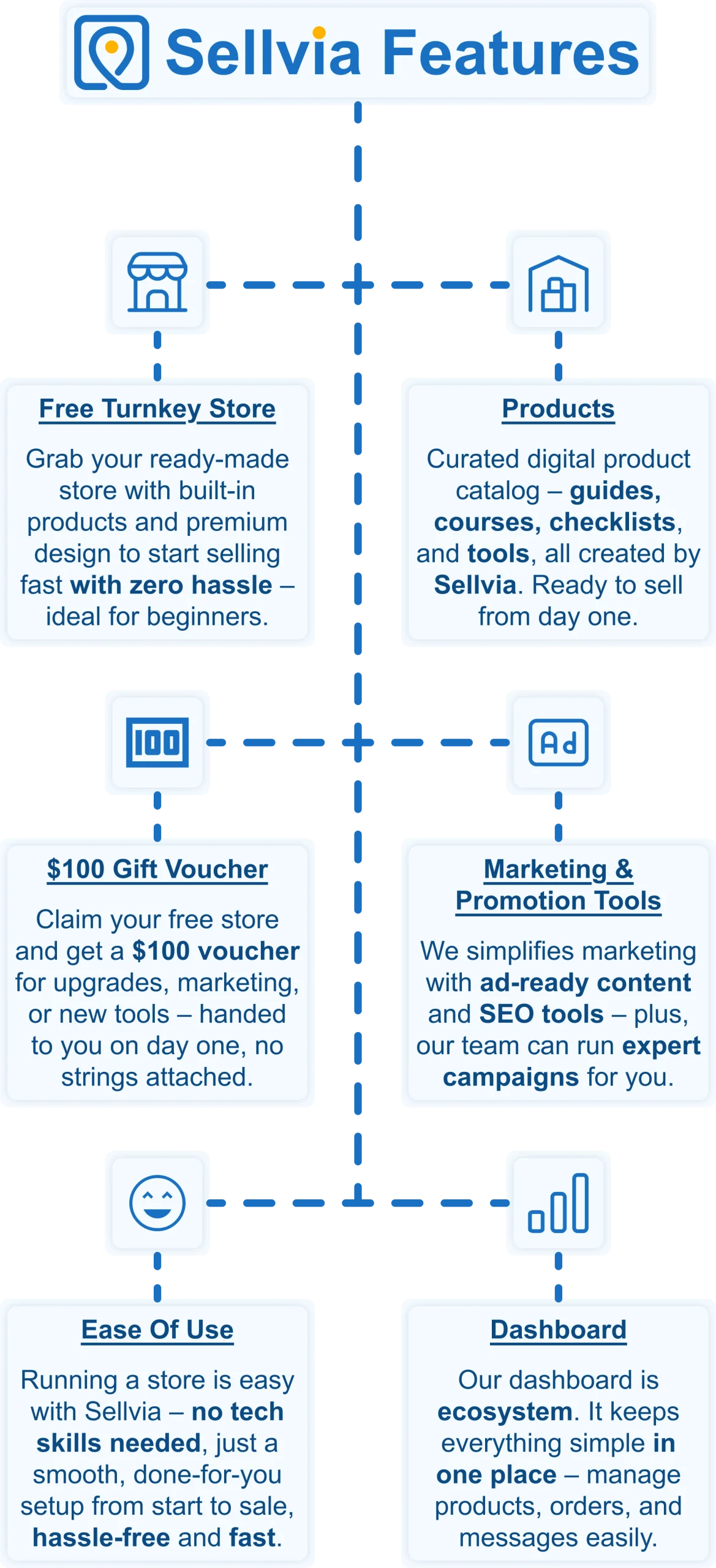
Want to start selling but don’t know where to begin? No worries! Just share your ideas, and Sellvia’s team will build a free ecommerce website that’s fully set up and ready to take orders from day one. No coding, no stress – just a store that works right out of the box.
A $100 gift voucher to grow your business faster 🎁
Starting a business takes momentum – and Sellvia gives you a head start. When you claim your free store today, you also get a $100 gift voucher to put toward growing your business. Use it to upgrade your store, boost your marketing, or unlock new tools. It is a real dollar value, handed to you on day one, with no catch and no hoops to jump through.
A massive catalog of digital products to sell 🏆
One of the biggest struggles in starting an online business is figuring out what to sell. Sellvia solves that completely. Your store comes pre-loaded with digital products – guides, courses, checklists, and tools – all created by Sellvia. You keep 50–70% of every sale. No inventory. No shipping. No logistics headaches.
Everything in one easy-to-use platform 🔥
Managing an online store shouldn’t be complicated. With Sellvia, you can handle orders, add new products, and even chat with customers – all from a simple and user-friendly platform. No need to mess with confusing tools or deal with unnecessary tech stuff. It’s all smooth sailing.
No upfront costs, just start selling 💰
A big reason people hesitate to start an online business is the cost. But here’s the good news: With Sellvia, you don’t need to invest in stock, storage, or shipping supplies. You can run your store with no upfront costs, keeping things low-risk while still making money.
Support that’s always got your back 🤝
Running a business comes with questions, but you’re never alone. Sellvia’s dedicated support team is available 24/7 to help with anything you need. Whether it’s a small question or a big challenge, they’ve got you covered.
If an Etsy side hustle sounds like a lot of work for uncertain results, Sellvia is the faster path – a ready store, digital products loaded in, and built-in ads to get your first orders moving. Claim your free store and voucher today and see what your online business can do.
What is a good Etsy side hustle for beginners?
How much can you earn from an Etsy side hustle per month?
Most part-time Etsy sellers earn between 200 and 1,500 dollars per month once their shop has been active for 60 to 90 days. Hobby sellers with just a few listings often see 50 to 300 dollars monthly. Full-time shops with 50 or more listings, strong branding, and consistent marketing can reach 3,000 dollars or more per month, though that level typically takes many months of sustained effort to build.
How long does it take for an Etsy side hustle to make money?
Most new Etsy shops take 60 to 90 days to start generating consistent sales. The first month is usually slow while listings gain search history and reviews accumulate. Sellers who optimize their titles and tags with buyer-focused keywords, use high-quality photos, and promote outside of Etsy using Pinterest or social media tend to reach their first meaningful income milestone faster than those who list and wait.
What digital products sell best on Etsy as a side hustle?
The best-performing digital products on Etsy in 2026 include printable planners and trackers, editable Canva templates for small businesses, SVG files for cutting machines, wedding invitation suites, and social media graphic bundles. Products that target a specific audience – teachers, wedding planners, real estate agents – tend to convert better than generic designs because buyers feel the product was made for them.
Is an Etsy side hustle worth it in 2026?
An Etsy side hustle is worth it for people who enjoy design or creative work and are willing to invest 3 to 6 months building momentum. It is a real, sustainable income source for sellers who treat it like a small business rather than a passive lottery. For anyone who wants faster results with less setup time, platforms like Sellvia offer a pre-built store with digital products already loaded and a built-in advertising system that can generate orders from the first day.