If you have been wondering how do you make money with bond funds, you are not alone. Millions of Americans use bond funds as part of their financial plan – and for good reason. They offer a reliable way to earn regular income without picking individual stocks or watching the market every single day.
The answer is simpler than most finance articles make it sound. Bond funds earn money for you in two ways: they pay regular interest income, and their share price can rise over time so you can sell at a profit. This guide walks through both mechanisms clearly – with real numbers, not just theory.
Quick Answer: You make money with bond funds through regular interest payments distributed to shareholders, and through capital appreciation when fund share prices rise. Most investors benefit from both, especially when distributions are automatically reinvested.
Whether you are completely new to investing or looking to sharpen an existing strategy, understanding how bond funds actually generate returns will help you make smarter choices with your money. Let’s start at the beginning.
What exactly are bond funds?
A bond is essentially a loan you make to a government or a company. In exchange, they promise to pay you interest at regular intervals and return your original amount when the loan term ends. Governments and corporations issue bonds to fund projects, cover operating costs, and manage their finances.
A bond fund pools together hundreds of individual bonds into a single investment. Instead of researching dozens of bonds yourself, a professional fund manager makes all the buying and selling decisions. You buy shares of the fund – and each share gives you a slice of every bond inside it.
That pooling creates instant diversification. If one company in the fund struggles to pay its debt, it affects only a small portion of your total investment. That built-in protection is one of the main reasons bond funds are so popular with everyday investors who do not want to manage a portfolio themselves.
Bond funds are available through nearly every major brokerage – Vanguard, Fidelity, Schwab, and many others. Some are mutual funds that price at the end of the trading day. Others are exchange-traded funds (ETFs) that trade throughout the day like regular stocks. Both types work on the same basic earning principles.
How much can you realistically earn from bond funds?
Before diving into the mechanics, it helps to see the earning potential laid out in plain numbers. Here is a comparison of the most common bond fund types, their typical annual yields, and their risk levels based on current market conditions.
To put those numbers in real terms: a $10,000 investment in a government bond fund at 4.5% earns roughly $450 per year in interest – about $37 per month. That is reliable income. But generating enough to cover significant monthly expenses requires meaningful capital to start with.
For most working Americans, bond funds make the most sense as a long-term wealth-building tool rather than an immediate income solution. If you need income this year rather than in ten years, it usually pays to build an earning stream alongside your investments – something that pays off faster while your portfolio compounds quietly in the background.
One note on these yield figures: These ranges reflect current market conditions and fluctuate with interest rates. Always check the current yield of any specific fund before investing, as what applies today may shift within months.
The two main ways to make money with bond funds
Now to the heart of it. How do you make money with bond funds exactly? There are two distinct mechanisms at work, and most investors benefit from both over time.
Interest payments: earning regular income from the fund
How interest income works
Every bond in the fund pays interest – sometimes called a coupon payment. The fund collects those payments from all the bonds it holds and distributes them to shareholders on a regular schedule, usually monthly or quarterly. You receive your portion based on how many shares of the fund you own.
The amount depends on two things: your share count and the fund’s current yield. For example, if you own 500 shares of a bond fund at $20 per share – a $10,000 investment – with a 5% yield, you can expect roughly $500 per year in interest, or about $41 per month distributed to your account.
Earning potential: $30–$90 per month for every $10,000 invested, depending on the fund type and current interest rate environment.
The power of reinvesting your distributions
When interest payments hit your account, you have a choice: take them as cash or reinvest them by buying more fund shares. Reinvesting is one of the most powerful things you can do as a bond fund investor.
Here is a simple illustration: $10,000 invested at 5% annually with distributions reinvested grows to roughly $16,289 after 10 years. Without reinvestment, the balance stays near $10,000 while you collect $5,000 in cash payments you have likely already spent. The compounding effect is real, and most brokerages let you enable automatic reinvestment at no extra cost.
What determines how much interest you receive
Three factors shape your interest income. First, the current interest rate environment – when the Federal Reserve raises rates, newly issued bonds pay more, gradually pushing fund yields upward. Second, the type of bonds in the fund – corporate bonds pay more than government bonds because they carry more risk. Third, the fund’s expense ratio – the annual fee deducted from your returns before you see them. A fund yielding 5% with a 0.5% expense ratio actually puts 4.5% in your pocket. That difference compounds significantly over a decade.
Capital appreciation: earning money when prices rise
How bond fund prices move
Bond fund prices do not stay fixed. They move up and down based on market conditions, just like stock prices. If you sell your shares for more than you paid for them, you earn a capital gain on top of whatever interest income you have already collected.
The biggest driver of bond fund prices is interest rates. When rates fall, existing bonds become more attractive – they are paying a higher rate than anything newly issued. That pushes fund prices up. When rates rise, the opposite happens: new bonds offer better terms, making older ones less valuable, which lowers the fund’s share price.
A clear example of capital gains
Say you invest $2,400 by buying 200 shares of a bond fund at $12 per share. Over the following two years, interest rates fall and the fund’s price rises to $13.50. You sell your 200 shares for $2,700 – a $300 gain on your original investment. Add in the interest distributions you received over those two years (roughly $200 at a 4% yield), and your total return is approximately $500 – about 21% on a $2,400 starting investment over two years.
Important: Bond fund prices can also fall. If rates rise sharply after you invest, your fund value may drop below what you paid. Capital appreciation is not guaranteed – timing and patience both matter significantly.
Short-term vs. long-term bond funds and price sensitivity
Long-term bond funds are far more sensitive to interest rate changes. When rates shift by 1%, a long-term fund might gain or lose 8%–12% in price. A short-term fund might only move 1%–3% in the same scenario. If your goal is steady income and stability rather than capturing price swings, short-term bond funds carry less risk – even if their yields run slightly lower.
Types of bond funds: finding the right one for you
Not all bond funds are built the same way. The type you choose changes your income level, your risk exposure, and in some cases your tax situation. Here is a plain-language breakdown of the main options available to everyday investors in 2026.
Lower-risk options for steady income
Government bond funds
These funds hold U.S. Treasury bonds and notes – debt issued by the federal government. Because the U.S. government has never defaulted on its debt obligations, these are considered among the safest investments available. The trade-off is a lower yield, typically 3.5%–5.0%, compared to corporate bond funds.
Why this works in 2026: With ongoing economic uncertainty, many investors are using government bond funds as a stable income foundation while managing risk in other parts of their portfolio.
Municipal bond funds
Municipal bond funds invest in bonds issued by state and local governments – cities, counties, school districts, and public agencies. The key advantage is tax treatment: interest income from municipal bonds is generally exempt from federal income tax, and sometimes state tax too. For people in higher tax brackets, a 4% tax-free yield is worth more after taxes than a 5.5% taxable yield from a corporate fund.
Inflation-protected bond funds (TIPS)
TIPS funds hold Treasury Inflation-Protected Securities. The principal value of the underlying bonds adjusts with the Consumer Price Index, so your investment keeps pace with inflation automatically. They do not offer the highest yields, but they protect the real purchasing power of your money in a way that standard bond funds cannot.
Higher-yield options for growth-focused investors
Corporate bond funds
Corporate bond funds invest in bonds issued by companies rather than governments. Since companies carry more default risk than the U.S. government, they have to offer higher interest rates to attract investors. A solid investment-grade corporate bond fund typically yields 4.5%–6.5% – meaningfully better than government bonds without requiring you to take on extreme risk.
High-yield bond funds
Sometimes called junk bond funds, these invest in bonds from companies with lower credit ratings. Yields run the highest in the bond fund world – often 7%–9% or more. But the risk is proportional. During economic downturns, companies in these funds are more likely to default on their debt, which can cause the fund to lose significant value in a short period. High-yield bond funds are not suited for conservative investors or anyone who cannot absorb meaningful losses.
Earning potential: $60–$90 per month per $10,000 invested at current high-yield rates – but with real risk of losing principal during a downturn.
Risks every bond fund investor needs to understand
Bond funds carry far less volatility than stocks – but they are not risk-free. Here are the four main risks explained without jargon, so you know exactly what you are dealing with before you invest.
Interest rate risk
This is the most significant risk for bond fund investors. When the Federal Reserve raises interest rates, existing bond prices fall – because newly issued bonds offer better terms. That means your fund’s share price can drop even if you are still receiving steady interest payments each month. Long-term bond funds take the hardest hit because they hold bonds locked in at lower rates for many years. If you sell during a rate-rising period, you may receive less than you originally paid.
Credit risk
Credit risk is the possibility that a bond issuer cannot make its scheduled interest or principal payments. Government bond funds carry virtually zero credit risk. High-yield bond funds carry significant credit risk, particularly during recessions when companies under financial pressure may default on their obligations. Investment-grade corporate bond funds sit somewhere in between.
Inflation risk
If inflation runs higher than your bond fund’s yield, your real purchasing power actually decreases even as your account balance grows. A bond fund yielding 3.5% in a 5% inflation environment means your money is losing real value every year. This is why TIPS funds exist as a partial hedge, though they do not fully solve the problem for every investor.
Expense ratio drag
Every bond fund charges annual fees – the expense ratio. On a low-cost index fund, this might be 0.03%–0.10%, which barely affects your returns. On an actively managed fund, it can be 0.5%–1.0% or more. On a $20,000 investment earning 5%, the difference between a 0.05% expense ratio and a 1% expense ratio is roughly $190 per year – and that gap compounds significantly over a decade. Bond funds simply do not earn enough to absorb high fees gracefully.
Key principle: Low expense ratios matter more in bond funds than almost anywhere else in investing, because the yields are modest enough that fees eat a disproportionately large share of your actual return.
Tips to get more from your bond fund investments
Whether you are just getting started or fine-tuning an existing strategy, these approaches can meaningfully improve what you earn from bond funds over time.
Match the fund type to your actual goal
If your priority is steady monthly income, a short-to-intermediate corporate bond fund or government bond fund fits well. If you are in a high tax bracket, run the numbers on municipal bond funds – the tax exemption can make a lower headline yield worth more than it appears. If protecting your savings against inflation matters most, TIPS funds deserve serious consideration.
Always check the expense ratio
Bond fund yields are modest – typically 3%–7% depending on type. That makes fees unusually important. The difference between a 0.05% and a 0.80% expense ratio may not sound large, but over 15 years on a $15,000 investment it can cost you more than $2,000 in lost compounding. Stick to low-cost index funds from established providers whenever possible, and treat any expense ratio above 0.50% as a yellow flag worth questioning.
Enable automatic reinvestment from day one
Setting up automatic reinvestment of distributions takes two minutes at most brokerages and costs nothing. Every payment you receive buys more shares, which earn more interest the following month. Over a decade, the compounding effect adds thousands of dollars to your total return without any additional effort – or additional investing – on your part.
Spread across more than one fund type
No single bond fund type outperforms in every market condition. When corporate bonds struggle in a downturn, government bonds often hold steady or appreciate. When rates fall sharply, long-term bond funds gain more than short-term ones. Holding a simple mix of two or three fund types smooths out your returns and limits your exposure to any one risk factor.
Think in years, not weeks
Bond funds are a long-term tool. Short-term price swings are normal, especially when interest rates are moving. Investors who hold steady through rate cycles consistently come out ahead of those who sell during downturns and try to buy back in at better prices. Patience is not just a virtue with bond funds – it is the actual strategy that makes them work.
Which approach fits your situation?
The right answer to how do you make money with bond funds depends heavily on where you are in your financial life. Here is how to think about it based on four common situations.
If you are just starting out
Start with a low-cost total bond market index fund from Vanguard or Fidelity. These funds hold thousands of bonds across all maturities and sectors, giving you broad diversification at an expense ratio of 0.03%–0.10%. You can start with as little as $100, set up automatic monthly contributions, and build a solid portfolio over time without overthinking any individual bond selection.
If you are planning toward retirement
A classic strategy is to gradually increase your bond fund allocation as retirement approaches – more stocks when you are young, more bonds as you get closer to needing the money. Bond funds provide price stability during the years when a large market drop would be hardest to recover from. Many target-date retirement funds handle this shift automatically based on your planned retirement year.
If you need income this year, not in ten years
This is where bond funds hit a practical ceiling. A 5% yield on $5,000 earns about $21 per month. That is real money – but it is not going to change your monthly budget. If you need meaningful supplemental income this year, it usually makes sense to build an additional earning stream alongside your investing. Many people do both: put what they can into bond funds for the long term, and build something else that pays off faster in the shorter term.
If you are in a higher tax bracket
Municipal bond funds deserve serious attention. Interest from municipal bonds is typically exempt from federal income tax. For someone in the 32% or higher bracket, a 4% tax-free yield is worth more in net terms than a 5.5% taxable yield from a corporate bond fund. Always run the after-tax comparison before assuming the higher headline number is better.
How to get started with bond fund investing
Getting started is more straightforward than most people expect. Here is the process in plain steps.
- Open a brokerage account with Vanguard, Fidelity, or Schwab – all three offer no-minimum-balance accounts and a wide selection of bond funds with low fees.
- Choose a fund type that matches your goal – government for stability, corporate for income, municipal for tax efficiency, or a total bond market index fund for broad, simple diversification.
- Check the expense ratio before committing – aim for under 0.20% for index funds and under 0.60% for actively managed options.
- Make your first purchase – even starting with $500 gets you earning interest right away and builds the habit of consistent investing.
- Enable automatic reinvestment of distributions – this turns regular income into long-term compounding growth without any extra effort.
- Set up automatic monthly contributions, even small ones – consistency over time matters far more than the starting amount.
- Review your portfolio once or twice a year, not weekly – frequent monitoring leads to emotional decisions that hurt long-term returns.
That is genuinely it. Bond fund investing does not require advanced knowledge, constant attention, or large starting capital. Consistency and patience are the actual strategy – and they are both free.
Want to earn income while your bond funds grow?
Bond funds are a proven, reliable long-term wealth-building tool. But they are designed to pay off over years and decades – not this month. If you are looking for income that shows up sooner while your investments do their slow, steady work in the background, many people are using a second path alongside their investing.
Over 1,500,000 people have already launched online stores through Sellvia – earning 50%–70% on every sale, with no experience, no technical setup, and no upfront inventory to buy. Sellvia builds your store for you, loads it with digital products to sell, and powers a built-in advertising system that gets orders moving on day one.
Think of it this way: your bond funds grow quietly in the background over decades. Your online store earns in the foreground, covering real expenses right now. The two work together well – and the combination can significantly change what financial freedom actually looks like in practice, not just on paper.
Why Sellvia is a game-changer for your online store 🚀
Sellvia isn’t just another ecommerce tool. We are a trusted name in the industry, recognized by Forbes and even ranked in Inc.’s list of the 5,000 fastest-growing companies in the U.S. So if you’re serious about starting as a solopreneur, this is a smart place to begin.
Starting an online business can feel overwhelming, but that’s exactly where Sellvia steps in. It takes care of the tricky parts, so you can focus on making sales and growing your brand. Let’s break down what makes it such a great choice.
Get a ready-to-go store hassle-free 🎯
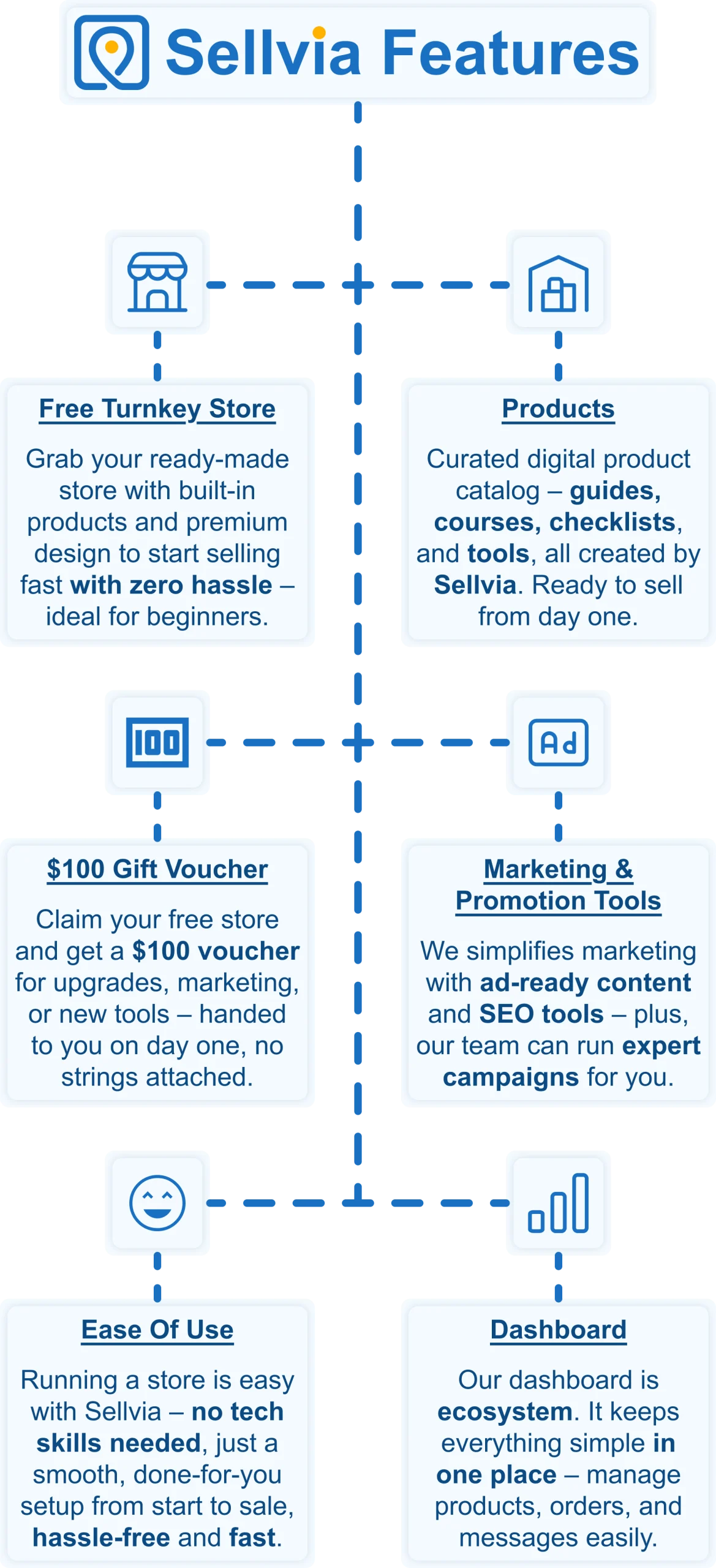
Want to start selling but don’t know where to begin? No worries! Just share your ideas, and Sellvia’s team will build a free ecommerce website that’s fully set up and ready to take orders from day one. No coding, no stress – just a store that works right out of the box.
A $100 gift voucher to grow your business faster 🎁
Starting a business takes momentum – and Sellvia gives you a head start. When you claim your free store today, you also get a $100 gift voucher to put toward growing your business. Use it to upgrade your store, boost your marketing, or unlock new tools. It is a real dollar value, handed to you on day one, with no catch and no hoops to jump through.
A massive catalog of digital products to sell 🏆
One of the biggest struggles in starting an online business is figuring out what to sell. Sellvia solves that completely. Your store comes pre-loaded with digital products – guides, courses, checklists, and tools – all created by Sellvia. You keep 50–70% of every sale. No inventory. No shipping. No logistics headaches.
Everything in one easy-to-use platform 🔥
Managing an online store shouldn’t be complicated. With Sellvia, you can handle orders, add new products, and even chat with customers – all from a simple and user-friendly platform. No need to mess with confusing tools or deal with unnecessary tech stuff. It’s all smooth sailing.
No upfront costs, just start selling 💰
A big reason people hesitate to start an online business is the cost. But here’s the good news: With Sellvia, you don’t need to invest in stock, storage, or shipping supplies. You can run your store with no upfront costs, keeping things low-risk while still making money.
Support that’s always got your back 🤝
Running a business comes with questions, but you’re never alone. Sellvia’s dedicated support team is available 24/7 to help with anything you need. Whether it’s a small question or a big challenge, they’ve got you covered.
Bond funds build wealth over time – and a Sellvia store can start adding income right now. Claim your free store today and start earning from your very first sale.