If you have ever posted a video, written a blog, or shared advice on social media – you are already closer to making money as a content creator than you think. In 2026, the creator economy is worth hundreds of billions of dollars, and more people than ever are earning real income by doing what they love online.
But here is the honest truth: knowing how to make money as a content creator is the part most beginners get wrong. They create great content and then wait for money to appear. It does not work that way. You need a strategy – and this guide gives you one.
Quick Answer: Content creators earn income through advertising revenue, affiliate marketing, selling digital products, brand sponsorships, membership platforms, and coaching. Most successful creators use two or three methods at once. Building consistent income typically takes 6–12 months of focused effort.
The creator economy is not just for celebrities and influencers with millions of followers. Regular people – teachers, parents, hobbyists, retirees – are building income online every single day. The key is picking the right methods for where you are right now and starting before you feel completely ready.
What does it mean to make money as a content creator?
A content creator is anyone who produces online content – videos, blog posts, podcasts, social media posts, courses, or guides – and builds an audience around it. The audience is the asset. The income comes from monetizing that audience in different ways.
In 2026, the tools available to creators are better than ever. You do not need a studio, a big team, or years of experience. A smartphone, a consistent posting schedule, and a clear niche are enough to get started. What matters most is showing up consistently and delivering genuine value to a specific group of people.
What makes content creation valuable is that your knowledge and perspective are unique. Whether you are into personal finance, fitness, parenting, cooking, or travel – there is an audience looking for exactly what you have to say. The challenge is not creating content. The challenge is turning that content into reliable income.
Important note: Making money as a content creator is not a quick path to riches. It requires consistency, patience, and a willingness to learn. But for people who stick with it, the income potential is real and grows significantly over time.
How much can you realistically earn?
The range is wide. Some creators earn 50 dollars a month. Others earn 50,000 dollars a month. What you earn depends on your niche, your platform, your audience size, and how many income streams you have running at once. The good news is that most successful creators combine two or three methods – and that is exactly what makes the income add up.
Here is a realistic breakdown of what different creator income methods typically pay:
The honest caveat: most creators do not hit the top of these ranges in their first year. For the first 6–12 months, expect to earn $0–$200/month while you build an audience. After 12–24 months of consistent effort, $500–$2,000/month is realistic for creators who combine two or three methods. Full-time income of $3,000+/month is absolutely possible but requires sustained effort and smart monetization from the start.
Why this works in 2026: The creator economy keeps expanding. More brands are shifting advertising budgets toward creator partnerships, and digital product sales continue to grow as people prefer learning online over traditional education formats.
The top ways to make money as a content creator
There is no single best method. The smartest creators stack multiple income streams so that no single platform or algorithm change can wipe out their earnings. Here is a deep look at each approach, starting with the most accessible for beginners.
Earning through platforms
Ad revenue
This is the most well-known creator income method. YouTube, blogs, and podcasts all let you earn money by allowing ads to run alongside your content. YouTube pays per thousand views – typically $1–$5 per thousand views for most niches, though finance and business content can earn $10–$30 per thousand views. To qualify for YouTube’s Partner Program, you need 1,000 subscribers and 4,000 watch hours. That takes most new creators 6–18 months to reach.
Blogs monetized through display ad networks need at least 25,000–50,000 monthly visitors before seeing meaningful income. Premium ad networks like Mediavine and Raptive pay significantly more than Google AdSense, but they require meeting those traffic thresholds first. Ad revenue is a long game – great for building a foundation, but not where beginners should focus their monetization energy early on.
Earning potential: $10–$500/month in the first year; $500–$5,000+/month once you have significant traffic or views.
Affiliate marketing
With affiliate marketing, you recommend products or services and earn a commission when your audience makes a purchase through your link. Amazon Associates pays 1–10% depending on the category. Software and digital products typically pay 20–50% commissions – which is why many creators focus on these over physical products.
The key to affiliate marketing is trust. Only recommend things you genuinely believe in, and your audience is far more likely to buy. A single video or blog post with the right affiliate link can earn income for years after you publish it. This is one of the most accessible methods for beginners because you can start with zero audience and grow your commissions as your reach grows.
Earning potential: $100–$3,000/month once you have an engaged audience of 5,000+ followers or 10,000+ monthly readers.
Selling your own content and expertise
Digital products
Selling digital products is one of the highest-return methods available to content creators. An e-book, course, template, checklist, or guide can be created once and sold hundreds of times. There is no inventory, no shipping, and no ongoing cost after the initial creation. You set the price. You keep most of the revenue. And you reach buyers anywhere in the world.
A well-positioned course in a high-demand niche – personal finance, fitness, parenting, career growth – can sell for $47–$497. Even at the lower end, selling 10 copies a month generates $470+ in income. Popular courses on platforms like Teachable or Gumroad regularly generate $1,000–$10,000/month for creators with engaged audiences. If you are already creating valuable content, you already have the raw material for a digital product.
Earning potential: $200–$5,000+/month depending on price point, audience size, and how well you market the product.
Membership platforms
Platforms like Patreon allow your most dedicated fans to support you directly through monthly payments. In exchange, you offer exclusive content, early access, behind-the-scenes material, or direct access to you as the creator. Even a small, dedicated community generates reliable monthly income. 100 members paying $10/month equals $1,000/month. 500 members at $15/month equals $7,500/month.
The real advantage of memberships is that the income is recurring and predictable. It also creates a tight-knit community that becomes your most loyal audience segment – the people most likely to buy any other product or service you launch. Start with a low barrier entry tier ($5–$10/month) to build membership numbers before increasing pricing.
Earning potential: $200–$2,000/month for creators with an engaged niche audience of 2,000–20,000 followers.
High-value creator income
Brand sponsorships
Brand deals are where significant income potential lives for creators who have built a following. Companies pay creators to feature their products or services – in videos, blog posts, social media content, or podcasts. You do not need millions of followers to get paid for this. Micro-influencers with 10,000–50,000 engaged followers routinely charge $200–$1,000 per sponsored post.
Creators with 100,000+ followers can command $2,000–$10,000 per deal. The key metric brands care about is engagement, not raw follower count. A small but highly engaged audience is worth more than a large disengaged one. To attract brands, build a professional media kit listing your audience demographics, engagement rate, and platform statistics. Pitch brands in your niche directly – do not wait to be discovered.
Earning potential: $500–$10,000+ per deal, with established creators doing multiple deals per month.
Coaching and consulting
If you have expertise in a specific area – fitness, business, relationships, career growth, personal finance – you can offer one-on-one coaching or consulting sessions to your audience. This is often the fastest way to earn meaningful income early in your creator journey because you can start with just two or three clients and no large following required.
Coaching rates typically run $50–$300 per hour for beginners and $300–$1,000 per hour for established experts. Group coaching programs can generate $2,000–$10,000+ per cohort. The main trade-off is that this method trades time for money, which is why many creators use coaching as a bridge income while building more scalable digital products and courses on the side.
Earning potential: $500–$5,000/month for part-time coaching, more for creators with premium positioning and a proven audience.
Legal and ethical considerations every creator should know
Getting paid as a content creator comes with real responsibilities. Ignoring the legal side can cost you your audience’s trust – or worse, real financial and legal consequences. This part is not optional, and understanding it protects both your income and your reputation.
Key principle: Transparency is not optional. Your audience trusts you. Protecting that trust protects your income.
- Disclose sponsored content. The FTC requires creators to clearly label paid and sponsored content. Use “#ad” or “#sponsored” in a visible location – not buried in a caption or description. This applies to YouTube, Instagram, TikTok, blogs, and podcasts.
- Respect copyright. Do not use music, images, or video clips you do not have rights to. Use royalty-free libraries like Unsplash, Pexels, or YouTube Audio Library. Copyright strikes can get channels demonetized or permanently removed.
- Protect audience privacy. If you collect email addresses or run analytics on your website, you need a clear privacy policy. If you are reaching EU visitors, GDPR compliance is a legal requirement.
- Report your income. Creator income is taxable. Keep records of every payment you receive – from ad networks, affiliates, sponsorships, and product sales. Set aside 25–30% for taxes from the very first dollar you earn.
Important: Avoid tactics like buying followers, generating fake engagement, or hiding affiliate links. These practices can get you banned from platforms and permanently damage the trust you worked hard to build.
Strategies that help content creators earn more
Knowing the income methods is one thing. Applying them effectively is another. These are the strategies that separate creators who earn consistently from those who stay stuck at zero for months.
Pick a specific niche
Trying to create content for everyone means you reach no one well. The most successful creators are known for something specific – personal finance for single mothers, fitness for people over 50, cooking for beginners on a tight budget. Specificity builds a loyal audience faster, and loyal audiences spend more money on the recommendations and products their trusted creator recommends.
Post consistently, not constantly
Consistency beats frequency every time. One great video or article per week outperforms three rushed ones. Pick a schedule you can realistically maintain for a full year and stick to it. Algorithms reward consistent creators, and audiences come back when they know what to expect. Burnout is the number one reason most creators quit before they start earning.
Build an email list from day one
Social media platforms can change their algorithms or terms overnight. Your email list is an asset you own completely. Even 1,000 engaged email subscribers can generate more income than 10,000 passive social media followers. Offer a free checklist, guide, or mini-course in exchange for an email address and start building your list from day one – regardless of which platform you are creating on.
Stack your income streams
Do not rely on a single income method. The most stable creator businesses run three or more streams at the same time – for example: an affiliate link in every blog post, a course for sale in every video description, and one or two brand deals per month. Stacking income streams protects you when one stream dips due to algorithm changes or seasonal slowdowns.
Invest back into your content
The creators who grow fastest reinvest their early earnings into better tools, education, or targeted promotion. A better microphone, a video editing course, or a small paid promotion budget can accelerate growth significantly. Treat content creation like a business, not a hobby, and your results will reflect that shift in mindset.
Which approach is right for you?
Not every method suits every person or every starting point. Here is a breakdown to help you match the right strategy to where you are right now.
Complete beginner
If you are brand new to content creation, start with one platform and one niche. YouTube or blogging are the most monetizable long-term. Pick affiliate marketing as your first income method – it has the lowest barrier to entry and can generate income before you have a large audience. Aim for your first $100/month within 3–6 months as a realistic early milestone.
Intermediate creator
If you already have some content and a small audience of 1,000–10,000 followers, add a digital product to your mix – even a simple $27 guide or template. Your existing audience already trusts you. Converting even 1% of them into buyers once a month adds meaningful income. Begin pitching smaller brands for sponsorships as a second parallel stream.
Full-time goal
If your goal is to replace a full-time income, think like a business owner from the start. Target $3,000–$5,000/month from a combination of ad revenue, affiliate commissions, a flagship course or digital product, and recurring membership income. This is achievable within 18–36 months for creators who treat content creation as a full-time effort and invest consistently in growth.
Looking for income faster
If you need income sooner rather than later – in the next 30–90 days – content creation alone is a slow path. Building an audience takes time. Consider adding a separate online income stream that does not depend on a large following. Selling digital products through an established platform is one option. Another is launching an online store where the products, advertising, and infrastructure are already in place so you can focus on generating your first sales right away.
Why Sellvia is a game-changer for your online store 🚀
Sellvia isn’t just another ecommerce tool. We are a trusted name in the industry, recognized by Forbes and even ranked in Inc.’s list of the 5,000 fastest-growing companies in the U.S. So if you’re serious about starting as a solopreneur, this is a smart place to begin.
Starting an online business can feel overwhelming, but that’s exactly where Sellvia steps in. It takes care of the tricky parts, so you can focus on making sales and growing your brand. Let’s break down what makes it such a great choice.
Get a ready-to-go store hassle-free 🎯
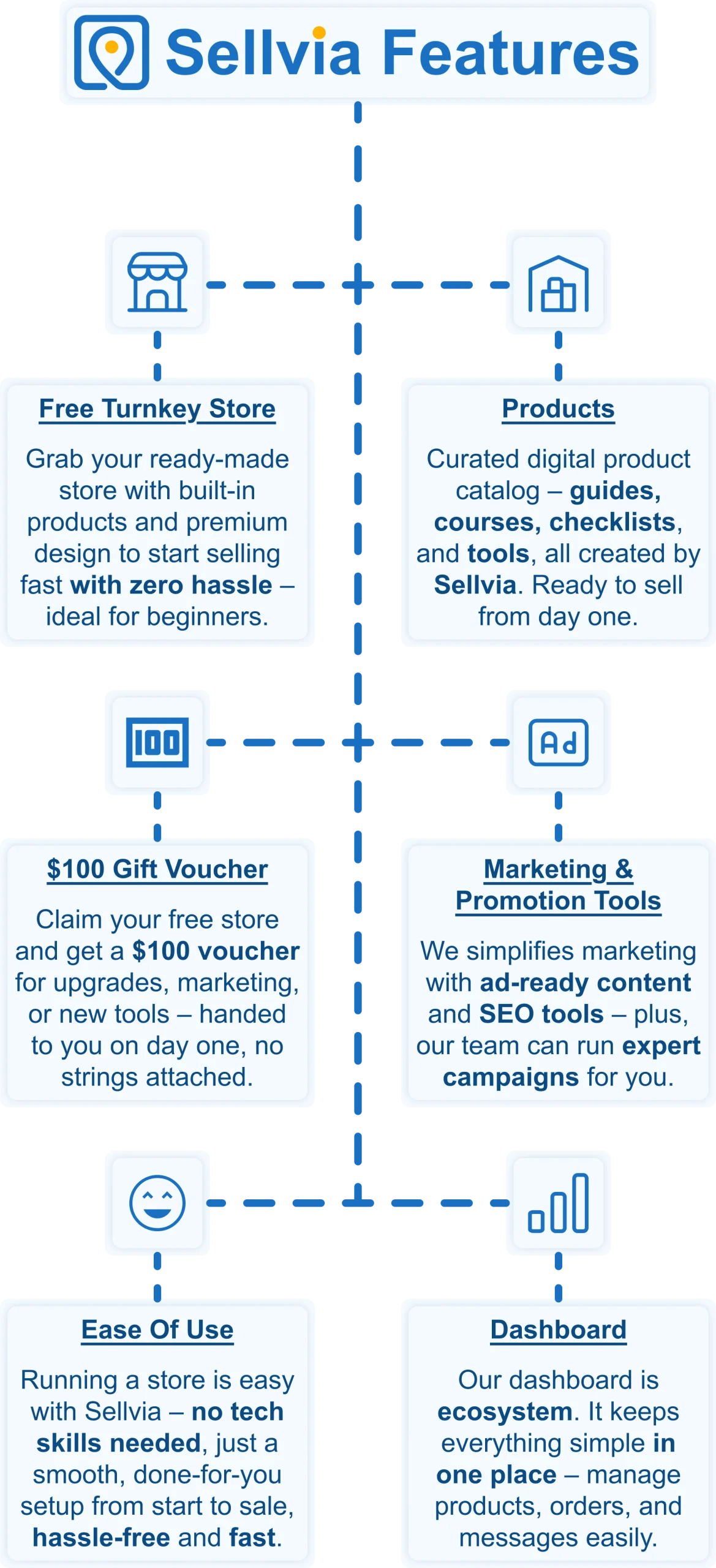
Want to start selling but don’t know where to begin? No worries! Just share your ideas, and Sellvia’s team will build a free ecommerce website that’s fully set up and ready to take orders from day one. No coding, no stress – just a store that works right out of the box.
A $100 gift voucher to grow your business faster 🎁
Starting a business takes momentum – and Sellvia gives you a head start. When you claim your free store today, you also get a $100 gift voucher to put toward growing your business. Use it to upgrade your store, boost your marketing, or unlock new tools. It is a real dollar value, handed to you on day one, with no catch and no hoops to jump through.
A massive catalog of digital products to sell 🏆
One of the biggest struggles in starting an online business is figuring out what to sell. Sellvia solves that completely. Your store comes pre-loaded with digital products – guides, courses, checklists, and tools – all created by Sellvia. You keep 50–70% of every sale. No inventory. No shipping. No logistics headaches.
Everything in one easy-to-use platform 🔥
Managing an online store shouldn’t be complicated. With Sellvia, you can handle orders, add new products, and even chat with customers – all from a simple and user-friendly platform. No need to mess with confusing tools or deal with unnecessary tech stuff. It’s all smooth sailing.
No upfront costs, just start selling 💰
A big reason people hesitate to start an online business is the cost. But here’s the good news: With Sellvia, you don’t need to invest in stock, storage, or shipping supplies. You can run your store with no upfront costs, keeping things low-risk while still making money.
Support that’s always got your back 🤝
Running a business comes with questions, but you’re never alone. Sellvia’s dedicated support team is available 24/7 to help with anything you need. Whether it’s a small question or a big challenge, they’ve got you covered.
The same drive that makes you a great content creator is exactly what it takes to run a thriving online store. Start your free Sellvia store today and put your entrepreneurial energy to work.