Most artists are told to “follow your passion” – but passion alone does not pay the bills. The truth is, in 2026, there are more ways than ever to turn your creative skills into real, consistent income. Whether you paint, illustrate, design, or create digital art, there is a clear path from making art to earning money from it.
Quick answer: Artists can make money by selling original works, prints, commissions, and digital products – or by teaching, licensing their art, and building an online presence. Income ranges from $200 to $5,000+ per month depending on the method and how consistently you show up.
This guide breaks down the most realistic ways to make money as an artist in 2026 – what each approach involves, how much you can earn, and where to focus first if you are just getting started.
The artists who earn consistently do not rely on a single income source. They combine methods – a few commissions here, some print sales there, maybe a digital download shop or a course. Understanding the full picture is the first step to building something that actually works for you.
What does making money as an artist mean in 2026?
Making money as an artist used to mean selling paintings at a local gallery or taking portrait commissions for cash. That still exists – but it is a small slice of what is possible today. In 2026, making money as an artist means building multiple income streams around your creative skills, both online and in person.
The biggest shift in recent years is digital. Artists can now sell digital products – downloadable prints, illustrated guides, design files, creative courses, and more – without ever touching a shipping box. A piece of work you create once can sell hundreds of times. The overhead is low, the reach is global, and the startup cost is minimal.
Beyond digital, artists also earn through commissions, teaching, licensing deals, and selling on platforms like Etsy and Redbubble. The key is choosing the methods that match your skills, your style, and the time you realistically have available to invest each week.
How much can you realistically earn as an artist?
Income as an artist varies enormously depending on your method, your consistency, and how long you have been building your audience. Here is a realistic breakdown of what different approaches tend to pay in 2026:
Most artists starting out earn $200–$800 per month in their first year. By combining two or three methods consistently and growing an audience, reaching $2,000–$5,000 per month within 12–24 months is realistic for those who treat it like a real business.
One note on these figures: The ceiling numbers require a built audience, a high volume of products, or significant effort over time. Do not expect top-end results in your first 60 days. A realistic early goal is $30–$80 per day, and building from there.
The artists who reach the higher end of these income ranges almost always share one trait – they did not wait until they felt “ready.” They started, learned from real feedback and real sales, adjusted, and kept going. The timeline is shorter than most people expect once you are actually in motion.
Top ways to make money as an artist in 2026
There is no single best method – the right approach depends on your art style, your schedule, and how much you want to interact directly with customers. Below are the most reliable paths artists use to build real income today.
Selling original art and prints
Selling your original work is the most traditional path. Original paintings and illustrations can command strong prices, especially as you build a reputation. The challenge is that each piece takes time to create and can only be sold once.
Print-on-demand platforms solve this problem by letting you upload your designs and sell unlimited copies without managing any printing or fulfillment yourself. When someone buys a print, the platform handles production and delivery – you earn your cut without lifting a finger on the logistics side.
Best platforms for selling art online
Etsy is one of the most visited platforms for handmade and artistic goods, with millions of active buyers searching every day. Setting up a shop is straightforward, and you gain access to a built-in audience that is already looking for art. Strong product photography and detailed descriptions make the biggest difference in how quickly your listings convert.
Redbubble and Society6 are popular print-on-demand platforms where you upload your designs and they handle the rest. Both take a cut of each sale, so your margins per item are smaller – but there is no upfront cost and zero fulfillment work involved. Many artists use these platforms to test which designs resonate before investing more deeply.
Saatchi Art is designed specifically for fine art buyers and collectors. If your work is strong and priced appropriately, this platform connects you with serious buyers willing to invest in original or limited-edition pieces.
Art fairs and local markets
In-person sales through art fairs, craft markets, and local exhibitions give you the chance to connect directly with buyers. People often spend more when they can see the work up close and hear the story behind it. Booth fees vary widely – start with smaller, lower-cost local events while you build confidence and test which work sells best in person.
Commissioned work
Taking commissions means creating custom artwork for clients who pay you to make something specifically for them. Portraits, pet illustrations, logo design, and mural work are all common commission types. Pricing commissions depends on your style, your level of experience, and the size and complexity of the project.
The key to making commissions a reliable income stream is having a clear process – a simple brief form, a defined timeline, and a pricing structure that does not undervalue your time. Most artists charge a deposit upfront to protect against cancellations, which is standard practice and completely appropriate to require.
Earning potential: $50–$500 per commission depending on scope and your reputation. A steady backlog of repeat clients can bring in $800–$2,000 per month once you have built word-of-mouth.
Teaching art and running workshops
If you can do it, you can teach it. Art classes and workshops are a strong income source for artists at every level, and demand for creative instruction has grown steadily as more people look for meaningful hobbies and new skills. You can teach in person at a community center or art supply store, or take your classes online through platforms like Skillshare, Teachable, or even live on Instagram or YouTube.
Online courses carry one big advantage: you create the content once and it earns for months or years afterward. A well-produced class on a specific technique – watercolor florals, digital illustration, hand lettering – can bring in $500–$2,000 per month with a dedicated student base and steady promotion.
Why this works in 2026: The demand for creative skill development has grown alongside the rise of remote work and the shift toward self-directed learning. Platforms like Skillshare alone have millions of students actively searching for art instruction every month.
How to get started with art classes
Start with what you know best. Do not try to teach everything at once – a focused class on one specific technique performs better than a broad “intro to art” course. Record a short free lesson first, share it on social media or in a relevant online community, and see what interest it generates before investing time in a full multi-lesson course. Let real demand guide what you build.
Licensing your artwork
Art licensing means allowing companies to use your designs on their products – phone cases, greeting cards, textiles, stationery, home goods – in exchange for a royalty or flat fee. This can be a strong income source once you have a portfolio of work and understand how to pitch it to the right brands.
Companies like Spoonflower, Society6, and Vida actively seek artists for licensing partnerships. You can also pitch directly to brands whose aesthetic matches your style. Royalties typically run 5–15% of each product sold, which adds up quickly when a design ends up on a product line with wide distribution.
Earning potential: $100–$3,000/month depending on the number of active licenses and sales volume. A single popular design on a widely distributed product can earn consistently for years with no ongoing work required.
Selling digital products and downloads
This is one of the fastest-growing income methods for artists right now. Digital products – downloadable art prints, coloring pages, surface pattern files, illustration packs, Procreate brushes, or creative guides – can be created once and sold an unlimited number of times. No printing, no logistics, no overhead.
Etsy has a strong digital downloads section, and many artists build entire businesses there. Gumroad and Creative Market are also popular platforms for selling creative digital goods directly. The economics are strong: once a product is live, every sale after the first is nearly pure profit.
Important: The artists who do best with digital products build a catalog of 20, 30, or 50 products over time. A larger catalog means more search entries, more traffic, and more consistent monthly sales – not just one-off wins.
How to build your artist brand online
No matter which income method you choose, having a consistent online presence helps every single one of them. Artists with a recognizable online brand attract more commissions, more sales, and more students – often without spending money on advertising.
Start simple. Pick one or two platforms and show up consistently. Instagram and TikTok reward process videos and behind-the-scenes content – both formats that come naturally to artists. Pinterest drives long-term traffic to your shop without requiring a large following. A simple website or Linktree ties everything together and makes it easy for buyers to find you.
Your brand does not need to be perfect. It just needs to be real and consistent. Show your work. Share your process. Let your personality come through. Buyers connect with artists they feel like they know – and that connection is what turns a casual browser into a loyal customer who comes back again and again.
Legal and ethical considerations for artists
Making money as an artist comes with a few important responsibilities that are easy to overlook when you are just getting started.
Key principle: Always use original work or properly licensed reference material. Selling art based on another person’s photo, character, or design without permission can lead to copyright claims – even if you painted or illustrated it yourself from scratch.
Protect your own work by watermarking digital previews and using platform tools that track unauthorized use. Registering original works with the U.S. Copyright Office gives you stronger legal standing if disputes ever arise.
On the business side, treat your income like a business from the start. Keep records of sales, set aside money for taxes (self-employment tax applies to freelance income in the U.S.), and look into registering as a sole proprietor or LLC once your income becomes consistent.
Important note: Misleading “original” listings for reproductions, fake reviews, or using AI-generated art without disclosure can damage your reputation and violate platform terms of service. Transparency builds trust – and trust is the foundation of every long-term income stream.
How to choose the right path for where you are now
Not every income method makes sense for every artist. The right choice depends on your skills, your schedule, and how quickly you need results. Here is a breakdown based on where you are starting from.
Complete beginner
If you are just starting out and want income as soon as possible, begin with digital downloads on Etsy. Low setup cost, no inventory needed, and instant access to a large buyer pool. Aim to create 10–20 listings in your first month and focus on high-demand niches like printable wall art, coloring pages, or illustrated planner templates. Expect your first sales within 30–60 days with consistent promotion.
Part-time and building momentum
If you already have some work online and want to grow your income, add commissions or online classes to your mix. These give you direct, higher-margin income while you continue building your digital product catalog. Start with one class focused on your strongest skill area and promote it to your existing audience before building anything more elaborate.
Full-time income goal
If your goal is to fully replace your current income with earnings from your art, you need multiple streams running simultaneously. Combine digital downloads, an online course, regular commissions, and a ready-to-go online store. Artists who consistently earn $3,000–$5,000 per month from their creative work typically have at least three of these active at the same time and treat each one as a business, not a hobby.
Whatever stage you are at, the most important step is starting. You will learn more from your first 10 real sales than from 100 hours of reading about it. Progress is built through action – not preparation.
A faster way to build income alongside your art
Art income is real – but it takes time to build an audience, a reputation, and consistent sales. While you are growing that side of your creative business, there is a complementary path that many artists overlook: running a simple online store that sells digital products you did not have to create yourself.
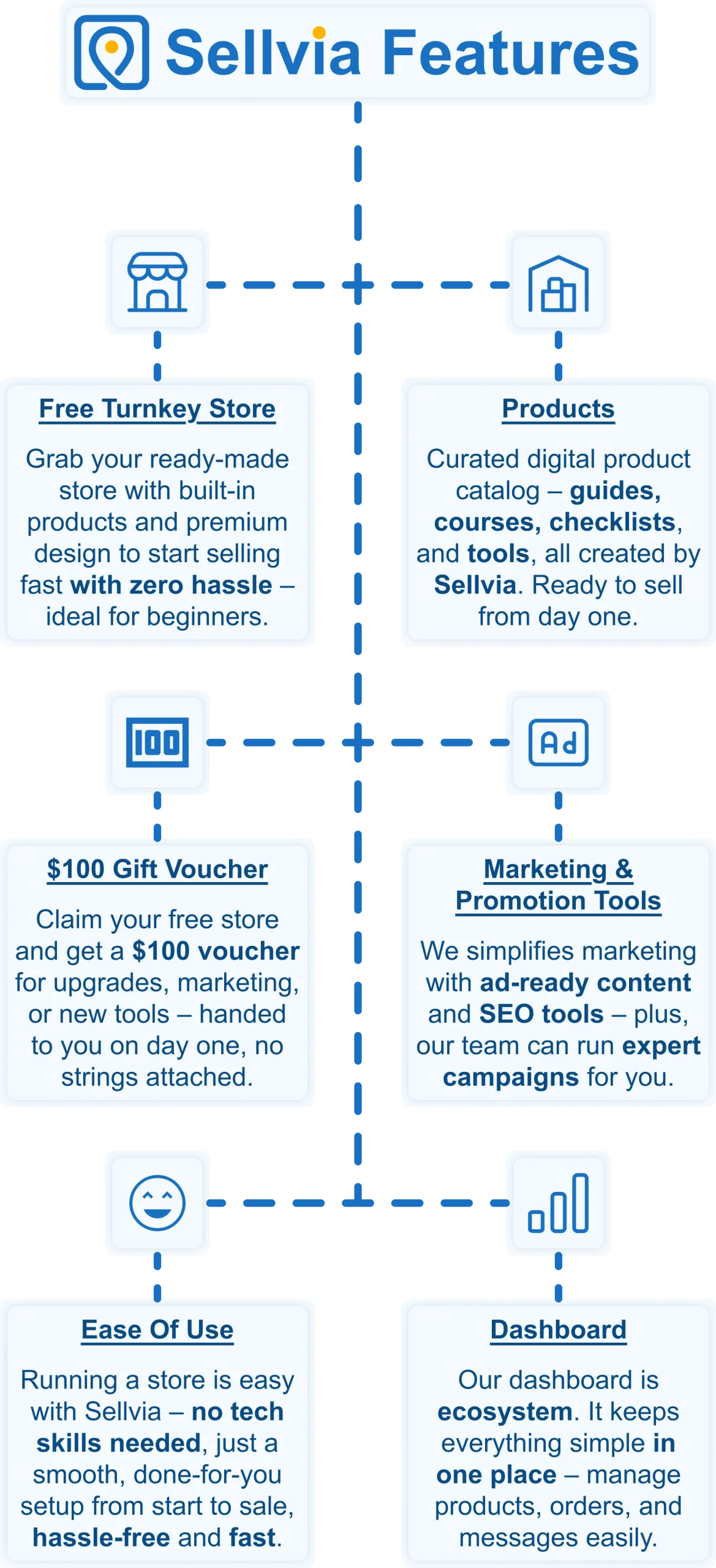
Sellvia gives you a fully built online store pre-loaded with digital products – guides, courses, checklists, and tools – all created by Sellvia and ready to sell. You keep 50–70% of every sale. There is no design work, no content creation, and no inventory. You just activate the built-in advertising system and start making sales. It is a separate income stream that runs in the background while you focus on your art.
For creative people who already understand the value of digital content, this model makes a lot of sense. You are not replacing your art business. You are adding a second engine to it.
Why Sellvia is a game-changer for your online store 🚀
Sellvia isn’t just another ecommerce tool. We are a trusted name in the industry, recognized by Forbes and even ranked in Inc.’s list of the 5,000 fastest-growing companies in the U.S. So if you’re serious about starting as a solopreneur, this is a smart place to begin.
Starting an online business can feel overwhelming, but that’s exactly where Sellvia steps in. It takes care of the tricky parts, so you can focus on making sales and growing your brand. Let’s break down what makes it such a great choice.
Get a ready-to-go store hassle-free 🎯
Want to start selling but don’t know where to begin? No worries! Just share your ideas, and Sellvia’s team will build a free ecommerce website that’s fully set up and ready to take orders from day one. No coding, no stress – just a store that works right out of the box.
A $100 gift voucher to grow your business faster 🎁
Starting a business takes momentum – and Sellvia gives you a head start. When you claim your free store today, you also get a $100 gift voucher to put toward growing your business. Use it to upgrade your store, boost your marketing, or unlock new tools. It is a real dollar value, handed to you on day one, with no catch and no hoops to jump through.
A massive catalog of digital products to sell 🏆
One of the biggest struggles in starting an online business is figuring out what to sell. Sellvia solves that completely. Your store comes pre-loaded with digital products – guides, courses, checklists, and tools – all created by Sellvia. You keep 50–70% of every sale. No inventory. No shipping. No logistics headaches.
Everything in one easy-to-use platform 🔥
Managing an online store shouldn’t be complicated. With Sellvia, you can handle orders, add new products, and even chat with customers – all from a simple and user-friendly platform. No need to mess with confusing tools or deal with unnecessary tech stuff. It’s all smooth sailing.
No upfront costs, just start selling 💰
A big reason people hesitate to start an online business is the cost. But here’s the good news: With Sellvia, you don’t need to invest in stock, storage, or shipping supplies. You can run your store with no upfront costs, keeping things low-risk while still making money.
Support that’s always got your back 🤝
Running a business comes with questions, but you’re never alone. Sellvia’s dedicated support team is available 24/7 to help with anything you need. Whether it’s a small question or a big challenge, they’ve got you covered.
Artists who are serious about making money from their creativity deserve more than one income stream. Claim your free Sellvia store today and add a second engine to your income.