
Every week, thousands of Americans search for how to make money day trading. The appeal is real – buying and selling stocks from your phone, answering to nobody, and walking away with cash at the end of the day. Financial freedom sounds like it is one good trade away.
Quick Answer: Day trading means buying and selling stocks, currencies, or other financial instruments within the same trading day to profit from short-term price movements. Experienced traders can earn $500–$5,000 or more per month, but roughly 70–80% of beginners lose money in their first year. Success requires months of practice, significant starting capital, and the kind of emotional discipline most people underestimate before they begin.
This guide gives you the full picture – what day trading actually is, how much you can realistically earn, which strategies professionals use, and an honest look at the risks. If you are searching for a way to build income in 2026, you deserve the truth about what this path involves before you commit to it.
Understanding how to make money day trading starts with separating what the ads promise from what the data actually shows. Whether day trading becomes your path or you find a smarter alternative, the goal of this guide is simple: give you clear, honest information so you can make the right call for your situation.
What is day trading?
Day trading is a style of active trading where you buy and sell financial instruments – most commonly stocks, currency pairs, futures contracts, or options – within the same trading day. The goal is not to hold assets for long-term appreciation. The goal is to capture short-term price movements and close every open position before the market shuts at 4:00 PM Eastern.
This is fundamentally different from traditional investing. Day traders are not betting on a company’s long-term growth story. They are betting on where a price will move in the next few minutes or hours – and they need to be right more often than they are wrong to come out ahead after fees and taxes.
Day trading is legal and regulated in the United States. The Securities and Exchange Commission (SEC) classifies anyone who makes four or more day trades within five business days as a “pattern day trader.” Under this rule, you must maintain a minimum of $25,000 in a margin account at all times. This requirement alone puts standard day trading out of reach for a large portion of people who are searching for ways to earn income from home.
Core concepts every new trader must understand
Rapid transactions
Active day traders execute dozens – sometimes hundreds – of trades in a single session. Each individual trade targets a small price move, often less than 1%. The strategy relies on volume: enough small wins across enough trades to generate meaningful daily income. This is why fast platforms, reliable data feeds, and low transaction fees matter so much at this level.
Closing positions before market close
Most day traders close every position before the trading day ends. The reason is overnight risk – sudden price gaps caused by earnings releases, economic data, or global market events that happen while U.S. markets are closed. A stock that closed at $50 can open the next morning at $43 because of a single after-hours announcement. Closing daily is how traders manage that exposure.
Leverage and margin
Many brokerages allow day traders to use margin – borrowed money – to take larger positions than their cash balance alone would support. This amplifies potential gains, but it amplifies losses at exactly the same rate. Important: Using margin without strict, pre-set risk management rules is one of the most reliable ways to lose your entire trading account, especially as a beginner.
Now that you understand what day trading is, it is worth asking the harder question – how much can you actually expect to earn? That answer is more nuanced than most trading content will admit.
How much can you realistically earn day trading?
This is the question that matters most, and the honest answer depends on your experience level, your starting capital, your time commitment, and – perhaps most importantly – your emotional discipline under pressure. The table below reflects real-world outcomes, not best-case testimonials.
The Sellvia row is included for context because many people searching for how to make money day trading are really looking for financial freedom – and there are paths that offer similar income potential with significantly lower startup requirements and no mandatory $25,000 account balance.
One note on the ceiling figures: The upper-end numbers – $3,000 to $5,000+ per month – require starting capital of $25,000 or more, full-time commitment, and at minimum 6–12 months of deliberate practice. Most part-time traders with smaller accounts realistically earn between $200 and $800 per month in strong months during their first year. Many earn nothing at all, or lose money.
Day trading income is also deeply unpredictable. Strong weeks and rough weeks follow no reliable pattern. Markets shift character without warning, and strategies that worked last quarter can stop working entirely. This unpredictability makes day trading a poor choice as a primary income source for anyone who depends on steady monthly cash flow to cover their bills.
Ready to dig into the practical side? Here is exactly how to get started with day trading – step by step, with no shortcuts skipped.
How to get started with day trading
If you are serious about learning how to make money day trading, you need more than a brokerage account and a few YouTube videos. You need a real foundation. Here is a practical roadmap for beginners starting from zero.
Step 1: Build your knowledge base
Think of day trading as a skilled profession, not a side hustle you can pick up on a weekend. Before risking a single dollar, spend time learning the following:
- Financial instruments: Stocks are the most beginner-friendly starting point. Understand how they are priced, how order types work, and what drives short-term price movements before looking at forex, options, or futures contracts.
- Market mechanics: Learn how bid-ask spreads affect your real entry and exit price, how market orders vs. limit orders behave under different conditions, and what trading volume tells you about the strength behind a move.
- Technical analysis basics: Study candlestick charts, support and resistance levels, and key indicators like moving averages and the Relative Strength Index (RSI). Most active traders rely heavily on these tools to find entries and exits.
- Risk management: Never risk more than 1–2% of your total account on a single trade. This is the rule that keeps beginners alive long enough to actually learn from their mistakes.
Free resources include Investopedia’s day trading guides, paper trading simulators offered by most major brokerages, and active forums where experienced traders share live setups. Spend 60–90 days in paper trading before committing any real money.
Step 2: Choose the right brokerage
Your brokerage is your gateway to the market. Not all of them are designed for the speed and volume that day trading demands. Look for these key features:
- Low commissions: With dozens of trades per day, transaction fees pile up fast. Many U.S. brokerages now offer commission-free stock trading, though options and futures typically still carry per-contract fees that add up.
- Fast, reliable platform: You need real-time data and a platform that does not freeze during high-volume market moves. A system crash or delay at the wrong moment can turn a winning trade into a loss within seconds.
- Educational resources: The best brokerages for beginners offer paper trading features, tutorials, and webinars. TD Ameritrade’s thinkorswim platform, Webull, and Interactive Brokers all have strong educational components for new traders.
- Responsive customer support: When a technical issue comes up mid-trade, fast support is not a luxury – it is a necessity.
Step 3: Build a trading plan and actually follow it
No professional trader operates without a written plan. Yours should define your daily profit target, your maximum loss limit (the dollar amount at which you stop trading for the day), the specific strategy you will use, and a weekly review process to evaluate your performance over time.
The reason trading plans matter more than most beginners expect is this: markets are emotional environments. When a trade starts moving against you, the instinct is to hold on and wait for a recovery. That instinct is expensive. A written plan with pre-set stop-loss levels forces you to cut losing trades before they become account-damaging losses – and that discipline is what separates traders who last from those who burn out.
Day trading strategies that actually work
There is no single best strategy for how to make money day trading. The right approach depends on your risk tolerance, your schedule, and how much screen time you can realistically commit. Here are the three most widely used strategies among retail traders in 2026.
Scalping
Scalping is the most high-frequency approach to day trading. Scalpers hold positions for seconds to a few minutes, targeting tiny price movements – often just cents per share – and making up for thin margins with very high trade volume. A scalper might execute 50 to 100 trades in a single session, stacking small wins into meaningful daily totals.
Why this works in 2026: Tight bid-ask spreads on high-liquidity stocks and fast retail trading platforms have made scalping more accessible than it was a decade ago. Electronic execution speeds that were once available only to institutional firms are now within reach for individual traders with the right setup.
The downside is real. Scalping demands intense, unbroken focus for hours at a time. Even small per-trade commission fees can seriously erode profits at high volume. Most financial educators do not recommend scalping as a starting strategy for beginners – the margin for error is too thin and the cognitive load too high.
Momentum trading
Momentum trading is about riding stocks that are already moving strongly in one direction. When a company reports better-than-expected earnings, a product launch goes viral, or a major news event hits a sector, momentum traders aim to enter early and exit before the trend reverses.
The key tools are financial news feeds, pre-market volume scanners, and breakout recognition on charts. A stock breaking above a key resistance level on unusually high volume is a classic momentum signal. Experienced momentum traders have clear entry criteria – and even clearer exit rules – because reversals happen fast and without much warning.
Earning potential: $300–$3,000 per month for consistent momentum traders, though this depends heavily on starting capital, position sizing discipline, and overall market conditions in any given month.
Technical analysis trading
Technical analysis trading uses historical price data, chart patterns, and mathematical indicators to anticipate future price movements. Rather than reacting to news events, technical traders look at patterns on a chart and make decisions based on what those setups have historically tended to produce.
Common tools in this approach include:
- Moving averages: Help identify overall trend direction. A widely used signal is when a short-term moving average crosses above a longer-term one, suggesting upward momentum is building.
- Relative strength index (RSI): Measures whether a stock is overbought or oversold, helping traders time entries and exits with more precision than price action alone.
- Support and resistance levels: Price zones where stocks have historically reversed direction. These become natural targets for entry points, profit-taking levels, and stop-loss placement.
Technical analysis is a skill that takes months to develop properly. The same chart setup that worked reliably last quarter can stop working when overall market conditions shift. The most successful technical traders combine pattern recognition with volume data, broader market context, and strict position sizing rules – not charts alone.
Mastering any of these strategies takes real time and real practice. While you build that foundation, it helps to know exactly what tools the professionals are using every day.
Tools every day trader needs
Even the best strategy falls apart without the right infrastructure behind it. These are the tools serious traders keep in their toolkit every single session.
Trading platforms and charting software
A reliable trading platform with live market data is non-negotiable. Look for real-time Level 2 quotes, which show the full order book beyond just the surface-level bid and ask price. Advanced charting with multiple indicator overlays and fast order execution are equally important. thinkorswim by TD Ameritrade, TradeStation, and Webull are widely recommended at different price points. Poor execution speed – even a fraction of a second of delay – can be the difference between a profitable and a losing entry in a fast-moving market.
Real-time news feeds
Markets move on news, and traders who see it first hold a real edge. A single headline about interest rate policy, a product recall, or a government regulation can send individual stocks or entire sectors moving 5–10% within minutes. Services like Benzinga Pro and Bloomberg Terminal provide market-specific alerts filtered to cut through general noise. Free tools like Finviz offer basic headline monitoring as a solid starting point before investing in paid services.
Stock screeners
A stock screener filters the entire market in real time based on your criteria – price movement percentage, unusual volume, sector, volatility range, or technical setups. Instead of manually watching hundreds of tickers, you set your filters and let the screener surface candidates that match your strategy. Finviz, Trade Ideas, and StockFetcher are among the most popular options for retail day traders at every experience level.
The mental and legal side of day trading
Most people who try day trading and fail do not fail because they chose the wrong strategy. They fail because they could not manage their emotions when real money was on the line.
Trading psychology is a well-documented field, and the core challenges are universal. Fear of missing out pushes traders into entries they had not planned. Fear of loss prevents them from cutting losers quickly, turning small setbacks into large ones. Overconfidence after a strong winning streak leads to oversized positions that destroy weeks of gains in a single bad session.
Key principle: Discipline and emotional control determine long-term trading success more than any strategy, indicator, or platform you will ever use.
The legal side deserves equal attention. The SEC’s pattern day trader rule requires a $25,000 minimum account balance for anyone making four or more trades per week. Trading in retirement accounts like IRAs comes with significant additional restrictions. And all trading profits are fully taxable – short-term capital gains are taxed at ordinary income rates ranging from 22–37% depending on your bracket. After taxes, the real take-home income from day trading is meaningfully lower than the gross figures most trading content promotes.
How to choose the right path for your goals
Knowing how to make money day trading is one thing. Knowing whether it is the right path for your specific situation is another. Here is an honest breakdown by where you are starting from.
Complete beginner
If you are new to investing and have limited savings, day trading is a high-risk entry point. The $25,000 SEC minimum alone puts professional-level day trading out of reach for most people starting from scratch. Before committing any real money, spend 60–90 days using a paper trading simulator to understand how the market actually behaves. In the meantime, consider building a lower-barrier income stream on the side – something that earns while you learn, rather than costing you while you practice.
Part-time income seeker
If you have a full-time job and are looking for side income, day trading is a difficult fit. The U.S. stock market runs from 9:30 AM to 4:00 PM Eastern – the exact hours most working people are unavailable. Swing trading, which involves holding positions for 2–5 days instead of closing daily, is a more practical alternative if you want market exposure without being glued to a screen. For those who want income that works around their schedule rather than against it, an online income stream that generates $30–$80 per day without requiring real-time attention is often a smarter first move.
Full-time entrepreneur or advanced goal
If you have the capital to invest, can dedicate full working days to the markets, and are genuinely willing to spend 6–12 months in deliberate study before going live with real money, day trading can become a legitimate income source over time. The most successful traders treat it exactly like a business: they log every single trade, review their performance weekly, and refine their approach based on what the data shows – not what their gut says. For people with this level of discipline and available capital, the income ceiling is genuinely high.
For everyone else – which is most people who search for how to make money day trading – there is a path to financial freedom that does not require $25,000 to start, years of practice before your first profit, or watching price charts during your lunch break.
Why Sellvia is a game-changer for your online store 🚀
Sellvia isn’t just another ecommerce tool. We are a trusted name in the industry, recognized by Forbes and even ranked in Inc.’s list of the 5,000 fastest-growing companies in the U.S. So if you’re serious about starting as a solopreneur, this is a smart place to begin.
Starting an online business can feel overwhelming, but that’s exactly where Sellvia steps in. It takes care of the tricky parts, so you can focus on making sales and growing your brand. Let’s break down what makes it such a great choice.
Get a ready-to-go store hassle-free 🎯
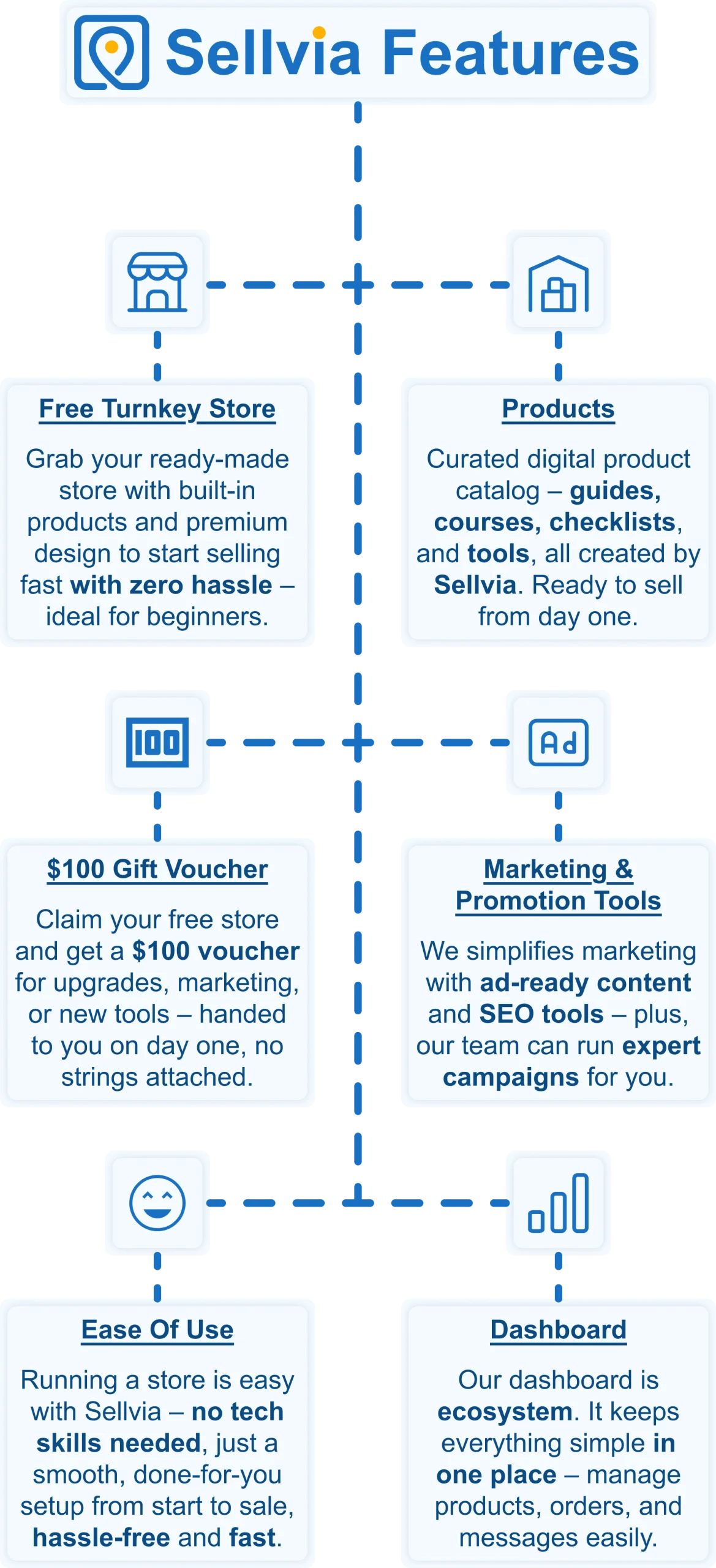
Want to start selling but don’t know where to begin? No worries! Just share your ideas, and Sellvia’s team will build a free ecommerce website that’s fully set up and ready to take orders from day one. No coding, no stress – just a store that works right out of the box.
A $100 gift voucher to grow your business faster 🎁
Starting a business takes momentum – and Sellvia gives you a head start. When you claim your free store today, you also get a $100 gift voucher to put toward growing your business. Use it to upgrade your store, boost your marketing, or unlock new tools. It is a real dollar value, handed to you on day one, with no catch and no hoops to jump through.
A massive catalog of digital products to sell 🏆
One of the biggest struggles in starting an online business is figuring out what to sell. Sellvia solves that completely. Your store comes pre-loaded with digital products – guides, courses, checklists, and tools – all created by Sellvia. You keep 50–70% of every sale. No inventory. No shipping. No logistics headaches.
Everything in one easy-to-use platform 🔥
Managing an online store shouldn’t be complicated. With Sellvia, you can handle orders, add new products, and even chat with customers – all from a simple and user-friendly platform. No need to mess with confusing tools or deal with unnecessary tech stuff. It’s all smooth sailing.
No upfront costs, just start selling 💰
A big reason people hesitate to start an online business is the cost. But here’s the good news: With Sellvia, you don’t need to invest in stock, storage, or shipping supplies. You can run your store with no upfront costs, keeping things low-risk while still making money.
Support that’s always got your back 🤝
Running a business comes with questions, but you’re never alone. Sellvia’s dedicated support team is available 24/7 to help with anything you need. Whether it’s a small question or a big challenge, they’ve got you covered.
If learning how to make money day trading showed you the power of building income on your own schedule, Sellvia gives you a smarter, lower-risk way to get there. Claim your free store today and start building real income with digital products.