
Millions of Americans are searching for ways to build wealth on their own terms. And for many, the stock market feels like the answer. The idea is straightforward enough – buy shares in companies you believe in, watch them grow over time, and eventually stop worrying about money. For patient, long-term investors, that plan has worked for generations.
Quick answer: You make money in stocks primarily through capital gains (buying shares at a lower price and selling them higher) and dividends (regular cash payments from profitable companies). Most diversified, long-term investors see average annual returns of 7–10%. Real results take time – typically 5–10 years before compounding starts to make a visible difference in your account balance.
This guide covers every major strategy for making money in stocks, realistic earning expectations, how to protect yourself from the biggest risks, and – for those who want a faster path to income – one alternative that lets you start earning this week rather than years from now.
Stock investing rewards patience and punishes panic. Before putting a single dollar into the market, it is worth understanding the basics. Most of the people who lose money in stocks are the ones who skipped this step.
What is stock market investing?
When you buy a stock, you are purchasing a small ownership stake in a real company. If that company grows and becomes more valuable, your shares go up in price. If it struggles, your shares lose value. That is the core mechanic behind how to make money in stocks – and the core risk too.
Stock prices are driven by three main forces: company performance (profits, growth, leadership decisions), broader economic conditions (interest rates, inflation, unemployment), and investor sentiment (what millions of buyers and sellers collectively believe will happen next). All three forces move in unpredictable ways, which is why even the most experienced investors make mistakes.
There are two primary ways stocks generate returns for investors:
- Capital gains – You buy shares at one price and sell them at a higher price later. The difference, minus any taxes and fees, is your profit.
- Dividends – Some companies distribute a portion of their profits to shareholders on a regular schedule, typically every quarter. These payments come to you whether or not the stock price goes up.
A third force – compounding – is what makes long-term investing so powerful. When you reinvest dividends and let gains generate their own gains over time, your portfolio can grow far beyond what your original contributions would suggest. This is the engine behind most serious wealth-building strategies, and it needs time to work.
The catch is that compounding needs years, not months, to produce meaningful results. And it requires you to stay invested through the inevitable dips and downturns without selling in a panic. For many people who need income sooner, that timeline is where the plan hits a wall.
How much can you realistically earn from stocks?
This is the question every beginner asks, and the honest answer depends entirely on which strategy you use, how much capital you start with, and how long you stay in the market. Here is a clear breakdown of the main approaches:
Index funds are consistently the most reliable path for the average investor. Value investing can beat the market, but requires deep research and years of practice. Day trading is essentially a full-time job with a high failure rate – studies consistently show that over 70% of active day traders lose money over time.
One note on earning potential: The percentages above are long-term annual averages. In any single year, your returns can be higher – or deeply negative. A $10,000 investment growing at 8% annually becomes roughly $46,600 in 20 years. But you need to leave it there for all 20 of those years, through every dip and correction, to realize that gain.
For people who need income in weeks rather than decades, the stock market alone is not the answer. That is why many smart earners in 2026 combine a long-term investing strategy with an online income stream that pays much sooner – which we will get to later in this guide.
Key investment strategies for making money in stocks
There is no single right way to invest in the stock market. The best strategy depends on your timeline, your risk tolerance, and how actively you want to manage your money. Here are the four proven approaches that actually deliver results.
Growth and value investing
Value investing
Value investing means identifying companies whose stock price is lower than what the business is actually worth – like buying something on sale. The goal is to find undervalued companies with solid fundamentals: strong revenue, manageable debt, and experienced leadership. Then you hold them patiently until the broader market recognizes what you already saw.
This is the strategy made famous by Warren Buffett. It takes years to develop the analytical skills to do it consistently. Done well, however, value investing can significantly outperform the market – sometimes 15–20% or more per year over long periods. The barrier is time and knowledge, not capital.
Growth investing
Growth investors target companies expanding faster than the overall market – often in technology, healthcare, or emerging sectors. These businesses may not yet be profitable, but they show rapid revenue growth and the potential to dominate a large market.
The upside can be dramatic. Early investors in companies like Apple, Amazon, and Nvidia earned life-changing returns. The downside is equally significant – these stocks can drop 40–50% in a market correction and take years to recover. Growth investing suits people with a long time horizon and a high tolerance for short-term volatility.
Earning potential: 15–30%+ per year in strong markets, with significantly higher risk of loss in downturns.
Income-focused investing
Dividend investing
Dividend stocks are shares in companies that pay you a regular cash payment simply for holding them. These tend to be stable, established businesses – utilities, consumer staples, financial companies – that generate reliable profits and share them with investors on a quarterly basis.
The appeal is predictability. Instead of watching prices move up and down, you receive consistent income regardless of what the market is doing that quarter. A well-built dividend portfolio can generate 3–6% per year in income, with gradual price appreciation on top of that over time.
Why this works in 2026: With interest rates stabilizing after years of volatility, dividend stocks have regained strong attention from income-focused investors who want reliable cash flow without excessive market risk.
Index fund investing
Index funds track a broad market index – like the S&P 500 – meaning you automatically own a tiny slice of hundreds or thousands of companies at once. This is the most beginner-friendly approach to making money in stocks, because it removes the need to pick individual winners. You simply own the market.
The returns are historically consistent. The S&P 500 has averaged roughly 10% annual returns over the past 90 years. Low-cost index funds from providers like Vanguard or Fidelity have expense ratios as low as 0.03%, meaning almost all of your return stays in your account rather than going to fees.
Earning potential: 7–10% per year over the long term with minimal active management – the best strategy for most beginners.
How to choose the right stocks
Once you move beyond index funds and start selecting individual companies, you need a repeatable process for evaluating what you buy. Here is what experienced investors actually look at before putting money into a stock.
Reading financial statements
Every publicly traded company files quarterly and annual financial reports. Three documents matter most: the income statement (is the company profitable and growing?), the balance sheet (does it hold more assets than liabilities?), and the cash flow statement (is real cash actually flowing into the business?). A company can report accounting profits while running out of actual cash – this is how many investment mistakes happen.
You do not need to be an accountant to read these documents. You do need to understand the basics. A company growing revenue at 20% per year while maintaining healthy profit margins is a completely different investment from one borrowing money just to keep the lights on.
Understanding the industry
A company does not exist in isolation. Its prospects depend heavily on the industry it operates in, who its competitors are, and what regulatory environment it faces. A strong company in a declining industry often underperforms. A mediocre company in a rapidly growing sector can still deliver solid returns. Industry context matters enormously.
Look at market trends, competitive dynamics, and barriers to entry before selecting a stock. The best long-term investments tend to have one or more durable advantages – sometimes called “economic moats” – that protect them from new competitors eating into their business over time.
Evaluating company leadership
Management quality is one of the most underrated factors in stock selection. Study who is running the company, how long they have been there, and what their track record looks like. CEOs who have successfully grown or turned around companies before are a meaningful positive signal. Leaders who consistently miss their own projections are a warning sign.
Look for executives who are transparent with investors, make smart capital allocation decisions, and hold significant personal ownership of the company’s stock. When leaders own a large stake themselves, their incentives align directly with yours.
How to manage risk and protect your money
Risk management is what separates successful long-term investors from people who buy high, panic during a downturn, sell low, and lose money. Before putting any capital into individual stocks, these principles can protect you from the most common – and most costly – mistakes beginners make.
Diversify across sectors and asset classes
Never concentrate your money in a single stock or a single industry. Spread your investments across technology, healthcare, consumer goods, financials, energy, and other sectors. When one area struggles – and it will – the others can offset those losses. Diversification does not eliminate risk, but it reduces the chance that one bad decision wipes out a large portion of your wealth.
True diversification also means building a mix of asset types: stocks, bonds, cash reserves, and possibly other assets depending on your goals. The right mix changes based on your age, risk tolerance, and the time you have before you need the money.
Only invest money you can leave alone
The single biggest mistake beginners make is investing money they need in the short term. Markets can drop 30–40% in a recession and stay down for 12–24 months. If you need that money during the dip – for an emergency, a bill, or a planned expense – you are forced to sell at exactly the wrong time, locking in your losses permanently.
A simple rule: only invest money you genuinely do not need for at least 3–5 years. Anything you might need sooner belongs in cash or a high-yield savings account, not the stock market.
Set realistic expectations and stay the course
The stock market is not predictable in the short term. Good years are regularly followed by bad ones. The investors who build real wealth over time are those who stay invested through the difficult stretches rather than panic-selling when headlines get scary.
Study the history of market downturns – the 2000 dot-com crash, the 2008 financial crisis, the 2020 pandemic drop. In every case, a diversified investor who stayed in the market came out ahead within 3–5 years. The strategy works. But it demands a level of patience that most people find genuinely difficult to maintain.
Building your emergency fund before you invest
Financial advisors make one recommendation more consistently than any other: before you invest a single dollar in stocks, build an emergency fund. This is not optional advice – it is the foundation everything else depends on.
An emergency fund is 3–6 months of living expenses kept in cash or a high-yield savings account. Its only job is to keep you from being forced to sell investments at the worst possible time. When an unexpected expense shows up – a medical bill, a car repair, a job loss – your portfolio should not be your backup plan. Once your emergency fund is in place, you can invest with a completely different level of confidence and patience.
Keep this fund in a high-yield savings account or money market account where it earns some interest but stays accessible within 1–2 business days. Do not invest it in anything that can lose value. The entire point is stability.
One practical way to build your emergency fund faster is to create a supplemental income stream while you save. Selling digital products – guides, courses, checklists, and tools – through an online store can generate $30–$80 per day in additional income with very little upfront cost. Many Sellvia store owners fund their entire emergency fund this way before they put a single dollar in the stock market.
Legal and ethical considerations for stock investors
Stock investing is a regulated activity governed by federal law. There are rules every investor needs to understand – not just to avoid legal problems, but to protect your own decision-making from bad actors who will try to exploit your interest in making money in stocks.
What to avoid absolutely
Insider trading is the most serious legal risk individual investors can face. Trading based on material non-public information – facts about a company that have not been made available to the general public – is a federal crime. It does not matter whether the tip was shared casually over dinner. Using non-public information to trade is illegal, period.
Pump and dump schemes are widespread on social media platforms and online forums. Someone with a large position in a small-cap stock hypes it publicly, attracts buyers who drive the price up, then sells their own shares at the inflated price. Late buyers take significant losses. These schemes are illegal, and participating in them – even unknowingly by following the hype – can have financial and legal consequences.
What to do instead
Stick to publicly available information: SEC filings, earnings reports, analyst research, and reputable financial news sources like the Wall Street Journal, Bloomberg, or Yahoo Finance. If something sounds too good to be true – a guaranteed stock tip, a “secret method,” a stranger sharing a sure thing online – treat it with extreme skepticism.
Key principle: Sustainable investing success comes from process, patience, and discipline – not from tips, tricks, or shortcuts. Anyone promising otherwise is likely trying to profit from you.
For guidance on your specific financial situation, consult a qualified financial advisor. The strategies in this article are educational – they are not a substitute for personalized professional advice tailored to your circumstances.
Which approach is right for you?
The best strategy for making money in stocks depends entirely on where you are right now and how much time you realistically have. Here is a practical guide by reader profile.
Complete beginner
Start with index funds. Open a brokerage account with a reputable provider (Fidelity, Schwab, and Vanguard are all solid choices), set up automatic monthly contributions, and invest in a broad market fund tracking the S&P 500. Do not pick individual stocks yet. Do not attempt day trading. Contribute consistently and let compounding do the work. The key insight is that starting early matters far more than starting perfectly.
Realistic timeline to meaningful visible returns: 5–10 years of consistent contributions.
Intermediate investor
If you have been investing for a few years and want to go beyond index funds, consider adding a small allocation – 10–20% of your portfolio – to carefully researched individual stocks. Keep the bulk of your portfolio in index funds. Study financial statements, track company news, and build your research process patiently before increasing any single position. The mistake most intermediate investors make is moving too fast into stock picking before the skills are there.
Advanced or full-time income goal
If your goal is to eventually live entirely off investment income, you are looking at building a portfolio of $500,000–$1,000,000 or more to generate meaningful monthly income from dividends and gains. That is genuinely achievable – but it takes 15–25 years of consistent, disciplined investing for most people starting from zero. The math works. The timeline is the reality most people do not fully account for when they first get interested in how to make money in stocks.
The people who reach that goal fastest are almost always those who combine long-term investing with active income generation alongside their portfolio. Running an online business, building digital income streams, or developing high-earning skills accelerates the timeline significantly. Sellvia has helped more than 1,500,000 people launch online businesses and has contributed to over $1.5 billion earned collectively by store owners worldwide – many of whom used that income to fund their investment accounts faster.
From stocks to store: a faster income path for 2026
The stock market is a legitimate, time-tested wealth-building tool. But for most people starting out, it is measured in decades. If you need income in weeks or months – to build your emergency fund, cover a gap, or create financial breathing room – building an online business is a more immediate path.
Sellvia lets you launch a store selling digital products – guides, courses, checklists, and online tools – with no inventory, no shipping, and no technical setup required on your end. The built-in advertising system lets you set a daily budget of $10–$50 and start receiving orders from day one. Store owners keep 50–70% of every sale, and the platform is ranked by Forbes, featured in Inc., and recognized by the Entrepreneur Leadership Network as a legitimate, growing business platform.
You do not have to choose between stock investing and running an online business. The best financial plans often include both. Use Sellvia to generate active income now, invest a portion of that income consistently into a diversified index fund, and let compounding take over over the next decade.
Why Sellvia is a game-changer for your online store 🚀
Sellvia isn’t just another ecommerce tool. We are a trusted name in the industry, recognized by Forbes and even ranked in Inc.’s list of the 5,000 fastest-growing companies in the U.S. So if you’re serious about starting as a solopreneur, this is a smart place to begin.
Starting an online business can feel overwhelming, but that’s exactly where Sellvia steps in. It takes care of the tricky parts, so you can focus on making sales and growing your brand. Let’s break down what makes it such a great choice.
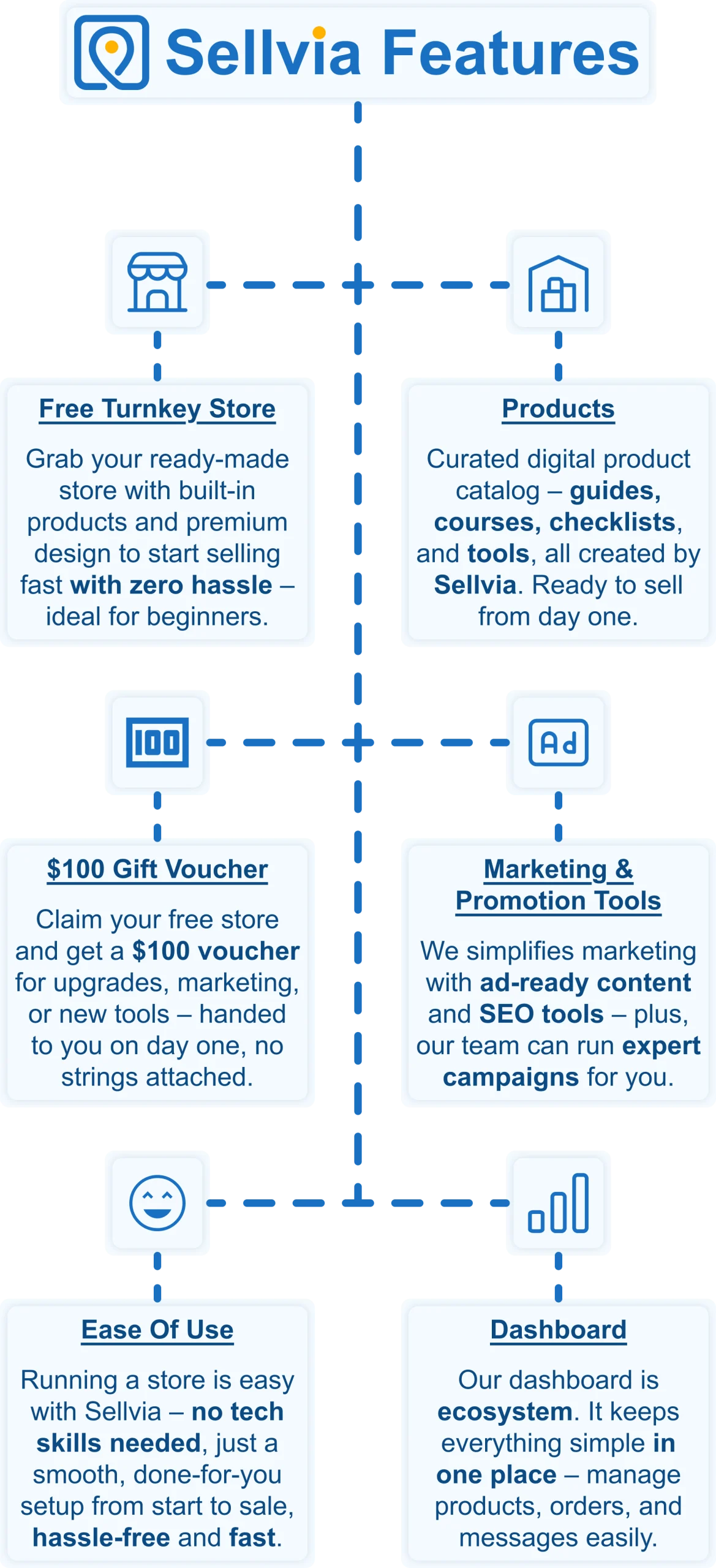
Get a ready-to-go store hassle-free 🎯
Want to start selling but don’t know where to begin? No worries! Just share your ideas, and Sellvia’s team will build a free ecommerce website that’s fully set up and ready to take orders from day one. No coding, no stress – just a store that works right out of the box.
A $100 gift voucher to grow your business faster 🎁
Starting a business takes momentum – and Sellvia gives you a head start. When you claim your free store today, you also get a $100 gift voucher to put toward growing your business. Use it to upgrade your store, boost your marketing, or unlock new tools. It is a real dollar value, handed to you on day one, with no catch and no hoops to jump through.
A massive catalog of digital products to sell 🏆
One of the biggest struggles in starting an online business is figuring out what to sell. Sellvia solves that completely. Your store comes pre-loaded with digital products – guides, courses, checklists, and tools – all created by Sellvia. You keep 50–70% of every sale. No inventory. No shipping. No logistics headaches.
Everything in one easy-to-use platform 🔥
Managing an online store shouldn’t be complicated. With Sellvia, you can handle orders, add new products, and even chat with customers – all from a simple and user-friendly platform. No need to mess with confusing tools or deal with unnecessary tech stuff. It’s all smooth sailing.
No upfront costs, just start selling 💰
A big reason people hesitate to start an online business is the cost. But here’s the good news: With Sellvia, you don’t need to invest in stock, storage, or shipping supplies. You can run your store with no upfront costs, keeping things low-risk while still making money.
Support that’s always got your back 🤝
Running a business comes with questions, but you’re never alone. Sellvia’s dedicated support team is available 24/7 to help with anything you need. Whether it’s a small question or a big challenge, they’ve got you covered.
If you are serious about financial freedom – whether through stocks, online business, or both – having a reliable income stream is the foundation everything else builds on. Claim your free Sellvia store today and start building income on your own terms.