
Millions of people are searching for real ways to earn income online in 2026 – and the metaverse is one of the most talked-about options right now. Virtual worlds, digital marketplaces, and blockchain economies have created genuine earning opportunities that simply did not exist five years ago. But with so much hype floating around, it is worth asking honestly: can you actually make money in the metaverse, and where do you even begin?
Quick answer: Yes – you can make money in the metaverse through virtual real estate, digital products, play-to-earn games, metaverse services, and content creation. Some of these cost nothing to start. That said, realistic earnings for most beginners range from $20 to $200 per month depending on the method and how consistently you show up. The highest figures you see online are outliers, not typical results.
This guide breaks down the 7 most reliable ways to make money in the metaverse in 2026 – including free-to-start options – and helps you figure out which path fits your skills, budget, and income goals. We also cover the risks honestly, so you can move forward with your eyes open.
Before we dive in, it is worth being clear: the metaverse is evolving quickly, and some earning methods carry real risk – especially anything tied to crypto or speculative assets. This guide focuses on grounded, legitimate ways to earn income. And at the end, we will show you a more stable alternative that hundreds of thousands of people across the United States are already using to build real income from home.
What is the metaverse?
The metaverse is a collection of interconnected virtual worlds where people can socialize, work, play, and do business. It blends virtual reality (VR), augmented reality (AR), blockchain technology, and artificial intelligence to create digital environments that have real economies attached to them.
Platforms like Decentraland, The Sandbox, Roblox, and Horizon Worlds allow users to buy and sell digital goods, attend virtual events, and earn income through various activities. Many of these platforms operate on their own cryptocurrency tokens that can be exchanged for real-world money – which is what makes the metaverse interesting as an income source, not just a gaming hobby.
The key thing to understand is that the metaverse is not one single place. It is a growing ecosystem of digital spaces, each with its own rules, economy, and opportunities. Some are gaming-focused. Some are social. Some are built specifically for commerce. Learning how to make money in the metaverse starts with understanding which of these spaces fits what you actually want to do.
Why this works in 2026: Digital economies are maturing. More brands are investing in virtual presence, NFT markets are stabilizing, and play-to-earn models are refining their mechanics – creating more sustainable income streams for everyday participants than existed just two years ago.
How much can you realistically earn in the metaverse?
Earnings in the metaverse vary enormously depending on the method, your skill level, and how much time you invest. The table below gives you a grounded overview of what to expect across the main approaches.
Most beginners earn between $20 and $200 per month when starting out. Reaching the upper end of these ranges typically takes 6–12 months of consistent effort, a developed skill set, or real capital to invest. Virtual real estate and metaverse services have the highest ceiling – but also demand the most time, learning, and often upfront money.
One note on metaverse earnings: The headline-grabbing figures – land selling for six figures, NFTs worth tens of thousands – represent outliers, not typical results. Most earners in the metaverse are making supplemental income, not replacing a full-time salary. Build your expectations around that reality from the start.
If you want a more predictable path to extra income – one that does not require crypto wallets, blockchain knowledge, or months of grinding before your first dollar – there is a smarter starting point to consider. Over 1,500,000 people have already launched stores on Sellvia, and store owners have collectively earned more than $1.5 billion. We will cover that in more detail at the end of this guide.
7 ways to make money in the metaverse in 2026
Here is a breakdown of the most proven methods available right now – from zero-investment options to higher-effort strategies for people with serious income goals.
Virtual real estate
Virtual land in platforms like Decentraland and The Sandbox works similarly to real-world property. You can buy it, develop it, rent it to businesses, or sell it for a profit when the platform grows. Some parcels in high-traffic areas have changed hands for thousands of dollars.
Buy and hold
Purchase land in a promising virtual world and wait for its value to increase as the platform expands its user base. This is a long-term play that requires research and patience – similar to buying property in an up-and-coming neighborhood before the value rises. Timing and platform selection matter enormously here.
Flip virtual land
Buy undervalued parcels in growing areas and sell them once demand increases. Successful flippers monitor platform development closely, track upcoming events and brand partnerships, and position themselves near virtual attractions that drive foot traffic. The risk is real – values can drop as fast as they rise.
Rent out your virtual space
Brands, event organizers, and artists pay to use virtual venues for concerts, product launches, and NFT gallery shows. Renting generates recurring income without having to sell your land – and demand from businesses wanting a virtual presence is steadily growing. This is generally the most stable income approach in virtual real estate.
Earning potential: $50–$5,000+ per month, depending on platform activity, location quality, and whether you develop the space into an attractive destination.
Selling digital products and NFTs
If you are creative, the metaverse has a market hungry for digital goods. People spend real money customizing their avatars, decorating virtual spaces, and collecting digital art. The key is finding your niche and building a consistent body of work over time.
Digital art and collectibles
Create digital art, illustrations, or 3D objects and list them as NFTs on platforms like OpenSea or Rarible. Free tools like Blender and Tinkercad mean you can start creating without spending anything. Many platforms also offer royalty mechanics – typically 5 to 10 percent of the resale price – so your original work can keep generating income long after the first sale.
Virtual fashion and avatar accessories
Clothing, accessories, and skins for metaverse avatars are a growing category. Games and virtual worlds charge users for cosmetic upgrades, and independent creators can tap directly into this demand. Platforms like Roblox have built-in creator storefronts where you can sell digital items to other users with no intermediary required.
Earning potential: $50–$2,000 per month for consistent creators who build a recognizable style and an engaged following within a specific platform community.
Play-to-earn games and virtual jobs
Play-to-earn (P2E) games reward players with cryptocurrency or in-game assets that carry real monetary value. Popular platforms include Axie Infinity, Gods Unchained, and The Sandbox. Beginners can enter through scholarship programs – where experienced players lend game assets in exchange for a share of earnings – so you can start without buying anything upfront.
Beyond gaming, virtual jobs are growing across metaverse platforms. You can work as a virtual assistant, community moderator, event host, or tour guide inside platforms like Decentraland and Horizon Worlds. These roles are usually paid in crypto tokens and typically bring in $20 to $150 per month for part-time hours.
Earning potential: $20–$300 per month for consistent players. Competitive tournament players in skill-based games can earn more with practice, but this takes serious time investment – treat it like a sport, not a quick income stream.
Hosting virtual events and experiences
Brands, influencers, and creators are paying for virtual events in the metaverse – concerts, product launches, networking meetups, and educational workshops. You can profit by organizing ticketed events, renting out venue space, or offering full event planning and production services to other organizers.
Starting out, offer free or low-cost events to build a reputation and attract paying clients. Once you have a track record, brands will pay for your organizational skills and your network. Event organizers in established metaverse platforms regularly charge $50 to $500 per event for their services.
Selling metaverse services
Skilled professionals are in high demand in the metaverse. If you can code, design 3D spaces, create marketing strategies, or write content, businesses building a virtual presence need exactly what you offer. Common service categories include:
- Building virtual spaces and branded environments for companies
- Creating digital assets and NFT artwork for other projects
- Marketing and consulting for brands entering virtual worlds
- Writing guides, blog content, and educational materials about specific platforms
Service providers with a strong portfolio can earn $500 to $3,000 per project. The fastest way to land your first paying client is to build an initial portfolio with discounted or free work – then use those results to pitch bigger contracts.
Becoming a metaverse content creator
The metaverse is new enough that early content creators still have a real advantage. Starting a YouTube channel, TikTok account, or newsletter around metaverse topics costs nothing – and audience interest continues to grow as more people try to understand what virtual worlds actually are and how they work.
Revenue sources for metaverse content creators include brand sponsorships, ad revenue, paid digital courses, and affiliate partnerships. Realistic earnings start at $100 to $300 per month after 3 to 6 months of consistent content, and can scale significantly with a loyal and engaged following.
Investing in metaverse crypto and stocks
The metaverse economy is powered by cryptocurrency. Tokens like MANA (Decentraland) and SAND (The Sandbox) can be purchased on major crypto exchanges. Metaverse-focused stocks like Meta Platforms, Nvidia, and Unity Software offer a more traditional investment angle for those who prefer regulated markets.
This path carries real risk. Crypto markets are highly volatile – MANA dropped over 90 percent from its 2021 peak. Only invest money you can genuinely afford to lose, and research each asset thoroughly before committing any funds. Earning free crypto through gaming rewards or platform incentives is a lower-risk entry point for beginners testing the waters.
Legal and ethical considerations
The metaverse is largely unregulated in 2026, which creates real risks alongside the genuine opportunities. Here are the most important things to watch out for – and what to do instead of falling into them.
Key principle: If an opportunity in the metaverse promises guaranteed returns or pressures you to recruit other people to earn, walk away.
What to avoid absolutely
- NFT rug pulls – projects where developers take investor money and disappear before delivering
- Pump-and-dump schemes on low-liquidity metaverse tokens
- Fake scholarship programs that charge a fee to participate
- Platforms with no verifiable company information, registered address, or operating history
What to do instead
- Research every platform thoroughly before investing time or money
- Stick to established platforms with documented payout records and active communities
- Check Reddit, Discord, and Trustpilot for real user reviews before signing up for any paid program
- Use legitimate NFT marketplaces with verified transaction histories and transparent fee structures
Tax obligations are also real. Income earned from NFT sales, crypto gaming rewards, and metaverse services is generally taxable in the United States. Keep clear records of your earnings from the start, and consult a tax professional once your income becomes meaningful.
Which metaverse path is right for you?
Not every method suits every person or every situation. Here is a practical breakdown based on where you are starting from today.
Complete beginners
If you are brand new to all of this, start with play-to-earn games through free scholarship programs, or begin creating short-form content on YouTube or TikTok about your experience exploring the metaverse. Both options cost nothing to start and give you a real feel for the space before you invest serious time in more complex strategies. Expect the first 60 to 90 days to be about learning, not earning – that is a normal and healthy timeline.
Part-time earners
If you have 5 to 10 hours a week to invest, metaverse services and content creation offer the best balance of effort and reward. Build a portfolio of 3D design or marketing work for other project owners, or grow a niche audience around a specific platform you enjoy using. Consistent part-time earners can realistically reach $200 to $500 per month within 3 to 6 months of focused effort.
Full-time income goals
Replacing a full-time salary through the metaverse alone is ambitious and typically takes 12 to 24 months of serious, consistent work. The most realistic path combines multiple methods – services plus content, or virtual real estate plus event rentals. Many people building full-time online income treat the metaverse as one revenue channel alongside a more stable online business, rather than relying on it exclusively.
Whatever your profile, the metaverse works best as part of a broader income strategy – not as your only source of revenue. Diversification protects you when one platform’s value drops, a game shifts its economy, or a trend fades faster than expected.
A simpler path to earning online
The metaverse is exciting – but honest people will tell you it takes real time, ongoing research, and often upfront money to see meaningful results. If you are looking for a way to earn income online that does not require crypto wallets, tech skills, or grinding for months before your first dollar arrives, there is a more direct route worth knowing about.
Sellvia gives you a fully built online store preloaded with digital products – guides, courses, checklists, and tools – all ready to sell from day one. You do not create any products, research blockchain technology, or figure out any complicated platforms. The built-in advertising system handles your marketing for you. You choose a daily ad budget between $10 and $50, and many store owners start seeing their first orders the same day they activate.
Ranked by Inc. magazine among America’s 5,000 fastest-growing companies and recognized by Forbes, Sellvia is trusted by over 1,500,000 store owners who have collectively earned more than $1.5 billion on the platform. The trial is completely free for 14 days, and includes a $40 ad coupon to get your first sales moving. After that, the monthly plan is $39 – roughly $1.30 a day.
Why Sellvia is a game-changer for your online store 🚀
Sellvia isn’t just another ecommerce tool. We are a trusted name in the industry, recognized by Forbes and even ranked in Inc.’s list of the 5,000 fastest-growing companies in the U.S. So if you’re serious about starting as a solopreneur, this is a smart place to begin.
Starting an online business can feel overwhelming, but that’s exactly where Sellvia steps in. It takes care of the tricky parts, so you can focus on making sales and growing your brand. Let’s break down what makes it such a great choice.
Get a ready-to-go store hassle-free 🎯
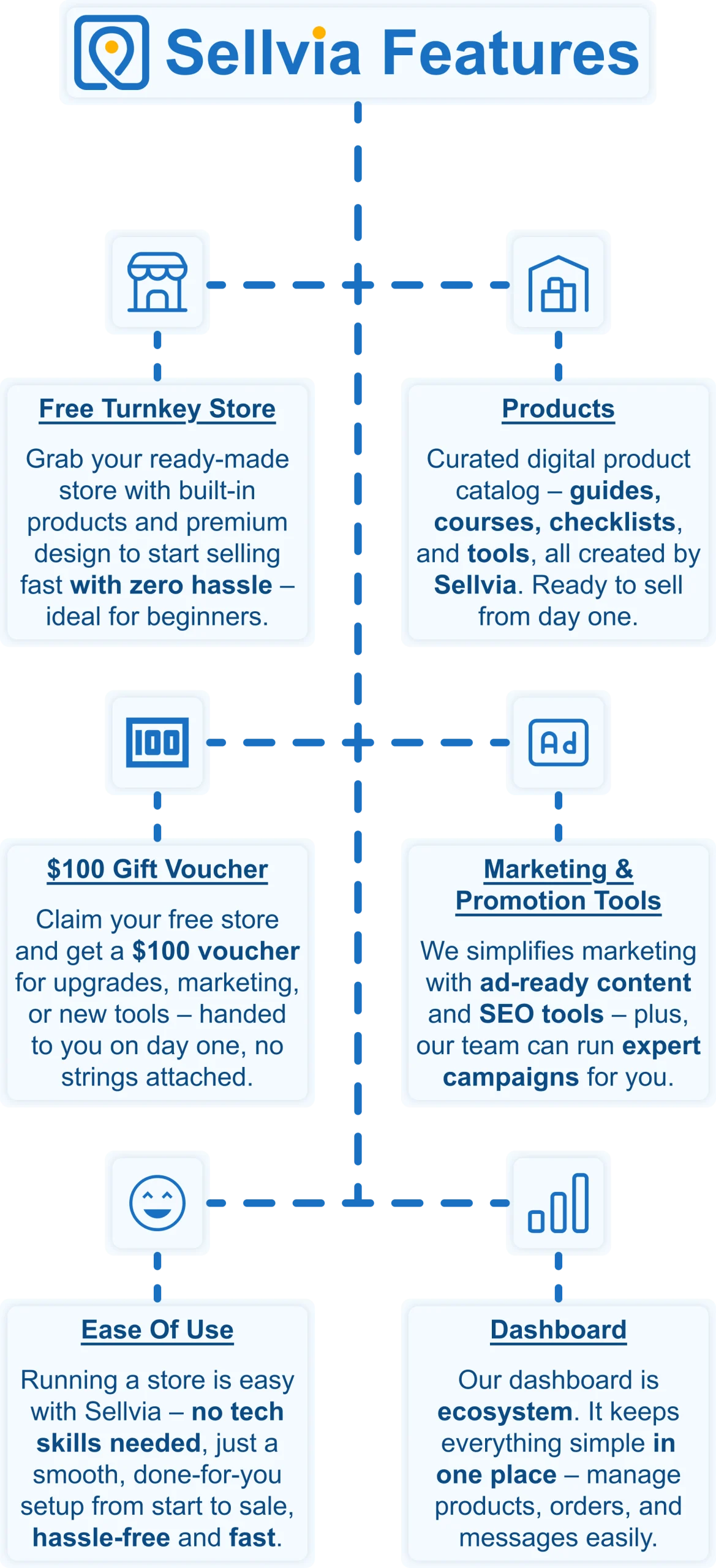
Want to start selling but don’t know where to begin? No worries! Just share your ideas, and Sellvia’s team will build a free ecommerce website that’s fully set up and ready to take orders from day one. No coding, no stress – just a store that works right out of the box.
A $100 gift voucher to grow your business faster 🎁
Starting a business takes momentum – and Sellvia gives you a head start. When you claim your free store today, you also get a $100 gift voucher to put toward growing your business. Use it to upgrade your store, boost your marketing, or unlock new tools. It is a real dollar value, handed to you on day one, with no catch and no hoops to jump through.
A massive catalog of digital products to sell 🏆
One of the biggest struggles in starting an online business is figuring out what to sell. Sellvia solves that completely. Your store comes pre-loaded with digital products – guides, courses, checklists, and tools – all created by Sellvia. You keep 50–70% of every sale. No inventory. No shipping. No logistics headaches.
Everything in one easy-to-use platform 🔥
Managing an online store shouldn’t be complicated. With Sellvia, you can handle orders, add new products, and even chat with customers – all from a simple and user-friendly platform. No need to mess with confusing tools or deal with unnecessary tech stuff. It’s all smooth sailing.
No upfront costs, just start selling 💰
A big reason people hesitate to start an online business is the cost. But here’s the good news: With Sellvia, you don’t need to invest in stock, storage, or shipping supplies. You can run your store with no upfront costs, keeping things low-risk while still making money.
Support that’s always got your back 🤝
Running a business comes with questions, but you’re never alone. Sellvia’s dedicated support team is available 24/7 to help with anything you need. Whether it’s a small question or a big challenge, they’ve got you covered.
While the metaverse offers real earning opportunities, nothing beats having your own online store with proven digital products and built-in marketing ready to go from day one. Claim your free Sellvia store today and start your online income journey.