
Most people think investing is something reserved for the wealthy – people with a stockbroker on speed dial, a finance degree, or thousands in savings they never touch. That world is gone. Learning how to make money investing in 2026 is more accessible than it has ever been, and you can start today with less than $20.
Quick Answer: You make money investing by putting your money into assets that grow in value over time – stocks, index funds, real estate, bonds, or a digital business. Beginners can start with as little as $1 through commission-free apps. Meaningful income typically builds over 12 to 36 months with consistent contributions, though the exact timeline depends heavily on how much you invest and which strategy you choose.
This guide covers the best ways to make money investing, what you can realistically expect to earn at each stage, the mistakes that cost beginners the most money, and how to find the right strategy for your specific situation. Whether you have $50 or $5,000 to start, you will find a clear path here.
What is investing and why it matters in 2026
Investing means putting your money into something today with the expectation that it will be worth more in the future. That something could be a share of a company, a government bond, a piece of real estate, or even a digital business. The core idea: instead of only trading your time for money at a job, you put your money to work alongside you.
Why does this matter so much right now? Inflation is real. The $1,000 sitting in a regular savings account today buys less every single year. A standard savings account earns somewhere between 0.5% and 5% annually – often not enough to keep up. The stock market, by contrast, has historically returned an average of 7% to 10% per year. Real estate has outpaced inflation for decades. And a well-run digital business can generate income far faster than either.
The barrier to entry has also dropped dramatically. Apps like Robinhood, Fidelity, and Vanguard now let anyone buy stocks, index funds, and ETFs from their phone with no minimum balance and no commission fees. You no longer need a financial advisor, a big starting portfolio, or a finance background. You just need a plan and the willingness to start.
The foundation is simple to understand, even if building real wealth takes time. What matters most is getting clear on what you want your money to do – and then choosing the strategies that match that goal.
How much can you realistically earn from investing?
This is the question most investing guides skim past or dress up with best-case figures. Here is an honest breakdown – with real numbers, not hype.
These figures reflect realistic averages – not guarantees and not outliers. A $10,000 investment in a broad index fund today could realistically grow to $26,000 in 10 years at a 10% annual return. That is powerful – but it requires patience and capital to get there.
One note on the earnings timeline: Earning $1,000 a month from dividend stocks alone typically requires a portfolio of $200,000 to $300,000. That is absolutely achievable, but it takes years of consistent contributions to reach that level. That is exactly why many people now pair traditional investing with an active income stream that generates cash sooner – while their portfolio quietly builds in the background.
Getting that foundation right – understanding what each method pays, what it costs, and how long it takes – is what separates investors who eventually reach financial freedom from those who give up after a frustrating first year.
Best ways to make money investing in 2026
There is no single right answer for everyone. The best strategy depends on your starting capital, your timeline, and how much risk you are comfortable with. Here are the most reliable approaches, broken into three groups by how they work.
Growth-based investing
These strategies focus on buying assets and holding them as their value increases over time. They require patience, but they carry the strongest long-term track records of any investing category.
Stocks
When you buy a share of a company, you own a small piece of it. If the company grows, your shares grow in value. If it distributes profits to shareholders, you earn dividends on top. Individual stocks can deliver high returns – some investors see 20% to 50% gains in a single year – but they also carry more risk if a company struggles or the broader market pulls back.
For beginners, the smartest approach is to research before buying, spread your money across multiple sectors, and resist the urge to sell during market downturns. A portfolio of 10 to 15 well-known, stable companies is a reasonable starting point. Think slow and steady, not fast and flashy.
Earning potential: The S&P 500 has returned approximately 10% per year on average historically, including dividends. A $10,000 investment held for 20 years could grow to roughly $67,000 at that rate.
Index funds and ETFs
Index funds and ETFs (exchange-traded funds) are baskets of stocks that track a market index like the S&P 500. Instead of picking individual companies, you invest in all of them at once. This automatically diversifies your money and dramatically reduces single-company risk.
This is the most recommended starting point for beginners who want to make money investing without spending hours researching individual stocks. You get broad market exposure, very low fees, and returns that closely mirror the overall market. Vanguard, Fidelity, and Charles Schwab all offer index funds with no minimum investment and no trading commissions.
Earning potential: 7–10% annually on average over time. $5,000 invested today could grow to $9,000–$13,000 in 10 years without adding a single extra dollar.
REITs (real estate investment trusts)
REITs let you invest in real estate without buying property. These are companies that own and manage income-producing buildings – apartment complexes, office towers, shopping centers – and they are legally required to pay at least 90% of their taxable income as dividends to shareholders.
You can invest in REITs through any standard brokerage account, just like buying a stock. They are a popular choice for people who want real estate income without the responsibilities of being a landlord. The downside: REIT share prices can be sensitive to interest rate changes, so expect some volatility.
Earning potential: 4–8% annual dividend yield, plus potential capital appreciation on the shares themselves.
Income-generating investing
While growth investing builds long-term wealth, income investing focuses on generating regular cash flow. These strategies produce returns you can see – and use – while your portfolio grows in the background.
Dividend stocks
Dividend stocks pay regular cash distributions – typically quarterly – to shareholders as a share of company profits. Over time, reinvesting those dividends creates a compounding effect that significantly accelerates portfolio growth.
Companies with long, reliable histories of paying dividends are often called “dividend aristocrats.” These are established businesses like Johnson & Johnson, Coca-Cola, and Procter & Gamble – not exciting startups, but steady income producers. A $50,000 portfolio of strong dividend stocks might generate $1,500 to $3,000 per year in dividend income – roughly $125 to $250 a month.
Earning potential: $50–$500/month, depending on portfolio size. Most investors need $60,000 or more invested to see meaningful monthly dividend income.
Bonds and high-yield savings accounts
Bonds are loans you make to a government or corporation in exchange for fixed interest payments. They carry less risk than stocks but also deliver lower returns. U.S. Treasury bonds, corporate bonds, and I-Bonds are common options at different risk levels.
High-yield savings accounts and CDs (certificates of deposit) work similarly – you deposit money and earn a fixed rate. In 2024 and into 2025, many high-yield savings accounts offered 4% to 5% APY – a significant improvement over the near-zero rates of the previous decade. These work best as part of a diversified strategy rather than a standalone wealth-builder.
Earning potential: 3–5% annually. Predictable, low-risk, and a solid home for short-term savings you may need access to.
Active and alternative investing
These strategies can produce faster returns – but they require more knowledge, more time, and a stronger stomach for risk. Build your foundation first before exploring these options.
Rental real estate
Owning a rental property is one of the oldest wealth-building strategies in the world. You earn monthly rent while the property itself appreciates in value. In strong rental markets, a well-chosen property can net $300 to $2,000 per month after expenses like mortgage payments, insurance, maintenance, and property management fees.
The challenge is the upfront cost. A down payment on a rental property typically runs $20,000 to $80,000 or more depending on location. Add in ongoing costs and the time commitment of being a landlord, and this is a serious undertaking – but one with significant income potential for those who execute it well.
Earning potential: $300–$2,000/month net income, depending on location, property type, and financing structure.
Cryptocurrency
Crypto remains one of the most volatile asset classes available today. Bitcoin gained over 150% in 2023 before experiencing sharp corrections. Some altcoins have multiplied hundreds of times in value – and then dropped 90%. This is closer to speculation than investing for most everyday people.
If you choose to include crypto, most financial advisors recommend keeping it to no more than 5% to 10% of your total holdings. It can play a supporting role in a diversified portfolio, but it should never be your primary strategy or a source of income you depend on.
Earning potential: Highly variable. Potential for large gains – and equally large losses. Not recommended as a primary strategy for beginners.
Robo-advisors
If you want to invest without managing it yourself, a robo-advisor does the work for you. Platforms like Betterment and Wealthfront use algorithms to build and rebalance a diversified portfolio based on your goals and risk tolerance. Fees are low – typically 0.25% per year – and the process is nearly fully automated after initial setup.
This is a solid option for people who want consistent market exposure without time spent managing individual holdings. Set it up, fund it regularly, and let it run while you focus on building income elsewhere.
Earning potential: 6–9% annually depending on market conditions and your chosen risk level – similar to index funds, but with automated rebalancing included.
The strategies above give you a strong starting point. The most successful everyday investors do not rely on just one – they combine growth investing with income-generating methods to balance long-term wealth-building with near-term cash flow.
Common investing mistakes to avoid
Most beginner investors do not lose money because their strategy was bad. They lose money because of avoidable emotional decisions made in the moment. Here are the biggest ones, and how to protect yourself.
Trying to time the market
No one – not even the most sophisticated professional fund managers – can consistently predict when the market will rise or fall. Investors who try to buy at the exact bottom and sell at the exact top almost always underperform people who simply invest regularly and hold. The principle you will hear from long-term investors again and again: time in the market beats timing the market. Every time.
Not diversifying
Putting all your money into one stock, one sector, or one asset type dramatically increases your exposure to loss. If that single holding drops, there is nothing to cushion the blow. Diversification – spreading money across different types of investments – is one of the most powerful tools available to ordinary investors, and index funds make it completely effortless from day one.
Investing money you cannot afford to lose
Before putting a single dollar into the market, build an emergency fund – ideally 3 to 6 months of living expenses in a liquid savings account you can access immediately. Markets go down, sometimes significantly and suddenly. If you need that invested money before it recovers, you will be forced to sell at a loss. Keep emergency funds and investment funds in completely separate accounts, always.
Ignoring fees
Fees compound just like returns – but in the wrong direction. A fund charging 1% per year instead of 0.1% does not sound like much, but over 30 years that difference can cost tens of thousands of dollars on a moderate portfolio. Always check expense ratios before investing in any fund, and stick to low-cost index options wherever possible.
Letting emotions drive decisions
Fear and greed are the two most expensive emotions in investing. Fear causes people to sell at the bottom when markets drop. Greed causes people to chase hot trends near their peak. Both lead to buying high and selling low – the exact opposite of what works. The solution is a written plan you follow regardless of what the market does on any given day.
Long-term vs. short-term investing
Understanding the difference between these two approaches – and which one fits your situation – is one of the most important decisions you will make as a new investor.
Long-term investing
Long-term investing means buying assets and holding them for years or decades. It is the most proven path to building wealth for everyday people. The stock market has recovered from every single major downturn in history – including the 2008 financial crisis and the 2020 pandemic crash. Investors who held through both drops saw their portfolios not only recover but grow significantly beyond their previous peaks.
Long-term strategies work best with index funds, ETFs, dividend stocks, and real estate. You contribute consistently, reinvest returns, and let compounding do the heavy lifting. This approach is lower stress, requires less active management, and consistently outperforms most active trading strategies over a 10 to 20 year horizon.
Short-term investing
Short-term strategies – day trading, crypto flipping, options contracts – promise faster results but carry significantly higher risk. Research consistently shows that the vast majority of day traders lose money over time. The few who win are typically professional traders with years of experience, specialized tools, and very deep pockets for absorbing losses.
If you want to try short-term trading, start with a very small amount you can genuinely afford to lose. Treat it as tuition, not income. Never fund short-term trades with money you need for bills, rent, or emergencies.
If you are just starting out, skip short-term trading for now. Build your foundation with index funds and consistent contributions first – then revisit more active strategies once you have experience and a solid financial cushion beneath you.
How to choose the right strategy for your situation
Not everyone starts from the same place financially. Here is a simple guide to matching the right investing approach to where you are right now.
Complete beginner (under $1,000 to start)
Start with a simple, low-cost index fund through Fidelity or Vanguard. Set up automatic monthly contributions – even $25 to $50 – and commit to leaving the money alone for at least five years. While your investment grows quietly in the background, consider building an active income stream at the same time. More monthly income means more to invest each month, which dramatically accelerates your timeline.
Intermediate investor ($5,000–$20,000 in the market)
Start diversifying beyond a single fund. Add a few dividend-paying stocks, look into a REIT for real estate exposure, and consider a robo-advisor for automated rebalancing. At this stage, you are building a foundation that can sustain serious long-term growth. Now is also a great time to explore an online business as a parallel income stream you can funnel directly back into your portfolio.
Advanced investor (full-time income goal)
Building full financial freedom through investing typically requires a multi-pronged approach: stock market holdings, real estate income or REITs, dividend reinvestment, and an active online business all working together. The goal is not picking one perfect investment – it is building multiple income streams that reinforce each other. With real capital and consistent effort, a realistic timeline is 5 to 10 years.
Whatever stage you are at, the most important step is the same: start now. Every year you wait is a year of compounding you cannot get back. And if you need income sooner rather than later – which is true for most people reading this – an online business running alongside your investments is one of the smartest ways to bridge that gap.
Building active income alongside your investments
Traditional investing is powerful – but it takes time. For most people, 10 to 20 years of consistent contributions is what it takes to build meaningful wealth through the market alone. If you need more income in the near term, the smartest move is building an active income stream that runs in parallel and funds your investing habit at the same time.
That is where digital businesses have changed the game for ordinary people. A well-run online store can generate $500 to $5,000 a month in income – money you can use to cover bills, reduce debt, and invest more each month. The compounding effect of investing $500 a month instead of $50 a month is enormous over a 10-year horizon. An online business does not replace investing – it makes investing faster and more powerful.
Sellvia is the platform built for exactly this situation. It gives you everything you need to launch a digital store – products, a website, and a built-in advertising system – without requiring any technical skills or a large upfront investment. Many store owners see their first orders on day one after activating ads. This is real income you can use now, while your investment portfolio quietly grows in the background.
Why Sellvia is a game-changer for your online store 🚀
Sellvia isn’t just another ecommerce tool. We are a trusted name in the industry, recognized by Forbes and even ranked in Inc.’s list of the 5,000 fastest-growing companies in the U.S. So if you’re serious about starting as a solopreneur, this is a smart place to begin.
Starting an online business can feel overwhelming, but that’s exactly where Sellvia steps in. It takes care of the tricky parts, so you can focus on making sales and growing your brand. Let’s break down what makes it such a great choice.
Get a ready-to-go store hassle-free 🎯
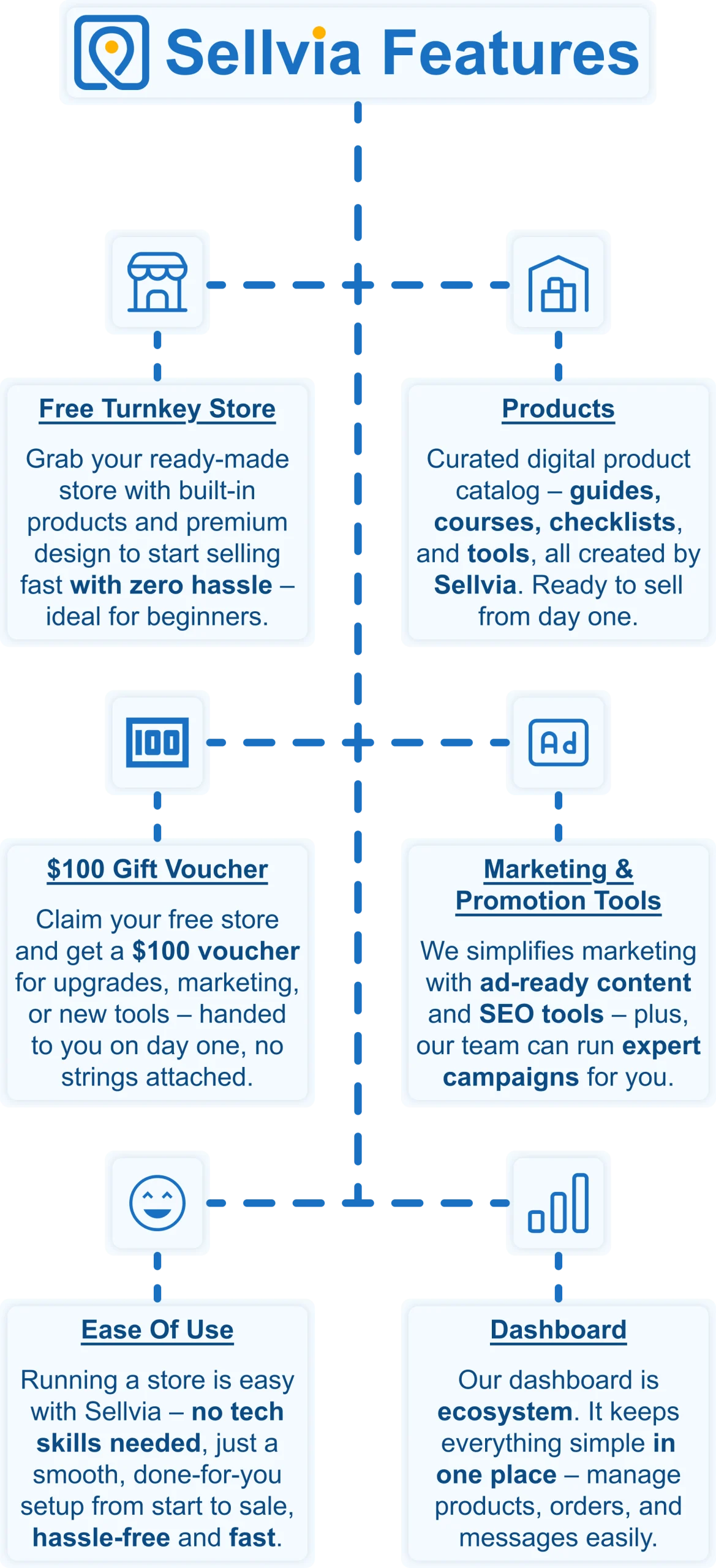
Want to start selling but don’t know where to begin? No worries! Just share your ideas, and Sellvia’s team will build a free ecommerce website that’s fully set up and ready to take orders from day one. No coding, no stress – just a store that works right out of the box.
A $100 gift voucher to grow your business faster 🎁
Starting a business takes momentum – and Sellvia gives you a head start. When you claim your free store today, you also get a $100 gift voucher to put toward growing your business. Use it to upgrade your store, boost your marketing, or unlock new tools. It is a real dollar value, handed to you on day one, with no catch and no hoops to jump through.
A massive catalog of digital products to sell 🏆
One of the biggest struggles in starting an online business is figuring out what to sell. Sellvia solves that completely. Your store comes pre-loaded with digital products – guides, courses, checklists, and tools – all created by Sellvia. You keep 50–70% of every sale. No inventory. No shipping. No logistics headaches.
Everything in one easy-to-use platform 🔥
Managing an online store shouldn’t be complicated. With Sellvia, you can handle orders, add new products, and even chat with customers – all from a simple and user-friendly platform. No need to mess with confusing tools or deal with unnecessary tech stuff. It’s all smooth sailing.
No upfront costs, just start selling 💰
A big reason people hesitate to start an online business is the cost. But here’s the good news: With Sellvia, you don’t need to invest in stock, storage, or shipping supplies. You can run your store with no upfront costs, keeping things low-risk while still making money.
Support that’s always got your back 🤝
Running a business comes with questions, but you’re never alone. Sellvia’s dedicated support team is available 24/7 to help with anything you need. Whether it’s a small question or a big challenge, they’ve got you covered.
If you are serious about how to make money investing in your future, pairing a growing investment portfolio with a Sellvia store is one of the most powerful moves you can make in 2026. Claim your free store today and start building the income that funds your investment goals.