Every day, millions of people search for a way to earn money from home. Amazon affiliate marketing has been one of the most talked-about answers for years – and for good reason. You recommend products you trust, share a link, and earn a cut when someone buys. No office. No boss. No commute. Just you, your content, and your links.
Quick Answer: The Amazon affiliate program pays commissions of 1–10% depending on the product category. Most beginners earn $50–$300 per month in their first six months. With the right niche and consistent content strategy, some affiliates reach $1,000–$5,000 per month or more – but that typically takes 12–24 months of focused effort.
This guide walks you through everything you need to know about how to make money on Amazon affiliate in 2026 – from signing up and choosing your niche to picking the right platform and actually getting clicks that convert into cash.
If you have been wondering whether Amazon affiliate marketing is worth your time, the honest answer is: it depends entirely on how you approach it. The program is real, the commissions are real, and the income potential is real. But it takes patience, strategy, and consistency to get there. Let us walk through every step so you can decide if this path is right for you – and what to do when you are ready to take things further.
What is the Amazon affiliate program?
The Amazon Associates program is one of the oldest and most trusted affiliate networks on the internet. Launched in 1996, it has grown to include millions of participants worldwide. The concept is simple: you sign up, generate unique affiliate links to products on Amazon, share those links through your content, and earn a commission every time someone clicks through and makes a purchase.
What makes the Amazon affiliate program stand out is the sheer breadth of products available. Amazon sells everything from kitchen gadgets to fitness equipment to tech accessories. Whatever topic you write or post about, there is almost certainly a relevant product you can link to. And here is a detail that surprises a lot of beginners: when someone clicks your link, you earn a commission on everything they buy within the next 24 hours – not just the item you linked to. If a reader clicks your link for a $20 book and ends up also buying a $300 air fryer, you earn commission on both.
Commission rates range from as low as 1% on electronics to as high as 10% on certain luxury beauty items. The average hovers around 3–5% for most popular categories. That means to earn $100 in commissions, you typically need to drive $2,000–$3,000 worth of purchases through your links. This is why traffic – and lots of it – is the real currency of Amazon affiliate marketing.
The program is beginner-friendly in the sense that there is no upfront cost and no product to create. But it is also highly competitive. The affiliates who earn consistent income are the ones who treat it seriously – picking a focused niche, publishing quality content regularly, and building an audience over time.
How much can you realistically earn with Amazon affiliate?
This is the question every beginner wants answered before they commit. The truth is that Amazon affiliate income varies widely based on your traffic volume, your niche, your content quality, and how much time you invest each week. Here is a realistic breakdown to set honest expectations.
These figures assume you are promoting mid-range products with commission rates between 3–8%. High-ticket niches can push earnings higher, while electronics categories – which pay only 1–4% – require far more traffic to generate meaningful income.
One note on the top-end figures: Reaching $5,000 or more per month from Amazon affiliate marketing typically takes 12–24 months of consistent effort, strong SEO, and a growing audience. Those results are achievable – but they are not where you start. Most people earn between $50 and $300 in their first six months. Setting that expectation now will save you a lot of frustration later.
The biggest variable in your earnings is traffic. No traffic means no clicks, and no clicks means no commissions. That is why the rest of this guide focuses heavily on where to publish your content, how to attract the right audience, and how to turn clicks into consistent income. Those decisions matter far more than which specific products you choose to promote.
How to join the Amazon affiliate program
Getting started with Amazon Associates is free and does not require an existing website, a large following, or any prior experience. You do need at least one platform where you plan to share links – a blog, a YouTube channel, or a social media profile all qualify. Here are the steps to get your account up and running:
- Visit the Amazon Associates website and click “Sign Up” using your existing Amazon account or create a new one.
- Enter the website, blog, or social media profile where you plan to promote affiliate links.
- Describe your traffic sources and explain how you plan to use affiliate links in your content.
- Submit your payment and tax information so Amazon knows where to send your earnings.
- Start generating affiliate links right away through the Associates dashboard.
- Earn at least 3 qualifying sales within your first 180 days to keep your account active.
Important: That 180-day requirement is real and non-negotiable. If you sign up and wait too long before actively promoting your links, your account will close. You can reapply, but it resets your progress. The moment you are approved, start promoting.
Once you are inside the Associates dashboard, you can browse millions of products, create affiliate links with one click, and track your performance by clicks, conversions, and earnings category. The interface is straightforward enough for complete beginners to navigate without any technical background.
Why this works in 2026: Amazon’s brand recognition does a significant portion of the selling for you. When a reader sees a link pointing to Amazon, trust is already built in. That built-in credibility makes conversion easier than with most lesser-known affiliate programs, which is a real advantage for newcomers still building their own audience.
One more thing worth knowing before you dive in: Amazon periodically adjusts its commission rates across categories. In 2020, the company significantly cut rates in multiple categories with very little notice to affiliates. This is the biggest structural risk of relying solely on Amazon affiliate income – you are always one policy change away from a pay cut.
Choosing the best niche for Amazon affiliate marketing
Your niche is the single most important decision you will make in your Amazon affiliate journey. It determines who finds your content, what products you can promote, how competitive your space is, and – critically – how much you earn per commission. Picking the wrong niche is one of the most common reasons beginners give up after a few months of effort with little to show for it.
A strong niche for Amazon affiliate marketing meets three criteria:
- Real buyer intent – People in your niche are actively searching for products to purchase, not just browsing for entertainment or inspiration. Niches built around solving specific problems (better sleep, home gym setup, pet health) convert far better than lifestyle or entertainment niches.
- Reasonable commission rates – Categories like beauty, home improvement, outdoor recreation, and tools pay 3–8% per sale. Electronics pay 1–4%. Know your rates before you invest months of effort in a niche that will pay you very little per conversion.
- Content sustainability – You will be creating content on this topic consistently, week after week. Choose something you can write or talk about without running out of ideas or losing interest inside six months.
Some of the strongest-performing niches for Amazon affiliate marketing in 2026 include home office gear, fitness and recovery equipment, pet care products, kitchen tools, and outdoor recreation. These categories carry strong year-round demand, a wide range of price points, and audiences that are already in a buying mindset when they land on your content.
Avoid niches that are too broad – like “tech” or “fashion” – where standing out against established competitors is nearly impossible. Also avoid niches so narrow that you run out of content ideas within a few weeks. The sweet spot is a niche focused enough to attract a loyal, specific audience but broad enough to keep generating fresh content opportunities for years.
Once you choose a niche, commit to it for at least 90 days before evaluating your results. The blogs, Pinterest accounts, and YouTube channels that earn the most in affiliate income all have one thing in common: they kept going when results were slow. Consistency beats strategy every single time in the early months of building affiliate income.
Where to promote your Amazon affiliate links
You do not need your own website to make money with Amazon affiliate marketing – although having one gives you the most long-term control. There are several platforms that work well for sharing affiliate links and building consistent traffic. Here is what you need to know about each.
Blog or website
A blog is the most powerful long-term platform for Amazon affiliate marketing. SEO-optimized content can attract organic traffic from Google for months or even years after it is published, and each article can include multiple affiliate links to multiple products. The content types that convert best are product review articles, comparison posts (“Best X Under $500” style roundups), and practical how-to guides that naturally incorporate affiliate product recommendations.
The trade-off is time. A new blog typically takes 3–6 months to start ranking in Google search results, and meaningful organic traffic usually does not arrive until 9–12 months in. The payoff, once you get there, is significant – evergreen blog content can earn commissions around the clock without any additional work. But it requires patience and a genuine commitment to publishing quality content consistently.
Pinterest is one of the most underused and underestimated platforms for Amazon affiliate marketing. Unlike typical social media, Pinterest functions as a visual search engine. People come to Pinterest specifically to discover products and ideas – which means the buyer intent of your audience is already high before they even see your content. Pinterest also allows direct affiliate links in pin descriptions, which removes one step from the path to purchase.
To make money with Amazon affiliate on Pinterest, create visually strong pins that link directly to your affiliate products or to blog posts containing your links. Write keyword-rich descriptions so your pins surface in Pinterest search. With consistent effort and good visual content, Pinterest can start driving meaningful traffic in 2–4 weeks – significantly faster than Google SEO.
Instagram works particularly well for visual niches – fashion, beauty, home decor, fitness, food, and lifestyle. You do not need a massive following to earn affiliate income on Instagram. Accounts with as few as 2,000–5,000 highly engaged followers can generate real commissions by recommending the right products to the right audience consistently.
Use Instagram Stories and Reels to show products in action. Place your affiliate link in your bio using a link-in-bio tool, and direct your followers there with clear calls to action in your captions. Authenticity is the most important factor on Instagram – audiences can immediately sense when a recommendation is genuine versus when it is just a paid placement. Only promote products you have actually used or genuinely believe in.
YouTube
YouTube is the highest-converting platform for Amazon affiliate links because video allows viewers to see products in action before committing to a purchase. Unboxing videos, product comparison reviews, and tutorials all perform exceptionally well. A viewer who watches a full product review video is far more likely to click an affiliate link than someone who skimmed a written blog post.
The challenge with YouTube is production time – videos take significantly longer to create than written content. But the return is strong. YouTube videos also rank in Google search, giving you two separate traffic sources from a single piece of content. For niches where demonstrations matter – fitness equipment, kitchen tools, tech gadgets – YouTube can be your most powerful asset.
Whatever platform you choose, focus your energy on one or two channels at most when starting out. Trying to build a blog, a Pinterest account, an Instagram page, and a YouTube channel simultaneously is a recipe for burnout. Pick the platform that fits your skills and content style, master it, and add others only once you have traction.
How to increase your Amazon affiliate earnings
Getting your first clicks and commissions is exciting. But most affiliates hit a ceiling early on and struggle to push past $100–$200 per month. The difference between beginners who plateau and those who keep growing comes down to a handful of strategic decisions. Here is what actually moves the needle:
- Target high-intent keywords – Focus your content on phrases like “best X for Y” or “X vs. Y reviews” rather than broad informational topics. Readers searching for comparisons and recommendations are already close to making a purchase decision and convert at much higher rates.
- Place links strategically – Do not just drop affiliate links at the bottom of your content. Place them where readers are most likely to be thinking about the product – inside comparison tables, near pros and cons sections, and in summary boxes at the end of reviews.
- Build an email list from day one – Email subscribers are your most loyal and highest-converting audience. Share personal affiliate recommendations in newsletters with a genuine note about why you like the product. Email converts better than almost any other channel.
- Create seasonal and event-driven content – Holiday gift guides, back-to-school roundups, and seasonal product lists see massive traffic spikes each year. Publish them 4–6 weeks before the peak season so they have time to rank before the traffic arrives.
- Track performance and cut what is not working – Use your Amazon Associates dashboard to identify which links get clicks and which products actually convert. Double down on your winners and replace underperformers with better alternatives.
One strategic consideration worth thinking about seriously: Amazon controls your income. The company has reduced commission rates across major categories multiple times over the years – often with little warning to affiliates. Many experienced affiliate marketers hedge against this risk by building a complementary income stream they own and control directly. Running your own online store alongside your affiliate content is one of the most common and effective ways to do exactly that.
Legal and ethical considerations for Amazon affiliate marketing
Amazon affiliate marketing has firm rules that you must follow to stay in good standing with the program. These are not optional suggestions – violating them can result in permanent removal from the program and the loss of all unpaid earnings. The FTC also has its own requirements that apply independently of Amazon’s policies.
Key principle: Always disclose your affiliate relationship clearly and prominently. The FTC requires this by law, and Amazon’s operating agreement requires it too. A statement like “This page contains affiliate links. I earn a commission if you purchase through my links at no extra cost to you” placed near the top of your content is sufficient disclosure.
Here are the most important rules every Amazon affiliate must follow:
- Never include Amazon affiliate links in email marketing campaigns – Amazon explicitly prohibits this in its operating agreement.
- Never disguise or cloak affiliate links in a way that hides their destination or origin.
- Never fabricate or exaggerate reviews to drive clicks on products you have not genuinely evaluated.
- Never share affiliate links in downloadable PDFs, eBooks, or offline documents.
- Always link to the correct Amazon regional store for your audience – US traffic should point to amazon.com.
Important note: Amazon requires that you keep your affiliate links current. If a product is discontinued or a listing changes significantly, an outdated link earns nothing and signals to your audience that your content is not maintained. Regularly audit your top-performing pages to ensure all links are active and relevant.
The ethical side of affiliate marketing is simpler than the legal side: only recommend products you genuinely believe in. Readers who trust your recommendations are worth far more in the long run than a short-term commission from pushing something mediocre. Your audience’s trust is your most valuable asset – protect it every time you place a link.
Final thoughts: which approach is right for you?
Amazon affiliate marketing is a legitimate way to earn income online. It is not a scam, and it is not a lottery ticket either. It is a real business model with real requirements – consistent content, patient traffic building, and strategic product selection. Here is a quick snapshot based on where you are right now.
Complete beginner
If you are brand new to online income, Amazon affiliate marketing is a reasonable starting point because it teaches you the fundamentals – content strategy, SEO, audience building, and conversion thinking. Start with a focused niche blog or a Pinterest account. Set the expectation that your first 60–90 days are for learning, not earning. Small wins in that period are a sign you are on the right track.
Part-time or intermediate
If you already have some content published or a small but engaged following, affiliate marketing can grow into a meaningful side income. Focus on high-converting content types, build your email list aggressively, and consider adding YouTube to amplify your reach. With consistent effort, $300–$1,000 per month is achievable within 6–12 months for most intermediate creators in the right niche.
Advanced or full-time goal
If you want online income to eventually replace a full-time salary, affiliate marketing alone is unlikely to get you there without very high traffic volumes – which takes years to build. Most online entrepreneurs who reach full-time income levels combine affiliate marketing with at least one other revenue stream they control directly. Owning your own store is the most common complement because it gives you higher margins, more control, and income that is not dependent on a third party’s commission rates.
The opportunity to earn online has never been more accessible than it is in 2026. The tools are better, the audiences are larger, and the platforms are easier to use than they were even three years ago. The question is not whether you can make it work – it is which combination of methods fits your life, your skills, and your timeline right now.
Why Sellvia is a game-changer for your online store 🚀
Sellvia isn’t just another ecommerce tool. We are a trusted name in the industry, recognized by Forbes and even ranked in Inc.’s list of the 5,000 fastest-growing companies in the U.S. So if you’re serious about starting as a solopreneur, this is a smart place to begin.
Starting an online business can feel overwhelming, but that’s exactly where Sellvia steps in. It takes care of the tricky parts, so you can focus on making sales and growing your brand. Let’s break down what makes it such a great choice.
Get a ready-to-go store hassle-free 🎯
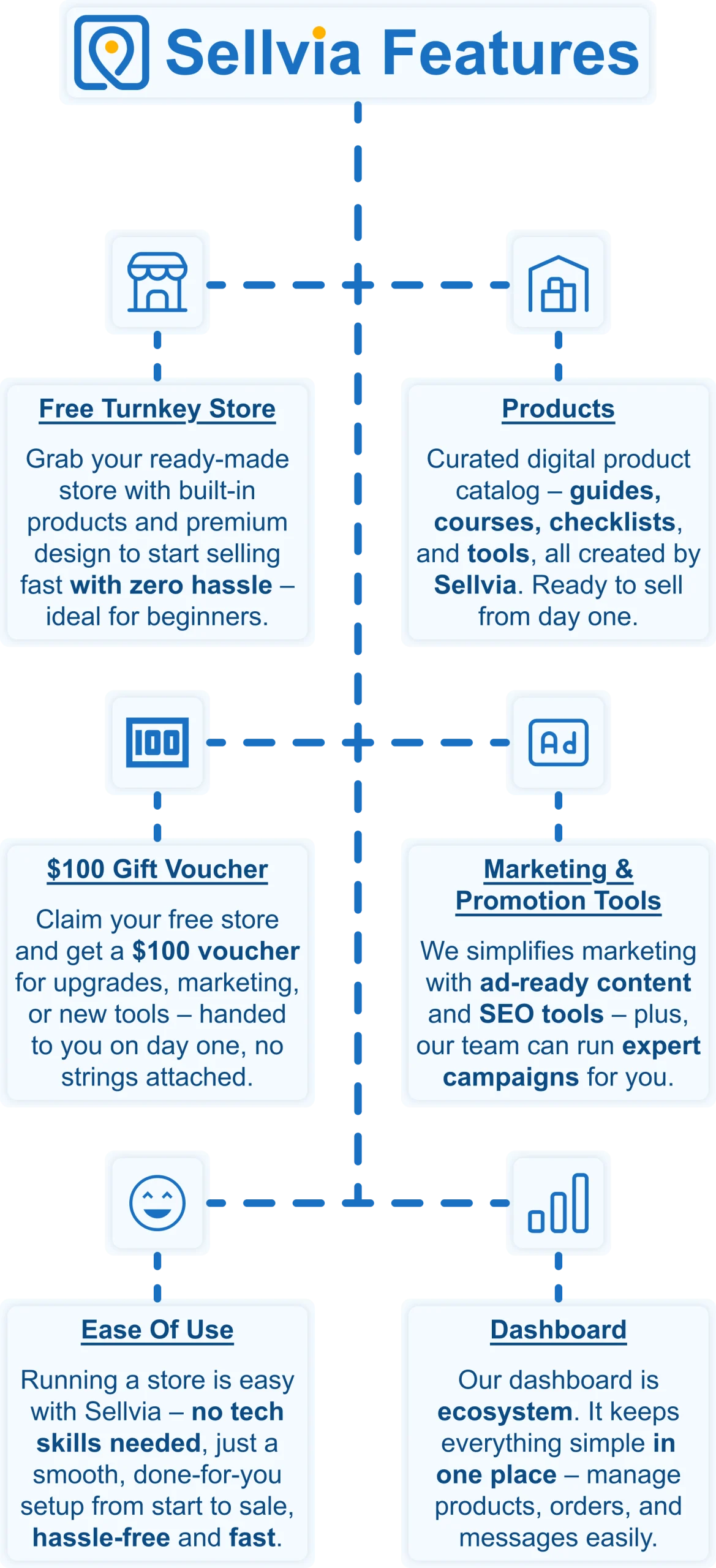
Want to start selling but don’t know where to begin? No worries! Just share your ideas, and Sellvia’s team will build a free ecommerce website that’s fully set up and ready to take orders from day one. No coding, no stress – just a store that works right out of the box.
A $100 gift voucher to grow your business faster 🎁
Starting a business takes momentum – and Sellvia gives you a head start. When you claim your free store today, you also get a $100 gift voucher to put toward growing your business. Use it to upgrade your store, boost your marketing, or unlock new tools. It is a real dollar value, handed to you on day one, with no catch and no hoops to jump through.
A massive catalog of digital products to sell 🏆
One of the biggest struggles in starting an online business is figuring out what to sell. Sellvia solves that completely. Your store comes pre-loaded with digital products – guides, courses, checklists, and tools – all created by Sellvia. You keep 50–70% of every sale. No inventory. No shipping. No logistics headaches.
Everything in one easy-to-use platform 🔥
Managing an online store shouldn’t be complicated. With Sellvia, you can handle orders, add new products, and even chat with customers – all from a simple and user-friendly platform. No need to mess with confusing tools or deal with unnecessary tech stuff. It’s all smooth sailing.
No upfront costs, just start selling 💰
A big reason people hesitate to start an online business is the cost. But here’s the good news: With Sellvia, you don’t need to invest in stock, storage, or shipping supplies. You can run your store with no upfront costs, keeping things low-risk while still making money.
Support that’s always got your back 🤝
Running a business comes with questions, but you’re never alone. Sellvia’s dedicated support team is available 24/7 to help with anything you need. Whether it’s a small question or a big challenge, they’ve got you covered.
If learning how to make money on Amazon affiliate taught you one thing, it is that recommending great products online is a real and powerful way to earn – now imagine keeping 50–70% of every sale instead of 1–10%. Claim your free Sellvia store today and see what your first orders could look like.