
Every week, millions of Americans open Coinbase hoping to turn their crypto holdings into something real. Whether you discovered Bitcoin last year or you have been watching prices rise and fall for a while, the question is always the same: how do you actually make money on Coinbase — not just hold it and wait?
The honest answer is that Coinbase offers several real earning methods. But none of them come with guarantees. Crypto markets are unpredictable. Staking rewards vary. And most beginners lose money before they find their footing. That does not mean you should not try — it means you should go in with clear expectations.
Quick Answer: The main ways to make money on Coinbase include trading crypto for profit, staking coins for rewards, using Coinbase Earn to receive free tokens, and earning cashback with the Coinbase Visa Card. Each method has different risk levels, time requirements, and realistic earning potential. None of them replace a full income on their own.
This guide breaks down every method honestly — what it is, how it works, and what you can realistically expect to earn. We will also show you a way to build income online that does not depend on the crypto market moving in your direction.
Before diving in, it helps to understand the bigger picture. Coinbase is a legitimate, well-regulated platform — but the amount you can earn is tied directly to how much you already own or how well you can read the market. For most people, that makes Coinbase one piece of a broader income strategy rather than a standalone solution.
What is Coinbase and how can you earn from it?
Coinbase is one of the largest and most trusted cryptocurrency exchanges in the United States. Founded in 2012 and publicly traded on the Nasdaq, it serves over 100 million verified users worldwide. For most Americans entering the crypto space for the first time, Coinbase is the starting point — and for good reason. It is regulated, beginner-friendly, and offers a range of tools that go beyond simply buying and selling coins.
Beyond acting as a marketplace, Coinbase has built several features specifically designed to help everyday users earn from their holdings without needing to be professional traders. From staking rewards that drip into your account automatically to educational programs that pay you in crypto for watching short videos, there are real paths to returns on the platform.
The key is understanding what each method actually involves — and being realistic about what the risks and earning ceiling look like for someone starting from scratch.
Knowing your options is half the battle. The other half is choosing the method that fits your current situation — how much you have to invest, how much time you have, and how much risk you can comfortably absorb. Let us look at the numbers first.
How much can you realistically earn on Coinbase?
This is the most important question — and the one most articles sidestep. Here is an honest breakdown across the four main Coinbase earning methods.
Trading carries the highest upside and the highest risk. Staking is more predictable but requires significant holdings to generate meaningful income. Coinbase Earn and cashback are the lowest effort but also the lowest return.
One note on these figures: To earn $500/month from staking at roughly 2% APY, you would need approximately $300,000 invested. Most beginner traders lose money in their first 6–12 months. The methods with the least risk also pay the least. This does not make Coinbase a bad tool — it just means it works best as part of a broader strategy, not as a standalone income source.
Understanding the ceiling on Coinbase earnings is not meant to discourage you — it is meant to help you set expectations and make smarter decisions. The people who do best with Coinbase are those who treat it as one stream of income among several, rather than betting everything on a single platform.
Now let us look at each method in detail so you can decide which one fits your situation best.
Ways to make money on Coinbase in 2026
There are four main earning paths on Coinbase that are accessible to beginners. Each one works differently, carries different risks, and suits different types of people. Here is a clear breakdown of all four.
Trading crypto for profit
The most well-known way to earn on Coinbase is buying and selling cryptocurrency. The concept is simple: buy when prices are low, sell when they are higher. In practice, crypto trading is one of the harder skills to develop — especially without experience.
Crypto markets move fast. Bitcoin can gain or lose 10–20% of its value in a single week. Without practice, it is easy to panic-sell at a loss or hold through a steep decline hoping for a recovery that takes months or never comes. Most first-time traders do not profit in their first year. Many lose a significant portion of what they started with.
That said, some strategies reduce the risk significantly. Long-term holding — buying a major coin like Bitcoin or Ethereum and keeping it for 1–3 years rather than trading week to week — has historically outperformed reactive short-term trading for most beginners. Dollar-cost averaging (investing a fixed amount weekly or monthly regardless of price) removes the pressure of trying to time the market perfectly.
If you do want to trade actively, using Coinbase’s Advanced Trade interface gives you access to more order types and lower fees than the standard app. Limit orders — which let you set the exact price at which you want to buy or sell — are a useful tool for protecting yourself from buying at a peak or selling at a bottom.
Earning potential: $0–$500+/month, highly variable. Long-term holders with $1,000–$5,000 invested have seen strong multi-year returns historically, but past performance does not guarantee future results.
Why this works in 2026: Institutional adoption of crypto has increased, adding some stability — but significant volatility remains. Patient, research-driven strategies tend to outperform reactive trading for most non-professional investors.
Staking crypto for rewards
Staking is a way to earn returns on crypto you already own by helping support a blockchain network. When you stake a coin, you temporarily lock it up so it can help validate transactions on the network. In return, the network pays you a percentage of new coins — similar to earning interest on a savings account, but with more variables.
Coinbase makes staking straightforward. You do not need to run any software or deal with any technical setup. Just hold an eligible coin in your Coinbase account, opt in to staking, and rewards are deposited automatically on a regular basis.
Coins available for staking on Coinbase include Ethereum (ETH), Solana (SOL), Cardano (ADA), Cosmos (ATOM), Avalanche (AVAX), Polygon (MATIC), and Polkadot (DOT). Reward rates vary significantly by coin. ETH currently earns around 1.9% APY, while Cosmos has offered rates above 10% APY at times. Rates change with network conditions and are never guaranteed.
Earning potential: $5–$100/month for most regular users, depending on the value of your holdings and which coins you stake.
Important note: While your assets are staked, they cannot be sold or transferred until the unstaking process is complete. Unstaking periods range from a few hours to several days depending on the coin. Only stake crypto you do not need to access quickly.
Coinbase Earn: get free crypto for learning
Coinbase Earn is one of the most beginner-friendly features on the entire platform. It lets you watch short educational videos about specific crypto projects, answer a few simple quiz questions, and receive a small amount of that cryptocurrency for free. No investment required and no risk involved.
The amounts per campaign are small — typically $1–$10 worth of tokens — and availability changes frequently as campaigns run for limited periods. But for someone who has never held crypto before, Coinbase Earn is a genuine zero-risk way to start building a small portfolio and learning how different coins work at the same time.
Once you have earned tokens through the program, you have options. You can hold them and see if they appreciate over time, swap them for a more established coin like Bitcoin or Ethereum, or simply convert them to cash. The choice is yours.
Earning potential: $1–$10 per campaign, not a meaningful income source on its own. Think of it as a free introduction to the crypto world rather than an earning strategy.
Coinbase Card: earn cashback in crypto
The Coinbase Visa Debit Card lets you spend digital assets anywhere Visa is accepted and earn cashback on every purchase in the form of cryptocurrency. You choose which coin you want to receive as a reward — Bitcoin, Ethereum, or another supported option — and the cashback deposits automatically after each transaction.
The card offers up to 4% cashback on eligible purchases, with no annual fee. Some transaction fees may apply for ATM withdrawals or international use, so read the terms before relying on it heavily abroad. The card handles crypto-to-fiat conversion automatically at the point of sale, so you can use it like a normal debit card without thinking about exchange rates.
For people who spend regularly on everyday purchases, the Coinbase Card essentially turns routine spending into gradual crypto accumulation. It is not a path to significant income on its own — but it is one of the lowest-effort earning methods on the entire platform.
Earning potential: $10–$50/month for average spenders, depending on your regular expenses and the cashback rate you qualify for.
All four methods are real. All four have genuine limitations. The most important thing is to match the method to where you actually are right now — your budget, your time, and your risk tolerance.
Whichever method you choose on Coinbase, there is one more area you need to understand before you start earning — and most beginner guides skip right over it. Taxes.
Legal and ethical considerations for Coinbase earners
If you are earning money through Coinbase — through trading gains, staking rewards, or even free tokens from Coinbase Earn — the IRS considers that taxable income. This is not a gray area. The U.S. government has made crypto tax reporting a clear legal requirement, and Coinbase itself is required to report certain activity to the IRS.
Here is what you need to know before you start earning.
- Crypto gains are taxable. When you sell crypto for more than you paid, that profit is subject to capital gains tax. Short-term gains — assets held under one year — are taxed as ordinary income. Long-term gains — assets held over one year — qualify for lower capital gains rates.
- Staking rewards are taxable income. The IRS treats staking rewards as ordinary income at the moment they are received, based on the market value of the tokens on that date.
- Coinbase Earn tokens are taxable. Even free crypto received through educational campaigns counts as income at the time of receipt.
- Card cashback is generally not taxed. Crypto cashback from the Coinbase Card is typically treated as a rebate rather than income in the U.S. — but consult a tax professional for your specific situation.
Key principle: Keep a record of every transaction — the date, the amount, and the USD value at the time. Coinbase offers downloadable tax reports that make this much easier. Staying organized from day one saves you significant headaches at tax time.
Important: Never trust social media tips, unverified “crypto gurus,” or anyone promising guaranteed returns on Coinbase. These are among the most common setups for online financial scams targeting people who are new to crypto.
Tax compliance is straightforward once you build good habits early. The bigger question for most people is whether the earning potential of Coinbase methods actually fits what they need financially.
Which Coinbase method is right for you?
The best earning path on Coinbase depends on what you already have — your time, your existing capital, and how much risk you are comfortable carrying. Here is a breakdown by reader situation.
If you are a complete beginner with little to invest
Start with Coinbase Earn. It costs nothing, teaches you the basics of how different cryptocurrencies work, and gives you a small amount of real crypto in your account. Once you understand how coins behave, you will be in a much better position to decide whether trading or staking is worth pursuing.
The Coinbase Card is also a smart add-on if you spend regularly. Turning everyday purchases into gradual crypto accumulation is one of the few ways to grow your holdings without putting any additional money at risk.
If you have $500–$5,000 to invest and a long time horizon
Staking is worth exploring alongside long-term holding. Coins like Ethereum and Solana let you earn rewards on assets you plan to hold anyway. The returns are modest — ETH currently sits around 1.9% APY — but they compound over time without requiring any ongoing action from you.
Avoid active short-term trading until you have spent several months studying how the market moves. Most people who jump into trading with a few hundred dollars lose a significant portion before they develop enough skill to profit consistently.
If your goal is meaningful monthly income
This is where Coinbase runs into its biggest limitation. Staking at 1.9–2% APY on $5,000 earns roughly $100 per year — about $8 per month. To generate $500/month from staking alone, you would need roughly $300,000 invested. Trading can produce more, but only with the skill to do it profitably — which takes considerable time to develop.
This is why many people who start on Coinbase eventually add other income streams that do not depend on large upfront capital or favorable market conditions. Building an online store — one that earns from digital product sales rather than price movements — is a very different model, and one that puts more of the earning equation in your hands.
The most financially resilient approach is building multiple income streams: Coinbase for long-term crypto growth, staking for passive rewards on existing holdings, and a separate online business for income you can influence through your own actions. That combination gives you exposure to crypto upside while protecting you from the downside.
Why Sellvia is a game-changer for your online store 🚀
Sellvia isn’t just another ecommerce tool. We are a trusted name in the industry, recognized by Forbes and even ranked in Inc.’s list of the 5,000 fastest-growing companies in the U.S. So if you’re serious about starting as a solopreneur, this is a smart place to begin.
Starting an online business can feel overwhelming, but that’s exactly where Sellvia steps in. It takes care of the tricky parts, so you can focus on making sales and growing your brand. Let’s break down what makes it such a great choice.
Get a ready-to-go store hassle-free 🎯
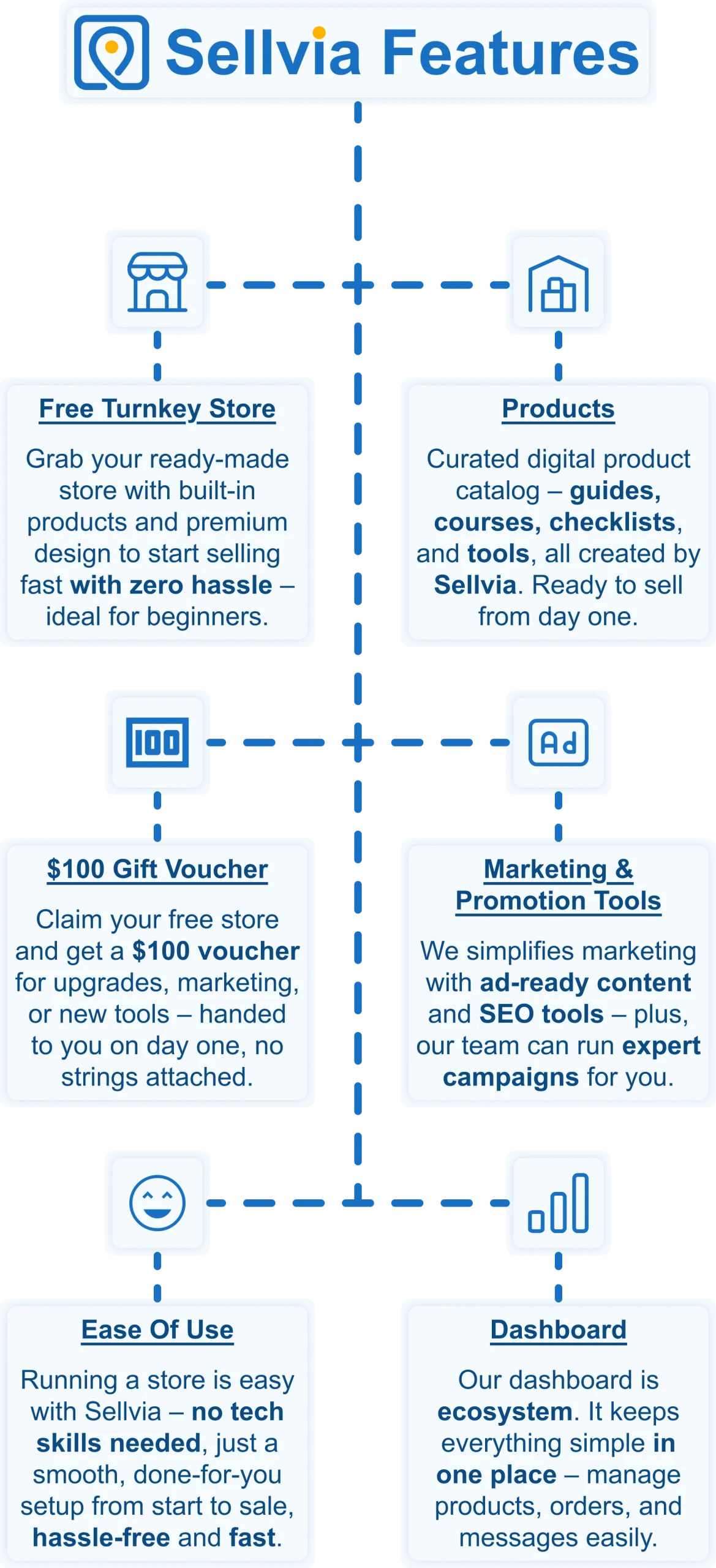
Want to start selling but don’t know where to begin? No worries! Just share your ideas, and Sellvia’s team will build a free ecommerce website that’s fully set up and ready to take orders from day one. No coding, no stress – just a store that works right out of the box.
A $100 gift voucher to grow your business faster 🎁
Starting a business takes momentum – and Sellvia gives you a head start. When you claim your free store today, you also get a $100 gift voucher to put toward growing your business. Use it to upgrade your store, boost your marketing, or unlock new tools. It is a real dollar value, handed to you on day one, with no catch and no hoops to jump through.
A massive catalog of digital products to sell 🏆
One of the biggest struggles in starting an online business is figuring out what to sell. Sellvia solves that completely. Your store comes pre-loaded with digital products – guides, courses, checklists, and tools – all created by Sellvia. You keep 50–70% of every sale. No inventory. No shipping. No logistics headaches.
Everything in one easy-to-use platform 🔥
Managing an online store shouldn’t be complicated. With Sellvia, you can handle orders, add new products, and even chat with customers – all from a simple and user-friendly platform. No need to mess with confusing tools or deal with unnecessary tech stuff. It’s all smooth sailing.
No upfront costs, just start selling 💰
A big reason people hesitate to start an online business is the cost. But here’s the good news: With Sellvia, you don’t need to invest in stock, storage, or shipping supplies. You can run your store with no upfront costs, keeping things low-risk while still making money.
Support that’s always got your back 🤝
Running a business comes with questions, but you’re never alone. Sellvia’s dedicated support team is available 24/7 to help with anything you need. Whether it’s a small question or a big challenge, they’ve got you covered.
Coinbase is a real tool for growing crypto holdings over time – but if you want income you can actually influence, a Sellvia store gives you a proven path to daily sales from digital products. Claim your free store today and see what your online business can look like.