
If you create content – videos, podcasts, writing, art, anything – there is a real chance your audience would pay you for it. That is the whole idea behind Patreon. It gives creators a direct way to earn income from the people who already love their work, without depending on ad revenue or one-time sales.
Over 250,000 creators use Patreon today. Some earn a few hundred dollars a month as a side income. Others make enough to do it full time. The difference between those two groups usually comes down to one thing: how well they understand how the platform actually works.
This guide breaks down exactly how to make money on Patreon – from setting up your page to choosing the right tier structure to growing your income over time. Whether you are just starting out or already have an audience, there are strategies here that will help you earn more.
Quick Answer: To make money on Patreon, you set up tiered memberships with exclusive perks, consistently deliver value to your supporters, and promote your page across your existing platforms. Most creators earn between $50 and $2,000 per month depending on their niche and audience size.
Making money on Patreon takes more than just setting up a page and waiting. The creators who earn real income on the platform are consistent, strategic, and genuinely focused on giving their supporters something worth paying for. The good news? None of that requires a massive following to get started.
What is Patreon and how does it work?
Patreon is a membership platform that lets creators earn recurring income directly from their fans. Instead of waiting for ad revenue to trickle in or hoping a product sells, you offer exclusive access at a monthly price – and your fans decide whether the value is worth it.
The platform works through tiers. You create different membership levels, each with its own price and set of perks. A basic tier might cost $3–$5 a month and include early access to your content. A higher tier might cost $25–$50 and include personalized shoutouts, live Q&A access, or downloadable resources. Your supporters choose the level that fits their budget and interest.
Patreon was founded in 2013 by musician Jack Conte, who wanted a better way to fund his creative work without relying on YouTube ad revenue. Today the platform hosts creators in every category – from illustrators and podcasters to fitness coaches and independent journalists.
Why this works in 2026: Audiences are increasingly willing to pay directly for content they trust. Ad-supported platforms pay fractions of a cent per view. A creator with 500 dedicated supporters paying $5 a month earns more than most mid-tier YouTube channels – without ever running an ad.
That said, Patreon is not a shortcut. Sustainable income on the platform comes from consistently showing up for your supporters, delivering real value, and treating your Patreon page like the business it is.
How much can you realistically earn on Patreon?
Earnings on Patreon vary widely depending on your niche, audience size, and how consistently you show up. Here is a realistic look at what creators at different stages tend to make:
One note on these figures: The top-end numbers belong to a very small group of creators with large, highly engaged audiences. For most people starting on Patreon today, realistic first-year earnings fall in the $50–$500 per month range – and that is with consistent effort. The platform rewards patience and relationship-building, not overnight launches.
It is also worth knowing how Patreon takes its cut. The Pro plan charges 8% of your earnings. The Premium plan charges 12% but includes a dedicated partner manager and extra features. Payment processing fees add another 5–8% on top. So if you earn $500 in a month, you will likely take home around $420–$450 after all fees.
The encouraging thing about Patreon income is that it compounds over time. Unlike a one-time product launch, a well-run Patreon page generates income every single month from the same supporters – and that number grows as you bring in new patrons. A creator who adds just 10 new $5 supporters per month adds $600 a year to their recurring income, and the momentum keeps building.
Now that you have a realistic picture of what Patreon income looks like, let us get into the specific methods that actually work.
How to make money on Patreon: 7 proven methods
There is no single formula for success on Patreon. But the creators who earn the most tend to combine several income methods at once and layer them together as their audience grows. Here is a breakdown of the most effective ones.
Membership tiers and recurring support
Entry-level tier ($3–$5/month)
This is your most accessible tier and often your most popular one. At this price point, supporters are not expecting anything complex – they want to feel close to you and know their contribution helps. Common perks at this level include early access to content, exclusive posts, or a patron-only community feed. Even at $5 a month, 100 supporters generate $500 in recurring monthly income. That is a meaningful supplement to almost any other income stream, and it costs you very little extra effort to maintain.
Mid-level tier ($10–$25/month)
This is where you start adding real value. At this price, supporters expect tangible perks – downloadable resources, exclusive tutorials, access to a private community, or a monthly Q&A. The key is making sure the value at this tier feels clearly different from your entry level. A creator charging $15 a month who offers a monthly live session and a library of exclusive guides will retain supporters far better than one who simply offers “extra posts.” Be specific about what patrons get.
Earning potential: $300–$2,500/month with 20–100 mid-tier supporters.
Premium tier ($50+/month)
Premium tiers work best for creators with a highly engaged, smaller audience – coaches, consultants, and niche experts. At this level, supporters expect something personal: a monthly one-on-one call, custom content created specifically for them, or a direct line of communication with you. You do not need many premium supporters to make this tier worthwhile. Just 10 supporters at $50 a month is $500 in recurring income from a single high-touch tier.
Earning potential: $500–$5,000/month with 10–100 premium-tier supporters.
Content and digital products
Exclusive posts and behind-the-scenes access
Patron-only posts are the backbone of most successful Patreon pages. This can mean early access to videos before they go public, behind-the-scenes updates on your creative process, or exclusive written content your audience cannot find anywhere else. The more personal and specific this content feels, the more valuable it is. A podcast host who shares outtakes and producer notes with patrons gives supporters something no algorithm can replicate – and that connection is exactly what keeps people renewing month after month.
Digital downloads and tutorials
If you teach something, digital downloads are one of the highest-value perks you can offer. Templates, checklists, ebooks, Lightroom presets, audio stems, source code, printables – anything your audience would normally pay for elsewhere. Bundling monthly digital downloads into a mid-tier membership can significantly increase your average patron value. A photography creator offering 10 exclusive presets per month at $15 gives supporters a very clear, concrete reason to stay subscribed.
Live events and Q&A sessions
Live access is one of the perks supporters value most. Monthly live streams, patron-only Q&A sessions, or virtual workshops give your audience direct interaction with you – something that feels impossible to replicate elsewhere. Even a 30-minute monthly session can justify a $20–$25 tier for many supporters. The key is consistency: if you promise a monthly session, you must deliver it every single month without exception. Missed sessions are one of the top reasons patrons cancel.
Personalized perks and shoutouts
At premium tiers, personalization is the main draw. This can be as simple as a personal thank-you message, a shoutout in your video or podcast, or as involved as custom artwork or a personalized video message. Personalized perks take time, so be careful not to over-promise at scale. Start with a small cap on how many people can access these perks at any given time to protect your schedule and ensure every supporter receives real quality.
Important note: As you add tiers and perks, keep your total offering simple enough that you can deliver on it consistently. Overpromising and underdelivering is the fastest way to lose patrons – and your reputation.
Tips to grow your Patreon earnings faster
Understanding the methods is only half the picture. How you run your Patreon day-to-day makes the biggest difference in whether patrons stick around and whether new ones find you. Here are the habits that separate growing pages from stagnant ones.
Promote your page consistently
The biggest mistake creators make on Patreon is setting up a page and never mentioning it again. Your Patreon link should be in your bio, your video descriptions, your podcast outro, and your email footer. Mention it naturally in your content at least once a week. The creators who grow fastest do not do a single big launch and go quiet – they make Patreon feel like a normal, expected part of their content ecosystem.
Post on a regular schedule
Patrons are paying a recurring fee. If there is nothing new on your page for two weeks, many will start questioning whether the cost is worth it. Even a short update – a behind-the-scenes note, a quick patron-only poll, a photo from your workspace – signals to your supporters that their money is going somewhere meaningful. Consistency builds loyalty, and loyalty is what keeps your monthly income stable over time.
Start free members on a path to paid
Patreon allows creators to offer free membership tiers. These are a great way to get people into your community who are not ready to pay yet. Once they are inside and experiencing the value of your content and your community culture, converting them to a paid tier becomes far more natural. Think of free members as your warm audience – they are one great exclusive post away from becoming paying supporters.
Reward your longest supporters
Patron retention is just as important as new sign-ups. A patron who stays for 12 months is worth 12 times what a patron who cancels after one month is worth. Celebrate anniversaries, offer loyalty perks, or simply name-check long-term supporters in your content. Small gestures go a long way when someone feels personally seen by a creator they admire and have been following for years.
Use analytics to refine what you offer
Patreon’s built-in analytics show you which tiers attract the most patrons, what content gets the most engagement, and where you lose subscribers. Use this data actively. If your $5 tier is full and your $25 tier is empty, that is a signal to rethink the value at the mid-level. If patrons consistently cancel in month two, there may be an expectation gap between what you promise and what you actually deliver.
Who should try Patreon and who should look elsewhere
Patreon works well for some types of creators and less well for others. Here is an honest breakdown to help you decide if it is the right move for you right now.
Best for beginners
If you already have a small but loyal following – even a few hundred people – Patreon is worth exploring. The setup is free, the barrier to entry is low, and even $100–$200 a month in early income validates your audience and gives you a foundation to grow from. Start with one or two tiers maximum to keep things manageable while you figure out what your patrons actually want.
Best for creators with consistent output
If you publish content regularly and your audience already shows up for you on a schedule, Patreon is a natural next step. You are essentially formalizing the relationship your audience already has with your work. Bloggers, podcasters, newsletter writers, and YouTubers tend to do well on Patreon when they already have a consistent posting habit – because the hardest part is already built in.
Best for niche experts
Patreon performs especially well for niche creators with dedicated audiences. A small YouTube channel about vintage watch restoration with 2,000 subscribers can outperform a general lifestyle channel with 50,000 subscribers on Patreon – because the audience is highly specific and deeply invested. Niche content equals loyalty, and loyalty is the real currency of Patreon income.
When Patreon may not be the right fit
If you do not have an existing audience on any platform, Patreon is a hard place to start. The platform has very little built-in discovery – people find your Patreon page through your other channels, not by browsing Patreon itself. If you are starting from zero, you need to build an audience first before Patreon makes sense. In that case, other income-building options that do not require a following may be a smarter starting point.
How to set up your Patreon page: a simple step-by-step guide
Getting started on Patreon takes less than an hour. Here is exactly what to do.
- Go to patreon.com and create a free creator account.
- Choose your niche and write a clear, honest description of what patrons will receive.
- Set up two or three tiers with specific, concrete perks at each level.
- Connect your payout method – Patreon supports PayPal, Stripe, and direct bank transfers.
- Announce your launch to your existing audience across every platform you are active on.
- Post your first piece of patron-only content within 48 hours of launching.
The most important thing you can do in the first week is deliver on your promise. Whatever you told patrons they would get at each tier, make sure it is there before anyone signs up. First impressions on Patreon are hard to recover from if you start slow or under-deliver on day one.
Looking beyond Patreon for a bigger income
Patreon is a legitimate income source for creators, but it has real limits. You need an existing audience. You need to keep creating content constantly. And your income depends entirely on whether your patrons choose to renew each month. If even 20% cancel in a given month, your earnings drop significantly – and there is no simple way to recover fast.
For people who want a more reliable path to online income – one that does not depend on already having a following or constantly producing new content – a digital product business is worth looking at. Instead of earning from your existing audience, you sell products to customers who are already searching and ready to buy.
That is where Sellvia comes in. Over 1,500,000 stores have launched on Sellvia, and store owners have collectively earned more than $1.5 billion. The platform is recognized by Forbes and ranked in Inc.’s list of the 5,000 fastest-growing companies in the U.S. If you are serious about building an online income in 2026, it is one of the most accessible starting points available today.
Why Sellvia is a game-changer for your online store 🚀
Sellvia isn’t just another ecommerce tool. We are a trusted name in the industry, recognized by Forbes and even ranked in Inc.’s list of the 5,000 fastest-growing companies in the U.S. So if you’re serious about starting as a solopreneur, this is a smart place to begin.
Starting an online business can feel overwhelming, but that’s exactly where Sellvia steps in. It takes care of the tricky parts, so you can focus on making sales and growing your brand. Let’s break down what makes it such a great choice.
Get a ready-to-go store hassle-free 🎯
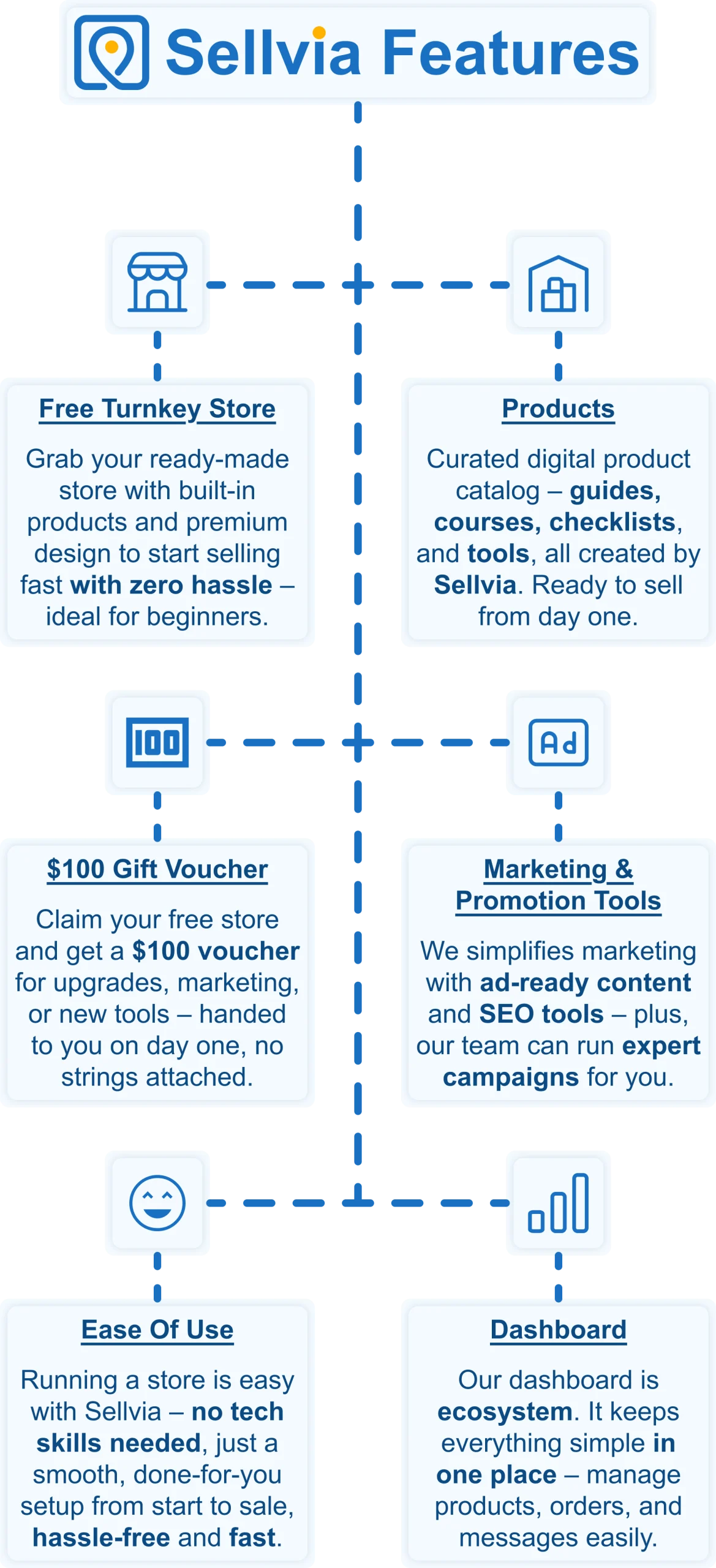
Want to start selling but don’t know where to begin? No worries! Just share your ideas, and Sellvia’s team will build a free ecommerce website that’s fully set up and ready to take orders from day one. No coding, no stress – just a store that works right out of the box.
A $100 gift voucher to grow your business faster 🎁
Starting a business takes momentum – and Sellvia gives you a head start. When you claim your free store today, you also get a $100 gift voucher to put toward growing your business. Use it to upgrade your store, boost your marketing, or unlock new tools. It is a real dollar value, handed to you on day one, with no catch and no hoops to jump through.
A massive catalog of digital products to sell 🏆
One of the biggest struggles in starting an online business is figuring out what to sell. Sellvia solves that completely. Your store comes pre-loaded with digital products – guides, courses, checklists, and tools – all created by Sellvia. You keep 50–70% of every sale. No inventory. No shipping. No logistics headaches.
Everything in one easy-to-use platform 🔥
Managing an online store shouldn’t be complicated. With Sellvia, you can handle orders, add new products, and even chat with customers – all from a simple and user-friendly platform. No need to mess with confusing tools or deal with unnecessary tech stuff. It’s all smooth sailing.
No upfront costs, just start selling 💰
A big reason people hesitate to start an online business is the cost. But here’s the good news: With Sellvia, you don’t need to invest in stock, storage, or shipping supplies. You can run your store with no upfront costs, keeping things low-risk while still making money.
Support that’s always got your back 🤝
Running a business comes with questions, but you’re never alone. Sellvia’s dedicated support team is available 24/7 to help with anything you need. Whether it’s a small question or a big challenge, they’ve got you covered.
Patreon is a great tool for creators who already have an audience, but building your own online business gives you income that grows on your own terms. Claim your free Sellvia store today and start earning from a business that is ready to go from day one.