Quick Answer: You can make money on Poshmark by listing clothing, shoes, and accessories from your closet, pricing them competitively, and staying active in the platform’s community. Most casual sellers earn $50–$300 per month, while dedicated resellers treating it like a business can reach $1,000–$3,000 or more.
Maybe you have a closet full of clothes you never wear anymore. Maybe a friend told you they made a few hundred dollars clearing out their wardrobe. Whatever brought you here, the question is the same: can you actually make real money on Poshmark, and is it worth your time?
This guide covers everything you need to know about how to make money on Poshmark in 2026 — from setting up your account and taking photos that sell, to pricing your items and growing beyond your first few listings. We also look at what happens when you are ready to build something bigger than a closet side hustle.
Before you list your first item, it is worth understanding how Poshmark works, what the fees look like, and what kind of income is actually realistic for someone at your level. Starting with clear expectations will save you a lot of frustration down the road.
What is Poshmark?
Poshmark is an online marketplace where people buy and sell new and used fashion items, including clothing, shoes, accessories, and home goods. Launched in 2011, it has grown into one of the largest resale platforms in the United States with tens of millions of registered users browsing and buying every day.
What sets Poshmark apart from a standard marketplace is its social layer. You can follow other sellers, share their listings, attend virtual Posh Parties, and build a community around your closet. That social activity is directly tied to how many people see your items and how quickly they sell. The more active you are, the more visibility you earn.
Poshmark handles payments and provides a prepaid shipping label every time a sale is made. Their fee structure is straightforward: for sales under $15, Poshmark charges a flat $2.95 fee. For sales at $15 or more, they take 20% and you keep the remaining 80%. Factoring that into your pricing from the start is essential.
Poshmark is a real platform with a real audience, and it is genuinely useful for turning items you no longer need into cash. But it is also a business model that depends entirely on what physical items you have available to sell. Once your closet runs out, the income slows down unless you actively source new inventory elsewhere.
How much can you realistically earn on Poshmark?
Poshmark income varies widely depending on how much you list, what you charge, and how active you stay on the platform. Here is a realistic breakdown of what different types of sellers tend to bring in:
These figures reflect what active, consistent sellers report across reseller communities and forums. Casual sellers listing from their own closets tend to land in the $50–$300 range. Part-time resellers sourcing inventory from thrift stores and garage sales regularly push past $500 per month. The $1,000-plus tier requires treating Poshmark like a real job.
One note on the higher figures: Earning $2,000–$3,000 per month on Poshmark is possible, but it typically takes 3–6 months of consistent work to reach that level. Most sellers at that income point are listing new items daily, sharing their closet multiple times a day, and actively sourcing fresh inventory at least a few times per week.
The type of item you sell matters just as much as your effort level. Name-brand and designer pieces command far higher prices than fast fashion. A gently used designer bag can sell for $150–$400, while a basic shirt might bring in $8 after fees. Focusing on quality over volume tends to produce much better results, especially early on.
How to make money on Poshmark: a step-by-step guide
Whether you are listing your first item tonight or you have been on the platform for a few weeks without much traction, this walkthrough covers every step you need to know to start making consistent sales.
Getting set up and finding your inventory
Create your Poshmark account
Download the Poshmark app on your phone or visit the website from your computer. Sign up with your email address or connect through Facebook. Once you are in, fill out your profile with a clear photo and a short bio describing what you sell. A complete profile builds trust with potential buyers before they ever look at your listings.
Spend a few minutes browsing the platform before you list anything. Look at the top sellers in categories similar to what you plan to sell. Notice how they write their titles, what their photos look like, and how they price similar items. That quick research will pay off when you list your own items.
Choose the right items to list
Start with what you already own. Go through your closet and pull out anything you have not worn in the past year, clothes that no longer fit, or pieces that are no longer your style. Focus on items in good, clean condition — buyers expect what they see in the photos, and honest listings lead to better reviews and fewer disputes.
Quality beats quantity here. A single well-photographed piece from a recognizable brand will almost always outsell ten listings of fast-fashion basics. Prioritize branded clothing, designer accessories, items with tags still attached, and anything that is currently trending.
Take photos that close the sale
Your photos are the first thing every buyer sees, and they make or break whether someone clicks on your listing. Use natural light whenever possible — a spot near a window during the day works better than indoor lighting for most items. Take at least four to six photos per listing: front, back, tag, and any unique details or minor flaws.
Keep your background clean and uncluttered. A white wall, a neutral bedsheet spread on the floor, or a plain table surface all work well. Flat lay shots on a light surface tend to perform consistently for clothing, while accessories often look better on a solid-color surface with good contrast.
Listing, pricing, and getting your first sales
Write listings that attract buyers
Your description is where you convert a browser into a buyer. Include the brand, size, material, condition, and any details a buyer would want to know before purchasing. Be honest about flaws — disclose every stain, snag, or scuff. Buyers who receive items that match the listing leave good reviews; buyers who feel misled open disputes.
Use the language that buyers actually search for. If you are selling a navy blue Ralph Lauren polo in size medium, include all of those exact terms in your title and description. Poshmark’s search works best when your listings match the specific words buyers type in, so do not be vague.
Price your items to actually sell
Before you set a price, search Poshmark for similar items and filter by “sold” listings. There is often a significant gap between what sellers ask and what buyers actually pay. Focus on sold prices to understand real market value, not wishful thinking from listings that have been sitting for months.
Factor Poshmark’s fee into every price you set. If you want to take home $20 on a sale, you need to list at $25 to account for the 20% cut. Pricing slightly above your floor also gives you room to accept offers or run a short-time promotion. Most buyers will try to negotiate, and leaving a small buffer lets you say yes without losing money.
Important note: Poshmark’s “Offer to Likers” feature lets you send private discounts to users who have liked your items. Sending a 10–20% offer often turns inactive browsers into paying buyers the same day you send it.
Stay active in the Poshmark community
Poshmark is not a platform where you can list items and walk away. The more active you are, the more the algorithm surfaces your listings to potential buyers. Share your own items multiple times each day, and share other sellers’ listings too. The community tends to return the favor, and those return shares put your closet in front of new eyes.
Join Posh Parties whenever you can. These are themed virtual selling events where sharing your relevant listings dramatically increases their reach for a limited window of time. Look for parties that match your inventory, such as themed brand events or category-specific parties, and be active during the event window to maximize visibility.
The sellers who make consistent money on Poshmark are the ones who treat daily engagement as a non-negotiable part of the process — not something they do when they remember to.
Tips to grow your Poshmark income
Getting your first few sales is satisfying, but keeping that momentum going requires a few habits that most beginners overlook. These strategies are what separate sellers who plateau at $50 a month from those who build a real side income.
Track your sales data
Keep a simple spreadsheet of every item you list: what it cost you (if you sourced it), what you listed it for, how long it sat before selling, and what the final sale price was. After a month of data, patterns become obvious. Some item categories sell in days at good margins. Others sit for weeks at any price. That data lets you stop wasting time on slow inventory and put your energy into what actually moves.
Show up on the app every day
Poshmark’s algorithm rewards active accounts. Sellers who log in and share their listings every single day consistently outperform those who check in once a week. Set aside 15–20 minutes each morning to share your top items, respond to comments and offers, and engage briefly with a few other sellers in your niche. That small daily habit builds compounding visibility over time.
Stay current on what is trending
Poshmark buyers follow fashion, and what sells best on the platform shifts throughout the year. Follow a few fashion accounts on social media, browse Poshmark’s featured listings on the home page, and keep an eye on which brands and styles are getting attention. When you source new inventory, prioritizing pieces that match current trends means your listings get noticed faster and sell closer to your asking price.
Use every tool Poshmark gives you
Poshmark builds in more seller tools than most people use. The “Offer to Likers” feature is one of the highest-converting actions you can take on the platform. The Poshmark Ambassador program gives you added credibility and access to exclusive seller resources once you hit certain activity milestones. These tools cost nothing extra and are often the difference between a stagnant closet and a consistently earning one.
Legal and ethical considerations for Poshmark sellers
Poshmark has clear rules about what you can and cannot sell, and following them protects your account, your income, and your reputation. Here is what every seller needs to know before they start listing in volume.
What to avoid absolutely
Never list counterfeit items. Poshmark takes authenticity seriously, and selling fake designer goods is both a violation of their terms of service and potentially illegal. Buyers who receive counterfeit items can open disputes, your account can be permanently banned, and in some cases sellers face legal consequences beyond the platform itself.
Do not misrepresent the condition of any item. If a shirt has a small stain, disclose it. If a zipper is stiff, mention it. Buyers who receive items that do not match the listing can open a dispute through Poshmark’s buyer protection system, and your sale will be reversed, including the shipping label cost.
Key principle: Honest listings protect your earnings. A strong review history is one of the most valuable assets a Poshmark seller can build, and it is built one accurate listing at a time.
What to do instead
Build your reputation by being transparent in every listing. Sellers who describe their items honestly, communicate quickly with buyers, and handle any issues professionally outperform those who cut corners, even when the honest sellers have smaller closets. Trust is the currency that actually drives repeat buyers and word-of-mouth visibility on Poshmark.
Is Poshmark worth it in 2026? Choosing the right path for your goals
Poshmark works well for some people and falls short for others. Here is a realistic breakdown by reader profile to help you decide whether it is the right fit for your goals or whether it is time to look at something with more income potential.
Complete beginner
If you are brand new to selling online and just want to make some extra cash from things you already own, Poshmark is a solid starting point. It is free to join, easy to use on a phone, and requires no upfront investment. Start with 10–20 items from your closet, learn how the platform works, and build from there. Expect to earn $50–$200 in your first month if you stay active and engage with the community daily.
Part-time reseller
If you are willing to invest 10–15 hours per week — sourcing items at thrift stores, photographing and listing consistently, and staying active on the platform — you can work toward $300–$800 per month. This level takes 2–3 months of consistent effort to build up your inventory, your review history, and your follower base. It is a genuine side hustle for people who have the time and the drive to run it like a small business.
Full-time income seeker
If your goal is to replace a full-time income, Poshmark alone is a challenging path. Full-time resellers earning $2,000–$3,000 per month are essentially running small businesses: sourcing inventory multiple times per week, handling outgoing shipments daily, and spending significant time on engagement and sharing. The ceiling is always tied to how much physical inventory you can find, photograph, and process. Many people at this level eventually look for a business model that scales without those physical constraints.
Someone ready to go beyond Poshmark
If you want an online business that is not limited by your closet, does not require sourcing physical items, and has income potential that grows as you scale, a different type of online store might be the better fit. There are options available today that cost nothing to start, come with products already ready to sell, and include a built-in advertising system to help you get your first orders quickly.
Why Sellvia is a game-changer for your online store 🚀
Sellvia isn’t just another ecommerce tool. We are a trusted name in the industry, recognized by Forbes and even ranked in Inc.’s list of the 5,000 fastest-growing companies in the U.S. So if you’re serious about starting as a solopreneur, this is a smart place to begin.
Starting an online business can feel overwhelming, but that’s exactly where Sellvia steps in. It takes care of the tricky parts, so you can focus on making sales and growing your brand. Let’s break down what makes it such a great choice.
Get a ready-to-go store hassle-free 🎯
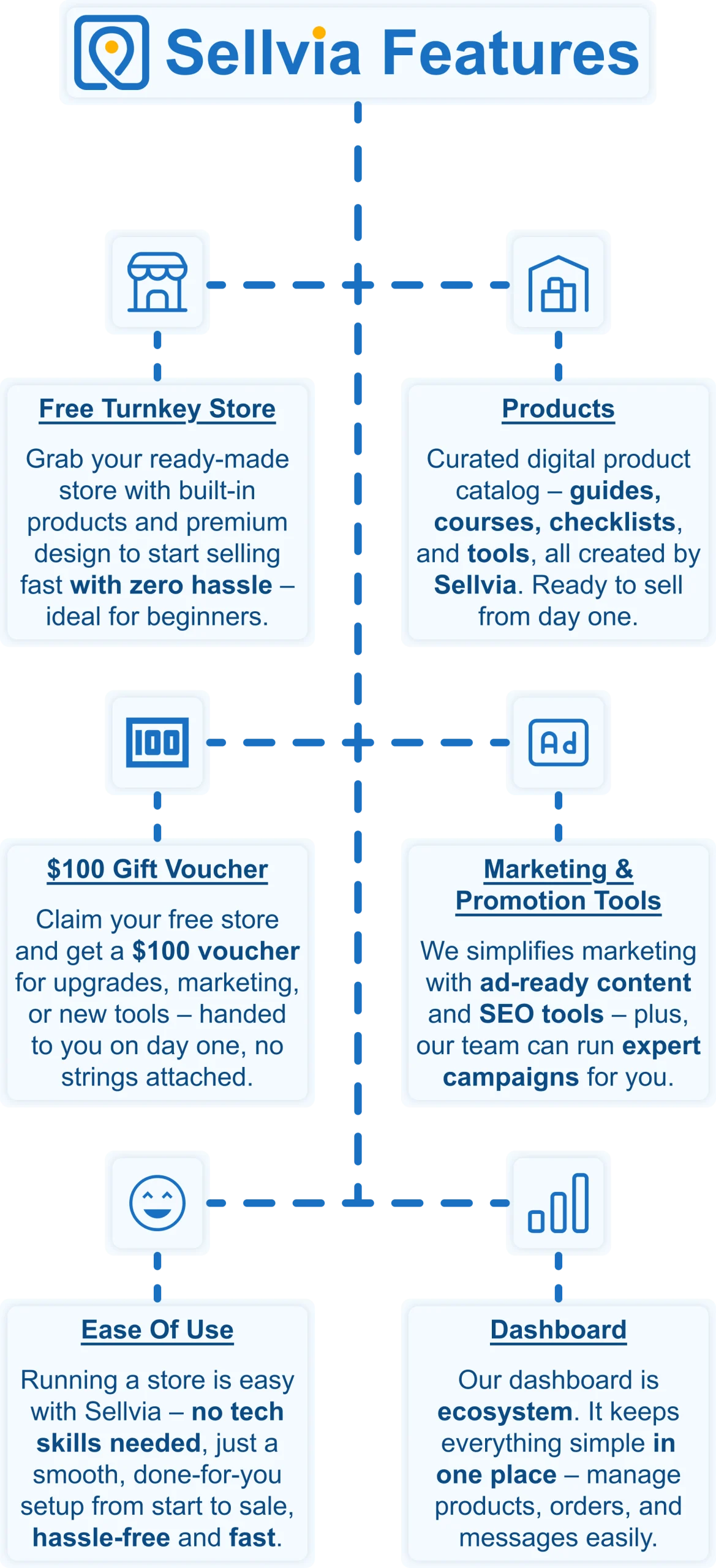
Want to start selling but don’t know where to begin? No worries! Just share your ideas, and Sellvia’s team will build a free ecommerce website that’s fully set up and ready to take orders from day one. No coding, no stress – just a store that works right out of the box.
A $100 gift voucher to grow your business faster 🎁
Starting a business takes momentum – and Sellvia gives you a head start. When you claim your free store today, you also get a $100 gift voucher to put toward growing your business. Use it to upgrade your store, boost your marketing, or unlock new tools. It is a real dollar value, handed to you on day one, with no catch and no hoops to jump through.
A massive catalog of digital products to sell 🏆
One of the biggest struggles in starting an online business is figuring out what to sell. Sellvia solves that completely. Your store comes pre-loaded with digital products – guides, courses, checklists, and tools – all created by Sellvia. You keep 50–70% of every sale. No inventory. No shipping. No logistics headaches.
Everything in one easy-to-use platform 🔥
Managing an online store shouldn’t be complicated. With Sellvia, you can handle orders, add new products, and even chat with customers – all from a simple and user-friendly platform. No need to mess with confusing tools or deal with unnecessary tech stuff. It’s all smooth sailing.
No upfront costs, just start selling 💰
A big reason people hesitate to start an online business is the cost. But here’s the good news: With Sellvia, you don’t need to invest in stock, storage, or shipping supplies. You can run your store with no upfront costs, keeping things low-risk while still making money.
Support that’s always got your back 🤝
Running a business comes with questions, but you’re never alone. Sellvia’s dedicated support team is available 24/7 to help with anything you need. Whether it’s a small question or a big challenge, they’ve got you covered.
If you are ready to grow beyond what Poshmark can offer, Sellvia gives you a free store loaded with digital products and a built-in system designed to get you your first orders fast. Claim your free Sellvia store today and see what your online business can really look like.