Robinhood changed the game for everyday investors. Before it arrived, buying stocks meant paying commissions, calling a broker, and having a decent amount of money already saved. Now you can open an account in minutes on your phone and start trading with almost nothing.
But knowing how to make money on Robinhood is a very different thing from just having access to it. The platform makes it easy to get started. Turning that access into real, consistent income takes strategy, patience, and a willingness to learn from losses.
Quick Answer: You can make money on Robinhood through buy-and-hold investing, swing trading, dividend stocks, options, and IPO participation. Most beginners see modest results in year one. Serious earnings require meaningful capital, ongoing education, and the discipline to stay calm through market swings.
This guide covers every method in plain language — with honest earning estimates, real risk warnings, and no empty promises. If you have been searching for how to make money on Robinhood, you are in the right place.
Millions of Americans have turned to Robinhood as a first step toward financial independence. With no minimum balance and commission-free trades, the barrier to entry is lower than it has ever been. But the barrier to profit is still real. Understanding what you are getting into before you invest a single dollar is the smartest move you can make — and that is exactly what this guide is for.
What is Robinhood?
Robinhood launched in 2013 with a clear mission: make investing accessible to everyone, not just wealthy traders. Before Robinhood, buying even one share of stock typically meant paying a brokerage commission of $5 to $10 per trade. Robinhood eliminated that fee entirely, and millions of everyday Americans joined the stock market for the first time.
Today the platform lets you trade stocks, ETFs (exchange-traded funds), options, and cryptocurrencies — all from a simple smartphone app. You do not need a financial advisor, a stockbroker, or a degree in finance. You need an account and money you are prepared to put at risk.
Important note: Robinhood earns money through a process called payment for order flow and through its premium Robinhood Gold subscription. Your individual trades are commission-free, but understanding how the business operates helps you use the platform more wisely.
Robinhood has faced legitimate criticism over the years, particularly for how easily it puts advanced tools like options trading in the hands of users who may not fully understand them. That is not a reason to avoid the platform — it is a reason to go in with clear eyes and a strategy that fits your experience level.
How much can you realistically earn on Robinhood?
This is the question every new investor asks — and the honest answer depends entirely on how much capital you start with, which strategy you use, and how disciplined you are.
The stock market has historically returned an average of around 10% per year before inflation. That means a $5,000 investment might earn roughly $500 in a strong year — and lose money in a bad one. Short-term traders face steeper odds: studies consistently show that most retail day traders lose money over any given 12-month period.
One note on these figures: The numbers above assume a functioning portfolio with real capital behind it. Results vary based on market conditions, the stocks you pick, and your ability to hold a strategy when things get uncomfortable.
There is no guaranteed outcome in the stock market. Even professional fund managers frequently underperform simple index funds over a 10-year period. That said, long-term buy-and-hold investing through Robinhood has helped many everyday Americans grow real wealth — the key word being long-term. Most beginners should not expect meaningful returns inside their first year.
If you are starting with a small amount of money and need income sooner rather than later, it is worth knowing that investing is not the only path available to you. More on that later in this guide.
How to make money on Robinhood: top strategies
There are several distinct ways to earn on Robinhood, each requiring a different level of risk tolerance, time, and knowledge. Here is a clear breakdown of what each one actually looks like in practice.
Buy-and-hold investing
Buy-and-hold is the simplest Robinhood strategy — and for most people, it is also the most reliable. You buy shares of strong companies or broad index funds and hold them for years, letting the market do the work.
The logic is straightforward. Quality companies and index funds tracking the S&P 500 tend to grow over time, even through short-term drops. If you had put $1,000 into a basic S&P 500 index ETF ten years ago and simply left it alone, it would be worth significantly more today.
How to get started: Open a Robinhood account, deposit an amount you could afford to lose, and look for broad index ETFs like those tracking the S&P 500. Set up automatic monthly contributions — even $25 or $50 — and resist the urge to sell during downturns.
Earning potential: 7–10% annually on average, compounding over time. On a $5,000 portfolio, that is roughly $350–$500 per year in a solid market environment.
Swing trading for faster returns
Swing trading means holding stocks for days or a few weeks, trying to profit from short-term price swings. It is more active than buy-and-hold and requires reading charts and technical indicators.
To swing trade effectively you need to understand tools like moving averages, RSI (Relative Strength Index), and stop-loss orders — which automatically sell a stock if it falls below a price you set. Without these, you are essentially guessing.
Important: Research consistently shows that most retail swing traders lose money, particularly in their first year. If you pursue this strategy, start with the smallest amount you can afford to lose entirely while you build your skills.
Earning potential: Highly variable. Skilled swing traders report gains of 1–3% per successful trade. Beginners frequently give those gains back — and more — during inevitable losing streaks.
Options trading: high stakes, serious risk
Options are contracts that give you the right — but not the obligation — to buy or sell a stock at a set price before a specific expiration date. They can multiply your gains quickly, but they can also expire worthless, which means you lose 100% of what you put in.
Robinhood makes options easy to access. That is both a feature and a warning. Easy access does not reduce the risk — it just removes the friction that used to slow people down.
How to get started: Study options for at least several weeks before placing a single real trade. Learn what call and put options are, understand time decay (options lose value as expiration approaches), and start with the smallest possible amounts. A paper trading account lets you practice without real money at risk.
Earning potential: Theoretically very high — skilled options traders can turn modest sums into substantial gains. But most beginners who jump into options without preparation lose their entire investment within weeks.
Dividend investing for regular income
Dividend stocks pay you a share of the company’s profits on a regular schedule — usually every quarter. This gives you income without needing to sell any shares, which many investors find appealing as a way to build a steady income stream over time.
Companies in utilities, consumer staples, and real estate investment trusts (REITs) are common dividend payers. The real power comes from reinvesting those dividends to buy more shares, compounding your returns year after year.
How to get started: Look for stocks with a consistent dividend history and a yield of 2–5%. Be careful of yields above 8–10% — unusually high yields often signal that a company is in financial trouble and may cut the dividend entirely.
Earning potential: 2–5% annual yield on your invested capital, plus stock price growth. On a $10,000 portfolio, that is $200–$500 per year in dividend income — reinvested, it compounds meaningfully over a decade.
IPO investing through Robinhood
An IPO — Initial Public Offering — is when a private company sells shares to the public for the first time. Robinhood gives eligible users access to IPO shares before trading opens on the open market, a privilege historically reserved for institutional investors.
Some IPOs surge dramatically on their first day. Others drop immediately and spend years recovering. The excitement around IPOs can push valuations higher than they deserve, leaving early buyers underwater from the start.
Important note: IPO investing is speculative. Even companies with impressive products can debut at inflated prices. Study the company’s financials, business model, and competitive position carefully before committing real money.
Earning potential: Unpredictable. Some early IPO investors have doubled their money in a single day. Many others have watched their investment lose 30–50% within the first few months. There is no typical outcome here.
Each of these strategies has a place — the right one depends entirely on how much time you have, how much capital you are starting with, and how much risk you can genuinely handle without making emotional decisions.
Managing your investment risks on Robinhood
No strategy on Robinhood — or any investment platform — works without solid risk management. These principles apply whether you are putting in $100 or $10,000.
Set a hard budget: Only invest money you could afford to lose without affecting rent, groceries, or utilities. Investing money needed for living expenses is one of the most common and costly mistakes first-time investors make.
Diversify your holdings: Do not put everything into one stock or one sector. Spread your investments across technology, healthcare, consumer goods, and other areas so a downturn in one place does not wipe out your entire portfolio.
Use stop-loss orders: A stop-loss automatically sells a stock when it drops to a price you set in advance. This limits how much you can lose on any single position without you needing to monitor the market all day.
Avoid emotional trading: The market rises and falls constantly. Fear and greed cause most beginner mistakes. When a stock drops 15%, the instinct is to sell. When it surges, the instinct is to buy more. Both reactions, if poorly timed, are how portfolios shrink instead of grow. Write your strategy down and follow it, even when the market tests your patience.
Stay informed without overreacting: Follow financial news and understand how events — interest rate decisions, earnings reports, economic data releases — affect stock prices. But do not react to every headline. The investors who perform best over time often trade the least frequently.
Risk management is not a strategy you add on top of investing — it is the foundation that makes any strategy survivable long enough to be profitable.
Proven tips to maximize your Robinhood earnings
Understanding the strategies is half the equation. These practical habits separate investors who build real returns from those who spin their wheels and break even.
Use Robinhood Gold for a research advantage
Robinhood Gold is the platform’s premium tier, available for $5 per month. It includes access to professional research reports from Morningstar, larger instant deposit limits, and the option to invest on margin. For any serious investor, the Morningstar research access alone can make the cost worthwhile — having professional analysis on the companies you are considering is a meaningful edge over going in blind.
Buy fractional shares to diversify with any budget
You do not need hundreds of dollars to own a piece of major companies. Robinhood lets you buy fractional shares, meaning you can invest $5 or $10 in any stock on the platform. This makes real diversification possible even if your starting budget is small — you can spread $100 across ten different companies instead of putting it all in one.
Earn interest on your uninvested cash
Robinhood’s cash management feature lets your idle dollars earn interest while you decide your next move. Rates fluctuate with broader interest rate conditions, so this will not transform your finances — but it is meaningfully better than letting cash sit earning nothing while you wait for the right opportunity.
Reinvest dividends automatically
When a dividend payment hits your account, do not let it sit as idle cash. Reinvest it immediately to buy more shares. Over 10 to 20 years, consistent dividend reinvestment amplifies your total return dramatically through the power of compounding. This is one of the most reliable wealth-building tools available — and it costs you nothing extra to use it.
Keep a simple trading journal
Few investors do this — which is exactly why it is such an advantage. Write down why you entered each position, what outcome you expected, and what actually happened. Reviewing that journal monthly reveals patterns in your thinking, both the smart moves and the emotional ones. It is one of the most effective free tools any investor can use, regardless of experience level.
Legal and ethical considerations when using Robinhood
Making money on Robinhood is completely legal — but there are important rules every user needs to know before they start trading actively.
Pattern day trader rules: If you make four or more day trades within any five-business-day period on Robinhood, the platform will flag you as a pattern day trader. This classification requires a minimum account balance of $25,000 to continue trading freely. Falling below that threshold restricts your trading ability. For most beginners, this rule alone is a strong reason to avoid frequent day trading.
Tax obligations: Any profit you make on Robinhood is taxable income. Short-term gains — from stocks held less than one year — are taxed at your regular income tax rate, which can be significant. Long-term gains — from stocks held over a year — receive a lower, more favorable tax rate. Keep records of every trade and consult a tax professional if your earnings become meaningful.
Key principle: Investing in the stock market is a legitimate path to building wealth over time. But it requires honest expectations, real capital, and patience measured in years. Anyone promising guaranteed daily returns from Robinhood is not telling you the truth.
What to avoid: Stay away from unsolicited stock tips on social media, pump-and-dump schemes targeting penny stocks, and any “hot stock” being aggressively pushed in online communities. These tactics harm real investors and are frequently illegal under securities law.
Final thoughts — which Robinhood strategy is right for you?
The best approach depends on who you are, how much time you have, and what you can realistically afford to invest. Here is a simple breakdown by reader profile.
Complete beginner
If you are new to investing, start with the simplest, lowest-risk option: buy a broad index ETF and hold it. Do not swing trade. Do not touch options. Do not invest money you need for expenses. Add a small, consistent amount each month — even $25 or $50 — and let time do the heavy lifting. Boring works.
Intermediate / part-time investor
If you have been investing for a year or more and want to be more active, swing trading or dividend investing can work alongside a core buy-and-hold portfolio. Study technical analysis before committing serious money to trades. Use stop-loss orders on every position. Treat every loss as a lesson, not a disaster.
Advanced / full-time income goal
If your goal is to replace a full-time income entirely with investment returns, understand the math first. Generating $3,000 per month in investment income typically requires $360,000 or more in a portfolio earning 10% annually. Options trading can accelerate that timeline — but it can also erase your principal if a run of bad trades hits. Most people pursuing full-time income goals are better served building an active income stream first, then investing the profits steadily over time.
Robinhood is a powerful platform. But it rewards patience and knowledge — neither of which can be skipped. The investors who do best are almost never the most excited ones in the room. They are the ones with a written plan, a realistic budget, and enough discipline to stick with both when the market turns uncomfortable.
If you are looking for a way to start building income faster — without needing a large portfolio or years of market education to get there — there is a different path worth knowing about.
Why Sellvia is a game-changer for your online store 🚀
Sellvia isn’t just another ecommerce tool. We are a trusted name in the industry, recognized by Forbes and even ranked in Inc.’s list of the 5,000 fastest-growing companies in the U.S. So if you’re serious about starting as a solopreneur, this is a smart place to begin.
Starting an online business can feel overwhelming, but that’s exactly where Sellvia steps in. It takes care of the tricky parts, so you can focus on making sales and growing your brand. Let’s break down what makes it such a great choice.
Get a ready-to-go store hassle-free 🎯
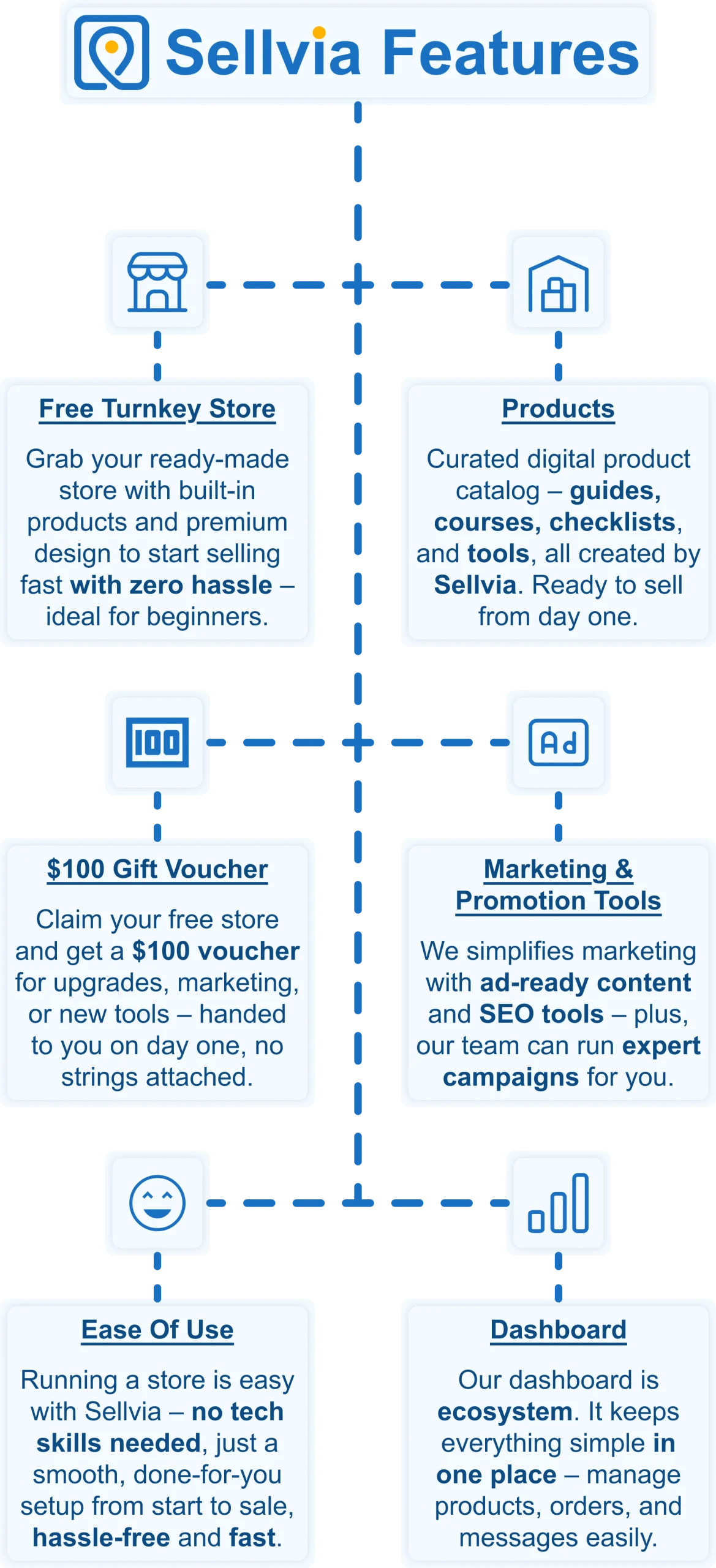
Want to start selling but don’t know where to begin? No worries! Just share your ideas, and Sellvia’s team will build a free ecommerce website that’s fully set up and ready to take orders from day one. No coding, no stress – just a store that works right out of the box.
A $100 gift voucher to grow your business faster 🎁
Starting a business takes momentum – and Sellvia gives you a head start. When you claim your free store today, you also get a $100 gift voucher to put toward growing your business. Use it to upgrade your store, boost your marketing, or unlock new tools. It is a real dollar value, handed to you on day one, with no catch and no hoops to jump through.
A massive catalog of digital products to sell 🏆
One of the biggest struggles in starting an online business is figuring out what to sell. Sellvia solves that completely. Your store comes pre-loaded with digital products – guides, courses, checklists, and tools – all created by Sellvia. You keep 50–70% of every sale. No inventory. No shipping. No logistics headaches.
Everything in one easy-to-use platform 🔥
Managing an online store shouldn’t be complicated. With Sellvia, you can handle orders, add new products, and even chat with customers – all from a simple and user-friendly platform. No need to mess with confusing tools or deal with unnecessary tech stuff. It’s all smooth sailing.
No upfront costs, just start selling 💰
A big reason people hesitate to start an online business is the cost. But here’s the good news: With Sellvia, you don’t need to invest in stock, storage, or shipping supplies. You can run your store with no upfront costs, keeping things low-risk while still making money.
Support that’s always got your back 🤝
Running a business comes with questions, but you’re never alone. Sellvia’s dedicated support team is available 24/7 to help with anything you need. Whether it’s a small question or a big challenge, they’ve got you covered.
While Robinhood builds wealth over years of careful investing, Sellvia gives you a way to start earning income from your own online store right now — no stock market knowledge required. Claim your free store today and see what is possible.