Wondering how to make money on Shutterstock? You are not alone. Every month, millions of people search for ways to turn their photos, videos, and creative work into real income. And Shutterstock – one of the world’s largest stock media platforms – genuinely does give contributors a path to getting paid.
Quick answer: You make money on Shutterstock by signing up as a contributor, uploading your images, videos, or illustrations, and earning royalties every time a buyer downloads your content. Most beginners earn between $5 and $50 per month in the first few months. With a large, well-optimized portfolio, experienced contributors can reach $200 to $800 per month or more.
But here is what most articles do not tell you: building a Shutterstock income takes time. You need to upload consistently, learn what buyers search for, and grow your portfolio over months – sometimes over a year. If you want a faster way to earn online, we will cover that option too. First, let us walk through exactly how Shutterstock works and what you can realistically expect in 2026.
Shutterstock has been around since 2003 and has one of the largest buyer bases in the stock media world. That is good news for contributors – there is real, ongoing demand for quality content. The challenge is that more than 500,000 contributors are uploading to the same platform. That means you need a strategy, not just a camera.
The sections below break everything down step by step: how to start, what to upload, how royalties work, and how to avoid the mistakes that hold most beginners back.
What is Shutterstock and how does it work?
Shutterstock is a stock media marketplace where businesses, designers, marketers, and publishers pay to license photos, videos, and illustrations for use in their projects. Contributors – people like you – upload their creative content and earn a royalty each time someone downloads it.
The model is simple. You shoot or create something. You upload it with a title, keywords, and a description. Buyers search the platform and license what they need. When they download your work, you receive a percentage of the sale. You never handle payments, deal with buyers directly, or send files manually. Shutterstock manages all of that.
What makes this model appealing is that your content can keep earning long after you uploaded it. A photo you took last year can still generate downloads today if it covers a topic buyers keep searching for. That is the kind of income people are chasing when they search “how to make money on Shutterstock” – income that does not require punching a time clock every morning.
How much can you realistically earn on Shutterstock?
This is the most important question to answer honestly. Shutterstock earnings depend heavily on how much you upload, how well you optimize your content, and how competitive your niche is. Here is a realistic breakdown by content type:
These figures reflect contributors who upload consistently and optimize their content. Most beginners start closer to $5–$30 per month in their first few months on the platform.
One note on the earning ceiling: Figures like “$1,000 per month on Shutterstock” are real – but they belong to contributors with years of uploads, thousands of files, and a strong understanding of what buyers search for. Reaching that level requires full-time effort over 12 to 24 months at minimum. For most people, Shutterstock works best as a supplement to other income, not a replacement for a paycheck.
Royalty rates on Shutterstock range from 15% to 40% for standard licenses and up to 50% for extended licenses. The amount you earn per download also depends on the buyer’s subscription level. Some downloads pay as little as $0.10, while editorial or extended license sales can pay several dollars each. The more content you have live on the platform, the more chances you have to generate higher-value downloads regularly.
Understanding this range matters before you invest serious time. Shutterstock can be a meaningful income stream – but it rewards patience and volume. If you want income that moves faster, the final section of this article covers a platform built to help you earn from day one.
How to get started as a Shutterstock contributor
Setting up on Shutterstock takes less than an hour. What matters most is what you do after your account is live.
Creating your contributor account
Go to contributor.shutterstock.com and sign up for free. You will need your name, email, and payment details. Shutterstock pays via PayPal, Skrill, or bank transfer depending on your location. You can reach the minimum payout threshold – $35 – faster than most people expect once you have a solid portfolio active.
Understanding what Shutterstock accepts
Shutterstock has specific quality standards. Images must be sharp, well-exposed, and free from noise or heavy compression. Photos of recognizable people require a signed model release form, and identifiable private property needs a property release. Videos must meet minimum resolution requirements, typically HD or 4K. Vectors should be submitted as EPS files. Content that does not meet these standards gets rejected during review, which can take 1 to 7 business days.
Uploading your first batch of content
Start with 10 to 15 of your strongest pieces rather than uploading everything at once. This helps you understand the review process, spot any recurring rejection reasons, and calibrate your quality standards before scaling up. Once you have a feel for what gets accepted, you can increase your upload frequency gradually week by week.
Optimizing your content for search
Every upload needs a title, description, and keyword tags. These are how buyers find your work inside Shutterstock’s search engine. Use specific, descriptive language that matches what a buyer would actually type. Instead of tagging a beach photo with “water,” use phrases like “tropical beach at sunset,” “summer vacation,” and “ocean waves at golden hour.” Think about the context buyers need your image for – not just what is literally in the frame.
Building your portfolio consistently
Consistency is the single biggest predictor of Shutterstock success. Contributors who upload 20 to 30 new assets per week grow their earnings faster than people who upload 100 pieces once and then stop. The platform rewards activity. The more content you have live, the more searches you show up in – and the more your monthly royalties compound over time.
What types of content sell best on Shutterstock?
Not all content performs equally on Shutterstock. Knowing what buyers are actively searching for is the difference between a portfolio that generates consistent downloads and one that sits unnoticed. Here is where the real demand lives in 2026.
Photos that sell consistently
Business and lifestyle shots
Images of people working, collaborating, and living modern daily life are among the most downloaded on the platform. A woman on a laptop at home, a team reviewing a project, a small business owner looking confident – these images are used constantly in marketing materials, websites, presentations, and social media. They are evergreen, they are always in demand, and they are accessible to shoot even with basic equipment and a willing friend or family member as a subject.
Nature and travel photography
Landscapes, cityscapes, and travel destinations sell steadily year-round, with spikes during booking seasons. If you have access to unique or underrepresented locations – rural land, national parks, coastlines, or small towns – you have an advantage because less competition exists in those searches. Authentic, unpolished travel photography often outperforms overly staged shots in this category.
Technology and concept images
AI, data, cybersecurity, and remote work are search categories that exploded over the past five years and continue growing in 2026. Photos and illustrations that visually represent these topics – even abstract or conceptual ones – are in constant demand from publishers, tech companies, and bloggers who need visual content for articles, ads, and websites. A simple graphic of hands on a keyboard or a person analyzing a screen can perform extremely well with the right keywords.
Videos that earn higher royalties
Aerial and slow-motion footage
Video earns significantly more per download than photos on Shutterstock. Drone footage, slow-motion clips, and cinematic nature shots are among the highest-demand categories. A single video clip on an extended license can sell for $20 to $150. If you own a drone or have access to video equipment, allocating some of your effort toward short clips can meaningfully accelerate your total earnings.
Business and editorial video
Short B-roll clips of everyday professional life – someone typing, opening a laptop, walking through an office, or reviewing documents – sell consistently to marketers and brands. Keep clips between 5 and 15 seconds, shoot in steady and well-lit conditions, and focus on versatility. Buyers want footage they can drop into any project without it looking out of place.
Vectors and illustrations
If you have design skills, the vector and illustration category is worth your attention. Icons, infographic elements, and flat design illustrations are downloaded heavily for web and app use. Niche illustration sets – such as a pack of icons built around a specific industry like healthcare, education, or finance – often outperform one-off pieces because buyers find and download the whole set in one purchase. Consistent visual styles and clear, keyword-rich titles help these files surface in competitive searches.
Tips to maximize your Shutterstock earnings
Getting accepted onto the platform is only step one. Growing your income from there requires some deliberate strategy. These habits consistently separate contributors who earn well from those who stall out.
Upload regularly, not in bursts
The single most common mistake on Shutterstock is treating it as a one-time upload project. The platform’s algorithm rewards consistency. Contributors who add new content weekly see steadier growth than those who upload 200 files in January and then disappear. Set a realistic weekly upload goal – even 10 new files – and stick to it. Volume compounds over time, and so do earnings.
Diversify across content types
Do not limit yourself to one format if you have skills across multiple areas. If you shoot photos, explore vector creation. If you illustrate, consider adding video clips as your equipment allows. Buyers search across all content types, and having a diverse portfolio means you show up in more search results – which means more downloads from a wider range of buyers.
Research what buyers are actually searching for
Shutterstock’s contributor dashboard shows you trending search terms. Use that data intentionally. If a topic is spiking in searches, create content around it before the market gets saturated. Seasonal content – holiday photos, back-to-school imagery, summer lifestyle shots – benefits from being uploaded 4 to 6 weeks before the peak so it has time to get reviewed and indexed.
Promote your portfolio outside of Shutterstock
Most contributors upload and wait. The ones who earn more take an extra step: they promote. Share your portfolio on social media, mention it in a blog or newsletter, or create short behind-the-scenes videos that drive viewers to your profile. Even a small external audience can noticeably increase your download rate and move you to higher royalty tiers faster.
Legal and ethical considerations for Shutterstock contributors
Earning from your creative work is completely legitimate – but there are rules you need to know before you upload a single file. Violating them can lead to rejected content or, in repeat cases, a suspended account.
Key principle: Only upload content you created or have full rights to. Uploading images from the internet, photos featuring third-party logos or trademarks, or photos of people without a model release will get your files rejected and your account flagged.
Here is what to avoid absolutely:
- Photos containing visible brand logos, car badges, or copyrighted product packaging
- Images of recognizable individuals in private or sensitive contexts without written consent
- AI-generated images submitted without the required AI content disclosure – Shutterstock updated its policy in 2023 and requires this clearly
- Keyword stuffing with tags that do not accurately describe the image – this is flagged by reviewers and damages your account standing over time
What to do instead: keep model and property release forms on file for every image that requires one, disclose AI-assisted or AI-generated work accurately, and use honest, specific keywords. These habits protect your account and make your portfolio more credible to the buyers who download from it.
Is Shutterstock worth it in 2026? How to choose your path
Shutterstock is a legitimate platform with a real buyer base and transparent royalty structure. Whether it is worth your time depends on your goals, your timeline, and what you are already working with.
Complete beginner
If you are new to online income and enjoy photography or design, Shutterstock is a reasonable starting point. Set realistic expectations before you begin: your first $50 could take two to three months. Focus on consistent uploads and learning the platform during the early weeks rather than watching your earnings dashboard.
Part-time creative
If you already have a hard drive full of photos, footage, or illustrations that have never been monetized, uploading them to Shutterstock is a smart use of content you already own. You may start seeing small earnings relatively quickly. Use those early results to learn what performs in your specific niche – then create more of it.
Full-time income goal
If your goal is to replace a full-time income, Shutterstock alone will not get you there quickly. Reaching $3,000 to $5,000 per month requires thousands of high-quality assets and years of consistent work. That is achievable, but it is a long-term goal – not a 90-day plan. Most contributors pursuing full-time online income treat Shutterstock as one piece of a larger strategy rather than a standalone business.
Whatever your profile, the most important thing is to start moving. Every upload builds toward something real. And while you build your Shutterstock portfolio, there is no reason you cannot have a second income stream running at the same time.
A faster way to earn income online in 2026
Shutterstock is real – and so is the income. But the honest truth is that it takes time. Most people searching for how to make money on Shutterstock are hoping to see results in weeks, not years. If that describes you, there is an alternative worth knowing about before you invest months of effort into a single platform.
Sellvia is a platform that builds you a complete online store – already stocked with digital products to sell – and includes a built-in advertising system that starts driving buyers to your store right away. You do not need to create anything from scratch. You do not manage inventory or deal with shipping. And you do not have to wait through a 6-month portfolio build to see your first sale.
More than 1,500,000 stores have been launched on Sellvia. Store owners have collectively earned over $1.5 billion. Sellvia is recognized by Forbes, ranked in Inc.’s list of America’s 5,000 fastest-growing companies, and has won multiple industry awards including the Hermes Creative Awards Gold for Best IT Product 2025–2026. This is not a shortcut with a catch. It is a real, structured platform built for people who are serious about earning online.
Why Sellvia is a game-changer for your online store 🚀
Sellvia isn’t just another ecommerce tool. We are a trusted name in the industry, recognized by Forbes and even ranked in Inc.’s list of the 5,000 fastest-growing companies in the U.S. So if you’re serious about starting as a solopreneur, this is a smart place to begin.
Starting an online business can feel overwhelming, but that’s exactly where Sellvia steps in. It takes care of the tricky parts, so you can focus on making sales and growing your brand. Let’s break down what makes it such a great choice.
Get a ready-to-go store hassle-free 🎯
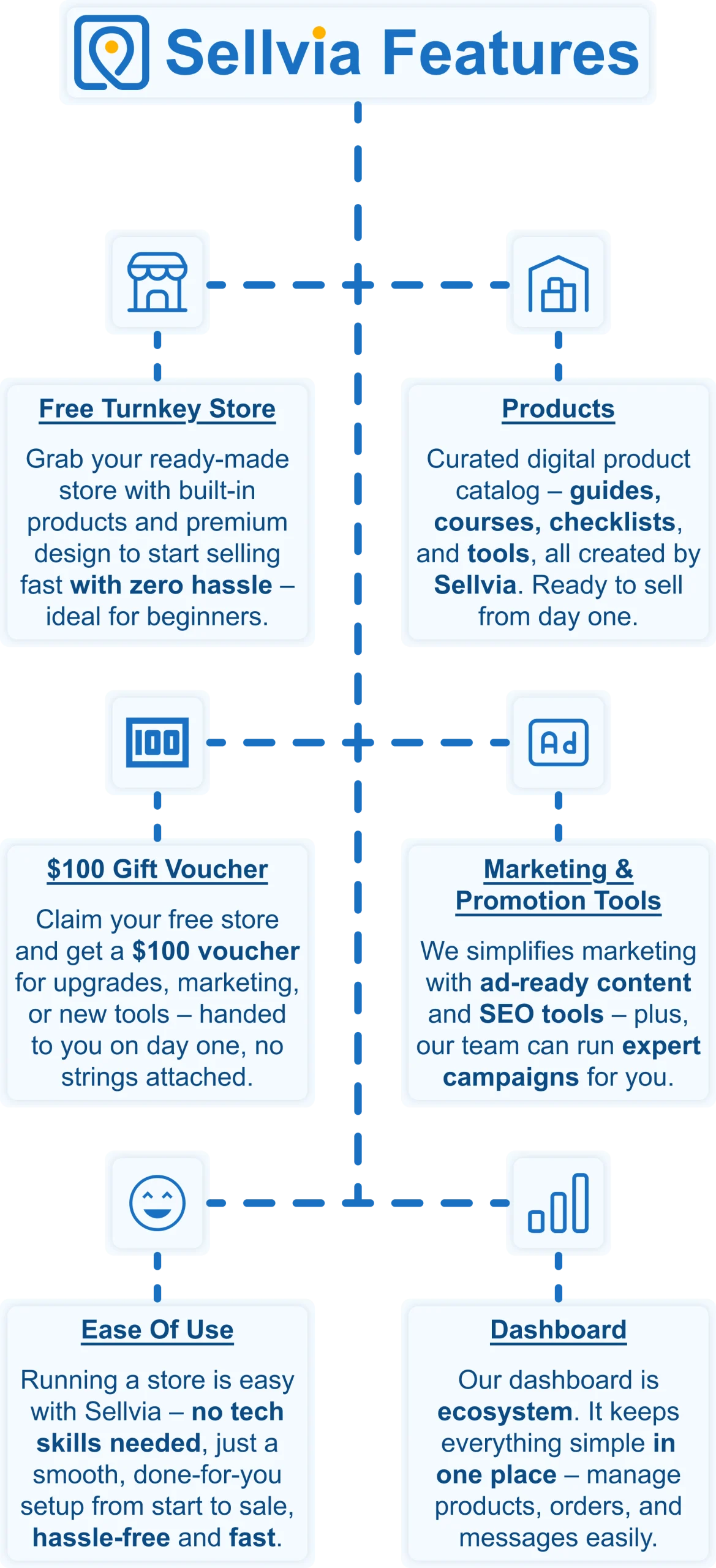
Want to start selling but don’t know where to begin? No worries! Just share your ideas, and Sellvia’s team will build a free ecommerce website that’s fully set up and ready to take orders from day one. No coding, no stress – just a store that works right out of the box.
A $100 gift voucher to grow your business faster 🎁
Starting a business takes momentum – and Sellvia gives you a head start. When you claim your free store today, you also get a $100 gift voucher to put toward growing your business. Use it to upgrade your store, boost your marketing, or unlock new tools. It is a real dollar value, handed to you on day one, with no catch and no hoops to jump through.
A massive catalog of digital products to sell 🏆
One of the biggest struggles in starting an online business is figuring out what to sell. Sellvia solves that completely. Your store comes pre-loaded with digital products – guides, courses, checklists, and tools – all created by Sellvia. You keep 50–70% of every sale. No inventory. No shipping. No logistics headaches.
Everything in one easy-to-use platform 🔥
Managing an online store shouldn’t be complicated. With Sellvia, you can handle orders, add new products, and even chat with customers – all from a simple and user-friendly platform. No need to mess with confusing tools or deal with unnecessary tech stuff. It’s all smooth sailing.
No upfront costs, just start selling 💰
A big reason people hesitate to start an online business is the cost. But here’s the good news: With Sellvia, you don’t need to invest in stock, storage, or shipping supplies. You can run your store with no upfront costs, keeping things low-risk while still making money.
Support that’s always got your back 🤝
Running a business comes with questions, but you’re never alone. Sellvia’s dedicated support team is available 24/7 to help with anything you need. Whether it’s a small question or a big challenge, they’ve got you covered.
Making money on Shutterstock is a real goal – but it takes months of consistent uploads before income becomes meaningful. Claim your free Sellvia store today and start with a ready-to-sell business already built for you.