Substack has quietly become one of the most popular platforms for writers who want to make money online. If you have been wondering how to make money on Substack, you are not alone. Every week, thousands of people launch newsletters hoping to turn their writing into a real income stream.
Here is the honest version: making money on Substack is real, but it is not fast. Most writers do not see meaningful income for at least three to six months. The people earning five figures a month are the exception, not the rule. Understanding what is realistic from the start will save you a lot of frustration.
Quick Answer: The main way to make money on Substack is through paid newsletter subscriptions, where readers pay $5–$10 per month for your content. Most new writers earn under $100/month in year one. With consistency and the right niche, $500–$2,000/month is achievable by year two. Top writers earn much more, but they typically come in with an existing audience.
Substack is a legitimate path to online income – but it rewards patience. If you need to start earning within the next 30 to 60 days, it makes sense to look at faster options alongside it. We will come back to that. First, let us break down exactly how Substack works and what you can realistically expect.
What is Substack?
Substack is a newsletter platform that lets writers publish directly to subscribers. You write content, your readers sign up, and you can charge them a monthly or annual fee to access your best material. Substack handles payments, email delivery, and subscriber management – you just focus on writing.
What makes Substack different from a regular blog is the email format. Your content lands directly in your subscribers’ inboxes, which means you are not fighting social media algorithms every time you publish. Once someone subscribes, you have a direct line to them. That is a real advantage over any platform that controls your reach.
The platform launched in 2017 and has grown significantly, with a reported 35 million active subscriptions as of 2024. Substack is free to use and only takes a 10% cut of paid subscription revenue. On the surface, that sounds like a great deal. The real challenge is building the audience that makes that 90% worth something.
Substack works best as a long-term platform – a place to build credibility and a loyal audience over time. If you are looking for a side income that starts sooner, there are complementary options worth considering at the same time.
How much can you realistically earn on Substack?
This is the question most people want a straight answer to, and most guides dance around it. Here are the actual numbers organized by method.
These figures reflect realistic early-stage income ranges. The upper ends require significant audience growth and consistent effort over time. A small number of Substack writers – usually those with an established audience from social media or journalism – earn $5,000 to $50,000 per month. For most people starting from zero, reaching that level takes one to three years.
One note on the headline figures: Top Substack earners almost always came in with an audience already built elsewhere. If you are starting from scratch, budget 60 to 90 days before your first 100 subscribers and 12 to 18 months before your first consistent monthly income.
Most people searching for how to make money on Substack are looking for real supplemental income – not an overnight fortune. The platform can absolutely deliver that over time. The key is going in with a clear niche, a consistent schedule, and realistic expectations for how long audience building actually takes.
Now let us get into the specific methods that actually bring in income on Substack and what each one realistically requires.
How to make money on Substack: the main methods
There are four proven ways to earn through Substack. Some work better early on, others require a larger audience first. Knowing which is which helps you prioritize your effort and avoid burning out chasing a method that your current list size cannot support yet.
Paid newsletter subscriptions
This is the most direct way to earn money on Substack, and it is what the platform was built for. You offer a free version of your newsletter to attract readers, then charge for premium access – deeper analysis, exclusive content, or full archives. Most writers charge between $5 and $10 per month or $50 to $100 per year.
Substack takes 10% of that revenue, and Stripe takes another 2.9% plus $0.30 per transaction. On a $7/month subscriber, you keep roughly $5.90 after fees. That does not sound like much, but it compounds quickly as your paid list grows.
How paid subscriptions work
The free-to-paid model is the most common structure. You give away regular content to build trust, then gate your best material – deep dives, research, bonus issues – behind the paywall. Readers who find real value in your free content are the ones most likely to convert to paid.
Some writers lock everything immediately, but that limits discovery and growth. The most effective approach is to offer enough free content to hook new readers, while making the paid tier genuinely valuable for those who want more.
What to realistically expect
The industry average for free-to-paid conversion is 3 to 5%. If you have 500 free subscribers, expect 15 to 25 paying readers. At $7/month, that is $90 to $150/month before fees – enough to be encouraging, but not enough to replace a paycheck on its own.
The writers who build meaningful Substack income usually combine subscriptions with one or two other methods, which is how the earnings compound over time.
Earning potential: $50–$500/month in year one for writers who publish at least weekly and actively promote outside the platform.
Sponsorships and brand deals
Once your newsletter grows past roughly 1,000 subscribers, brands may start paying you to mention their products or services. Sponsorships are completely separate from subscription revenue and can add meaningfully to your monthly income once your list reaches the right size.
How to find sponsors
Sponsors rarely approach small newsletters – you typically have to find them. Platforms like Passionfroot, Paved, and Letterhead connect newsletter writers with brands looking to advertise. Your niche matters enormously here. A personal finance newsletter with 1,500 engaged readers is worth far more to a financial services brand than a general lifestyle newsletter with 10,000 casual subscribers.
What to charge for sponsorships
A common starting rate is $20 to $50 per 1,000 subscribers per newsletter issue (CPM). At 2,000 subscribers, one sponsored placement might earn you $40 to $100. Rates grow significantly as your list grows and as your open rates and engagement metrics stay strong.
Earning potential: $100–$2,000/month once you have 1,000 or more engaged subscribers in a defined niche.
Selling digital products
Some Substack writers go beyond subscriptions and sell standalone digital products to their audience – ebooks, templates, swipe files, mini-courses, or worksheets. This can be a strong income stream because you set the price and earn the full amount minus payment processing fees, rather than splitting monthly revenue with Substack.
What works as a Substack product
The best products are closely tied to what you write about. A freelance writing newsletter might sell a pitch email template pack. A budgeting newsletter might sell a debt payoff spreadsheet. The product should solve a specific problem your readers already have and trust you to address. If your free content is teaching them something useful, your paid product should be the shortcut to getting there faster.
You can sell products directly through your Substack page or link to platforms like Gumroad or your own online store. Either way, your newsletter is the marketing engine – the bigger and more engaged your list, the more product sales you will generate.
Earning potential: $200–$3,000/month for writers with an engaged audience and a product that directly solves a specific reader problem.
Affiliate marketing on Substack
Affiliate marketing means recommending products or services using a trackable link and earning a commission when your readers buy through it. This works well on Substack because your subscribers already trust your recommendations – they opted in specifically to hear from you, not from a stranger on social media.
How affiliate marketing works here
Common programs include Amazon Associates, ShareASale, and direct brand affiliate programs. You apply, get a custom link, and mention the product naturally within your content. FTC rules require disclosure – always tell your readers when a link earns you a commission. This is not just a legal requirement; it also protects the trust you have worked hard to build with your audience.
Why this works in 2026: Newsletter readers are high-intent. They opted in specifically to hear from you, which makes them significantly more likely to act on a recommendation compared to a stranger scrolling past a social media post.
Earning potential: $50–$500/month for writers with 500 or more engaged subscribers and a niche that naturally lends itself to product recommendations.
Combining two or more of these methods is where real Substack income comes from. Subscriptions bring steady monthly cash flow, sponsorships scale with your list, and product sales and affiliate income add on top. No single method is enough on its own in the early stages.
How to grow your Substack audience
The difference between a newsletter that earns real money and one that plateaus at 200 subscribers usually comes down to audience growth strategy, not writing quality. Here is what actually moves the needle.
Pick a tight niche
The more specific your topic, the faster you will grow. “Personal finance” is too broad. “Paying off student loans on a teacher’s salary” is a niche. Readers in a tight niche are more likely to subscribe, stay subscribed, and eventually pay because the content speaks directly to their exact situation. Specificity is not a limitation – it is your competitive advantage.
Publish on a consistent schedule
Consistency beats frequency every time. Publishing every Tuesday is more effective than publishing five times one week and zero the next. Your subscribers should know when to expect your emails, and you should honor that rhythm even when inspiration is running low. Trust is built through reliability.
Promote on social media
Substack has some internal discoverability, but most early subscriber growth comes from outside the platform. Twitter/X, LinkedIn, and Instagram are where most newsletter writers find their first audience. Share excerpts of your content, engage in conversations in your niche, and make it easy for people to subscribe. One well-placed post that resonates can bring in dozens of new subscribers in a single day.
Cross-promote with other writers
Find Substack writers in adjacent niches and arrange mutual recommendations. A single Recommended post from a newsletter with 5,000 subscribers can send you hundreds of new followers overnight. Substack’s built-in Recommendations feature was designed for exactly this, and it remains one of the fastest organic growth levers available on the platform.
Use Substack Notes
Substack Notes is a short-form feed inside the platform, similar to Twitter. Writers who post regularly on Notes – short observations, insights, behind-the-scenes thoughts – tend to grow faster than those who only send newsletters. It is free, takes five minutes a day, and keeps you visible to readers already inside the Substack ecosystem who might not have found your newsletter yet.
Important note: Growing from zero to meaningful income takes real time – most writers see their first paid subscribers between months three and six. Setting a 12-month horizon for your first consistent monthly income is more realistic than expecting results in the first 30 days.
None of these growth tactics are complicated. But they all require consistent effort over months, not days. If you are willing to put in that work, Substack can absolutely reward it.
Honest challenges you will face on Substack
Before going all-in on Substack, here are the real obstacles most writers run into – and what they mean for your timeline and expectations.
The growth wall
Most newsletters plateau around 100 to 300 free subscribers and stay there for months. Breaking through requires consistent promotion outside the platform, partnerships with other writers, and sometimes a significant pivot in positioning. Good writing alone does not guarantee growth – distribution does.
Low free-to-paid conversion
Even with strong content, converting free readers to paying subscribers is hard. The industry average is 3 to 5%, and many new newsletters see even lower rates in the first year. If you have 300 free subscribers and 10 convert at $7/month, that is $70/month – real money, but it also means you spent months getting there. The numbers improve as your audience grows, but the path is slower than most guides suggest.
Burnout
Writing a newsletter on top of a full-time job or family responsibilities is harder than most people expect. Inconsistent quality, missed issues, or losing genuine interest in your topic are the most common reasons writers quit before reaching profitability. Building a sustainable writing pace – one you can actually maintain for 12 to 18 months – matters as much as the quality of any individual issue.
Is Substack right for you?
Substack is a genuinely great platform, but it is not the right fit for everyone at every stage. Here is how to think about whether it matches your specific situation and goals.
Complete beginners
If you have never built an online audience before, Substack is a reasonable starting point. The technical setup is simple, the platform is free, and email gives you a direct line to your readers from day one. Go in expecting a slow first three to six months and treat early issues as practice, not proof of failure. Your first 100 subscribers will teach you more than any guide.
Intermediate writers
If you already have a social media following, a blog audience, or a professional network, Substack can accelerate your monetization significantly. Your existing readers are pre-sold on you as a voice worth listening to – offering them a paid newsletter is a natural next step. Writers in this category often see faster early conversions than those starting from zero.
People who need income now
If you need supplemental income within the next 30 to 60 days, Substack alone is unlikely to deliver that. Building a paying audience takes time. If you are in this situation, pairing your newsletter with a faster-moving online income source while the newsletter builds in the background is the smarter approach. The two are not mutually exclusive.
Advanced creators
For experienced writers with an established audience and a well-defined niche, Substack can be a strong primary income stream. Pairing paid subscriptions with sponsorships and a digital product line can compound into $3,000 to $10,000 or more per month over time. The platform is built to support exactly this kind of layered monetization.
Whatever your experience level, the real key is combining consistent writing with active promotion and at least one additional income stream while your newsletter grows. Waiting for Substack alone to deliver financial freedom is how most writers end up disappointed.
The writers who make Substack work long-term are almost always the ones who treated it as one part of a broader online income strategy – not their only bet.
Why Sellvia is a game-changer for your online store 🚀
Sellvia isn’t just another ecommerce tool. We are a trusted name in the industry, recognized by Forbes and even ranked in Inc.’s list of the 5,000 fastest-growing companies in the U.S. So if you’re serious about starting as a solopreneur, this is a smart place to begin.
Starting an online business can feel overwhelming, but that’s exactly where Sellvia steps in. It takes care of the tricky parts, so you can focus on making sales and growing your brand. Let’s break down what makes it such a great choice.
Get a ready-to-go store hassle-free 🎯
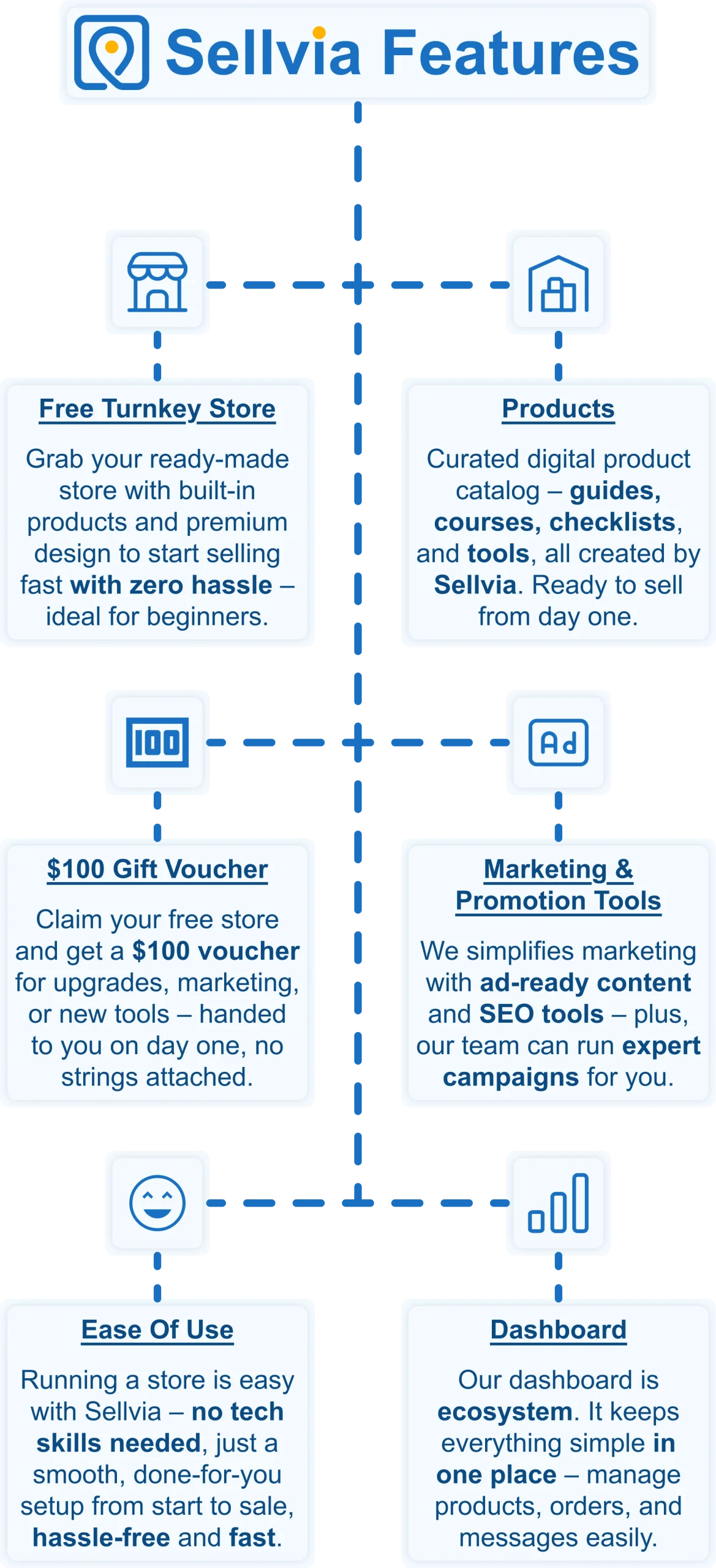
Want to start selling but don’t know where to begin? No worries! Just share your ideas, and Sellvia’s team will build a free ecommerce website that’s fully set up and ready to take orders from day one. No coding, no stress – just a store that works right out of the box.
A $100 gift voucher to grow your business faster 🎁
Starting a business takes momentum – and Sellvia gives you a head start. When you claim your free store today, you also get a $100 gift voucher to put toward growing your business. Use it to upgrade your store, boost your marketing, or unlock new tools. It is a real dollar value, handed to you on day one, with no catch and no hoops to jump through.
A massive catalog of digital products to sell 🏆
One of the biggest struggles in starting an online business is figuring out what to sell. Sellvia solves that completely. Your store comes pre-loaded with digital products – guides, courses, checklists, and tools – all created by Sellvia. You keep 50–70% of every sale. No inventory. No shipping. No logistics headaches.
Everything in one easy-to-use platform 🔥
Managing an online store shouldn’t be complicated. With Sellvia, you can handle orders, add new products, and even chat with customers – all from a simple and user-friendly platform. No need to mess with confusing tools or deal with unnecessary tech stuff. It’s all smooth sailing.
No upfront costs, just start selling 💰
A big reason people hesitate to start an online business is the cost. But here’s the good news: With Sellvia, you don’t need to invest in stock, storage, or shipping supplies. You can run your store with no upfront costs, keeping things low-risk while still making money.
Support that’s always got your back 🤝
Running a business comes with questions, but you’re never alone. Sellvia’s dedicated support team is available 24/7 to help with anything you need. Whether it’s a small question or a big challenge, they’ve got you covered.
While Substack slowly builds your audience, Sellvia gives you a complete online business that is ready to earn from day one. Claim your free store and start building real income today.