If you have a 3D printer — or you are thinking about buying one — you are probably wondering whether it can actually earn you consistent money. The short answer is yes. The longer answer is that it depends on which method you choose and how seriously you pursue it.
Quick Answer: The best ways to make money with a 3D printer include selling custom printed products online, offering a local print service, selling digital design files, developing prototypes for businesses, and creating educational kits. Most beginners earn $200–$800 per month in their first 90 days, with experienced sellers reaching $2,000–$5,000 per month or more.
This guide covers each method honestly — with real income ranges, practical steps, and the things nobody tells you before you get started. Whether you want a side income to cover a few extra bills or a full-time business that replaces your day job, there is a path here that fits your situation.
3D printing has become genuinely accessible in 2026. Entry-level printers now cost $200–$400, filament runs about $20–$30 per kilogram, and free design software is available for every skill level. The barrier to starting has never been lower — which also means competition is growing. Knowing which niche to target and how to stand out is what separates sellers who earn consistently from those who give up after a few weeks.
This guide will walk you through exactly that. Let us get into it.
What is 3D printing and why does it matter for income?
3D printing — also called additive manufacturing — is the process of creating a physical object layer by layer from a digital design file. You load a model into your printer software, feed in the material, and the machine builds the object from scratch. What used to require a factory can now happen on your desk.
What makes it interesting for income is the economics. Traditional manufacturing requires expensive tooling, large order quantities, and a supply chain. A 3D printer removes all of that. You can produce a single custom item for a client in a matter of hours with no factory involved. That flexibility is exactly why people build real businesses around it.
The 3D printing market is growing fast. Global revenue was estimated at over $20 billion in 2023 and is projected to reach $60 billion by 2030. Consumer demand for custom, one-of-a-kind products continues to rise, and platforms like Etsy have normalized buying handmade items online. You are entering a market with genuine momentum behind it.
The key to succeeding in this space is picking the right method for your current skill set and sticking with it long enough to build momentum. Most people who fail simply try to do too much at once, get overwhelmed, and walk away before the income starts showing up.
How much can you realistically earn with a 3D printer?
Before you invest in equipment or start taking orders, it helps to understand what the numbers actually look like. Income from a 3D printing business varies widely based on how much time you commit, what you sell, and how you market your work.
These figures reflect what real sellers report across platforms like Etsy, Reddit, and small business communities. The ceiling numbers assume full-time effort, repeat clients, and 60–90 days of consistent operation. Most beginners land in the lower half of these ranges during their first three months — and that is completely normal.
One note on the top figures: Hitting $3,000–$5,000 per month with a 3D printer is possible, but it typically requires a focused niche, reliable marketing, and a printer running most of the day. Set realistic expectations for your first 90 days and build from there.
One thing worth noting: income from a 3D printing business is directly tied to your time. You print something, someone buys it, you ship it. There is a ceiling to how many hours you can run the printer. For that reason, many 3D printing sellers eventually add other income streams — like digital product sales — to grow beyond what the printer alone can produce.
Best ways to make money with a 3D printer
There is no single method that works for everyone. The right path depends on your skills, your budget, and how much time you can realistically commit. Here are the five most proven income streams for 3D printer owners in 2026 — with honest assessments of each.
Sell custom printed products online
This is the most popular starting point for beginners and for good reason. You design or download a 3D model, print the finished product, and sell it on platforms like Etsy, eBay, or your own online store. Popular categories include home decor, custom jewelry, phone accessories, cosplay props, tabletop gaming pieces, and personalized gifts.
The key to making this work is picking a specific niche and committing to it. Niche sellers consistently outperform generalists because they build a recognizable brand and attract repeat buyers. A store that sells nothing but custom pet portrait keychains will outperform a store selling a little bit of everything — every time.
How to get started
Start by researching what is already selling on Etsy. Use the platform’s search bar to find popular items and look for niches with strong demand but manageable competition. Print a small test batch, photograph it well with natural lighting, and list it with clear descriptions and relevant keywords. Do not launch with 50 products — launch with five great ones and refine from there.
Earning potential: $300–$2,000/month with a focused niche and consistent new listings after 60–90 days of operation.
Offer a local 3D printing service
Many small businesses, engineers, architects, dentists, and hobbyists need 3D-printed parts but do not own a printer or know how to use one. You can fill that gap by offering a printing service in your area. A client sends you a file — or describes what they need — and you print it, inspect it, and deliver or ship the finished piece.
This is one of the highest-earning methods available because you are charging for time, material, and expertise — not just a product. The value to the client is immediate and tangible. A dentist who needs a custom model, or an architect who needs a scaled building prototype, will pay significantly more per print than a retail customer buying a decorative item.
Who to target
Start by posting in local Facebook groups and neighborhood apps like Nextdoor. Create a simple Google Business profile and list yourself under “3D printing service.” Attend local small business events and leave cards or samples. Word of mouth spreads fast once you land your first few clients and deliver quality work on time.
Earning potential: $500–$3,000/month depending on order volume, local demand, and the industries you serve.
Sell digital design files
If you have design skills — or are willing to develop them — selling digital files is one of the most scalable ways to earn from 3D printing. You create a model in software like Tinkercad, Blender, or Fusion 360, upload the file to platforms like Cults3D, MyMiniFactory, or Printables, and earn money each time someone downloads it. You do the work once and keep earning over time.
This approach has a lower ceiling per file ($3–$15 is typical), but the earnings compound as your catalog grows. A library of 30 well-reviewed files can generate $500–$1,500 per month with no additional printing, shipping, or fulfillment on your part.
What sells best
Functional items consistently outsell decorative ones. Think cable organizers, custom tool holders, replacement parts for common appliances, and kitchen gadgets. Seasonal designs — Halloween props, holiday decorations, back-to-school organizers — also sell well during peak periods. Build your library steadily and focus on designs that solve a real problem for the buyer.
Earning potential: $100–$1,500/month after building a catalog of 20 or more well-reviewed files.
Prototype development for businesses and inventors
Startups, inventors, and product developers regularly need physical prototypes to test ideas before going into full production. A working prototype can help secure investor funding, validate a concept, or dramatically speed up the development cycle. That value makes this one of the highest-paid services in the 3D printing space.
It requires more skill and client management than the other methods on this list, but the income per project is substantially higher. A single prototyping project can pay $300–$1,500 depending on complexity — and clients who find a reliable prototype partner tend to return again and again.
How to find clients
Attend local startup events, pitch competitions, and Meetup groups focused on product development or entrepreneurship. Connect with engineering students at nearby universities. Post your service on LinkedIn, Fiverr, and Upwork with a portfolio of sample prints that demonstrate precision and finish quality. One great referral in this space can lead to months of steady work.
Earning potential: $1,000–$5,000/month for experienced providers with multiple active clients.
Create and sell educational kits
STEM education is a growing and underserved market. Schools, homeschool families, and parents looking for hands-on learning tools are actively buying printed kits that help teach science, engineering, and math concepts. A well-designed kit might include 3D models of cells, mechanical assemblies, geometric shapes, or anatomy pieces — all printed, packaged, and shipped by you.
The educational market rewards quality and curriculum alignment above all else. If you can tie your kit to a specific grade level or learning standard, you dramatically increase its appeal to teachers and homeschool co-ops — who often buy in bulk.
How to build this business
List your kits on Etsy and Teachers Pay Teachers. Reach out directly to local schools and homeschool networks to offer samples. Bundle physical models with a printed instruction guide to increase perceived value and justify prices in the $25–$75 range. Partner with a homeschool influencer or STEM educator on social media and watch orders grow organically through their audience.
Earning potential: $200–$1,200/month with consistent school partnerships and active online listings.
Each of these methods works. The best one for you is the one that fits what you can actually do right now — with the time, skills, and equipment you already have.
Tips for maximizing your 3D printing income
Getting your first sale is one thing. Building consistent, growing income is another. These five strategies will help you go from occasional orders to a reliable revenue stream.
Prioritize quality above everything else
Your reputation is your business. One bad review on Etsy can suppress your sales for months. Use high-quality filament, dial in your printer settings carefully, and inspect every single print before it leaves your hands. Customers who receive a beautiful, well-packaged product come back — and they tell people about it.
Invest in proper packaging too. A $2 print that arrives safely in a branded box feels premium. A $15 print that shows up cracked in a flimsy envelope destroys the customer experience and your chance of a repeat order.
Learn the design software
You do not need to be a designer to make money with a 3D printer, but learning the basics of Tinkercad, Blender, or Fusion 360 opens up far more income options. Free tutorials on YouTube can take you from zero to functional within a few weeks. The more original designs you can create yourself, the less you compete with every other seller using the same free files — and the higher you can price your work.
Stay on top of trends
The 3D printing world moves fast. New materials, faster printers, and shifting consumer demand all affect what sells. Follow communities on Reddit — particularly r/3Dprinting and r/3dprintingbusiness — join Facebook groups for makers, and check Etsy trends regularly. Seasonal products like holiday decorations, Halloween props, and back-to-school organizers can create significant income spikes if you plan them 4–6 weeks in advance.
Build your presence on social media
Instagram, Pinterest, and TikTok are especially effective for visual product businesses. Post behind-the-scenes videos of your printer in action, before-and-after shots of custom pieces, and customer unboxing clips. Consistency matters more than perfection here — even a basic smartphone camera produces content that can drive real traffic to your store. Three posts per week over 90 days will build more momentum than one perfectly edited video.
Network and collaborate
Some of the best 3D printing income opportunities come through connections, not algorithms. Trade shows, maker fairs, and local small business meetups are all places where one conversation can turn into a recurring client. Reach out directly to local interior designers, architects, and product developers. Offer a free sample print to demonstrate your quality — it is one of the most effective low-cost marketing moves you can make in this business.
Legal and ethical considerations for 3D printing businesses
Most 3D printing businesses operate in a completely legal and straightforward space — but there are a few important rules to know before you start selling commercially.
Key principle: Never print and sell copyrighted or patented designs without the rights holder’s explicit permission. This applies to branded characters, trademarked logos, and any design that is not your original creation or covered by a commercial license.
Common mistakes to avoid:
- Downloading “free” design files that are licensed for personal use only and then selling the printed output
- Printing replica products that infringe on existing patents or trademarks — even if the design is publicly available online
- Misrepresenting the material composition or food safety rating of printed items
- Overstating the structural strength or durability of load-bearing printed parts
What to do instead: create original designs, purchase commercial licenses for any file you did not design yourself, and be completely transparent with customers about materials and appropriate use. Legitimate 3D printing businesses operate in a clear, well-established legal space. You just need to stay on the right side of it — and it is not hard to do.
Operating ethically also protects your business long-term. Sellers who build a reputation for quality, honesty, and reliability consistently out-earn those who cut corners — and they do it without the stress of potential legal issues hanging over every sale.
How to choose the right method for you
Not every 3D printing income method is right for every person. Here is how to think about the decision based on where you are right now.
Complete beginner
Start with selling custom products on Etsy. It requires the least upfront setup, gives you immediate feedback from real buyers, and does not require a client base. Focus on one product category, get your first ten solid reviews, and treat every order as a learning opportunity. Aim for $200–$400 per month in your first 60 days before adding anything new.
Intermediate / part-time
Once your Etsy store is generating consistent orders, consider adding a local print service on top of it. Run the local service orders during the day and process your online fulfillment in the evenings. At this stage, a realistic combined target is $800–$1,500 per month across both channels within 90 days of launching the service side.
Advanced / full-time goal
If your goal is to replace a full-time income, prototype development and digital file sales deserve serious attention. Both scale better than physical product sales because the income is not as directly tied to machine-hours. Prototype work in particular can grow into long-term retainer relationships with companies that need ongoing development support — and those relationships are some of the most financially stable things you can build as a solo operator.
No matter where you are starting, the principle is the same: pick one method, execute it consistently for 60–90 days, evaluate honestly, and then decide whether to double down or diversify. Most successful 3D printing businesses eventually run two or three income streams — but they built them one at a time.
Want to earn online without buying equipment?
3D printing is a legitimate way to earn money — but it does require a physical machine, consumable materials, time to print, and the logistics of packing and shipping every order. If you want a second income stream that runs alongside your 3D printing business with none of those constraints, selling digital products online is worth a serious look.
Digital products — like guides, courses, checklists, and tools — are delivered instantly the moment someone buys. There is no printer to maintain, no filament to reorder, no boxes to pack. The economics are different, and for many people, building both streams side by side is how they get to the income level they are really aiming for.
Why Sellvia is a game-changer for your online store 🚀
Sellvia isn’t just another ecommerce tool. We are a trusted name in the industry, recognized by Forbes and even ranked in Inc.’s list of the 5,000 fastest-growing companies in the U.S. So if you’re serious about starting as a solopreneur, this is a smart place to begin.
Starting an online business can feel overwhelming, but that’s exactly where Sellvia steps in. It takes care of the tricky parts, so you can focus on making sales and growing your brand. Let’s break down what makes it such a great choice.
Get a ready-to-go store hassle-free 🎯
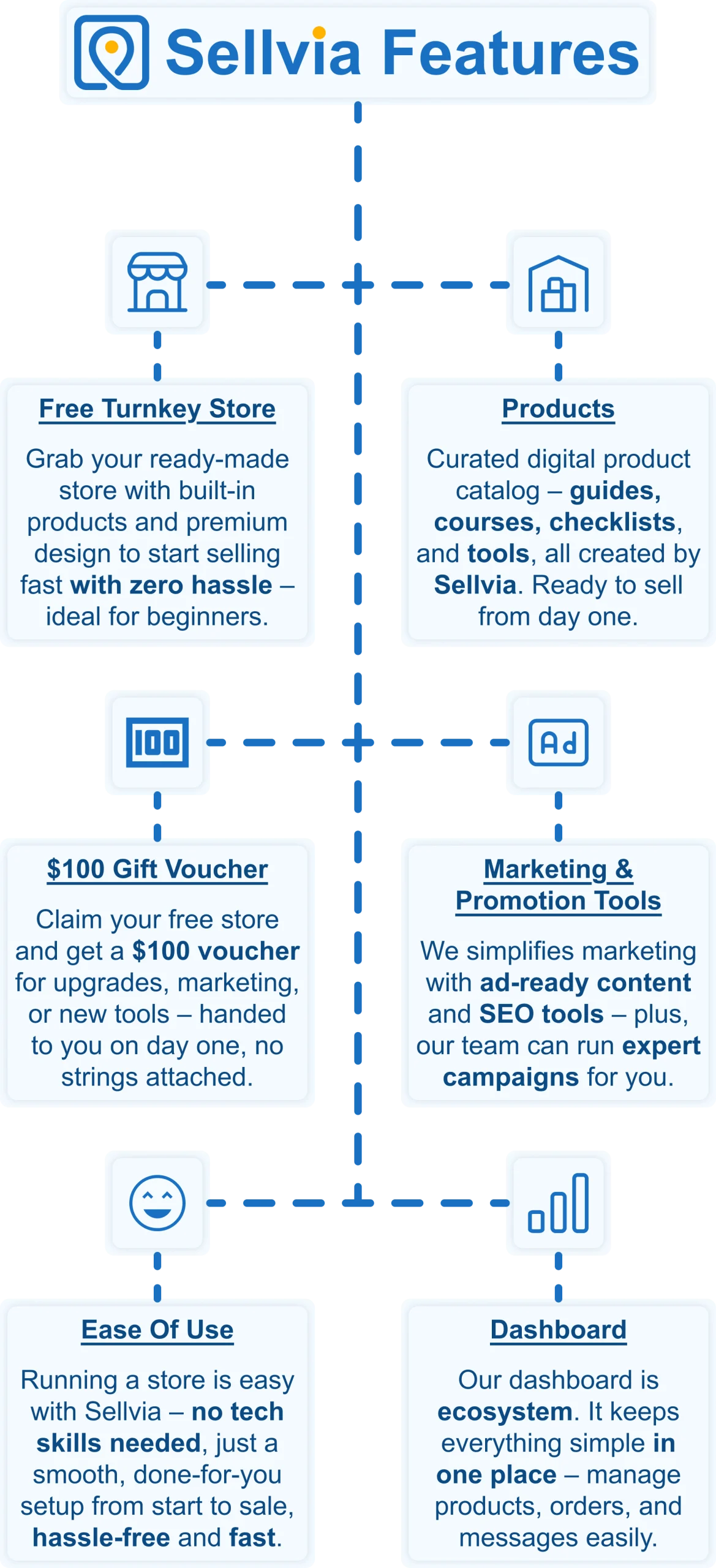
Want to start selling but don’t know where to begin? No worries! Just share your ideas, and Sellvia’s team will build a free ecommerce website that’s fully set up and ready to take orders from day one. No coding, no stress – just a store that works right out of the box.
A $100 gift voucher to grow your business faster 🎁
Starting a business takes momentum – and Sellvia gives you a head start. When you claim your free store today, you also get a $100 gift voucher to put toward growing your business. Use it to upgrade your store, boost your marketing, or unlock new tools. It is a real dollar value, handed to you on day one, with no catch and no hoops to jump through.
A massive catalog of digital products to sell 🏆
One of the biggest struggles in starting an online business is figuring out what to sell. Sellvia solves that completely. Your store comes pre-loaded with digital products – guides, courses, checklists, and tools – all created by Sellvia. You keep 50–70% of every sale. No inventory. No shipping. No logistics headaches.
Everything in one easy-to-use platform 🔥
Managing an online store shouldn’t be complicated. With Sellvia, you can handle orders, add new products, and even chat with customers – all from a simple and user-friendly platform. No need to mess with confusing tools or deal with unnecessary tech stuff. It’s all smooth sailing.
No upfront costs, just start selling 💰
A big reason people hesitate to start an online business is the cost. But here’s the good news: With Sellvia, you don’t need to invest in stock, storage, or shipping supplies. You can run your store with no upfront costs, keeping things low-risk while still making money.
Support that’s always got your back 🤝
Running a business comes with questions, but you’re never alone. Sellvia’s dedicated support team is available 24/7 to help with anything you need. Whether it’s a small question or a big challenge, they’ve got you covered.
If making money with a 3D printer sparked your entrepreneurial thinking, a Sellvia store is the next logical step — no equipment required. Claim your free store today and start building income on your terms.