Quick Answer: You can make money with Airbnb by renting out a spare room, a full property, or even a guesthouse to short-term travelers. Most US hosts earn between $500 and $3,000 per month, depending on location, property type, and how actively they manage their listing.
Millions of Americans are searching right now for a way to close the gap between what they earn and what they actually need. Whether you are behind on bills, tired of a paycheck that never stretches far enough, or simply want to stop worrying about money – you are not alone. Airbnb has become one of the most talked-about ways to earn extra income from something you already have: a spare room, a second property, or even an unused space in your home.
This guide walks you through exactly how to make money with Airbnb in 2026 – from setting up your first listing to maximizing every booking. We will also cover the real costs and limitations that most articles skip, and show you a powerful, lower-barrier alternative if Airbnb is not the right fit for where you are today.
Before jumping into the steps, it helps to understand what kind of income Airbnb actually is. It is not a set-it-and-forget-it source of earnings. It requires real, ongoing effort – cleaning, communication, guest management, and marketing. For people who have the space and the time, it can be a meaningful income stream. For those who do not, there is a better starting point – and we cover that too.
What is Airbnb hosting?
Airbnb is a platform that connects homeowners, renters, and property managers with travelers looking for short-term accommodation. You list your space – whether it is a spare bedroom, a full apartment, or a vacation home – and guests book it directly through the app. You set the nightly rate, the house rules, and how often your space is available.
Launched in 2008, Airbnb now operates in over 220 countries. In the US, the average active host earns around $14,000 a year according to Airbnb data – though that number varies sharply based on city, property type, and effort level. A host in Nashville renting a full apartment will earn very differently from someone in a small Midwestern town renting a spare room.
The appeal is real – if a space is sitting empty, it makes sense to let it earn. But successful Airbnb hosting comes with responsibilities and costs that are easy to underestimate before you start. The hosts who do best are the ones who go in with clear, realistic expectations from day one.
Important note: Airbnb income is not guaranteed. Occupancy rates, local competition, seasonality, and city regulations all affect what you actually take home after expenses.
How much can you realistically earn with Airbnb?
The honest answer is that it depends heavily on where you live and what you are renting. Hosts in high-demand cities like New York, Miami, or Austin earn significantly more than hosts in smaller towns with fewer travelers passing through. Here is a realistic breakdown of what US hosts typically see.
These are gross figures. After platform fees (roughly 3%), cleaning costs, utilities, maintenance, and any permit fees, the actual take-home from a single spare room in a mid-size US city is often $300–$800 per month. That is meaningful supplemental income – but it is rarely life-changing on its own, and it requires consistent effort to maintain.
One note on the ceiling figures: The high-end Airbnb earnings you see advertised tend to come from hosts in major tourist markets who run multiple listings with professional management teams. For most beginners starting with one room or one property, income is steady but modest – and it typically takes 60–90 days of active hosting to build enough reviews to see consistent bookings.
If you do not have property to rent or if the startup requirements feel out of reach right now, there are faster and lower-barrier ways to build income online. We cover one of the most popular options later in this article – but first, let us walk through exactly how to set up Airbnb the right way.
7 steps to start making money with Airbnb
If you have a space to rent and you are serious about making Airbnb work, here is a step-by-step guide to getting started the right way in 2026. Each step matters – shortcuts at any stage tend to show up in your reviews.
Step 1: Set up your listing the right way
Your Airbnb listing is your storefront, and guests decide in seconds whether to book. Before you go live, invest real time in making your listing as clear, honest, and appealing as possible. This is where most first-time hosts either win or lose early traction.
- Take clear, well-lit photos of every room – use natural light and tidy the space first.
- Write an honest description that highlights what makes your space genuinely special.
- Set house rules clearly upfront – no surprises for you or your guest later.
- Price competitively by checking similar listings in your area before you go live.
- Enable Instant Book to improve your visibility in Airbnb search results from day one.
Why this works in 2026: Airbnb’s search algorithm rewards listings with strong response rates, accurate descriptions, and competitive pricing. A well-built listing from the start earns early bookings – which leads to early reviews – which makes everything else easier.
Step 2: Price your space strategically
Pricing is where most new Airbnb hosts leave money on the table – or price themselves out of bookings entirely. The goal is to find the sweet spot where your listing stays competitive but still earns you meaningful income. Flat-rate pricing almost never achieves that.
- Use Airbnb’s Smart Pricing tool to let demand automatically adjust your rates.
- Raise prices around local events, holidays, and peak travel seasons.
- Offer weekly and monthly discounts to attract longer stays and reduce the time and cost of frequent turnovers.
- Review your pricing every 30 days – the local market shifts, and your rates should shift with it.
Hosts who adjust pricing dynamically typically earn 20–40% more than those who set a flat rate and leave it. Even small adjustments around busy weekends or local festivals can add hundreds of dollars per month without a single extra booking.
Step 3: Create an experience worth 5 stars
On Airbnb, reviews are everything. A 4.7 rating looks very different from a 4.9 in the eyes of the algorithm – and in the eyes of a guest deciding where to book. The fastest path to a strong rating is making every guest feel genuinely welcomed from the moment they arrive.
- Respond to every booking inquiry within an hour whenever possible.
- Send a pre-arrival message with clear directions and step-by-step check-in instructions.
- Leave a welcome note, some basic snacks, or a printed local guide.
- Check in with guests on day one – catching a small problem early is far better than reading about it in a review.
Small gestures matter more than expensive upgrades. Guests remember how a stay made them feel – not the thread count of the sheets. A warm, personal touch costs almost nothing and earns reviews that compound over time.
Step 4: Keep your property guest-ready at all times
Consistency separates good hosts from great ones. Guests expect the same clean, welcoming space every single time – and one bad experience can undo a dozen positive reviews. A sustainable maintenance routine is not optional – it is the foundation of a reliable Airbnb income.
- Schedule professional cleaning between every guest if your budget allows.
- Stock up on essentials before each stay: fresh towels, toiletries, and basic kitchen supplies.
- Do a quick maintenance walkthrough every two weeks – fix small issues before they become big problems.
- Use a keyless entry system so check-ins never depend on your physical schedule.
The biggest hidden cost in Airbnb hosting is not the platform fee – it is the time and money required to maintain a space that consistently meets guest expectations. Build these costs into your pricing before you launch, not after you notice they are cutting into your earnings.
Step 5: Boost your Airbnb income with add-on services
Once you have a steady flow of bookings, you can increase your Airbnb income without listing a single additional property. Add-on services let you earn more from the guests you already have – and they often improve your reviews at the same time.
- Offer early check-in or late check-out for a small additional fee.
- Create a local experience – a neighborhood walking tour, a cooking class, or a guided outdoor activity.
- Provide airport pickup for guests willing to pay for the convenience.
- Partner with local restaurants or tour companies to offer guest discounts in exchange for referral fees.
Earning potential: Add-on services can realistically add $50–$300 per month to your Airbnb income, depending on your location and how many bookings you handle each month.
Step 6: Know the rules before your first guest checks in
The legal side of Airbnb is one of the most overlooked parts of getting started – and ignoring it can cost you far more than you earn. Cities across the US have tightened short-term rental regulations significantly in recent years. Do your research before you list.
- Check local short-term rental laws – many cities require a permit or cap the number of nights you can host per year.
- Review your lease if you rent – subletting without permission can get you evicted.
- Contact your insurance provider – standard homeowner or renter policies often do not cover short-term rental activity.
- Report your Airbnb income on your taxes – the IRS treats it as taxable income regardless of amount.
Important: Cities like New York, San Francisco, and Los Angeles have strict short-term rental laws that limit hosting to your primary residence and require active city registration. Always verify your local rules before your first booking.
Step 7: Automate to reduce the workload
If you want Airbnb to feel less like a second job and more like a business, automation is the answer. The right tools let you manage bookings, communication, and cleaning schedules with far less time – while keeping your hosting quality consistent.
- Set up automated messages for booking confirmations, pre-arrival info, and post-stay thank-you notes.
- Connect your Airbnb calendar to a property management app like Guesty or Hospitable to centralize everything.
- Install a smart lock so check-ins and check-outs never require you to be physically present.
- Consider hiring a local co-host to handle in-person tasks – expect to pay 15–25% of your earnings for this service.
Automation does not eliminate the work – it moves it upfront. You invest time once in setting the system up properly, and the day-to-day management becomes much lighter after that. Most experienced hosts spend 5–10 hours per week managing a single well-automated listing.
How to maximize your Airbnb earnings
Getting bookings is step one. Getting the most out of every booking – and growing your income over time – is where the real gains happen. Here are the strategies that consistently move the needle for Airbnb hosts in 2026.
Optimize your listing for search visibility
Airbnb’s algorithm rewards active, responsive hosts who keep their calendars updated and their pricing competitive. Refresh your photos every six months, respond to every inquiry quickly, and keep your calendar open even during slow periods. Listings that go dark for extended stretches lose ranking and take time to recover.
Target high-demand periods before your competitors do
Look ahead at your local events calendar – music festivals, sporting events, university graduation weekends, conferences. Adjust your rates to reflect demand before your competitors do. Being two weeks early on a price increase during a big local event is often worth more than being the cheapest listing when the event arrives.
Make reviews a part of your process – every time
After every stay, send a polite message thanking your guest and asking them to leave a review. Most guests who had a genuinely positive experience will do it when asked. Reviews compound: more reviews mean higher search placement, which means more bookings, which means higher rates. A single extra review per month adds up significantly over a year of hosting.
Scale without buying more property
Once you have proven you can run a profitable listing, you can offer co-hosting services to other property owners in your area. Managing their Airbnb listings in exchange for 20–25% of their earnings lets you scale your income without any additional real estate investment. This is how many full-time Airbnb hosts make the jump from supplemental income to a real business.
Add a second income stream
The most financially secure Airbnb hosts do not rely on Airbnb alone. Occupancy fluctuates – seasonality, local events, economic shifts, and platform policy changes all affect your income in ways that are hard to predict. Combining rental income with another online income stream gives you a safety net and smooths out the slow periods. The option we cover at the end of this article is one of the most practical ways to do exactly that.
Legal and ethical considerations for Airbnb hosts
The short-term rental landscape is more regulated than it was even three years ago. Cities across the US continue to tighten the rules – and hosts who ignore them face fines, forced delistings, and legal complications that far outweigh any income they earned. Here is what you need to stay on the right side of.
What to avoid absolutely
- Listing a property without the required local permit – penalties can reach thousands of dollars and result in permanent removal from the platform.
- Subletting a rental property without your landlord’s written permission – this is grounds for eviction in most states.
- Misrepresenting your listing with outdated photos or inaccurate descriptions – this is against Airbnb policy and destroys trust with guests.
- Accepting cash outside the platform to avoid Airbnb fees – this voids Airbnb’s host protection and leaves you legally unprotected.
- Ignoring noise or occupancy complaints from neighbors – repeated violations can trigger city-level enforcement and platform bans.
What to do instead
Register your listing with your local government if it is required in your city. Keep accurate records of all Airbnb income for tax reporting. Get a short-term rental rider added to your homeowner or renter insurance policy. Be a considerate neighbor – your guests’ behavior reflects directly on you, and your reputation in the community matters as much as your Airbnb rating.
Key principle: Airbnb hosting is a legitimate business, and treating it like one from day one protects both your income and your standing in the community long-term.
Final thoughts: which approach is right for you?
Making money with Airbnb is a real, proven option for people who have space to rent and are willing to treat hosting as a genuine business. But it is not the right fit for every situation. Here is a quick way to figure out where you stand.
Complete beginner
If you have a spare room and have never hosted before, start small. List one space, set a competitive introductory price, and focus entirely on earning your first five reviews. Do not worry about automation or scaling yet – just learn the fundamentals. Most new hosts see their first consistent bookings within 30–60 days of going live, assuming strong photos and responsive communication.
Part-time host
If you already have some bookings and want to grow, focus on dynamic pricing and add-on services. Use automation tools to reduce your weekly management time. Look specifically for opportunities during local events and peak seasons – that is where the meaningful rate increases happen and where part-time hosts make the most noticeable income gains.
Full-time goal
If you want Airbnb to become a primary income source, you will almost certainly need to manage multiple listings – either your own or through co-hosting arrangements. This is a real business that requires real investment: professional cleaning, routine maintenance, and likely a property manager as you scale. Budget for all of it before you commit to it full time.
No property? There is a better starting point
Not everyone has a spare room or a second property. And even people who do are realizing that Airbnb income alone often is not enough – especially with the added time commitment and the unpredictability of occupancy. More and more Americans are turning to online income sources that do not require property, permits, physical space, or significant startup costs. The next section covers the most practical option available right now.
A smarter alternative for earning income online in 2026
Airbnb hosting requires property, time, and ongoing physical management. For millions of Americans who want to earn income online without those barriers – no real estate, no cleaning crews, no permit applications – there is a faster, lower-cost path: selling digital products through an online store.
Platforms like Sellvia make it possible to launch a fully functioning online store – with digital products already loaded and a built-in advertising system ready to go – in less time than it takes to set up an Airbnb listing. You do not need to create the products yourself. You do not need any technical skills. And you do not need to wait months for your first sale.
Sellvia has helped over 1.5 million store owners get started and is recognized by Forbes, ranked in the Inc. 5000 list of fastest-growing US companies, and trusted by real people looking for a legitimate, sustainable path to financial freedom. If Airbnb feels out of reach right now – or you simply want a second income stream that runs alongside it – this is worth a serious look.
Why Sellvia is a game-changer for your online store 🚀
Sellvia isn’t just another ecommerce tool. We are a trusted name in the industry, recognized by Forbes and even ranked in Inc.’s list of the 5,000 fastest-growing companies in the U.S. So if you’re serious about starting as a solopreneur, this is a smart place to begin.
Starting an online business can feel overwhelming, but that’s exactly where Sellvia steps in. It takes care of the tricky parts, so you can focus on making sales and growing your brand. Let’s break down what makes it such a great choice.
Get a ready-to-go store hassle-free 🎯
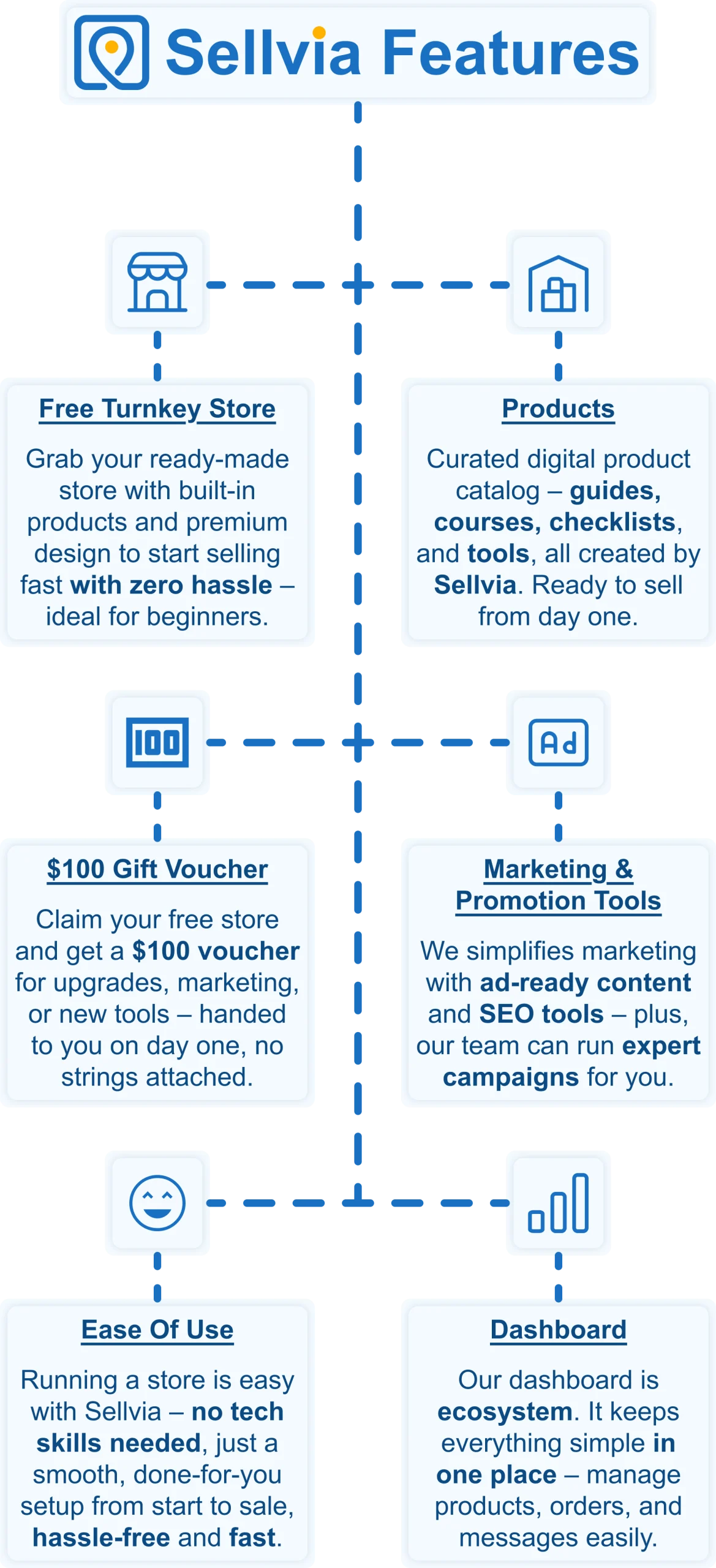
Want to start selling but don’t know where to begin? No worries! Just share your ideas, and Sellvia’s team will build a free ecommerce website that’s fully set up and ready to take orders from day one. No coding, no stress – just a store that works right out of the box.
A $100 gift voucher to grow your business faster 🎁
Starting a business takes momentum – and Sellvia gives you a head start. When you claim your free store today, you also get a $100 gift voucher to put toward growing your business. Use it to upgrade your store, boost your marketing, or unlock new tools. It is a real dollar value, handed to you on day one, with no catch and no hoops to jump through.
A massive catalog of digital products to sell 🏆
One of the biggest struggles in starting an online business is figuring out what to sell. Sellvia solves that completely. Your store comes pre-loaded with digital products – guides, courses, checklists, and tools – all created by Sellvia. You keep 50–70% of every sale. No inventory. No shipping. No logistics headaches.
Everything in one easy-to-use platform 🔥
Managing an online store shouldn’t be complicated. With Sellvia, you can handle orders, add new products, and even chat with customers – all from a simple and user-friendly platform. No need to mess with confusing tools or deal with unnecessary tech stuff. It’s all smooth sailing.
No upfront costs, just start selling 💰
A big reason people hesitate to start an online business is the cost. But here’s the good news: With Sellvia, you don’t need to invest in stock, storage, or shipping supplies. You can run your store with no upfront costs, keeping things low-risk while still making money.
Support that’s always got your back 🤝
Running a business comes with questions, but you’re never alone. Sellvia’s dedicated support team is available 24/7 to help with anything you need. Whether it’s a small question or a big challenge, they’ve got you covered.
Whether you are looking to replace Airbnb income or add a second stream that earns around the clock, selling digital products through Sellvia is a proven, low-barrier way to get started. Claim your free store today and start earning online.