
Millions of Americans search every month for ways to make money with cryptocurrency. Some find genuine, lasting income. Others lose savings they could not afford to lose. The difference usually comes down to one thing: going in with honest, accurate information before putting a single dollar on the table.
This guide does not promise overnight riches. What it does offer is a complete, honest picture of every major way to earn from cryptocurrency – trading, long-term investing, mining, staking, and more – along with realistic income ranges, the risks most articles skip, and a clear starting point based on your situation.
Quick answer: You can make money with cryptocurrency through trading, long-term investing, staking, mining, and portfolio diversification. Monthly income ranges from a few dollars to several thousand – but results depend heavily on your starting capital, experience level, and what the market is doing. Most beginners see modest gains in the first 60–90 days, and losses are common when starting out.
Whether you have $50 to spare or $5,000, the methods below cover different budgets, risk tolerances, and time commitments. Here is what you need to know before you start.
What is cryptocurrency and why does it matter in 2026?
Cryptocurrency is digital money that exists entirely online. Unlike the dollars in your bank account, no government or central bank controls it. Instead, it runs on a technology called the blockchain – a permanent, public, and tamper-proof record of every transaction ever made.
Bitcoin was the first, launching in January 2009. Today there are thousands of cryptocurrencies. Ethereum powers smart contracts and decentralized apps. Stablecoins like USDC are designed to hold a steady dollar value. Others – like Solana and Cardano – are built for speed and scalability. And then there are meme coins, created mostly for speculation, with values that can rise or crash overnight without warning.
In 2026, cryptocurrency is part of mainstream finance. Major financial institutions hold Bitcoin on their balance sheets. Millions of everyday people buy and sell through apps on their phones. That widespread adoption has made crypto more accessible than ever – but it has also made the market more competitive, more heavily regulated, and more volatile than at any point in its history.
Understanding the landscape is essential before putting money in. The most successful crypto earners share one quality: they understood exactly what they were buying before they bought it.
How much can you realistically earn with cryptocurrency?
This is the question most crypto guides refuse to answer directly. The honest answer is that your income depends almost entirely on how much capital you start with, how active you are, and what the market does. Here is a clear breakdown.
One note on the ceiling figures: Every number above assumes favorable market conditions and meaningful starting capital – typically at least a few thousand dollars at minimum to see consistent returns. Most beginners see much smaller gains, or net losses, in their first 60–90 days of active participation. The upper ranges are real, but reaching them takes time, patience, and a learning curve that costs most people real money before they figure out what works.
If you need income in the next 30–60 days and do not have much capital, crypto is probably not your fastest route. That said, understanding every method helps you decide which one fits your timeline and your risk tolerance. Here is what each one actually looks like in practice.
Each method below comes with its own risk profile, time commitment, and realistic earning potential – here is a complete breakdown of all of them.
How to make money with cryptocurrency – 5 proven methods
There is no single best way to earn from crypto. Each approach has a different risk level, a different time commitment, and a different ceiling on what you can earn. Here is an honest look at each one.
Trading cryptocurrency
Trading is the most active – and most talked about – way to make money with cryptocurrency. The concept is simple: buy when prices are low, sell when they go up. In practice, it is far harder than it sounds. Crypto markets run 24 hours a day, 7 days a week, and prices can swing 20–30% in a single day. Successful traders spend hours studying charts, tracking news cycles, and managing their risk exposure carefully.
Most beginners lose money in their first few months of trading. That is not a warning to scare you off – it is a documented reality that experienced traders acknowledge openly. The ones who eventually succeed went through a learning curve that cost them real money before they figured out a strategy that worked for them.
How to start trading
- Choose a reputable exchange – Coinbase, Binance, and Kraken are among the most established platforms
- Start with a sum you can genuinely afford to lose – not rent money or your emergency fund
- Learn the basics of chart reading and market analysis before risking real dollars
- Decide on a strategy: day trading (multiple trades daily), swing trading (holding for days or weeks), or position trading (weeks to months)
Earning potential: $50–$300/month for part-time traders with 6+ months of practice. Net losses are more common than gains for beginners in the first 3–6 months.
Long-term investing in cryptocurrency
Long-term investing – often called HODLing in the crypto world – means buying a cryptocurrency and holding it for months or years, betting that its value will be significantly higher in the future than it is today. This approach requires far less daily attention than trading, and it has produced some of the biggest gains in crypto history for patient investors.
The real challenge is psychological. Crypto markets go through dramatic downturns – Bitcoin has lost 70–80% of its value multiple times before recovering and reaching new highs. If you cannot handle watching your portfolio drop by half without selling in panic, long-term crypto investing will be far harder than it looks on paper.
Investment strategies worth knowing
- HODLing: Buy and hold an established coin like Bitcoin or Ethereum for a multi-year period, ignoring short-term price swings
- Dollar-cost averaging (DCA): Invest a fixed amount weekly or monthly – say, $25 every Friday – regardless of price. This reduces the impact of volatility and lowers your average purchase price over time
Why this works in 2026: Bitcoin has historically recovered from every major crash and reached new highs – but those recovery timelines have ranged from months to years. DCA removes the impossible task of trying to time the market perfectly.
Earning potential: Highly variable. An investor who put $1,000 into Bitcoin in 2019 saw it grow to over $5,000 by 2021. However, those who bought at the 2021 peak waited years to break even. Long-term results depend entirely on when you buy, when you sell, and whether you can hold through the downturns without blinking.
Mining cryptocurrency
Mining is how new cryptocurrency gets created. Miners use powerful computers to solve complex mathematical problems, verify blockchain transactions, and earn newly created coins as their reward. The concept is straightforward – the reality in 2026 is considerably more difficult.
Bitcoin mining is now dominated by massive industrial operations with access to cheap electricity and hundreds of specialized machines. For an individual at home, the math often does not work out – energy costs can easily exceed the value of coins earned. Some newer or smaller cryptocurrencies still offer opportunities for home miners, but competition increases rapidly as any given coin gains value.
Getting started with mining
- Choose your cryptocurrency – Bitcoin mining is largely out of reach for home miners; look at newer coins with less competition
- Select your hardware – ASIC miners for Bitcoin, powerful GPUs for other coins like Ethereum Classic or Ravencoin
- Join a mining pool to combine computing resources with others and receive more consistent (though smaller) payouts
- Calculate your electricity costs before you start – this is the make-or-break number for home mining profitability
Earning potential: Most home miners earn between $0 and $200 per month after electricity costs. Large-scale operations with access to cheap power can earn significantly more, but require upfront hardware investments of tens of thousands of dollars.
Staking and yield farming
Staking is one of the more beginner-friendly ways to earn from crypto. You lock up your coins in a compatible wallet or on a platform, and in return you earn rewards – similar in concept to interest in a savings account. No charts to watch all day. No complicated strategy required. Just hold, stake, and collect.
Yield farming takes it a step further. It involves lending your crypto through decentralized finance (DeFi) platforms to earn additional tokens. Yields can be higher than standard staking, but the risks are also higher – DeFi platforms can have bugs in their code, token values can crash, and some platforms have turned out to be outright fraud.
How to start staking
- Choose a staking-compatible coin – Ethereum, Cardano, Solana, and Polkadot are popular and well-established options
- Set up a compatible wallet, or use an exchange like Coinbase or Binance that offers built-in staking features
- Lock your tokens for the required period – some coins offer flexible staking with no lock-up; others require 30–90 days
- Collect your rewards – most platforms distribute staking rewards daily or weekly
Earning potential: Most staking options return 4–12% per year on your staked amount. On $1,000 of staked tokens, that is $40–$120 annually – modest but consistent. Yield farming can offer higher annual rates of 10–30% or more, but carries significantly higher risk of losing your principal.
Building a diversified cryptocurrency portfolio
Rather than putting everything into one coin, many investors spread their capital across multiple cryptocurrencies. A well-diversified portfolio typically anchors on large-cap coins like Bitcoin and Ethereum for relative stability, with smaller positions in promising altcoins for higher growth potential. The logic mirrors traditional investing: if one asset crashes, the others help cushion the blow.
The core rule every experienced investor agrees on: only invest money you can genuinely afford to lose. In crypto, the possibility of losing the entire amount you invest is real – not a remote risk, but a realistic outcome for poorly researched positions or during broader market crashes.
Earning potential: Depends entirely on market conditions and which coins you hold. A diversified portfolio generally moves with the broader crypto market – up sharply during bull runs, down significantly during bear markets. Over a 3–5 year horizon, portfolios weighted toward Bitcoin and Ethereum have historically appreciated – but past performance does not guarantee future results.
Portfolio diversification is a strategy, not a shortcut. It requires research, periodic rebalancing, and the discipline to hold through downturns without panic selling. Beginners who go in without a plan tend to buy high and sell low – the exact opposite of building wealth.
Risks you need to know before you start
Understanding how to make money with cryptocurrency also means understanding how to lose it. These are the risks that catch most beginners completely off guard – and the reason every honest guide has to cover them before covering the upside.
Market volatility: Crypto prices can drop 30–50% in a matter of weeks, and 70–80% in a full bear market cycle. What looks like a winning investment on Monday can be a significant loss by Friday. Beginners who panic sell during dips often lock in losses they would have recovered from – but holding through those drops requires nerves most people underestimate until they are in it.
Regulation risk: Governments around the world are still working out how to regulate crypto. New laws, exchange restrictions, and tax regulations can affect the value of coins and your ability to withdraw or move your money. Regulatory changes have triggered major market drops before and will likely do so again.
Security risk: Crypto exchanges have been hacked, gone bankrupt, and frozen user withdrawals. Individual wallets have been drained through phishing attacks and malware. A hardware wallet – a physical device that stores your crypto offline – and two-factor authentication on every account are essential steps, not optional ones.
Scam risk: The crypto space is saturated with fraud. Pump-and-dump schemes, fake investment platforms, and “guaranteed return” offers are everywhere. If someone promises you a fixed daily or weekly return on your crypto investment, that is a scam – walk away immediately. Many people have lost thousands of dollars to crypto fraud before they recognized what was happening.
Important: Never invest money you cannot afford to lose entirely. This is not just a legal disclaimer. It is the one rule that every experienced crypto participant – from traders to long-term investors – agrees on without exception.
Now that you have the full picture of the risks involved, here are the habits and strategies that consistently separate people who build income from crypto from those who lose it.
Tips for making money with cryptocurrency in 2026
If you decide to move forward with crypto, these five principles make a measurable difference in your outcomes – especially in the first year.
Do your research before anything else
Knowledge is the most valuable asset in crypto – more valuable than the capital you start with. Before investing in any coin, read its documentation, research the team behind it, study its real-world use case, and look at community sentiment on forums and Reddit. Coins with no real utility, anonymous founding teams, and hype-driven communities are almost always poor investments. The most expensive mistakes in crypto come from people who bought based on a tip or a trending tweet without doing any research of their own.
Start smaller than you think you should
Most beginners significantly overestimate how comfortable they are with losses – until they experience a real one. Start with an amount so small that losing it entirely would not meaningfully hurt your finances. This lets you learn how markets move, develop experience, and make your inevitable early mistakes without doing serious damage. Many experienced crypto investors started with $50 to $100 and only scaled up after earning that education the hard way.
Use dollar-cost averaging
Instead of trying to time the perfect entry point – buying at the exact low and selling at the exact high – invest a fixed amount on a consistent schedule. Dollar-cost averaging automatically buys more when prices are low and less when prices are high. Over a 12–24 month period, this approach consistently outperforms lump-sum buying for most beginners, primarily because it removes emotion and guesswork from the process.
Keep your crypto secure
Do not keep large amounts of crypto sitting on an exchange for extended periods. Exchanges can be hacked, freeze withdrawals, or go out of business entirely. A hardware wallet like a Ledger or Trezor keeps your holdings offline and under your direct control. Enable two-factor authentication on every account you use, and never share your seed phrase with anyone under any circumstances – not even with customer support representatives.
Know when to step back
One of the most overlooked skills in crypto is recognizing when the market is not working in your favor. During prolonged downturns, the best action is often no action at all – sitting in stablecoins or simply stepping away from active trading until conditions improve. Many of the most successful crypto participants cite their biggest gains as coming from periods of disciplined inaction, not from trading through every market cycle.
Legal and ethical considerations
Making money with cryptocurrency comes with legal responsibilities that most beginner guides do not mention. In the United States, the IRS treats cryptocurrency as property – which means every trade, sale, or spend of crypto is a taxable event. Capital gains taxes apply to any profit you make, and failing to report crypto income is a legal violation, not a gray area.
Beyond taxes, there are ethical lines worth staying well clear of. Pump-and-dump schemes – where groups artificially inflate a coin’s price and then sell, leaving other investors with losses – are fraudulent and carry legal consequences. Using crypto to hide income from tax authorities is also a serious risk that regulators are increasingly equipped to track.
Key principle: Sustainable crypto income comes from real market participation – not from manipulating prices, exploiting less-informed investors, or concealing earnings.
Keep detailed records of every transaction. Tools like Koinly or CoinTracker can generate accurate tax reports from your exchange history. If your crypto activity involves significant income, a tax professional who specializes in digital assets is worth the investment.
Applying the five habits from the previous section – along with staying on the right side of the law – will put you in a far stronger position than the majority of people who enter this space unprepared.
Final thoughts – how to choose your path with cryptocurrency
Cryptocurrency can be a real income source in 2026. The key is matching your approach to your actual situation – not to the highlight-reel stories of people who made a fortune in a bull market. Here is where to start based on where you are right now.
Complete beginner
If you are new to crypto and have limited capital, staking and long-term investing in established coins are the best starting points. Both require less technical knowledge than trading, carry lower day-to-day risk, and let you learn how the market works without making expensive mistakes. A realistic starting range for most beginners is $50 to $200 – an amount you are comfortable losing entirely if things go wrong.
Part-time or intermediate
If you have some experience and can dedicate a few hours per week, swing trading and diversified portfolio building offer more upside. Focus on 2–3 established coins rather than spreading too thin across dozens of altcoins. Track your results honestly – if you are consistently in the red after 3 months of practice, reassess before committing more capital.
Full-time income goal
Building full-time income from crypto requires substantial capital, deep market knowledge, and the emotional stability to handle major drawdowns without making rash decisions. Most full-time crypto earners combine methods: long-term holdings as a financial base, active trading for regular income, and staking for consistent supplemental rewards. Reaching that level sustainably can take 1–3 years of dedicated learning and practice.
Whatever your starting point, the core principles apply to everyone: invest only what you can lose, never skip your security steps, report your earnings honestly, and stay deeply skeptical of anything that promises guaranteed returns.
Want income that does not depend on market prices?
Cryptocurrency is a real opportunity – but it is also one where your earnings are tied entirely to forces outside your control. Market crashes, regulatory shifts, exchange failures – any one of these can cut your income to zero overnight, through no fault of your own.
That is why many people who seriously explore crypto also look for a more stable income stream to run alongside it. One that earns whether Bitcoin is up or down. One that does not require you to watch charts or stress about your balance every morning.
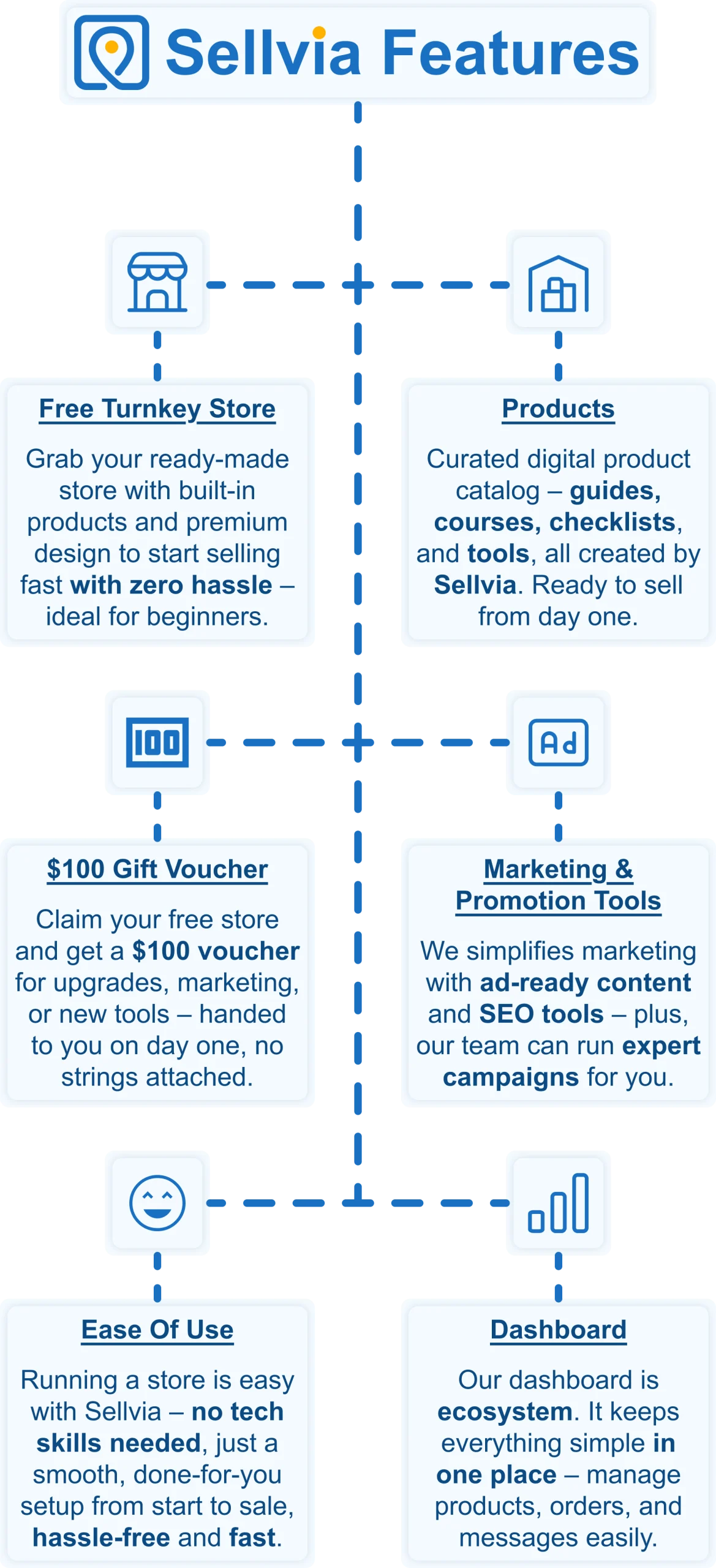
That is exactly what an online store through Sellvia offers. You sell digital products – guides, courses, checklists, and tools – that Sellvia creates for you. Your store is built by their team. The products are loaded in. The built-in ad system is ready to go. You do not need experience, tech skills, or a large budget to start. You just need to take the first step.
Why Sellvia is a game-changer for your online store 🚀
Sellvia isn’t just another ecommerce tool. We are a trusted name in the industry, recognized by Forbes and even ranked in Inc.’s list of the 5,000 fastest-growing companies in the U.S. So if you’re serious about starting as a solopreneur, this is a smart place to begin.
Starting an online business can feel overwhelming, but that’s exactly where Sellvia steps in. It takes care of the tricky parts, so you can focus on making sales and growing your brand. Let’s break down what makes it such a great choice.
Get a ready-to-go store hassle-free 🎯
Want to start selling but don’t know where to begin? No worries! Just share your ideas, and Sellvia’s team will build a free ecommerce website that’s fully set up and ready to take orders from day one. No coding, no stress – just a store that works right out of the box.
A $100 gift voucher to grow your business faster 🎁
Starting a business takes momentum – and Sellvia gives you a head start. When you claim your free store today, you also get a $100 gift voucher to put toward growing your business. Use it to upgrade your store, boost your marketing, or unlock new tools. It is a real dollar value, handed to you on day one, with no catch and no hoops to jump through.
A massive catalog of digital products to sell 🏆
One of the biggest struggles in starting an online business is figuring out what to sell. Sellvia solves that completely. Your store comes pre-loaded with digital products – guides, courses, checklists, and tools – all created by Sellvia. You keep 50–70% of every sale. No inventory. No shipping. No logistics headaches.
Everything in one easy-to-use platform 🔥
Managing an online store shouldn’t be complicated. With Sellvia, you can handle orders, add new products, and even chat with customers – all from a simple and user-friendly platform. No need to mess with confusing tools or deal with unnecessary tech stuff. It’s all smooth sailing.
No upfront costs, just start selling 💰
A big reason people hesitate to start an online business is the cost. But here’s the good news: With Sellvia, you don’t need to invest in stock, storage, or shipping supplies. You can run your store with no upfront costs, keeping things low-risk while still making money.
Support that’s always got your back 🤝
Running a business comes with questions, but you’re never alone. Sellvia’s dedicated support team is available 24/7 to help with anything you need. Whether it’s a small question or a big challenge, they’ve got you covered.
If you are serious about earning online in 2026 – whether from crypto or something more stable and predictable – Sellvia gives you a store, a product catalog, and a built-in ad system to get started with zero risk. Claim your free store today and see why over 1.5 million people have already launched theirs.