
If you love putting words on a page, you are already closer to earning real income than you might think. Making money writing is one of the most accessible online income paths in 2026 – and the demand for quality content has never been stronger. Businesses, bloggers, course creators, and brands all need writers who can communicate clearly and connect with real readers.
Quick Answer: The most reliable ways to make money writing include freelance content writing, copywriting, self-publishing ebooks, affiliate blogging, and selling online courses. Most beginners earn $20–$50 per hour within their first 60–90 days by focusing on one niche and delivering consistent, useful content.
You do not need a journalism degree or years of experience to get started. What you need is a clear niche, a willingness to learn, and a strategy you can commit to. This guide covers the top methods in plain, practical terms – so you can find the right one for your life and start moving forward today.
In the sections below, you will find the most practical ways to make money writing in 2026, realistic income ranges for each method, and clear steps to get your first clients or readers. Whether you want a steady side income or a full-time writing career, there is a path here for you.
What is making money writing?
Making money writing means earning income by producing written content – for businesses, for your own platforms, or through digital products you create and sell. It is not limited to authors and journalists. In 2026, content marketing is a multi-billion dollar industry, and companies of all sizes pay writers to produce blog posts, web copy, email newsletters, social media content, guides, and more.
The good news for beginners is that writing income is skills-based, not credential-based. Clients care about clarity, reliability, and relevance – not your degree. If you can write in a way that is useful and tailored to a specific audience, you have everything you need to start earning.
Your biggest decision as a new writer is where to focus first. Trying to be active on every platform and in every niche at once spreads you too thin. The writers who build real income are those who pick one method, get good at it, and grow from there. The sections below break down each option clearly so you can make that choice with confidence.
Whatever path you choose, the single most important quality you can develop is consistency. Writers who earn well are not always the most talented – they are the most reliable. Clients and readers come back to people they can count on, and that reputation compounds into steady, growing income over time.
How much can you realistically earn from writing?
Income from writing varies widely depending on your method, your niche, and the time you invest. Here is a realistic breakdown to set honest expectations before you choose your path:
The ceiling figures above reflect experienced, specialized effort – not what a casual writer earns in week one. Most beginners start in the lower range of their chosen method and scale up over 60–90 days. Freelance content writing and copywriting tend to pay the fastest, while blogging and self-publishing take longer to build momentum.
One note on income timelines: Choosing the right method matters less than choosing one and committing to it. Writers who switch strategies every few weeks rarely see meaningful results from any of them. Pick the method that fits your current skills and time, give it 90 days, and adjust based on what you learn.
The most important thing you can do right now is start. Writing income is cumulative – every client relationship built, every article published on Google, and every email subscriber gained adds up into a compounding asset that grows over time. The writers who struggle most are the ones who spend months researching instead of actually writing.
With realistic expectations in place, here is a detailed look at each method – starting with the one that produces income the fastest.
Content writing: get paid to write for businesses
Content writing is one of the fastest ways to make money writing online, because the demand is enormous and the barrier to entry is low. Businesses of all sizes need a steady flow of blog posts, landing pages, email campaigns, and web copy – and most of them outsource this work to freelance writers. You do not need to build an audience. You just need to find clients who need what you can write.
Blogs and articles
Writing blog posts for businesses is a natural starting point for most writers. Companies pay for regular content to attract search traffic, build authority in their market, and stay top of mind with potential customers. You can find clients through content platforms, job boards, or by pitching businesses directly in your niche.
ProBlogger job board
ProBlogger’s job board lists paid writing opportunities from real businesses across dozens of niches. Pay ranges from $0.05 to $0.50+ per word depending on the client and topic. It is a reliable place to find legitimate, paid writing assignments without cold-calling strangers. Check new listings at least twice per week and respond quickly – the best opportunities fill fast.
Textbroker and content platforms
Platforms like Textbroker and iWriter let you start writing for pay immediately, with no portfolio required. Rates start low – around $0.01–$0.03 per word – but they are useful for building writing speed and collecting initial samples. Most experienced writers use these platforms briefly to get started, then move to higher-paying direct clients within 60–90 days once they have a few samples to show.
Copywriting
Copywriting – writing persuasive content for ads, sales pages, and email sequences – is one of the highest-paying writing niches in 2026. Companies pay premium rates for copy that actually converts readers into buyers, and skilled copywriters are always in demand. If you are willing to study the fundamentals of persuasion and marketing, this is a path with serious long-term income potential.
Upwork
Upwork connects freelance copywriters with businesses that are actively hiring. Beginners often start at $25–$50 per hour to build their profile and reviews. Experienced copywriters with a track record of real results charge $75–$150+ per hour, and high-converting sales page writers can earn $500–$5,000 per project. Building a focused profile around one copy type – email sequences, ads, or landing pages – helps you stand out and attract better clients faster.
Direct outreach to businesses
Many of the highest-paid copywriters skip platforms entirely. They send targeted emails to businesses in their niche explaining specifically how their copy can help drive more sales. This approach takes more effort upfront but removes platform fees and puts you in direct control of your rate. Start with 5–10 outreach emails per day to small businesses in a niche you understand well, and make each pitch about one concrete result the business cares about.
Earning potential: $30–$80/hour for content writing with 6+ months of experience; $50–$150+/hour for copywriters with demonstrated client results.
Content writing rewards writers who go deep in a niche. A generalist gets paid $0.05 per word. A specialist in SaaS, healthcare, or personal finance earns $0.25–$0.50 per word for the same amount of writing. The faster you specialize, the faster your income grows.
Once you have built a solid body of work in one niche, rates climb quickly. Many writers who started at $0.05 per word are earning $0.20–$0.30 per word within 12 months – simply because they stayed in one lane, got better at it, and let their results do the selling for them.
Freelance writing: build a client base and work on your terms
Freelance writing gives you flexibility that a regular job cannot match. You set your schedule, choose your clients, and work from wherever you want. It is one of the most beginner-friendly ways to start making money writing because you do not need to build an audience or create products upfront – you just need to find one client who needs content and deliver something they love.
Platforms to find your first writing clients
The fastest way to get started is to put your services in front of people who are actively looking for writers. These platforms make that straightforward.
Fiverr
Fiverr lets you create a profile listing your writing services and attract clients who search the platform. New writers typically start at $15–$50 per piece to build reviews and visibility. Once you have a solid rating and a few positive reviews, you can raise your rates significantly. Focusing on a specific niche – finance, wellness, or technology – helps you stand out and attract better-paying clients faster.
LinkedIn is one of the best platforms for finding higher-quality writing clients, and it is massively underused by most freelancers. A well-optimized profile that clearly describes your writing niche – combined with consistent, useful posts – will bring inbound inquiries without cold pitching. Many B2B companies search LinkedIn actively for freelance writers who understand their specific industry. Start posting three times per week and engage regularly with content from businesses in your target niche.
Personal networking
Do not overlook the people already in your life. Former colleagues, friends, local business owners, and community members are often looking for exactly the content help you can provide. One warm referral from someone who trusts you is worth more than 50 cold emails to strangers. Let people in your network know you offer writing services, and ask directly if they know anyone who needs content help.
Building a portfolio that wins clients
Most clients want to see your work before they hire you. If you are just starting out, create three to five sample pieces in your chosen niche – even if they were not paid assignments. Publish them on a simple portfolio page (WordPress or Contently both work well) and link to it in every pitch and profile you create. A portfolio does not need to be long. It needs to prove that you can write clearly about the topic the client cares about.
Why this works in 2026: Demand for reliable content writers is outpacing supply. Businesses are actively looking for writers who understand their industry, meet deadlines, and require minimal editing. If you can consistently do those three things, finding and keeping clients becomes significantly easier over time.
The freelance writers who earn the most are not necessarily the most talented writers in their field – they are the most professional. They communicate clearly, deliver on time, and make the client’s job easier. That reputation spreads quickly inside any niche and is far more valuable than raw writing talent.
Digital publishing: earn income from your own content
If client work is not your style, digital publishing lets you build income entirely from your own ideas. You create something once – a book, a guide, or a blog – and it keeps earning without additional client work. The trade-off is that it takes more time upfront to build visibility and an audience. But the long-term upside is significant, especially for writers who enjoy creating content on their own schedule.
Ebooks and self-publishing
Amazon’s Kindle Direct Publishing platform lets anyone publish an ebook and sell it to millions of readers worldwide. You keep 35–70% of every sale, and a well-chosen nonfiction topic in a popular niche can generate $200–$1,000+ per month over time with little ongoing effort. Nonfiction how-to guides and practical reference books sell far more consistently than fiction for writers who are focused on building income.
To get started: research demand using Amazon’s bestseller lists and Google Trends, write a focused guide of 5,000–15,000 words on a topic you know well, design a clean cover using Canva, and publish. Promote it through your social channels, any email list you have, and relevant online communities. Most writers who follow this process see their first sales within two weeks of publishing.
Earning potential: $100–$2,000+/month per ebook with active promotion; writers with multiple published titles can reach $3,000–$5,000+/month over time.
Affiliate blogging
Starting a blog and earning commissions by recommending products is one of the most popular long-term income strategies for writers. You publish helpful articles that rank on Google, include affiliate links to relevant products or services, and earn a commission every time a reader clicks and buys. There is no client to manage and no service to deliver – just content that keeps working long after you write it.
Affiliate networks like Amazon Associates, ShareASale, and CJ Affiliate are solid starting points. Niches with strong affiliate programs include personal finance, health and wellness, home improvement, and technology. Most blogs take 6–12 months to generate meaningful search traffic, so this method works best alongside a shorter-term income source like freelance writing while you build momentum.
Important: Always disclose your affiliate relationships clearly in your content. It is legally required by the FTC and it actually builds more trust with readers, not less. A transparent recommendation from a writer they trust is worth far more to a reader than an unmarked product placement.
Educational content: get paid for what you know
If you have real expertise – whether in writing itself or in another field you understand deeply – you can package that knowledge into courses or workshops that people pay to access. This is one of the highest-income methods for writers who are also genuine subject-matter experts, and it scales well because you create the content once and sell it to new students repeatedly.
Online courses
Platforms like Udemy, Teachable, and Skillshare let you publish a course and earn from it over time. A well-structured writing course covering business writing, storytelling, content marketing, or a specific niche can generate $500–$2,000+/month for a well-rated instructor. The production does not need to be professional-grade. Clear instruction, good audio, and genuinely useful content matter far more than expensive equipment or studio lighting.
Start by choosing a topic you already know deeply. Outline 8–12 focused lessons, record them using a free tool like Loom or OBS, and publish on a platform with an existing built-in audience. Udemy in particular drives organic student discovery, which means your course can attract new learners without you actively marketing it every single day.
Workshops and webinars
Hosting paid live sessions is a strong option for writers who enjoy direct interaction with their audience. A single 90-minute workshop with 20 participants at $50 each generates $1,000 in one session. If you can run one session per month with an audience of just a few hundred engaged followers, that is a reliable $800–$1,500 monthly income stream with minimal overhead costs.
Zoom and Google Meet are free to use for hosting. Build your audience through consistent social media presence, a small email list, and by showing up in communities where your ideal students already spend time. Even 200–300 engaged followers in the right niche is enough to fill a paid workshop consistently month after month.
Earning potential: $500–$5,000+/month for online course creators with an established audience; $800–$3,000+/month for active workshop hosts who run regular paid sessions.
Tips to start making money writing faster in 2026
Whichever method you choose, these practical strategies will help you build income more quickly and avoid the mistakes that slow most writers down in the first 90 days.
Pick a niche and own it
Generalist writers earn the least. A writer who covers “everything” is easy to overlook. A writer who covers personal finance for first-generation college graduates, or cybersecurity for small business owners, is immediately valuable to a specific audience. Pick your niche based on three things: what you know, what you enjoy, and what has real market demand. Then stay in that lane for at least 90 days before considering any change of direction.
Build a simple, focused portfolio
You do not need a polished website to start winning clients. A clean, readable page that describes your niche, shows three to five samples of your work, and includes a clear way to contact you is enough. WordPress, Contently, or even a single well-formatted Google Doc can serve as your portfolio at the very beginning. The goal is to make it easy for potential clients to understand what you do – and see proof that you can actually do it – within ten seconds of landing on your page.
Learn basic SEO
Understanding how to research keywords, structure a blog post, and write headings that match what people search for will immediately raise your value to content writing clients. Writers with basic SEO knowledge regularly command $0.10–$0.25+ per word instead of the $0.03–$0.05 that non-SEO writers typically earn. A free course on keyword research takes less than a weekend to complete and will pay for itself in your very first month of client work.
Market yourself consistently
The best writers do not always win the most clients – the most visible ones do. Post on LinkedIn or in your chosen community two or three times per week. Share samples of your work regularly. Comment thoughtfully in spaces where potential clients are active. Just 15 minutes of consistent self-promotion per day compounds into a steady inbound stream of opportunities within 60–90 days. Visibility is a skill, and it is one of the highest-ROI habits a freelance writer can build.
Deal with writer’s block before it stops you
Writer’s block is real, but it does not have to derail your income. The most effective fix is to write before you feel ready. Set a timer for 10 minutes and write without editing – just get words on the page and let momentum do the rest. Changing your physical environment also helps: a café, a library, or even a different room can reset your focus when you are genuinely stuck. The writers who earn consistently are not the ones who never get blocked – they are the ones who push through it faster than everyone else.
How to choose the right writing method for your situation
Not every writing income strategy works for every person. Your best option depends on your current skills, available time, and income goals. Here is a simple framework to help you decide.
Complete beginner
If you have no portfolio and no clients yet, start with freelance content writing on a platform like Textbroker or by pitching through ProBlogger. Focus on one niche, write five to ten samples, and pitch consistently. Your first goal is one paying client within 30 days. Income and confidence build quickly once you have your first real assignment in hand – and that first assignment proves to you that this is real and achievable.
Intermediate – part-time income goal
If you have some writing experience and want $500–$2,000 per month as supplemental income, combine freelance content writing with a simple blog and affiliate links. The freelance work pays in the short term while the blog builds a long-term asset that grows on its own. Both methods reinforce each other – your blog samples become your portfolio, and your client work deepens your niche expertise over time.
Advanced – full-time income goal
If your goal is to replace a full-time income of $3,000–$6,000+ per month, copywriting combined with online courses or a profitable affiliate blog is the most realistic path. Both take 6–12 months of dedicated, focused effort – but writers who commit fully to one of these paths consistently reach full-time income levels within a year. The key is treating this like a real business from day one, not a side project you fit in when it is convenient.
Whatever stage you are at right now, remember that writing income is cumulative. Every article indexed on Google, every client relationship built, and every email subscriber gained adds to a body of work that generates income long into the future. The writers who build lasting income are the ones who stay the course past the slow, unglamorous early months.
Why Sellvia is a game-changer for your online store 🚀
Sellvia isn’t just another ecommerce tool. We are a trusted name in the industry, recognized by Forbes and even ranked in Inc.’s list of the 5,000 fastest-growing companies in the U.S. So if you’re serious about starting as a solopreneur, this is a smart place to begin.
Starting an online business can feel overwhelming, but that’s exactly where Sellvia steps in. It takes care of the tricky parts, so you can focus on making sales and growing your brand. Let’s break down what makes it such a great choice.
Get a ready-to-go store hassle-free 🎯
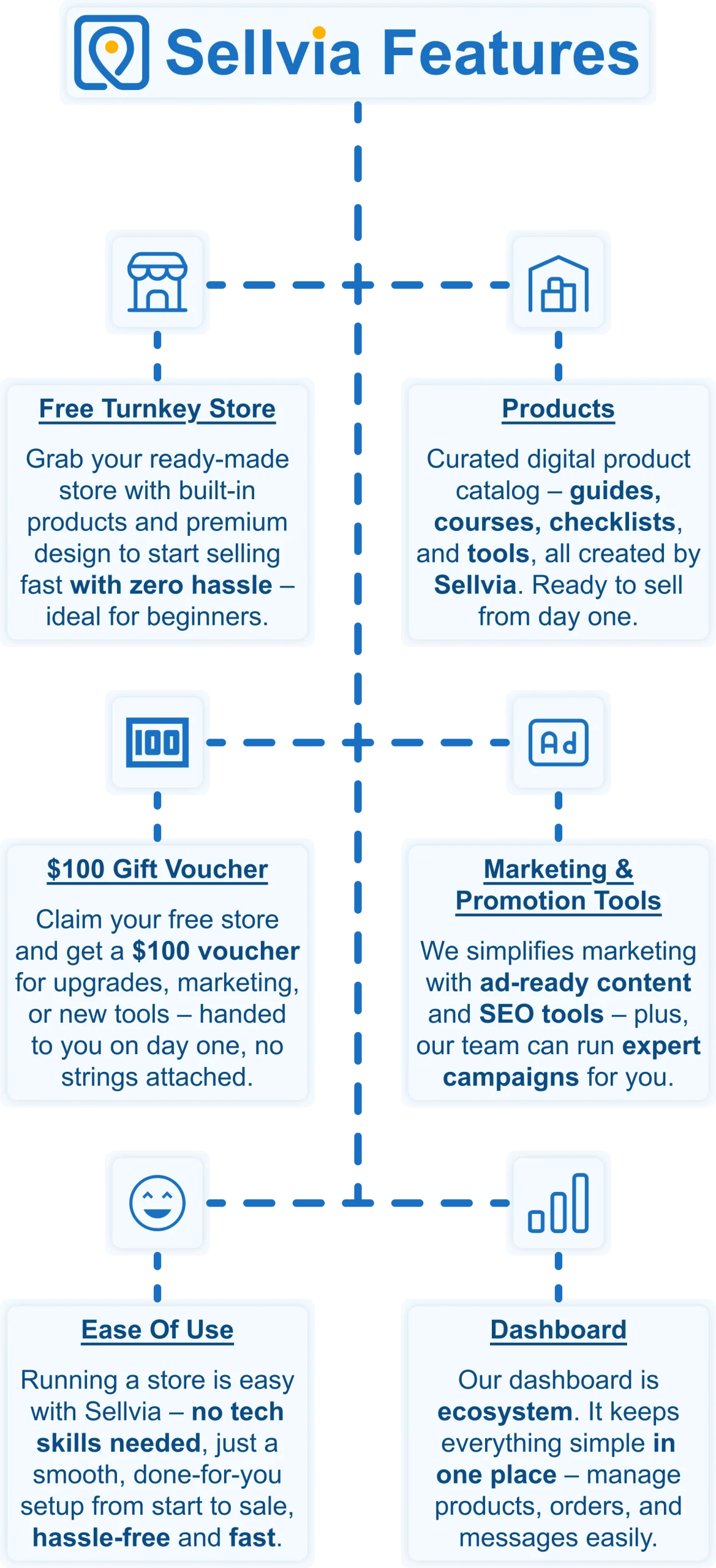
Want to start selling but don’t know where to begin? No worries! Just share your ideas, and Sellvia’s team will build a free ecommerce website that’s fully set up and ready to take orders from day one. No coding, no stress – just a store that works right out of the box.
A $100 gift voucher to grow your business faster 🎁
Starting a business takes momentum – and Sellvia gives you a head start. When you claim your free store today, you also get a $100 gift voucher to put toward growing your business. Use it to upgrade your store, boost your marketing, or unlock new tools. It is a real dollar value, handed to you on day one, with no catch and no hoops to jump through.
A massive catalog of digital products to sell 🏆
One of the biggest struggles in starting an online business is figuring out what to sell. Sellvia solves that completely. Your store comes pre-loaded with digital products – guides, courses, checklists, and tools – all created by Sellvia. You keep 50–70% of every sale. No inventory. No shipping. No logistics headaches.
Everything in one easy-to-use platform 🔥
Managing an online store shouldn’t be complicated. With Sellvia, you can handle orders, add new products, and even chat with customers – all from a simple and user-friendly platform. No need to mess with confusing tools or deal with unnecessary tech stuff. It’s all smooth sailing.
No upfront costs, just start selling 💰
A big reason people hesitate to start an online business is the cost. But here’s the good news: With Sellvia, you don’t need to invest in stock, storage, or shipping supplies. You can run your store with no upfront costs, keeping things low-risk while still making money.
Support that’s always got your back 🤝
Running a business comes with questions, but you’re never alone. Sellvia’s dedicated support team is available 24/7 to help with anything you need. Whether it’s a small question or a big challenge, they’ve got you covered.
If you are serious about building income online, a Sellvia store gives you a ready-made path that works alongside everything you are building as a writer. Claim your free store today and start earning with digital products that are already ready to sell.