Millions of people search for ways to sell things online and make money every single month. But most of them never actually start. Not because the opportunity isn’t there – but because the options feel overwhelming and the results aren’t always clear. So let’s cut through the noise.
Quick Answer: You can sell digital products, services, or handmade goods online through platforms like Etsy, eBay, or your own ecommerce store. Earnings range from $200–$500/month for casual sellers to $5,000–$20,000+/month for serious store owners – depending on the method, effort, and model you choose.
This guide walks you through the most legitimate, tested ways to sell online in 2026, how much each one realistically earns, and why building your own ecommerce store remains the path with the highest ceiling. Whether you are starting from scratch or looking to scale, there is a place for you here.
What does it mean to sell things online and make money?
Selling things online simply means exchanging products, services, or digital content for money through an internet-based channel. That could mean listing a handmade item on Etsy, offering freelance services on Fiverr, or running your own ecommerce store that sells digital products to customers across the country. The channel differs – but the core idea is the same. You find what people want, put it in front of them, and collect payment.
What makes 2026 different from even a few years ago is how much of the infrastructure already exists. Payment processors, ecommerce platforms, and built-in advertising tools have matured to the point where anyone – even without tech skills or business experience – can have a functioning online store running within a day. The barrier to entry has never been lower.
There are two broad categories of online selling worth understanding. Platform-dependent selling means you list on someone else’s marketplace – Amazon, eBay, Etsy – and play by their rules. Platform-independent selling means you own your store, your audience, and your data. Both have merit. But the long-term economics strongly favor building something you control.
How much can you realistically earn selling online?
Here is an honest breakdown of earning potential across the most common methods. The numbers below reflect realistic outcomes based on consistent effort – not best-case scenarios.
The table shows a clear pattern. Methods that rely entirely on your own time – freelancing, handmade goods – hit a natural ceiling. Scalable models like ecommerce and digital products can grow far beyond what your hours allow.
One note on ceiling figures: The top-end numbers above reflect sellers who have been operating consistently for 6–18 months, built repeatable traffic, and reinvested earnings into growth. If you are brand new, expect 60–90 days before seeing meaningful revenue from most methods. “Full-time effort” here means 4–6 hours per day of focused work – not occasional browsing.
The best ways to sell things online and make money in 2026
These methods are grouped by type – from low-barrier entry points to higher-ceiling models. Use this section to find the approach that fits your situation right now, not just the one that sounds most exciting.
Selling physical products through online marketplaces
Sell used and second-hand items
If you have items around the house – electronics, clothing, furniture, collectibles – platforms like eBay, Facebook Marketplace, and Poshmark let you turn clutter into cash with almost no upfront investment. eBay works best for electronics and niche collectibles, while Poshmark and Depop dominate fashion. Facebook Marketplace is ideal for bulky items where local pickup makes sense.
The process is straightforward: take clear photos, write an accurate title with brand, model, and condition, price competitively by checking recent sold listings, and ship promptly. Sellers who learn to source items cheaply – from thrift stores, estate sales, or clearance sections – can turn this into a repeatable side business.
Earning potential: $100–$600/month for casual decluttering; $800–$2,500/month for consistent retail arbitrage with active sourcing.
Sell on Amazon
Amazon gives you access to one of the largest buying audiences in the world. The two main routes are Fulfilled by Amazon (FBA), where you ship products to Amazon’s warehouses and they handle the rest, and Merchant Fulfilled, where you store and ship items yourself. FBA generally performs better for visibility and the Prime badge – but it comes with storage fees and requires more upfront capital.
For beginners watching their budget, starting small with a single validated product is the smarter approach. The key is choosing a niche with consistent demand and relatively manageable competition.
Earning potential: $500–$5,000/month for FBA with a validated product; results vary significantly by category and ad spend.
Sell handmade or vintage goods on Etsy
Etsy is the go-to marketplace for handmade, vintage, and craft-adjacent products. If you make candles, jewelry, ceramics, custom embroidery, or anything in that category, Etsy gives you a built-in audience actively searching for exactly those things. The platform has over 90 million active buyers – a ready market you do not have to build from scratch.
Etsy success comes down to three things: strong photography, keyword-rich product titles and tags, and consistent shop activity. New listings get a short visibility boost, so uploading regularly – even one or two new items per week – keeps your shop active. Top Etsy sellers often expand to their own store once they have validated their audience.
Earning potential: $300–$3,000/month for consistent makers; top sellers with strong SEO and multiple product lines can exceed $10,000/month.
Selling digital products online
Sell digital downloads
Digital products are one of the most attractive online selling models because of the economics: create once, sell as many times as you want with zero per-unit cost. Popular digital products include Notion templates, resume templates, financial spreadsheets, printable planners, and instructional guides. Etsy and Gumroad are the most beginner-friendly platforms for listing digital downloads, though your own store is also a strong option.
The upfront work is real – producing something polished takes time. But once the product exists and the listing is live, it can generate income for months or years. The key is solving a specific, searchable problem. A focused, practical product always outsells a generic bundle.
Earning potential: $200–$2,000/month for a focused digital product shop with strong SEO; creators with a social following frequently exceed $5,000/month.
Sell online courses and ebooks
If you have knowledge worth sharing – a professional skill, a niche hobby, language learning, or fitness expertise – packaging it into a course or ebook is a direct way to monetize it. Platforms like Teachable, Podia, and Thinkific handle hosting, payments, and delivery. Gumroad works well for simpler ebooks and guides.
Pricing matters a lot here. Ebooks typically sell in the $10–$30 range, while structured courses with video lessons can command $97–$497. The difference in revenue per sale is significant, which is why many creators use a low-cost ebook as an entry point and upsell to a full course later.
Earning potential: $300–$5,000/month depending on audience size, pricing, and the quality of your marketing approach.
Selling through your own ecommerce store
Owning your store is the highest-ceiling model available to online sellers in 2026. When you sell on someone else’s platform, you are renting shelf space. When you own your store, you control the pricing, the brand, and the customer relationship. That ownership compounds over time in ways that marketplace selling simply cannot match.
Print-on-demand
Print-on-demand (POD) removes inventory risk entirely: you create designs and apply them to products like t-shirts, mugs, hoodies, and phone cases, and a supplier prints and ships each item only when someone orders. Printful and Printify are the two dominant POD suppliers, both of which integrate with Etsy and WooCommerce.
POD works best when the designs are tied to a specific identity – a hobby, community, profession, or shared inside reference – rather than generic graphics. A niche-specific design for a dedicated audience will consistently outperform a generic motivational quote.
Earning potential: $200–$2,500/month for consistent designers with active promotion; margins are slimmer than other ecommerce models due to higher per-unit costs.
Selling services online
Freelance services on Fiverr and Upwork
Freelancing lets you sell what you already know how to do – writing, graphic design, video editing, web development, translation, social media management – directly to clients through platforms like Fiverr and Upwork. Fiverr works best for standardized services with a fixed deliverable. Upwork suits longer engagements and hourly contracts.
New freelancers typically start by pricing lower to collect reviews, then raise rates once their profile has social proof. The key to standing out early is specializing in one service for one industry – that focused positioning builds a reputation far faster than being a generalist.
Earning potential: $500–$3,000/month for part-time freelancers; $4,000–$10,000/month for experienced specialists with strong profiles.
Comparing your options: which method fits you best?
Every selling method has a different profile of time, risk, startup cost, and scalability. This comparison focuses on the factors that matter most to someone deciding where to start in 2026.
The pattern is consistent: methods with the lowest barriers tend to have the lowest ceilings. The methods with the highest ceilings – digital products, ecommerce, and owning your own store – require more intentional setup but pay off significantly over time.
Tips to make more money selling things online
Pick a niche, not a category
The biggest mistake new online sellers make is being too broad. “Clothing” is a category. “Minimalist workwear for women over 40” is a niche. Niches have more targeted buyers, less competition for attention, and stronger word-of-mouth. The tighter your focus at the start, the faster you will build authority and repeat customers.
Learn the basics of SEO for product listings
Whether you are on Etsy, Amazon, or your own store, organic search traffic is the most cost-effective way to get consistent buyers. For marketplace listings, that means putting your highest-value keywords front-loaded in the title, filling all available tags, and writing descriptions that answer real buyer questions. For your own store, it means building content around what your buyers are already searching for.
Use social proof actively
Reviews, ratings, and real customer photos are the most powerful conversion tools available to an online seller – and they are free. Follow up with buyers to encourage honest reviews. Respond to every review, positive or negative. Feature real customer content where your platform allows. Buyers trust other buyers far more than any ad or product description you write yourself.
Treat your first 90 days as market research
The products you think will sell and the products that actually sell are often different. Use your first three months to test multiple listings or product ideas at small scale, track which ones get clicks and which ones convert, and double down on what works. Successful ecommerce sellers treat data as a partner – they let numbers guide decisions, not gut feel alone.
Reinvest early profits into paid traffic
Once you have a product converting organically – even at small scale – that is the signal to test paid advertising. The key is starting with a small daily budget ($10–$20/day), proving your cost-per-acquisition before scaling, and never putting significant spend behind a product that has not already converted on its own. Sellvia’s built-in advertising system takes care of this entire process for you, from targeting to creatives to optimization.
What to avoid when selling things online
Most people who struggle with online selling don’t fail because the method doesn’t work. They fail because they make a handful of very predictable mistakes. Here are the ones worth knowing before you start.
Fake reviews and inflated claims
Buying reviews on Amazon or Etsy, using review-exchange groups, or writing fake testimonials for your own store might feel like a shortcut. It isn’t. Amazon permanently bans accounts when it detects review manipulation – and it detects it often. Etsy has become increasingly aggressive at removing listings with suspicious review patterns. Beyond the platform risk, fake social proof permanently damages your brand when exposed.
Key principle: Build credibility through real product quality and genuine follow-up – it compounds in your favor over time.
Misleading product listings
Selling something that looks nothing like the photos, omitting known defects, or using misleading specifications is a fast route to bad reviews, high return rates, and potential account suspension. Accurate, honest listings consistently outperform deceptive ones over any meaningful time frame. It is also simply the right way to run a business.
Over-relying on a single platform
If 100% of your income runs through one marketplace, you are one policy change away from losing everything. Platforms like Amazon, Etsy, and eBay change their fee structures, ranking algorithms, and policies regularly. The sellers who survive long-term are the ones who own their customer relationships – not just their listings. Having your own store alongside any marketplace presence gives you a real safety net.
How to choose the right method for where you are now
The best way to sell things online and make money isn’t a universal answer – it depends on your starting point, your available time, and what you want your business to look like in 12 months. Here is a practical breakdown by reader profile.
Complete beginner with limited time
Start with selling used items or digital downloads – both have near-zero startup costs and don’t require building an audience from scratch. Use this phase to learn the mechanics of online selling: how to write product copy, how to price competitively, and what buyers actually respond to. Give yourself 60 days before evaluating results.
Part-time seller looking to grow
If you have 10–15 hours per week and some initial capital, digital products and ecommerce are strong next steps. Both allow you to test what works without committing heavily upfront. Building your own store – rather than relying on a marketplace – gives you more control over your brand, pricing, and customer data.
Serious about building a full-time online income
If your goal is to replace a salary or build a genuine long-term business, owning your store and customer list is where the math works in your favor. The combination of a ready-to-go store, digital products with 50–70% margins, and a built-in advertising system creates compounding returns that no marketplace-dependent model can match. Budget 90–120 days for meaningful traction, and treat marketing as a core function from day one.
Already earning but want to scale
If you are already making $500–$2,000/month from one method, the highest-leverage next move is usually to build or expand your own store. That means more control over pricing, more margin to reinvest in promotion, and an asset you actually own. A platform like Sellvia combines store setup, digital product catalog, and built-in advertising into a single system designed to help you scale without the complexity.
Why Sellvia is a game-changer for your online store 🚀
Sellvia isn’t just another ecommerce tool. We are a trusted name in the industry, recognized by Forbes and even ranked in Inc.’s list of the 5,000 fastest-growing companies in the U.S. So if you’re serious about starting as a solopreneur, this is a smart place to begin.
Starting an online business can feel overwhelming, but that’s exactly where Sellvia steps in. It takes care of the tricky parts, so you can focus on making sales and growing your brand. Let’s break down what makes it such a great choice.
Get a ready-to-go store hassle-free 🎯
Want to start selling but don’t know where to begin? No worries! Just share your ideas, and Sellvia’s team will build a free ecommerce website that’s fully set up and ready to take orders from day one. No coding, no stress – just a store that works right out of the box.
A $100 welcome gift to grow your business faster 🎁
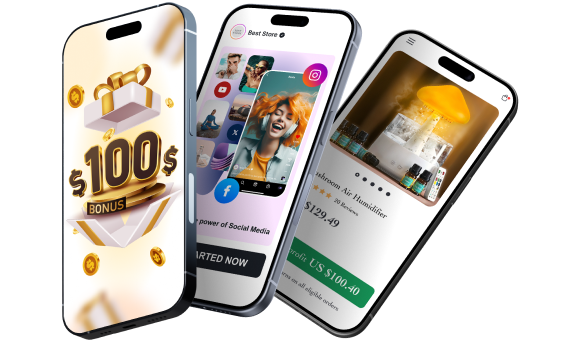
Starting a business takes momentum – and Sellvia gives you a head start. When you claim your free store today, you also get a $100 welcome gift to put toward growing your business. Use it to upgrade your store, boost your marketing, or unlock new tools. It is a real dollar value, handed to you on day one, with no catch and no hoops to jump through.
A massive catalog of digital products to sell 🏆
One of the biggest struggles in starting an online business is figuring out what to sell. Sellvia solves that completely. Your store comes pre-loaded with digital products – guides, courses, checklists, and tools – all created by Sellvia. You keep 50–70% of every sale. No inventory. No shipping. No logistics headaches.
Everything in one easy-to-use platform 🔥
Managing an online store shouldn’t be complicated. With Sellvia, you can handle orders, add new products, and even chat with customers – all from a simple and user-friendly platform. No need to mess with confusing tools or deal with unnecessary tech stuff. It’s all smooth sailing.
No upfront costs, just start selling 💰
A big reason people hesitate to start an online business is the cost. But here’s the good news: With Sellvia, you don’t need to invest in stock, storage, or shipping supplies. You can run your store with no upfront costs, keeping things low-risk while still making money.
Support that’s always got your back 🤝
Running a business comes with questions, but you’re never alone. Sellvia’s dedicated support team is available 24/7 to help with anything you need. Whether it’s a small question or a big challenge, they’ve got you covered.
If you are serious about learning how to sell things online and make money, the right platform makes all the difference. Claim your free Sellvia store today and start building your income from day one.