More than 500 million people listen to podcasts every week. That number keeps climbing – and so does the income flowing into the industry. If you have been wondering how to start a podcast and make money, 2026 is one of the best times to jump in.
Quick answer: You can start a podcast and make money by building an audience around a topic you know, then earning through sponsorships, listener support, affiliate marketing, or selling digital products online. Most podcasters begin seeing real income between 6 and 12 months of consistent publishing.
The good news is that you do not need a professional studio or a massive existing following to begin. You need a clear topic, a decent microphone, and a real plan. This guide walks you through every step – from picking your niche to getting your first dollars in.
Podcasting is no longer a niche hobby. It is a mainstream media format with real income potential – one that rewards people who show up consistently and choose the right monetization path for their situation. Whether you are a complete beginner or already planning your first episode, here is what actually works in 2026.
What is podcasting and why does it matter in 2026?
A podcast is a series of audio episodes that listeners can subscribe to, download, or stream on demand – on any topic, at any time, on any device. Think of it like a radio show that you fully control.
In 2026, podcasting is a mainstream media format with serious income potential. Brands spend billions of dollars on podcast advertising each year. Listeners trust podcast hosts more than almost any other type of media personality – and that trust translates directly into income for creators who build genuine, engaged audiences.
Whether your topic is personal finance, parenting, true crime, fitness, entrepreneurship, or something specific like “budgeting for single parents” or “side income for truck drivers,” there is an audience waiting to find you. The barriers to entry are genuinely low – and the earning potential for consistent creators has never been higher.
A podcast and an online business work well together. While your show grows over months, a Sellvia store can earn independently from the start – giving you real income while you build the audience that eventually makes your podcast profitable too.
How much can you realistically earn from podcasting?
Earnings from podcasting vary widely depending on audience size, niche, and how many income streams you have running at once. Here is an honest breakdown of what the main monetization methods actually pay in 2026.
Most new podcasters combine two or three of these methods at once rather than relying on a single stream. The realistic earning range for a consistent beginner is $200–$800/month by the end of year one – meaningful supplemental income when you stack affiliate links, listener support, and a small sponsorship deal.
One note on the top-tier numbers: Six-figure podcast incomes belong to hosts with 50,000 or more monthly listeners and multiple revenue streams built over several years of consistent work. For most people starting out, the honest goal in year one is to build an engaged audience and create the foundation for steady income – not overnight wealth.
What matters most in those first 6–12 months is consistency. Publishing on a set schedule – even imperfect episodes – builds the trust and loyalty that monetization depends on. Start with one income method, get comfortable with it, and add more from there.
How to start a podcast step by step
Setting up a podcast is more straightforward than most people expect. Here is everything you need to do – in order – to go from idea to published show.
Choose your niche
Your niche is the foundation of everything. A focused podcast that serves a specific audience will always outperform a vague general show. Before you lock in a topic, ask yourself three questions: What am I genuinely excited to talk about for years? Who would benefit from my knowledge or perspective? Is there already an audience actively searching for this kind of content?
Popular podcast categories in 2026 include personal finance, health and wellness, true crime, parenting, entrepreneurship, and self-improvement. Any of these can work – but so can a highly specific angle like “side income for teachers” or “financial planning for retirees on a fixed income.” The more specific your topic, the easier it is to build a loyal audience fast.
Pick your format
Choose a format that fits both your communication style and your available time. The most common options are solo shows (you speak alone and share insights or stories), interview-based shows (you bring in guests for conversations), co-hosted shows (you and a partner discuss topics together), and narrative shows (scripted, story-driven episodes). Solo and interview formats are the simplest starting points for most beginners.
Get your equipment
You do not need an expensive studio setup to sound professional. A $50–$100 USB microphone makes a dramatic difference compared to a built-in laptop mic. The Audio-Technica ATR2100x and Blue Yeti are two widely recommended beginner options. Add a pair of closed-back headphones to monitor your audio while recording.
For recording and editing software, Audacity is completely free on Windows and GarageBand works well on Mac. Both handle everything a beginner podcast needs without spending a dollar on software.
Important: Record in a small, soft-furnished room. Carpets, curtains, and bookshelves absorb echo more effectively than most commercial soundproofing products – and they cost nothing extra if you already have them.
Record and edit your first episodes
Your first recording session will feel awkward – that feeling disappears fast. Prepare a simple outline with three to five main points before you hit record. A loose outline produces more natural-sounding audio than a word-for-word script, and it cuts your editing time significantly.
When editing, focus on removing long silences and obvious mistakes. Do not aim for perfection. Listeners want to hear a real human voice, not a radio-smooth production that took 12 hours to polish.
Choose a podcast hosting platform
Your audio files need to live on a hosting platform before they can reach Spotify, Apple Podcasts, Amazon Music, or anywhere else. The host stores your files and generates the RSS feed that podcast directories use to distribute your show. Popular options in 2026 include Buzzsprout, Podbean, Libsyn, and Transistor. Most offer free starter tiers, with paid plans in the $12–$25/month range as your audience grows.
With your niche, format, equipment, and hosting sorted, you are fully equipped to launch. The only mistake most new podcasters make is waiting too long to publish their first episode. It does not need to be perfect – it just needs to exist.
How to make money from your podcast
Here is a breakdown of every realistic way to earn from podcasting in 2026 – what each method pays, what it requires, and how to get started.
Sponsorships and ads
Sponsorships are the most talked-about monetization method for podcasters – and they pay well once you have an established audience. Brands pay based on CPM (cost per thousand listeners). Mid-roll ads, placed in the middle of an episode, typically pay $20–$30 CPM. Pre-roll ads pay $15–$20 CPM. With 5,000 downloads per episode, a single mid-roll placement could earn $100–$150.
AdvertiseCast
One of the largest podcast advertising marketplaces. Connects podcasters directly with brand advertisers. You set your rates and receive inbound inquiries from interested brands. Works best once your show is consistently hitting 1,000 or more downloads per episode.
Podcorn
A self-serve platform where brands browse available podcasts and submit sponsorship proposals directly to creators. Works well for smaller and niche shows because brands specifically search for targeted audiences rather than raw download numbers. A smart first platform to join early – even before you hit the 1,000-download milestone.
Listener support and memberships
If your audience finds real value in your episodes, some of them will pay directly to support you. This is one of the most underrated revenue streams for podcasters because it works at any audience size – even 100 loyal listeners can generate meaningful monthly income through the right platform.
Patreon
The most well-known membership platform for creators. Listeners pay a monthly amount – typically $3, $5, or $10 – in exchange for bonus episodes, early access, or direct community membership. A podcast with 300 Patreon supporters at $5/month earns $1,500/month before platform fees – more than most beginner sponsorship deals combined.
Buy Me a Coffee
A simpler, one-time donation model that requires no ongoing commitment from supporters. Lower earning potential than Patreon, but quicker to set up and a good starting point before you build a full membership offering.
Affiliate marketing
Affiliate marketing means recommending products or services in your episodes and earning a commission when a listener buys through your unique referral link. Podcasting is particularly well-suited to affiliate marketing because listeners trust host recommendations far more than banner ads or sponsored posts.
Amazon Associates
The easiest entry point for podcast affiliate marketing. You earn 1–10% commission depending on the product category. Low per-sale amounts individually, but they add up consistently with a steady audience and products that naturally fit your episode topics.
ShareASale
A larger affiliate network connecting you to thousands of merchants across every niche. Commission rates are often significantly higher than Amazon, especially for software, online courses, and digital products – making it well-suited for podcasters in finance, business, or health niches.
Earning potential: $50–$500/month from affiliate links at the 1,000–5,000 listener stage, depending on your niche and how closely the products you recommend match what your audience actually wants.
Selling your own digital products
This is one of the highest-margin ways to earn from a podcast. When you sell your own digital products – guides, courses, checklists, templates – you keep most of the revenue instead of earning a small affiliate cut or waiting for a sponsor to call.
Podcasters in niches like personal finance, fitness, parenting, and business can use their episodes to build real authority, then convert listeners into buyers. A simple digital guide priced at $27, sold to just 30 listeners per month, generates over $800/month – more than most beginner sponsorship arrangements. The challenge is that creating quality digital products takes significant time and expertise to do well upfront.
Live events and workshops
As your show grows, live events become a real option – virtual Q&A sessions, paid workshops, or in-person meetups with your most engaged listeners. Ticket sales, event sponsorships, and product sales during events can layer meaningfully on top of your regular show revenue. This path works best once you have a highly engaged community, typically 12–24 months into consistent publishing.
Tips for growing your podcast for long-term success
Getting your podcast live is the first milestone. Keeping it growing toward real income is the longer game. Here is what actually moves the needle in 2026.
Stay on a consistent publishing schedule
Consistency is the single most important growth factor for any podcast. Publishing every week – even an imperfect episode – always outperforms releasing a polished masterpiece once a month. Listeners build habits around shows they can count on. If you miss your slot, they find someone else who shows up reliably.
Optimize your episode titles for search
Most new listeners find podcasts through search – inside Spotify, Apple Podcasts, or Google. Episode titles that answer specific questions perform dramatically better than vague ones. “How I paid off $22,000 in debt in 14 months” will consistently outrank “Episode 14: My money story” in search results and recommendation feeds.
Engage directly with your listeners
Reply to listener emails and DMs. Ask questions at the end of episodes. Run polls on social media between releases. The podcasters who build the most loyal communities treat their listeners like real people – not download statistics. Loyal listeners become Patreon supporters, digital product buyers, and your most effective word-of-mouth promoters.
Collaborate with guests and other creators
Guest appearances on other podcasts remain one of the fastest audience-growth tactics available. Appearing on a show with 10,000 listeners will send a real portion of that audience back to your own show. Aim for at least one cross-collaboration per month in your first year – it compounds fast.
Improve your production quality over time
You do not need perfect audio on day one – but you should be actively improving. Upgrade your microphone at episode 50 or 100. Learn basic audio compression in your editing software. Cleaner sound signals professionalism to both new listeners and potential sponsors who are evaluating your show for ad deals.
Growing a podcast takes patience and strategy in equal measure. The tips above work – but they work over months, not days. Set realistic expectations for your timeline and measure progress in audience engagement first, then raw download numbers.
Which approach is right for you?
Not every monetization path is the right fit for every podcaster. Here is a quick breakdown based on where you are right now.
Complete beginner
If you are just starting out, focus on publishing 10 solid episodes before you think seriously about money. Pick one niche, pick one format, and publish consistently. Add affiliate links from your very first episode – they cost nothing to set up and can earn from day one. The monetization compounds after consistency, not before it.
Intermediate (3–6 months in, 200–1,000 listeners)
At this stage, launch a Patreon page or Buy Me a Coffee profile. Submit your show to Podcorn and AdvertiseCast. Start creating simple digital resources your listeners have been asking for. These moves stack up quickly once you have a real, engaged audience – even a small one.
Advanced (12+ months, 5,000+ listeners)
At this level, start pitching sponsors directly – you no longer need to wait for them to find you. Build and sell your own digital products. Run paid live workshops and Q&A events. A podcast with multiple revenue streams running simultaneously – sponsorships, Patreon, affiliate income, and digital product sales – is a genuine full-time income business for the right creator in the right niche.
Not ready to wait that long?
Here is the honest reality about podcasting: building an audience from zero to a level that generates meaningful income typically takes 12–24 months of consistent work. That is not a reason to skip it – but it is important to go in knowing the timeline is real.
If you want a way to start earning income online now – without waiting for an audience to build – there is a better starting point. You can run both paths at the same time.
Want to earn online without waiting for an audience?
Podcasting is a real path to income – but the timeline is honest. Most podcasters spend 12–18 months building before they see consistent, meaningful revenue. If that pace feels too slow for your current situation, there is a parallel option worth knowing about.
A Sellvia online store gives you something podcasting cannot: a ready-to-earn business from day one. There is no audience to build from scratch, no months of free content to produce before you see a dollar, and no waiting for sponsors to discover you. Your store comes pre-loaded with digital products, a built-in advertising system that drives your first orders in, and full support from a team that has helped over 1.5 million stores launch successfully.
Podcasting and a Sellvia store are not mutually exclusive – they are actually a powerful combination. Many creators use their store as their primary income while their show grows in the background, then eventually incorporate their store products directly into their podcast content as the audience matures. It is one of the most practical double-income setups for independent earners in 2026.
Why Sellvia is a game-changer for your online store 🚀
Sellvia isn’t just another ecommerce tool. We are a trusted name in the industry, recognized by Forbes and even ranked in Inc.’s list of the 5,000 fastest-growing companies in the U.S. So if you’re serious about starting as a solopreneur, this is a smart place to begin.
Starting an online business can feel overwhelming, but that’s exactly where Sellvia steps in. It takes care of the tricky parts, so you can focus on making sales and growing your brand. Let’s break down what makes it such a great choice.
Get a ready-to-go store hassle-free 🎯
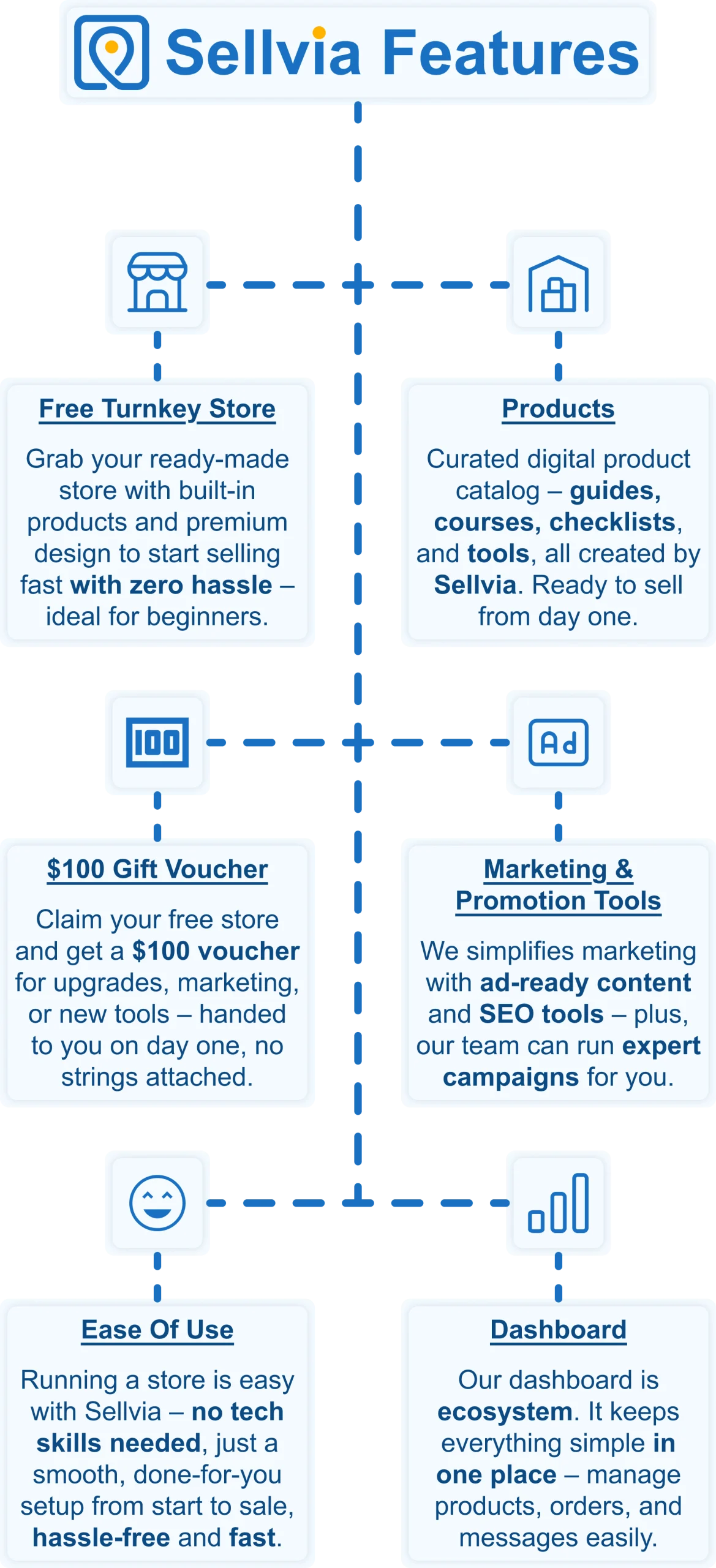
Want to start selling but don’t know where to begin? No worries! Just share your ideas, and Sellvia’s team will build a free ecommerce website that’s fully set up and ready to take orders from day one. No coding, no stress – just a store that works right out of the box.
A $100 gift voucher to grow your business faster 🎁
Starting a business takes momentum – and Sellvia gives you a head start. When you claim your free store today, you also get a $100 gift voucher to put toward growing your business. Use it to upgrade your store, boost your marketing, or unlock new tools. It is a real dollar value, handed to you on day one, with no catch and no hoops to jump through.
A massive catalog of digital products to sell 🏆
One of the biggest struggles in starting an online business is figuring out what to sell. Sellvia solves that completely. Your store comes pre-loaded with digital products – guides, courses, checklists, and tools – all created by Sellvia. You keep 50–70% of every sale. No inventory. No shipping. No logistics headaches.
Everything in one easy-to-use platform 🔥
Managing an online store shouldn’t be complicated. With Sellvia, you can handle orders, add new products, and even chat with customers – all from a simple and user-friendly platform. No need to mess with confusing tools or deal with unnecessary tech stuff. It’s all smooth sailing.
No upfront costs, just start selling 💰
A big reason people hesitate to start an online business is the cost. But here’s the good news: With Sellvia, you don’t need to invest in stock, storage, or shipping supplies. You can run your store with no upfront costs, keeping things low-risk while still making money.
Support that’s always got your back 🤝
Running a business comes with questions, but you’re never alone. Sellvia’s dedicated support team is available 24/7 to help with anything you need. Whether it’s a small question or a big challenge, they’ve got you covered.
Podcasting is a long game – but your online income does not have to wait. Claim your free Sellvia store today and start earning while your podcast builds its audience.