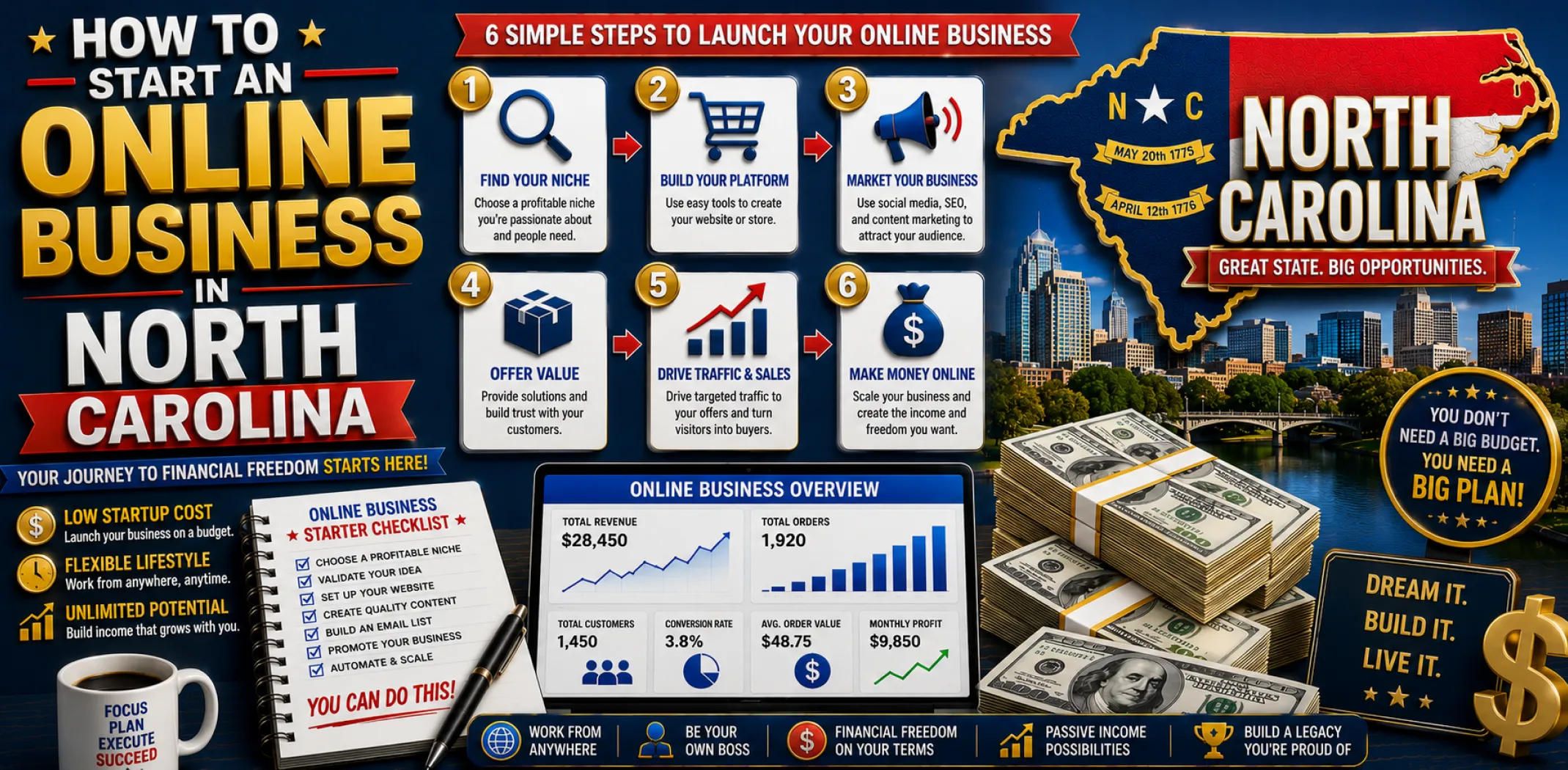
North Carolina is home to more than 10.7 million people, a growing tech corridor stretching from Raleigh to Durham, and a median household income of $74,000 – yet nearly one in five residents still feels the squeeze of a job market that does not pay enough to get ahead. If you have been Googling how to start an online business in North Carolina, you are not alone.
Every month, thousands of people across the Tar Heel State – from Charlotte suburbs to rural Appalachian counties – search for a way to earn money that works around their schedule, their family, and their life.
The good news is that starting an online business in North Carolina in 2026 is genuinely more accessible than it has ever been. You do not need a business degree, a tech background, or a lot of money to get started. What you need is the right model, honest information, and a clear first step.
Quick Answer: You can start an online business in North Carolina today with no upfront inventory, no coding skills, and no prior experience. The fastest path for complete beginners is a digital product store – a fully built online store that comes pre-loaded with products you can sell immediately. Platforms like Sellvia provide this as a free 14-day trial with no credit card required.
This guide covers everything a North Carolina resident needs to know – including the state’s registration requirements, real tax rates, honest earning expectations, and the most practical business models available right now. Whether you are looking to replace income, add a side income, or build something that lasts, this article gives you the real picture.
Why North Carolina is a good place to start an online business
North Carolina has quietly become one of the more interesting states for online entrepreneurs. The Research Triangle – anchored by Raleigh, Durham, and Chapel Hill – has drawn technology companies and remote workers from across the country, and that economic energy is spreading outward into smaller cities and towns. But you do not have to be in the Triangle to benefit from what is happening in the state’s digital economy.
Here are the numbers that matter most for anyone thinking about starting an online business in North Carolina:
- Population: 10.7 million residents, making North Carolina the 9th most populous state in the US.
- Median household income: $74,000 per year – about 9% below the national median, which means millions of North Carolina families are actively looking for ways to close that gap.
- Internet access: Approximately 76% of North Carolina households have home internet access. While this lags the national average slightly, smartphone adoption is high – meaning most residents can run an online business from their phone.
- Ecommerce growth: US ecommerce sales reached $1.23 trillion in 2025 – a 5.4% increase from 2024. North Carolina consumers are part of that trend, shopping online at rates that have risen sharply since 2020.
- Business-friendly tax environment: North Carolina has been steadily cutting its income tax rate – it stands at 4.25% for the 2025 tax year and is scheduled to drop to 3.99% in 2026, one of the lowest flat rates in the Southeast.
The practical takeaway is this: North Carolina has a large potential customer base, growing online activity, and a state tax structure that is becoming more favorable for small business owners every year. The conditions are right.
Best online business models for North Carolina residents
Not all online businesses are created equal – especially for someone starting with limited time, money, or tech experience. Here is an honest look at the most accessible models for North Carolina residents in 2026.
Digital product stores
A digital product store sells downloadable or deliverable items – guides, courses, checklists, tools, templates – that customers receive instantly after purchase. There is nothing to ship, no inventory to manage, and no warehouse involved. You earn 50–70% on every sale, and the products already exist – you do not have to create them yourself when you start with a platform like Sellvia.
Why this works in North Carolina in 2026: North Carolina has a wide range of people looking for practical information – home improvement guides, health and wellness resources, financial planning tools, parenting support. Digital products serve that demand without requiring local delivery or logistics. You can run this business from anywhere in the state, whether you are in Fayetteville or Franklin.
Earning potential: $30–$200/day with consistent marketing effort over 60–90 days, though results vary based on ad spend and consistency.
Freelancing
Freelancing means selling your skills – writing, design, bookkeeping, social media management, virtual assistance – directly to businesses or individuals. Platforms like Upwork and Fiverr connect you to clients across the country. There are no upfront costs, but your income is directly tied to your hours, which limits how far it can scale.
Why this works in North Carolina: Charlotte, Raleigh, and Asheville all have active small business communities that outsource tasks to remote workers. Rural North Carolina residents can access these same clients without leaving home.
Earning potential: $15–$75/hour depending on skill and experience. Hard to scale beyond one person’s available time.
Content creation
Building a YouTube channel, TikTok presence, or blog can generate advertising revenue and affiliate income over time. North Carolina’s outdoor scenery, food culture, and sports scene give content creators natural material to work with. The challenge is that meaningful income from content creation typically takes 12–18 months of consistent effort before it materializes.
Earning potential: $100–$3,000+/month once established, but slow to build and highly variable.
Affiliate marketing
Affiliate marketing involves promoting other companies’ products and earning a commission when someone buys through your link. It pairs well with a blog, social media presence, or email list.
The barrier to entry is low, but building an audience big enough to generate meaningful commissions takes time. Most beginners should treat this as a supplement to a primary income stream, not a replacement. If you want to explore how to start dropshipping in North Carolina as a comparison, that guide offers additional context on online selling models.
Earning potential: $50–$500/month is realistic for most beginners in the first year.
Online coaching and consulting
If you have professional expertise – in fitness, finance, career development, business, parenting, or any structured field – you can offer one-on-one coaching or group programs online. North Carolina’s diverse population creates demand for coaches across nearly every niche. The barrier here is confidence and packaging your knowledge into a sellable offer, which takes time but no upfront capital.
Earning potential: $500–$5,000+/month at scale, but most coaches take 6–12 months to build a sustainable client base.
Online tutoring
North Carolina’s large public school system and active college population create steady demand for tutors in math, reading, test prep, and foreign languages. Platforms like Wyzant and Tutor.com make it easy to find students. Like freelancing, tutoring income is time-limited – you earn when you are actively working.
Earning potential: $20–$60/hour depending on subject and experience level.
How to start an online business in North Carolina – step by step
Here is a practical walkthrough that applies regardless of which business model you choose. Skip any step that does not apply to your situation, but read all of them – knowing the full picture before you start saves a lot of headaches later.
Step 1: Choose your business model
The model you choose determines everything else – your startup costs, your time investment, how fast you can see income, and how much your business can grow. Be honest about your starting position: how many hours per week can you realistically dedicate? Do you have a skill to sell, or do you need a fully built starting point?
For North Carolina residents with no prior experience and limited time, a digital product store offers the fastest path from zero to first sale, because the products and the store are already built for you.
One note on choosing: Do not spend weeks researching and never start. Pick a model, commit to 90 days, and adjust based on real results – not theory.
Step 2: Register your business in North Carolina
You do not legally need to form a business entity on day one – many North Carolina residents operate as sole proprietors when they are just starting out. As a sole proprietor, you simply use your own Social Security Number for tax purposes and are not required to file any formation paperwork with the state. However, if you want liability protection and a professional business name, an LLC is the most common choice.
To form an LLC in North Carolina, you file Articles of Organization with the North Carolina Secretary of State and pay a $125 filing fee. Processing times for online submissions are generally faster than mail submissions. After formation, North Carolina LLCs must file an annual report by April 15 each year, with a $200 filing fee.
You can start the registration process at the official North Carolina Secretary of State Business Registration portal at sosnc.gov.
Important: Forming an LLC does not automatically register you for taxes. You will also need to obtain a federal EIN (free at IRS.gov) and register with the NC Department of Revenue if you will be collecting sales tax.
Step 3: Handle North Carolina taxes
North Carolina has a flat individual income tax rate of 4.25% for the 2025 tax year, dropping to 3.99% in 2026. As an online business owner, any profit you earn is subject to this rate, plus federal income tax.
North Carolina’s state sales tax rate is 4.75%, with local rates adding up to 2.75% depending on county – bringing the total combined rate to as high as 7.5% in some areas. For digital products – which is what Sellvia’s catalog consists of – you should verify your specific tax obligations with the NC Department of Revenue, as digital goods rules vary.
If your online business reaches $100,000 in gross sales to North Carolina customers in a calendar year, you must register and begin collecting North Carolina sales tax.
As a self-employed person, you are generally required to pay quarterly estimated taxes to both the IRS and the NC Department of Revenue. Set aside roughly 25–30% of your net business income to cover these obligations.
Key principle: Keep records from day one. A simple spreadsheet tracking income and expenses is enough at the start – you can upgrade to accounting software later.
Step 4: Set up your online presence
If you are building a digital product store with Sellvia, this step is handled for you – your store arrives fully built, with products already loaded and a payment system in place. You do not need to code anything, design anything, or source products. For other models like freelancing or coaching, your online presence is typically a simple profile on the relevant platform (Upwork, Wyzant, etc.) or a one-page website.
The single most common mistake at this stage is spending too much time on design and branding before you have made your first sale. Focus on getting something live, then improve it based on real customer feedback.
Step 5: Start marketing and making sales
For a digital product store, the most effective starting strategy is paid advertising – specifically the built-in one-click advertising system that platforms like Sellvia provide.
With a budget as low as $10–$50 per day, you can start reaching buyers without needing any prior marketing experience. Many Sellvia customers see their first orders on the same day they activate ads, though individual results vary based on niche, ad spend, and consistency.
For content-based businesses, organic methods – social media posts, YouTube videos, blog articles – are free but take longer to build momentum. Most successful online business owners use a combination of both, starting with paid ads for quick feedback and adding organic reach over time.
Tax and legal basics for North Carolina online businesses
Taxes and legal requirements are the part of starting a business that most people want to skip – but getting these basics right from the start protects you from problems later. Here is what North Carolina online business owners need to know.
State income tax
North Carolina taxes all income at a flat 4.25% for 2025. This applies whether your income comes from a job, a freelance project, or an online store. If your online business generates a profit, that profit is reported on your state return and taxed at this rate. The rate drops to 3.99% for the 2026 tax year, which is one of the lowest flat rates in the South.
Sales tax for online sellers
North Carolina’s base state sales tax rate is 4.75%. Most counties add between 2% and 2.75% in local tax, bringing the effective combined rate to 6.75%–7.5% depending on the customer’s location. North Carolina uses a destination-based system, meaning you charge the sales tax rate for the customer’s location, not your own.
If you sell entirely through a marketplace platform that collects and remits tax on your behalf (such as Amazon or Etsy), the platform handles sales tax compliance for those sales. If you sell through your own store, you are responsible for collecting and remitting once you exceed the $100,000 economic nexus threshold.
LLC vs sole proprietorship in North Carolina
A sole proprietorship is the default – if you start selling online without forming any entity, you are automatically a sole proprietor. There are no formation fees, no annual reports, and no paperwork. The downside is that your personal assets are not legally separated from your business.
An LLC costs $125 to form in North Carolina and requires a $200 annual report each year by April 15. In exchange, you get liability protection – your personal savings and property are generally shielded from business debts and lawsuits. Most North Carolina online business owners form an LLC once they are consistently generating income, not before.
Quarterly estimated taxes
If your online business generates more than $1,000 in profit per year above any withheld income, you are generally required to pay quarterly estimated taxes to the IRS and the NC Department of Revenue. Quarterly due dates are typically April 15, June 15, September 15, and January 15 of the following year. Missing these payments can result in penalties at tax time.
You can register your business with the NC Department of Revenue online at ncdor.gov.
See your state tax breakdown at a glance
Simply enter your annual net profit, select your state, and the calculator will instantly generate a detailed tax breakdown while showing how your state’s tax burden compares to others.
Resources for North Carolina entrepreneurs
You do not have to figure this out alone. North Carolina has a strong network of free and low-cost resources for new and growing business owners.
- SBA North Carolina District Office: The US Small Business Administration services all of North Carolina from offices in Charlotte and Wilmington, with satellite offices in Asheville and Raleigh. They offer help with SBA loans, business counseling, federal contracting certifications, and connections to local lenders. Visit sba.gov/district/north-carolina.
- NC SBTDC (Small Business and Technology Development Center): Operated through the UNC system, the SBTDC offers free one-on-one business counseling across 16 locations in North Carolina. Since 1984, it has helped more than 125,000 business owners make better decisions. Visit sbtdc.org.
- SCORE North Carolina: SCORE provides free mentoring from experienced business professionals. Chapters operate in Charlotte, Raleigh, Wilmington, Greensboro, and other cities. Mentoring is available in person and online. Visit score.org.
- NC Secretary of State Business Registration: The official portal for registering your LLC, searching business names, and filing annual reports. Visit sosnc.gov.
- NC Department of Revenue: For sales tax registration, income tax guidance, and online filing. Visit ncdor.gov.
Common challenges for North Carolina online business owners
Every online business faces obstacles. Here are the most common ones North Carolina residents encounter – and how to handle them.
Broadband gaps in rural areas
While urban areas like Charlotte and Raleigh have reliable, affordable internet access, rural North Carolina counties still face connectivity challenges. About 76% of NC households have home internet access – meaning roughly one in four does not.
If you are in a rural area with slow or unreliable home internet, consider building your business workflow around mobile data, or use local libraries, coffee shops, and community centers as backup options. Many successful online business owners started on a smartphone.
Practical solution: Sellvia’s platform is mobile-compatible. You can check orders, manage your store, and monitor ads from your phone – no laptop required.
Fear of being scammed
North Carolina residents who search for ways to earn money online are bombarded by genuinely deceptive offers. This makes it harder to recognize legitimate opportunities when they appear. The best way to counter this fear is to look for verifiable credentials, real customer data, and honest earning expectations – not promises of overnight income.
Sellvia is ranked among Inc. magazine’s 5,000 fastest-growing US companies (ranked #1818 in 2022), is a Forbes Communications Council member, and has helped launch more than 1.5 million stores. These are verifiable claims – not marketing language.
Practical solution: Always research before you invest. Start with platforms that offer a free trial with no credit card required, so you can verify the experience before committing a dollar.
Staying consistent during the slow early weeks
Most online businesses do not generate life-changing income in the first 30 days. The people who succeed are the ones who stay consistent during the early weeks when results are modest. Set a 90-day goal, track your actions (not just your outcomes), and do not compare your week three to someone else’s year two.
Practical solution: Start small and build. A $10/day ad budget on a Sellvia store is a real starting point – not a token gesture. It is enough to generate data, learn what is working, and build from there. Many Sellvia customers who start this way can keep more than 50% of every sale as profit.
If you want to explore how to start an online business in North Carolina for free, that guide covers the lowest-cost paths in detail.
Final thoughts
Starting an online business in North Carolina in 2026 is not complicated – but it does require choosing a direction and committing to it. The state gives you a fair tax environment, a large potential customer base, and a solid network of free support resources. What it cannot give you is momentum. That part is yours to create.
If you are a complete beginner with limited time and limited budget, a digital product store is the most practical starting point. The products are already there. The store is already built. The advertising system requires no marketing experience. What you bring is the decision to start.
If you have skills you want to monetize, freelancing or coaching can get you earning faster – but be honest about the ceiling. Time-based income does not scale on its own.
Whatever path you choose, start now rather than later. The income you want in 12 months depends on actions you take in the next 30 days. And if you want to explore other angles, the guide on how to start an online business in North Carolina for free breaks down the zero-cost starting options in detail.
Why Sellvia is a game-changer for your online store 🚀
Sellvia isn’t just another ecommerce tool. We are a trusted name in the industry, recognized by Forbes and even ranked in Inc.’s list of the 5,000 fastest-growing companies in the U.S. So if you’re serious about starting as a solopreneur, this is a smart place to begin.
Starting an online business can feel overwhelming, but that’s exactly where Sellvia steps in. It takes care of the tricky parts, so you can focus on making sales and growing your brand. Let’s break down what makes it such a great choice.
Get a ready-to-go store hassle-free 🎯
Want to start selling but don’t know where to begin? No worries! Just share your ideas, and Sellvia’s team will build a free ecommerce website that’s fully set up and ready to take orders from day one. No coding, no stress – just a store that works right out of the box.
1,000 digital products ready to sell from day one 🎁
Not sure what to sell? Sellvia solves that instantly. Your store comes pre-loaded with 1,000 ready-made digital products – guides, courses, checklists, and tools – all created by Sellvia. No writing, no recording, no product creation needed. Just pick your niche, and the products are already there waiting for your first customer.
A massive catalog of digital products to sell 🏆
One of the biggest struggles in starting an online business is figuring out what to sell. Sellvia solves that completely. Your store comes pre-loaded with digital products – guides, courses, checklists, and tools – all created by Sellvia. You keep 50–70% of every sale. No inventory. No shipping. No logistics headaches.
Everything in one easy-to-use platform 🔥
Managing an online store shouldn’t be complicated. With Sellvia, you can handle orders, add new products, and even chat with customers – all from a simple and user-friendly platform. No need to mess with confusing tools or deal with unnecessary tech stuff. It’s all smooth sailing.
No upfront costs, just start selling 💰
A big reason people hesitate to start an online business is the cost. But here’s the good news: With Sellvia, you don’t need to invest in stock, storage, or shipping supplies. You can run your store with no upfront costs, keeping things low-risk while still making money.
Support that’s always got your back 🤝
Running a business comes with questions, but you’re never alone. Sellvia’s dedicated support team is available 24/7 to help with anything you need. Whether it’s a small question or a big challenge, they’ve got you covered.
North Carolina residents who are ready to build something real now have a better starting point than ever before. Claim your free store with 1,000 digital products and start earning from the Tar Heel State today.
What is the best online business to start in North Carolina?
How much does it cost to start an online business in North Carolina?
Starting an online business in North Carolina can cost as little as zero dollars if you use a platform with a free trial. Formal business registration costs 125 dollars for an LLC filing with the North Carolina Secretary of State, plus a 200 dollar annual report fee due each April. If you operate as a sole proprietor without forming an LLC, there are no state formation fees. Many successful North Carolina online business owners start on a free trial, generate their first income, and then register the business once they have proof the model works.
Do I need a business license to sell online in North Carolina?
North Carolina does not require a statewide general business license. However, depending on your industry and location, you may need local permits from your city or county. If you sell taxable goods or services, you must register with the NC Department of Revenue for a sales tax permit, which is free to obtain. Most digital product sellers do not require any special license beyond standard tax registration. When in doubt, check with your local county government and the NC SBTDC for guidance specific to your business type.
Do I pay sales tax on online sales in North Carolina?
Yes, North Carolina has a state sales tax rate of 4.75%, with local additions bringing the combined rate to as high as 7.5% depending on the county. If your online business generates more than 100,000 dollars in gross sales to North Carolina customers in a calendar year, you are required to register and collect sales tax. If you sell through marketplace platforms that handle tax collection themselves, the platform is generally responsible for remitting sales tax on your behalf. The NC Department of Revenue website at ncdor.gov has full guidance.
Can I start an online business in North Carolina with no money?
Yes, it is possible to start an online business in North Carolina with very little upfront money. Platforms like Sellvia offer a free 14-day trial with no credit card required, giving you access to a fully built store and 1,000 digital products at no initial cost. Operating as a sole proprietor means no state formation fees. The main ongoing cost after the free trial is a monthly platform fee of 39 dollars and optional advertising. For most North Carolina residents, the total amount needed to start is well under 100 dollars for the first month.


