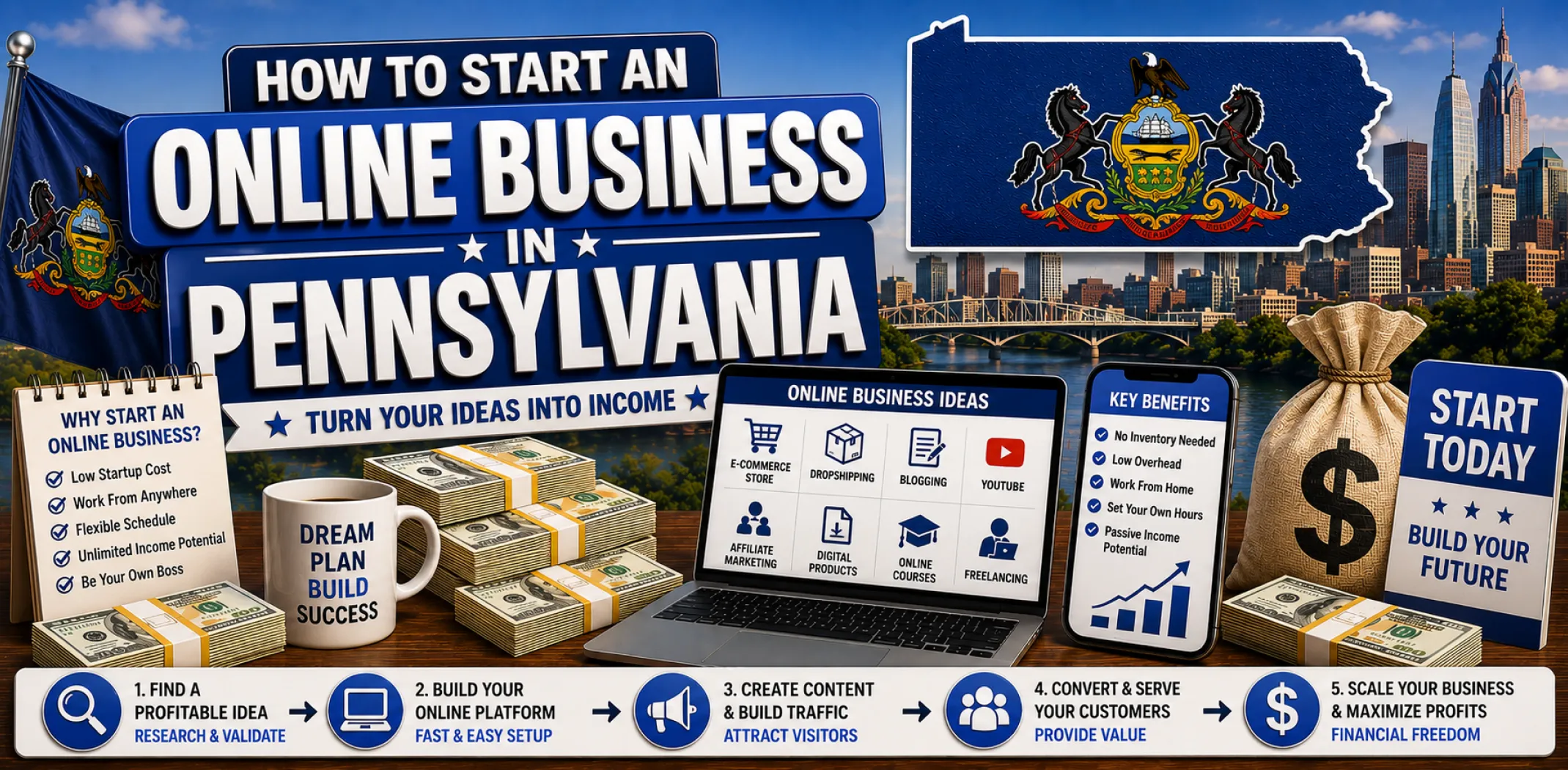
Pennsylvania has over 13 million residents, a median household income of $77,500, and more than 1.2 million small businesses already fueling the state’s economy. Yet for every person running a business here, there are thousands more asking the same question: how do I start an online business in Pennsylvania without needing a tech degree, a big budget, or years of experience?
The good news is that starting an online business in Pennsylvania is more achievable right now than at any point in history. Online retail is growing. Digital tools have removed nearly every technical barrier. And if you live in Pennsylvania – whether in Philadelphia, Pittsburgh, Erie, or a small town in the central part of the state – you already have everything you need to get started.
Quick Answer: You can start an online business in Pennsylvania in a matter of days. You do not need coding skills or prior business experience. The fastest path is selling digital products through a platform that builds and loads your store for you – so you can focus on making sales instead of building from scratch.
Why Pennsylvania is a good place to start an online business
Pennsylvania is the fifth most populated state in the country, home to roughly 13.1 million people as of the most recent Census estimates.
That population is spread across a mix of major cities, mid-size metros like Allentown and Harrisburg, and hundreds of smaller rural communities – many of which have seen manufacturing jobs shrink over the past two decades. For people in those communities, an online business is not just appealing – it is often the most realistic path to a real income boost.
The state median household income sits at $77,500 (2024 American Community Survey, US Census Bureau), which is about 5 percent below the national median. That gap matters.
It means a lot of Pennsylvania families are looking for ways to close the difference – and an online business with low startup costs is one of the few options that does not require leaving your town, going back to school, or picking up a third job.
On the internet access side, Pennsylvania has strong broadband infrastructure in urban and suburban areas, though rural coverage can vary by county. Nationally, home broadband adoption is around 77 percent among US adults (Pew Research, 2025). Pennsylvania tracks close to that figure, and even residents who only have a smartphone can run an online store – most modern platforms are fully mobile-compatible.
From an online retail standpoint, the numbers are moving in one direction. US retail ecommerce sales hit $1.19 trillion in 2024 and continued growing through 2025, accounting for over 16 percent of all US retail sales.
That means more than one in every six retail dollars is now being spent online – and that share keeps climbing. Pennsylvania consumers are part of that shift. Starting an online business in Pennsylvania means positioning yourself inside a market that is actively expanding.
Pennsylvania is also home to over 1.2 million small businesses, which together employ 2.5 million workers and account for 45.2 percent of all Pennsylvania employees (SBA Office of Advocacy, 2025). Small business is not a niche here – it is how this state runs. You would be joining a very large group of people who decided to build something of their own.
Best online business models for Pennsylvania residents
There is no single right way to start an online business in Pennsylvania. The best model depends on your time, skills, and starting budget. Here is an honest look at the most common options – including what each one actually requires and who each one suits best.
Digital product stores
A digital product store sells things like guides, courses, checklists, and tools that customers download or access instantly after purchase. There is nothing to pack, nothing to ship, and no inventory to manage. You set up your store once and it runs around the clock. Margins are high – often 50 to 70 percent per sale – because there are no physical goods involved.
Why this works in 2026: Demand for practical how-to guides, templates, and instructional content has grown alongside remote work and online learning. Pennsylvania residents in industries like healthcare, education, trades, and finance have existing knowledge that translates into digital products people will pay for.
Earning potential: $30 to $200+ per day with consistent promotion, depending on niche and ad spend. Results vary based on effort and consistency.
Freelancing
Freelancing means selling a skill – writing, design, web development, bookkeeping, social media management – on a project-by-project basis. It is a real option for people who already have a professional background and want to monetize it independently. Platforms like Upwork and Fiverr make it easier to find clients.
Why this works in 2026: Remote work has made Pennsylvania’s geographic location irrelevant for many service contracts. A freelancer in Scranton can serve a client in San Francisco.
Earning potential: $15 to $75 per hour depending on skill level and niche. Income is directly tied to hours worked, so scaling requires raising rates or adding clients.
Content creation
Content creators build audiences on platforms like YouTube, TikTok, Instagram, or a blog, then earn through advertising, sponsorships, or selling their own products. This is a legitimate model, but it takes time – typically 12 to 18 months of consistent posting before meaningful income appears. It suits people who enjoy being on camera or writing and have a specific topic they could cover for years.
Earning potential: Variable. Most small creators earn under $500/month. Larger channels can earn significantly more, but audience growth is slow and unpredictable.
Affiliate marketing
Affiliate marketers earn a commission by recommending other companies’ products and driving sales through unique links. It requires no inventory and no customer service, but it does require an existing audience – a blog, YouTube channel, or email list – to be effective. Building that audience takes months or years of upfront work with no guaranteed payoff.
Earning potential: $100 to $2,000 per month for mid-level affiliates with an established audience. Starting from zero can take 6 to 12 months before any meaningful income.
Online coaching and consulting
If you have professional expertise – in fitness, business, finance, career development, or another field – you can package that expertise into coaching sessions or consulting packages sold online. Platforms like Calendly and Zoom make delivery simple. The challenge is building the credibility and reputation needed to attract paying clients.
Earning potential: $50 to $300 per hour for experienced coaches. Income depends heavily on reputation and marketing.
Online tutoring
Pennsylvania has a strong educational tradition, and there is steady demand for tutors in K–12 subjects, SAT/ACT prep, college admissions coaching, and professional certification prep. Platforms like Wyzant and Tutor.com offer marketplaces, or you can build your own client base.
Earning potential: $20 to $80 per hour depending on subject and credentials. Scheduling constraints limit how many hours you can work per week.
For a deeper look at selling online from Pennsylvania, see our guide on how to start dropshipping in Pennsylvania – which covers the landscape of online selling models available to PA residents today.
How to start an online business in Pennsylvania – step by step
Here is a practical walkthrough of what it actually takes to get an online business running in Pennsylvania. Each step is something you can act on today.
Step 1: Choose your business model
Before you register anything or spend a dollar, decide what you are selling and how. If you are starting from scratch with no existing skills to sell or audience to monetize, a digital product store is the lowest-friction path.
You do not need to create the products yourself – platforms like Sellvia provide stores pre-loaded with 1,000 ready-made digital products. If you have a specific skill or professional background, freelancing or consulting may be a better fit. Be honest about your time, budget, and what you can realistically sustain for the first 90 days.
Step 2: Register your business in Pennsylvania
You have two main options for business structure in Pennsylvania: a sole proprietorship or a limited liability company (LLC).
A sole proprietorship requires no state filing. You can start selling under your own name immediately, though you may need a local business license depending on your municipality. If you use a business name different from your own, you will need to register a fictitious name (DBA) with the Pennsylvania Department of State for $70.
An LLC offers personal liability protection, which separates your personal assets from your business debts. Forming an LLC in Pennsylvania costs $125 for the Certificate of Organization, filed with the Pennsylvania Department of State.
Processing typically takes 7 to 14 business days for standard filings; online filings often process faster. Beginning in 2025, Pennsylvania requires all LLCs to file a simple annual report by September 30 each year – the fee is just $7.
Important: Veterans may be eligible to have LLC formation fees waived under Pennsylvania Act 135 of 2016. Check with the Department of State for eligibility details.
Register your business at the official Pennsylvania Department of State portal: file.dos.pa.gov. For SBA guidance specific to Pennsylvania, visit the SBA Pennsylvania District Office.
Step 3: Handle Pennsylvania taxes
Pennsylvania has a flat state income tax rate of 3.07 percent – one of the lowest flat rates in the country. That rate applies to all income, including your business earnings reported on your personal return. Most municipalities also collect a Local Earned Income Tax, typically 1 to 2 percent, though Philadelphia’s rate reaches 3.74 percent and some cities go higher.
Pennsylvania’s state sales tax is 6 percent. Allegheny County (Pittsburgh area) adds an additional 1 percent, and Philadelphia adds 2 percent – bringing those local totals to 7 percent and 8 percent respectively. Online sellers with more than $100,000 in annual gross sales to Pennsylvania customers are required to register, collect, and remit Pennsylvania sales tax.
Pennsylvania also has marketplace facilitator rules: if you sell through a qualifying platform that handles tax collection on your behalf, those sales may not count against your nexus threshold – but any direct sales you make always count.
Important note: Pennsylvania explicitly taxes digital products the same as tangible goods. If you sell digital downloads to Pennsylvania customers, sales tax rules apply once you meet the $100,000 threshold.
Most new online business owners are required to make estimated quarterly tax payments to both the IRS and the Pennsylvania Department of Revenue once business income begins. Keep records of all revenue and expenses from day one.
Step 4: Set up your online presence
You need a store – somewhere customers can find your products, browse, and check out. Options range from building on Shopify (which requires sourcing your own products and learning marketing from scratch) to using a platform that builds the store and fills it with products for you. For most Pennsylvania residents starting with no experience, the latter is the faster and lower-risk path.
Whatever platform you use, make sure your store is mobile-friendly. A significant share of online purchases are made on smartphones – and many Pennsylvania residents in smaller towns and rural communities rely primarily on mobile for internet access.
Step 5: Start marketing and making sales
Marketing does not have to be complicated when you are starting out. The most accessible options for new online business owners in Pennsylvania are paid social media ads (Facebook and Instagram), free organic content on TikTok or YouTube, and email marketing to people who opt in.
If your platform includes a built-in advertising system, use it – one-click ad setup removes the technical barrier entirely and gets your store in front of buyers without needing a marketing degree.
The key is consistency. Most stores that see their first sales within 30 days are the ones where the owner showed up every day – posting, adjusting, and learning. Stores that sit untouched after launch rarely produce results.
Tax and legal basics for Pennsylvania online businesses
Understanding your tax obligations in Pennsylvania is not optional – but it is also not as complicated as it sounds. Here is what you need to know as an online business owner in the state.
Pennsylvania income tax
Pennsylvania’s 3.07 percent flat income tax rate applies to your net business profits. Unlike the federal system, Pennsylvania does not have a standard deduction, but it does allow you to deduct legitimate business expenses from your gross income before calculating what you owe. Keep receipts and records for everything – platform fees, advertising costs, equipment, and any other business expense.
Retirement income – including Social Security and most pension income – is not taxed in Pennsylvania, which matters for older residents who are starting a side business on top of fixed income.
Sales tax for Pennsylvania online sellers
The $100,000 annual gross sales threshold is the number to watch. Once you exceed it in sales to Pennsylvania customers, you must register with the Pennsylvania Department of Revenue through myPATH at mypath.pa.gov and begin collecting the 6 percent state sales tax (plus applicable local rates). Sales tax returns are generally due the 20th of the month following the reporting period.
Key principle: Most new online businesses will not reach the $100,000 Pennsylvania threshold in their first year, so sales tax registration is usually not your immediate concern – but plan for it as you grow.
Business structure and liability
Sole proprietors have no liability protection – your personal assets are at risk if something goes wrong. An LLC separates your personal finances from your business, which is worth the $125 filing fee for most people who are serious about building a real income stream. Once your LLC is formed, register with the Pennsylvania Department of State’s Secretary of State office here: dos.pa.gov/BusinessCharities.
Estimated quarterly taxes
Once your online business starts generating meaningful income, the IRS and Pennsylvania Department of Revenue both expect estimated tax payments four times a year. Federal estimated taxes are due in April, June, September, and January.
Pennsylvania estimated payments follow a similar schedule. A reasonable rule of thumb: set aside 25 to 30 percent of your net income in a separate account from the day you start, so tax season does not come as a shock.
Resources for Pennsylvania entrepreneurs
Pennsylvania has a strong ecosystem of free and low-cost resources for new business owners. You do not have to figure this out alone.
Pennsylvania Small Business Development Centers (SBDC) – The statewide SBDC network has 15 locations across Pennsylvania, hosted at universities including Kutztown, Temple, Lehigh, University of Pittsburgh, Duquesne, and Penn State.
SBDCs offer free, confidential consulting to help you start and grow your business – covering everything from business planning and financing to marketing and legal compliance. Find your nearest center at pasbdc.org.
SCORE Pennsylvania – SCORE connects you with experienced volunteer business mentors at no cost. Mentoring sessions are available in person and online. Visit score.org/find-location to find your nearest chapter.
SBA Pennsylvania District Office – The US Small Business Administration’s Philadelphia district office serves Pennsylvania businesses with loan programs, training, and federal contracting resources. Visit sba.gov/offices/district/pa/philadelphia.
PA Business One-Stop Shop – Pennsylvania’s official starting point for new business owners. Covers registration, licensing, permits, and access to the statewide partner network. Visit business.pa.gov.
Common challenges for Pennsylvania online business owners
Starting an online business in Pennsylvania comes with real challenges. Here are the ones that trip people up most often – and how to handle them.
Inconsistent internet access in rural areas
Pennsylvania’s rural counties – particularly in the north-central and southwestern regions – can have slower or less reliable broadband. If your connection is unreliable, managing a store that depends on constant uploads, video content, or real-time advertising can feel frustrating.
The practical solution: use a platform with a simple mobile interface so you can manage your store from your phone when needed, and do your heavy-lift work (uploading content, adjusting ads) during peak connectivity hours. Selling digital products that are stored and delivered by your platform means your customers are never affected by your local internet speed.
Not knowing where to start with marketing
This is the most common reason new online business owners stall after setup. They have a store, they have products, and then they freeze because they do not know how to get people to see it. The honest answer: start small, stay consistent, and use every free tool available. Post on Facebook.
Share on TikTok. Ask your network to share. And if your store platform includes a built-in advertising tool with a manageable daily budget – even $10 to $20 per day – use it. Many Sellvia store owners see their first orders the same day they activate ads.
Fear of looking like a scam
Pennsylvania residents – like most Americans who have spent time online – are rightly skeptical of money-making claims. That skepticism can turn inward: “What if people think my store is a scam?” The answer is professionalism and transparency.
A well-built store with clear product descriptions, honest pricing, and responsive customer communication builds trust fast. If your platform includes a ready-built, professional-looking store from day one, that first-impression problem is already solved.
Final thoughts on starting an online business in Pennsylvania
Pennsylvania is a state full of people who work hard, know the value of a dollar, and are ready for something better. Whether you are a single parent in Allentown, a laid-off worker in Erie, a retiree in the Poconos, or someone in Pittsburgh who is tired of the 9-to-5 grind – the path to starting an online business in Pennsylvania is open to you right now.
Here is how to think about where you are starting from:
Complete beginner with no experience: Start with a digital product store on a platform that handles the technical setup for you. Your job in the first 30 days is to learn the platform and start marketing. Do not wait until everything feels perfect – launch first, improve as you go.
Part-time goal with an existing skill: Consider combining a digital product store with freelancing in your area of expertise. The store can generate income while you sleep; the freelancing provides reliable project-based revenue while your store grows.
Ready to go full-time: Treat it like a business from day one. Register your LLC ($125 in Pennsylvania), set up your accounting, track every dollar, and reinvest a portion of early earnings back into marketing. Build a real system, not just a side project.
For those who want to explore every option first, our guide on how to start an online business in Pennsylvania for free covers the lowest-cost paths available to PA residents today – including what “free” actually means in practice and where the costs are unavoidable.
Why Sellvia is a game-changer for your online store 🚀
Sellvia isn’t just another ecommerce tool. We are a trusted name in the industry, recognized by Forbes and even ranked in Inc.’s list of the 5,000 fastest-growing companies in the U.S. So if you’re serious about starting as a solopreneur, this is a smart place to begin.
Starting an online business can feel overwhelming, but that’s exactly where Sellvia steps in. It takes care of the tricky parts, so you can focus on making sales and growing your brand. Let’s break down what makes it such a great choice.
Get a ready-to-go store hassle-free 🎯
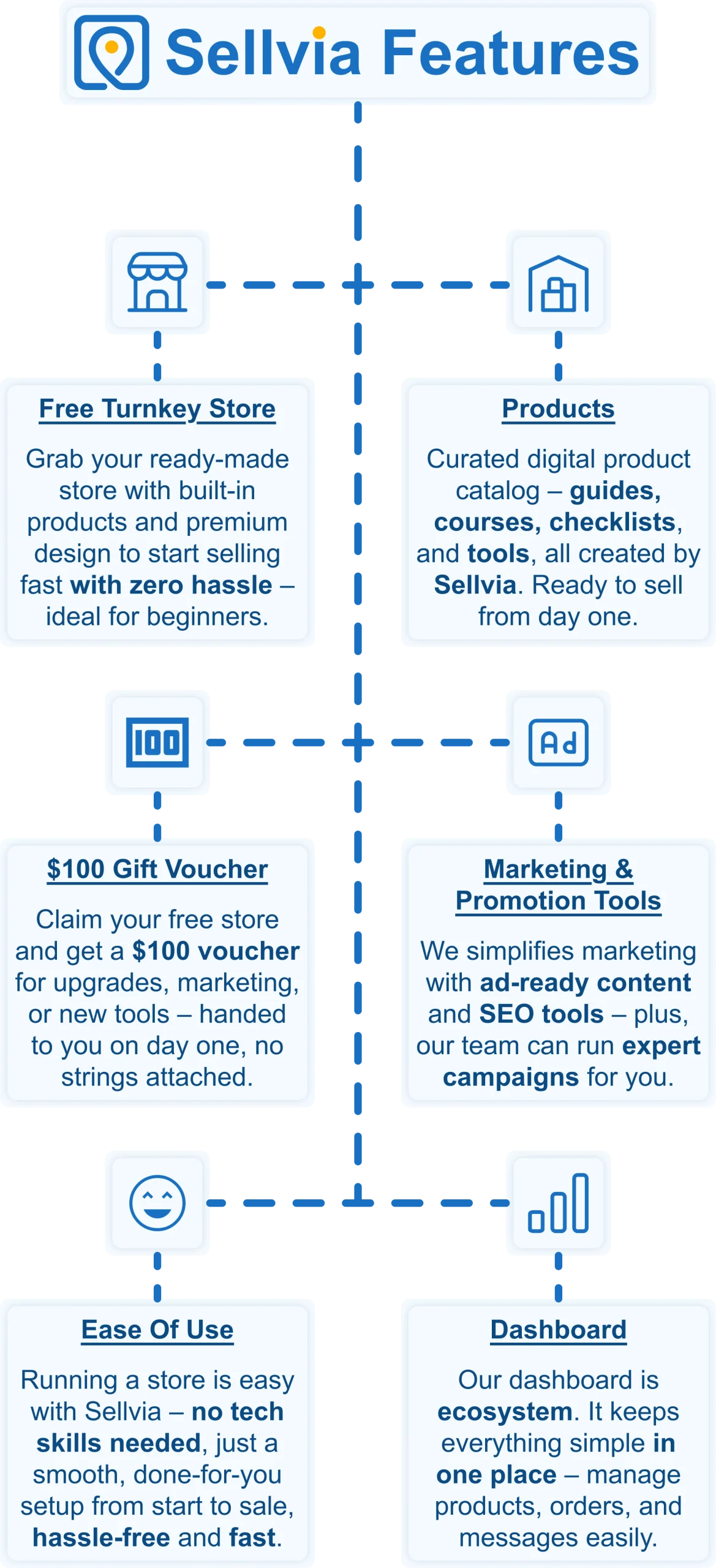
Want to start selling but don’t know where to begin? No worries! Just share your ideas, and Sellvia’s team will build a free ecommerce website that’s fully set up and ready to take orders from day one. No coding, no stress – just a store that works right out of the box.
1,000 digital products ready to sell from day one 🎁
Not sure what to sell? Sellvia solves that instantly. Your store comes pre-loaded with 1,000 ready-made digital products – guides, courses, checklists, and tools – all created by Sellvia. No writing, no recording, no product creation needed. Just pick your niche, and the products are already there waiting for your first customer.
A massive catalog of digital products to sell 🏆
One of the biggest struggles in starting an online business is figuring out what to sell. Sellvia solves that completely. Your store comes pre-loaded with digital products – guides, courses, checklists, and tools – all created by Sellvia. You keep 50–70% of every sale. No inventory. No shipping. No logistics headaches.
Everything in one easy-to-use platform 🔥
Managing an online store shouldn’t be complicated. With Sellvia, you can handle orders, add new products, and even chat with customers – all from a simple and user-friendly platform. No need to mess with confusing tools or deal with unnecessary tech stuff. It’s all smooth sailing.
No upfront costs, just start selling 💰
A big reason people hesitate to start an online business is the cost. But here’s the good news: With Sellvia, you don’t need to invest in stock, storage, or shipping supplies. You can run your store with no upfront costs, keeping things low-risk while still making money.
Support that’s always got your back 🤝
Running a business comes with questions, but you’re never alone. Sellvia’s dedicated support team is available 24/7 to help with anything you need. Whether it’s a small question or a big challenge, they’ve got you covered.
Pennsylvania has everything it takes to support a thriving online business – the people, the market, and the drive. Get your free store with 1,000 digital products and start building something real.
Do I need a business license to sell online in Pennsylvania?
How much does it cost to start an online business in Pennsylvania?
The minimum startup cost depends on your structure. A sole proprietorship can technically start for zero dollars in state fees, though a fictitious name filing costs 70 dollars. Forming an LLC in Pennsylvania costs 125 dollars for the Certificate of Organization plus a 7 dollar annual report starting in 2025. Add advertising costs and you could realistically launch a digital product store in Pennsylvania for under 200 dollars in the first month.
What is the best online business to start in Pennsylvania?
For beginners with no prior experience, a digital product store is widely considered the best online business to start in Pennsylvania in 2026. It requires no product creation, no shipping, and no technical skills – the store is built and loaded for you. Other strong options include freelancing if you have a marketable skill, online tutoring, and content creation, though those take longer to generate consistent income.
Do I pay sales tax on online sales in Pennsylvania?
Yes, if your online business generates more than 100,000 dollars in annual gross sales to Pennsylvania customers, you are required to register, collect, and remit Pennsylvania sales tax at the standard 6 percent statewide rate. Allegheny County adds 1 percent and Philadelphia adds 2 percent on top of that. Pennsylvania also treats digital products as taxable goods, so those rules apply to digital sales as well. Most new business owners will not hit the threshold in year one.
Can I start an online business in Pennsylvania with no money?
Yes, it is possible to start an online business in Pennsylvania with very little money, especially if you use a platform that provides your store and products for free at the start. A free trial eliminates most upfront costs – no inventory, no coding, no design fees. The unavoidable costs in Pennsylvania are the optional LLC formation at 125 dollars and any local permit fees, which you can delay until your business starts generating income. Many Pennsylvania residents have launched stores with under 50 dollars in their pocket.


