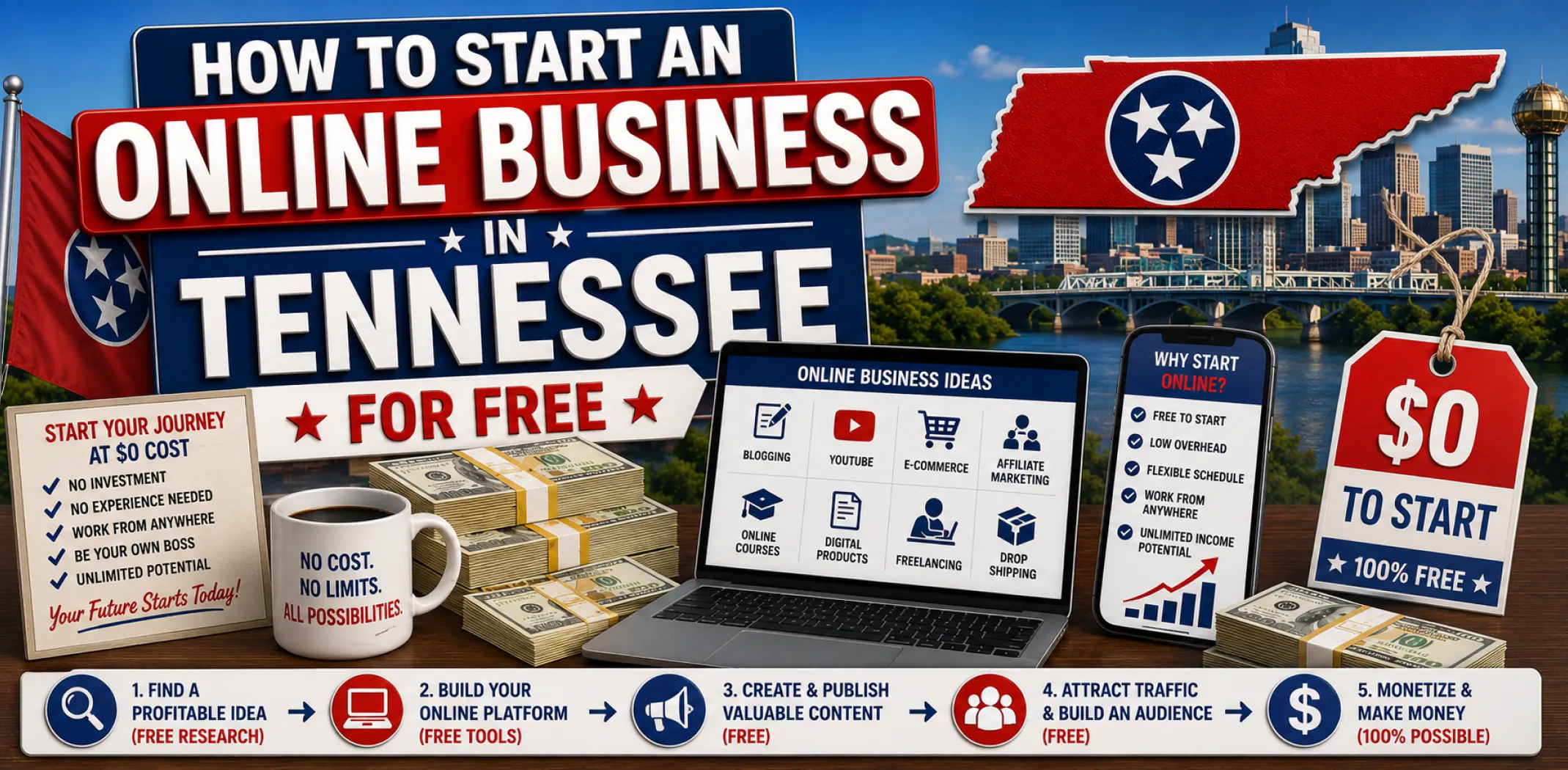
Most articles about starting a free online business in Tennessee will tell you it is easy, costs nothing, and anyone can do it. That is not the whole truth – and if you have been burned by that kind of content before, you already know it.
This article is different. We are going to be honest with you about what “free” actually means when it comes to starting an online business in Tennessee – which costs are genuinely zero, which ones are small but unavoidable, and where the realistic starting point is for someone without a lot of money to invest.
We will also show you the models that come closest to truly free, and the one option that gives you the most complete starting point for the least money.
Quick Answer: Yes, you can start an online business in Tennessee for free – or very close to it. Some models like freelancing and affiliate marketing cost nothing to begin. A digital product store through Sellvia starts with a free 14-day trial (no credit card required) and gives you a fully built store with 1,000 ready-made products. The one cost you cannot avoid is Tennessee’s business registration if you choose to formalize your business – but that is optional when you are just starting out.
Can you really start an online business for free in Tennessee?
The short answer is yes – but “free” means different things depending on what you are building and how seriously you take it. Let us break this down honestly, because the nuance matters for your decision.
Some things are genuinely free. Creating a profile on Upwork or Fiverr to offer freelance services costs nothing. Starting a TikTok or Instagram account to build an audience costs nothing. Signing up for a Sellvia free trial to launch a digital product store costs nothing upfront. These are real zero-cost starting points – not tricks.
Some costs are small but real. If you want to operate your online business under a name other than your own legal name in Tennessee, you need to file a DBA (Doing Business As) with your county clerk’s office. That typically costs $10–$25 depending on the county.
If you want the legal protection of an LLC, Tennessee’s state filing fee is $300 for a single-member LLC – with an annual report fee of $300/year after that. These are not required to start, but they become relevant as your business grows.
Some costs are unavoidable no matter what. Payment processors like Stripe and PayPal charge a percentage fee on every transaction – typically 2.9% plus $0.30 per sale. You cannot avoid this if you want to accept money online. It is not a startup cost, though – it only applies once you are actually making sales.
The honest version of “free” for most Tennessee residents starting an online business looks like this: zero upfront cost to start, small optional costs to formalize the business, and percentage-based fees once income starts flowing. That is a genuinely accessible starting point – especially compared to a traditional brick-and-mortar business that might require $10,000 or more just to open the doors.
Tennessee gives you one major financial advantage that residents in most states do not have: no state income tax. Whether you earn $500 a month or $5,000 a month from your online business, none of it is subject to Tennessee income tax. That means more of what you earn stays with you from day one.
What “free” actually covers – and what it does not
Let us go category by category so you have a clear picture before you commit to anything.
Business registration
Operating as a sole proprietor under your own legal name in Tennessee requires no formal state registration. You can start earning money online today without filing a single piece of paperwork – legally. If you use a business name that is different from your own name, a DBA filing with your county clerk costs $10–$25.
If you eventually want an LLC for liability protection and credibility, the Tennessee Secretary of State charges $300 to form a single-member LLC, plus a $300 annual report fee every year. You can file at sos.tn.gov/businesses. This is not a “free” cost – but it is a “later” cost. You do not need to form an LLC before you make your first dollar.
Important note: If your business sells taxable goods or services in Tennessee, you will eventually need to register for a sales tax account with the Tennessee Department of Revenue – but that registration itself is free at tn.gov/revenue.
Tools and platforms
The good news here is that most of what you need to run a basic online business is genuinely available for free, at least to start:
- Store platform: Sellvia’s free 14-day trial gives you a fully built store with 1,000 ready-made digital products – no credit card required. After the trial, it is $39/month.
- Design: Canva’s free tier covers everything a beginner needs – social media graphics, simple ads, product images.
- Email marketing: Mailchimp’s free plan supports up to 500 contacts and 1,000 emails/month – enough to get started building a list.
- Analytics: Google Analytics is free and gives you everything you need to understand your traffic.
- Social scheduling: Buffer’s free plan allows 3 channels and 10 scheduled posts per channel.
The honest limitation: free tiers have caps. As your business grows, you will hit the limits of free tools and need to upgrade. But at the start – when you are learning and testing – free tools are genuinely sufficient.
Marketing
Organic marketing – posting consistently on social media, creating short-form video content, writing blog posts, or building an email list – costs nothing except time. It is a real, viable path to traffic and sales. The honest caveat is that organic growth is slow. Most people building an audience from zero on social media see meaningful traction after 3–6 months of consistent posting, not 3–6 days.
Paid advertising accelerates this significantly. Sellvia’s built-in advertising system lets you activate ads with one click, and many customers who do so see their first orders on day one – though results vary based on niche, daily budget, and consistency. A $10–$20/day ad budget is not “free,” but it is a small, controllable cost that most people can manage once they have decided they are serious about growing.
Payment processing
This is the one cost that is truly unavoidable for any online business: payment processors charge a percentage of every sale. Stripe charges 2.9% plus $0.30 per transaction. PayPal charges similar rates. These fees come out of your revenue, not your pocket upfront – but they need to be factored into your pricing so you are not surprised when your payout is slightly less than the sale price.
Free or near-zero online business models for Tennessee residents
These are the models that come closest to a true zero-cost start for Tennessee residents. Each one has an honest profile – what it requires, what it can realistically earn, and who it suits best.
Freelancing
If you have a skill that other people or businesses need – writing, graphic design, bookkeeping, virtual assistance, video editing, social media management, web design – you can offer it as a service online for free. Platforms like Upwork and Fiverr have no signup fee, and you can have a profile live within an hour.
The barrier is lower than most people think. You do not need a portfolio of 10 clients to get started – you need one example of your work, a clear description of what you do, and the willingness to take on a first project at a competitive rate to build your reviews.
Earning potential: $300–$2,000/month within 60–90 days for someone with a marketable skill who applies consistently. Higher for specialized skills like web development or copywriting.
Honest limitation: You are trading time for money. Freelancing does not scale beyond the hours you are willing to work, and income stops when you stop working. It is a great starting point, but not a long-term scalable model on its own.
Affiliate marketing
Affiliate marketing means promoting other companies’ products and earning a commission when someone buys through your referral link. You do not handle the product, the fulfillment, or the customer service. You just drive traffic.
The startup cost is essentially zero – you can start with a free blog on platforms like WordPress.com, a free social media account, or a free YouTube channel. Most affiliate programs are also free to join.
Earning potential: Near zero for the first 3–6 months while you build traffic. $200–$1,500/month for established affiliate marketers with consistent content output over 12+ months.
Honest limitation: This is one of the slowest paths to income. It requires significant content output before you see results, and most people underestimate how long “building an audience” actually takes.
Content creation
Building a YouTube channel, TikTok account, or blog around a topic you know well can eventually earn through advertising revenue, sponsorships, and affiliate commissions. Tennessee offers rich content angles – music and Nashville culture, outdoor life in the Smokies, college sports, Southern food, rural homesteading.
Earning potential: Near zero for the first 6–12 months. $500–$5,000+/month for established creators with consistent audiences. YouTube requires 1,000 subscribers and 4,000 watch hours before you can monetize – a threshold that typically takes 6–18 months for new creators.
Honest limitation: Content creation is the longest runway of any model here. It is best approached as a long-term strategy alongside a shorter-term income source.
Digital product store
A digital product store sells guides, courses, checklists, templates, and tools – all delivered instantly online, with no shipping, no inventory, and no fulfillment. The customer pays, the file downloads automatically, and you keep 50–70% of every sale.
The biggest challenge with this model is normally figuring out what to sell and then creating those products. Sellvia removes both of those barriers entirely. Your store comes pre-loaded with 1,000 ready-made digital products, so you are not starting from a blank page.
The free 14-day trial (no credit card required) means you can launch a fully built store today, test it with the included $40 advertising credit, and see real results before you pay a single dollar.
If you want a full breakdown of the models, costs, and step-by-step process for how to start an online business in Tennessee, that guide covers everything in detail.
Earning potential: $30–$150/day with consistent effort and a modest ad budget over 60–90 days – though results vary based on niche, ad spend, and consistency.
Online tutoring
If you have subject-matter expertise – math, science, English, test prep, music, a foreign language – you can offer tutoring sessions online through platforms like Wyzant, Tutor.com, or directly via Zoom. Most platforms are free to join and take a percentage of your earnings rather than charging upfront fees.
Tennessee’s strong emphasis on education and the broad geographic spread of students across rural areas – where in-person tutoring access is limited – make online tutoring a real opportunity for qualified Tennessee residents.
Earning potential: $15–$60/hour depending on subject and experience. $500–$2,000/month for part-time tutors with a consistent client base.
Free tools to get started
Here is a practical, category-by-category list of tools that are genuinely free at the level a new Tennessee online business owner needs them.
Store platform: Sellvia’s free 14-day trial – a fully built store with 1,000 ready-made digital products, a built-in advertising system, and 24/7 support. No credit card required. After the trial: $39/month.
Design: Canva (free tier) – social media graphics, simple ad creatives, product mockups, and basic branding. The free version handles everything a beginner needs without paying for the Pro plan.
Email marketing: Mailchimp (free up to 500 contacts, 1,000 emails/month) – sufficient for building and emailing your first list while your business is getting started.
Social media scheduling: Buffer (free for up to 3 channels, 10 scheduled posts per channel) – schedule your social posts in advance so you are not manually posting every day.
Analytics: Google Analytics (free) – tracks who visits your site, where they come from, and what they do when they get there. Essential for understanding what is working.
Video creation: CapCut (free) – if you are creating short-form video content for TikTok, Instagram Reels, or YouTube Shorts, CapCut’s free version is a capable editor that requires no prior video editing experience.
Payments: Stripe and PayPal both have no monthly fee – you only pay per transaction (approximately 2.9% + $0.30 per sale). Both integrate with Sellvia stores.
Pro Tip: Start with the minimum number of tools you actually need. The biggest time-waster for new online business owners is learning five new platforms at once instead of focusing on getting their first sale.
Free Tennessee-specific resources
Tennessee has a solid network of free business support that most new online business owners never use. These are real, accessible resources – not theoretical.
Tennessee Small Business Development Centers (TSBDC): Free one-on-one business advising, market research support, and workshops across Tennessee. Locations in Nashville, Memphis, Knoxville, Chattanooga, Jackson, and more. Visit tsbdc.org to find your nearest center and schedule a free appointment.
SCORE: Free mentoring from experienced business professionals, available in-person and online. Tennessee chapters include Nashville and Memphis. A mentor can help you think through your business model, pricing, and early marketing strategy at no cost. Visit score.org to find a mentor.
SBA Tennessee District Office: Free resources including workshops, loan program information, and access to SBA-backed support. Based in Nashville. Visit sba.gov/offices/district/tn/nashville.
LaunchTN: Tennessee’s state-supported entrepreneurship initiative connects business owners with mentors, events, and a statewide network of resources. Visit launchtn.org.
IRS VITA Program: Volunteer Income Tax Assistance provides free tax preparation help for people who generally make $67,000 or less. Multiple Tennessee locations. For a new online business owner navigating self-employment taxes for the first time, a VITA volunteer can be genuinely helpful. Find locations at irs.gov/vita.
Tennessee Secretary of State – Business Services: Free business name search, online LLC filing portal, and business registration guidance at sos.tn.gov/businesses.
Tennessee small business grants: The Tennessee Department of Economic and Community Development periodically offers grant programs for small businesses, particularly in rural and economically distressed counties. Programs change regularly – check tn.gov/ecd for current offerings. The TSBDC advisors can also help you identify any grants you may qualify for.
Realistic timeline – what “free” leads to in 30, 60, and 90 days
This is the section most articles skip – because the honest answer is less exciting than “make money on day one.” We are going to give you the real picture, because setting the right expectations is what keeps people from quitting too early.
By day 30 with consistent effort: If you started with a Sellvia free trial and activated the built-in advertising system, you may have seen your first sales – especially if you chose a niche with strong demand and spent time learning what your ads respond to.
If you started with freelancing, you have likely landed one or two small projects and are building your first reviews. If you started with content creation or affiliate marketing, you are still in the building phase – do not expect revenue yet. Your “win” at day 30 is momentum, not income.
By day 60 with consistent effort: A Sellvia store owner who has been refining their ads and product selection is typically seeing more consistent order flow. Freelancers with good early reviews are starting to get repeat clients or inbound requests.
Content creators are starting to understand what resonates with their audience, even if monetization is not yet active. At day 60, patterns start to emerge – you can see what is working and what needs to change.
By day 90 with consistent effort: This is where the models start to diverge meaningfully. A digital product store owner who has been consistent with marketing – even on a small budget – can be generating $30–$100/day in revenue, though results vary based on niche, ad spend, and effort.
A freelancer with a few solid reviews and a specialty can be earning $1,000–$2,000/month in consistent project work. Content creators are still building – 90 days is not enough for most people to see monetization, but it is enough to have a real audience foundation. Affiliate marketers are in a similar position.
Important: “Free” almost always means slower growth. Paid advertising compresses the timeline significantly for store-based models. If your goal is income within 30–60 days and you have even $10–$20/day available for ads after the free trial, that investment accelerates results more than almost anything else you can do.
Common myths about starting a free online business
A few things circulate endlessly in this space that are simply not true. Here is the honest version.
Myth 1: “Free means no work”
Zero upfront cost does not mean zero effort. Every model on this list requires consistent time investment – whether that is learning a platform, creating content, building client relationships, or running and optimizing ads. “Free to start” and “easy to earn from” are two very different things. Anyone who tells you otherwise is selling something.
Myth 2: “You need a website to start”
You do not. Freelancers can start on Upwork or Fiverr with no personal website. Affiliate marketers can start on social media or YouTube. A Sellvia store gives you a complete storefront without building a website from scratch. A personal website is useful eventually – but it is not a prerequisite for your first dollar.
Myth 3: “Free tools are good enough long-term”
Free tools are good enough to get started and to test whether a model works for you. They are not designed to scale a serious business. As your income grows, upgrading your tools – better email marketing, better analytics, a paid advertising budget – is what allows you to grow further. Think of free tools as the runway, not the destination.
Myth 4: “If it’s free to start, there’s nothing to lose”
There is always something to lose: your time. Starting and abandoning five different “free” business ideas over two years is not actually free – it costs you two years of progress you could have made by committing to one model and giving it a real chance. The most expensive thing most people do is start over repeatedly instead of staying consistent long enough to see results.
See your state tax breakdown at a glance
Simply enter your annual net profit, select your state, and the calculator will instantly generate a detailed tax breakdown while showing how your state’s tax burden compares to others.
Why Sellvia is a game-changer for your online store 🚀
Sellvia isn’t just another ecommerce tool. We are a trusted name in the industry, recognized by Forbes and even ranked in Inc.’s list of the 5,000 fastest-growing companies in the U.S. So if you’re serious about starting as a solopreneur, this is a smart place to begin.
Starting an online business can feel overwhelming, but that’s exactly where Sellvia steps in. It takes care of the tricky parts, so you can focus on making sales and growing your brand. Let’s break down what makes it such a great choice.
Get a ready-to-go store hassle-free 🎯
Want to start selling but don’t know where to begin? No worries! Just share your ideas, and Sellvia’s team will build a free ecommerce website that’s fully set up and ready to take orders from day one. No coding, no stress – just a store that works right out of the box.
1,000 digital products ready to sell from day one 🎁
Not sure what to sell? Sellvia solves that instantly. Your store comes pre-loaded with 1,000 ready-made digital products – guides, courses, checklists, and tools – all created by Sellvia. No writing, no recording, no product creation needed. Just pick your niche, and the products are already there waiting for your first customer.
A massive catalog of digital products to sell 🏆
One of the biggest struggles in starting an online business is figuring out what to sell. Sellvia solves that completely. Your store comes pre-loaded with digital products – guides, courses, checklists, and tools – all created by Sellvia. You keep 50–70% of every sale. No inventory. No shipping. No logistics headaches.
Everything in one easy-to-use platform 🔥
Managing an online store shouldn’t be complicated. With Sellvia, you can handle orders, add new products, and even chat with customers – all from a simple and user-friendly platform. No need to mess with confusing tools or deal with unnecessary tech stuff. It’s all smooth sailing.
No upfront costs, just start selling 💰
A big reason people hesitate to start an online business is the cost. But here’s the good news: With Sellvia, you don’t need to invest in stock, storage, or shipping supplies. You can run your store with no upfront costs, keeping things low-risk while still making money.
Support that’s always got your back 🤝
Running a business comes with questions, but you’re never alone. Sellvia’s dedicated support team is available 24/7 to help with anything you need. Whether it’s a small question or a big challenge, they’ve got you covered.
Tennessee’s no-income-tax advantage means every dollar your free online business earns goes further here than in almost any other state. Start your free Sellvia store today and put 1,000 ready-made digital products to work for you.
Can I really start an online business in Tennessee with no money?
What is the cheapest business to start in Tennessee?
The cheapest online businesses to start in Tennessee are freelancing, affiliate marketing, and a digital product store trial. Freelancing requires only a free profile on Upwork or Fiverr and costs nothing to start. A Sellvia digital product store starts with a free 14-day trial and includes 1,000 ready-made products. If you choose to formalize your business later, a sole proprietorship requires no state filing fee in Tennessee, and a county DBA registration costs 10 to 25 dollars. Forming an LLC costs 300 dollars in state filing fees, but that step is optional when you are just getting started.
Do I need to register a free online business in Tennessee?
No formal registration is required to start earning money online as a sole proprietor under your own legal name in Tennessee. If you operate under a business name, a DBA filing with your county clerk costs 10 to 25 dollars. If you eventually sell taxable goods or services, you will need to register for a free sales tax account with the Tennessee Department of Revenue at tn.gov/revenue. Forming an LLC provides liability protection and costs 300 dollars to file with the Tennessee Secretary of State, but it is not required before you make your first sale.
What free tools do I need to start an online business in Tennessee?
The core free tools for a new Tennessee online business owner are Canva for design, Mailchimp for email marketing up to 500 contacts, Buffer for social media scheduling across 3 channels, and Google Analytics for tracking website traffic. Sellvia provides a free 14-day trial that includes a fully built store with 1,000 ready-made digital products and a built-in advertising system. Payment processors like Stripe and PayPal have no monthly fee and only charge a percentage per transaction, so they are effectively free until you are actively making sales.
How long does it take to make money from a free online business in Tennessee?
The timeline depends heavily on the model you choose and how consistently you work at it. A Sellvia store owner who activates the built-in advertising system can see their first orders within the first few days of the trial, though consistent daily earnings typically develop over 60 to 90 days of effort. Freelancers with a marketable skill often see their first paid project within 2 to 4 weeks. Affiliate marketing and content creation are the slowest paths, often taking 6 to 12 months before generating meaningful income. Free models without any ad spend typically take 2 to 3 times longer than those that combine organic and paid marketing.


