Vermont is a beautiful state – but it is not an easy place to make a living. With a population of just over 647,000 and a job market that leans heavily on tourism, healthcare, and agriculture, many Vermonters are looking for a way to earn income that does not depend on the local economy.
If you have been searching for how to start an online business in Vermont, you are not alone – and this guide will give you a straight answer.
You do not need a business degree. You do not need tech skills. And you do not need a big budget. What you do need is a clear picture of what works, what it costs, and how to get started without throwing money at the wrong things.
Quick Answer: You can start an online business in Vermont today with as little as $0 upfront using a free trial. The most accessible starting point for beginners is selling digital products through a ready-built online store – no inventory, no shipping, no technical setup required. Vermont has no special restrictions on online businesses, and you can operate as a sole proprietor with minimal paperwork to start.
Why Vermont is a good place to start an online business
Vermont may be small, but it punches above its weight when it comes to online opportunity.
The state has one of the highest broadband adoption rates in New England – approximately 87% of Vermont households have internet access, and the state has invested heavily in expanding high-speed connectivity to rural areas through the Vermont Community Broadband Board.
That means even if you live in Caledonia County or the Northeast Kingdom, you can run a real online business from home.
Vermont’s median household income sits at around $67,600 according to the U.S. Census Bureau – slightly below the national median of roughly $74,500. For many Vermonters, that gap is felt every month.
Heating bills, housing costs, and the general expense of living in a rural state with limited local employment options make a supplemental or replacement income stream genuinely necessary, not just nice to have.
The state’s ecommerce picture is growing. Vermont consumers increasingly shop online, particularly in rural areas where driving 45 minutes to the nearest retailer is a regular reality. That same consumer behavior translates to opportunity: Vermonters understand online commerce because they use it every day.
And nationally, digital product sales have grown sharply – the global e-learning and digital content market is projected to exceed $400 billion by 2026, which means the products you sell online are in demand right now.
Vermont also has a strong culture of independent work and entrepreneurship. The state ranks consistently high for small business ownership per capita. Starting something of your own is not unusual here – it is almost expected.
One more thing worth noting: Vermont has no special licensing requirements for most online businesses, and sole proprietorships can begin operating immediately. If you are selling digital products – guides, courses, tools, checklists – you are not dealing with inventory, storage, or shipping logistics. The barrier to entry is genuinely low if you pick the right model from the start.
Best online business models for Vermont residents
Not all online business models are created equal – especially for someone just starting out. Here is an honest look at the options that work well for Vermont residents, including what each one requires and what you can realistically expect.
Digital product stores
A digital product store sells things like guides, courses, checklists, templates, and online tools. The buyer pays, the product is delivered instantly, and you keep 50–70% of the sale price. There is no inventory to manage, no shipping to arrange, and no physical space required. This model works especially well for Vermonters who want to run a business from home without dealing with logistics.
Platforms like Sellvia take this a step further – they build the store for you and load it with 1,000 ready-made products, so you are not starting from scratch. If you want to know more about the free path into this model, see our guide on how to start an online business in Vermont for free.
Earning potential: $500–$3,000/month with consistent promotion over 60–90 days. Results vary based on effort and ad spend.
Why this works in 2026: Digital products have zero delivery cost and instant fulfillment – the margin stays with you, not with a supplier or shipping company.
Freelancing
If you have a skill – writing, graphic design, bookkeeping, web development, social media management – freelancing lets you sell that skill to clients online. Platforms like Upwork, Fiverr, and LinkedIn make it easier to find work without cold calling. The upside is low startup cost. The downside is that your income is tied directly to your hours – if you stop working, income stops too.
Freelancing is a solid starting point if you already have a marketable skill, but it has a ceiling. Many Vermont freelancers eventually look for ways to build income that scales beyond their personal time.
Earning potential: $20–$75/hour depending on skill and experience, with full-time equivalent income possible after 3–6 months of consistent client building.
Content creation
YouTube, TikTok, Instagram, and blogging can all generate income through ads, sponsorships, and affiliate links. The appeal is real – some creators earn significant income from Vermont-focused content like outdoor life, local food, or rural living. The reality is that content creation typically takes 12–18 months of consistent work before meaningful income appears. It is a long game, not a quick win.
Earning potential: $0–$500/month in the first year for most creators; significantly higher for those who build a following over time.
Affiliate marketing
Affiliate marketing means promoting someone else’s products and earning a commission on each sale you refer. You do not need to create or stock anything – just drive traffic to a link. The challenge is that commissions are typically 5–20%, so you need meaningful volume to see real income. It works best when paired with an established audience or content platform.
Earning potential: $100–$800/month for consistent part-time effort once an audience is established.
Online coaching and consulting
Vermont has a high concentration of professionals in healthcare, education, and environmental services. If you have expertise in any field, coaching or consulting online can be a strong income source. Platforms like Calendly and Zoom make the logistics simple. The startup cost is low, and rates for experienced consultants can be substantial. Like freelancing, though, this model is time-dependent.
Earning potential: $75–$200/hour for established consultants; typically 3–6 months to build a steady client base.
Online tutoring
Vermont’s education sector is strong, and online tutoring is in consistent demand – especially for test prep, language learning, and K–12 support. Platforms like Wyzant and Tutor.com connect tutors with students nationwide. If you have a subject area strength, this is one of the faster ways to earn online income without building anything from scratch.
Earning potential: $25–$80/hour depending on subject and level.
If you are exploring the broader landscape, our guide to how to start dropshipping in Vermont covers online selling models in more detail, including how digital products compare to physical product models on cost and complexity.
How to start an online business in Vermont – step by step
Once you know your model, the path forward is more straightforward than most people expect. Here is a practical step-by-step guide built specifically for Vermont residents.
Step 1: Choose your business model
Before you register anything or spend a dollar, decide what you are actually selling. If you are starting with no experience, no product ideas, and limited time, a digital product store is the lowest-barrier entry point – you do not need to create anything, and your store can be live in days. If you have a specific skill or audience already, freelancing or consulting may be a faster path to your first dollar.
The most important thing at this stage is picking one model and going with it. Trying to do everything at once is a reliable way to do nothing well.
Step 2: Register your business in Vermont
You have two main options for business structure in Vermont: sole proprietorship or LLC.
A sole proprietorship requires no formal state registration – you can simply begin operating under your own name. If you want to use a business name (a “DBA” or “doing business as”), you register with your county clerk’s office. There is no state filing fee for this structure. Vermont does not require a statewide DBA registration – it is handled at the county level.
An LLC (Limited Liability Company) provides personal liability protection and a more formal business structure. In Vermont, LLC formation costs $125 for online filing through the Secretary of State. Processing is typically completed within 1–3 business days for online submissions. You will also need to file an annual report ($35/year) to keep your LLC in good standing.
For most people just starting an online business, a sole proprietorship is fine to begin. Many business owners move to an LLC later once the business is generating consistent income. You can register your Vermont business and file your LLC through the Vermont Secretary of State’s office at sos.vermont.gov/corporations/starting-a-business/.
Important note: Vermont does not require a general business license at the state level, but some specific industries do require permits. Online businesses selling digital products typically do not need additional permits.
Step 3: Handle Vermont taxes
Vermont has a state income tax, so earnings from your online business will be taxed. Vermont uses a graduated income tax rate structure:
- 3.35% on the first $40,950 of taxable income
- 6.60% on income between $40,950 and $99,200
- 7.60% on income between $99,200 and $259,500
- 8.75% on income above $259,500
Vermont’s sales tax rate is 6%. However, digital products – including downloaded guides, courses, and software – are generally not subject to Vermont sales tax unless they fall into specific categories.
Vermont follows the Streamlined Sales and Use Tax Agreement, and most downloadable digital goods are currently exempt. You should confirm your specific product category with a tax professional or the Vermont Department of Taxes at tax.vermont.gov.
If your online business earns more than $1,000 in a year, you will likely owe quarterly estimated taxes to both the IRS and Vermont. Self-employment tax at the federal level is 15.3% on net earnings. Setting aside 25–30% of your online income for taxes from the beginning is a safe practice.
Key principle: Track every business expense from day one – hosting fees, platform costs, advertising spend, and any tools you pay for are all potentially deductible.
Step 4: Set up your online presence
Your online store is your storefront. For digital products, you need a platform that handles product delivery automatically – so when a customer buys, they receive their product instantly without you doing anything manually. Sellvia’s free trial gives you a fully built store pre-loaded with 1,000 digital products, which means this step can be completed in a day rather than weeks of building and testing.
If you prefer to build your own store, platforms like Shopify or WooCommerce are options – but they require you to source or create your own products, build the store yourself, and handle all the technical setup. For most Vermont beginners, the time and skill investment is not worth it when a ready-built alternative exists.
Step 5: Start marketing and making sales
Having a store without traffic is like opening a shop in a building with no signs. Marketing is how people find you. The good news: you do not need to be a marketing expert to get started.
Sellvia includes a built-in advertising system that lets you set a daily budget ($10–$50/day) and activate ads in one click – no marketing knowledge required. Many customers who turn on ads see their first orders on the same day. Beyond paid ads, consistent posting on social media, sharing in relevant online communities, and basic search engine optimization help build organic traffic over time.
Start small, track what works, and increase your budget as your revenue grows. That is how most successful online businesses in Vermont and everywhere else got started – not with a big launch, but with small consistent steps.
Tax and legal basics for Vermont online businesses
Vermont is not the most complex state for online business tax compliance, but there are a few things worth knowing before you start earning.
As noted above, Vermont’s income tax is graduated and applies to all income, including online business income. You file state income taxes annually using Form IN-111. If you are operating as a sole proprietor, your business income flows through to your personal return – no separate business return is required at the state level.
Vermont’s economic nexus threshold for sales tax is $100,000 in annual sales or 200 transactions in a calendar year. If you are selling to Vermont customers and exceed this threshold, you are required to collect and remit Vermont sales tax. For most new online business owners, this threshold is not a concern in the first year.
For LLC owners, Vermont requires an annual report filed with the Secretary of State by March 15 each year. The filing fee is $35. Missing this deadline can result in your LLC being administratively dissolved.
If you plan to hire employees at any point, Vermont requires employer registration with the Vermont Department of Labor and the Department of Taxes. For solo online business owners, this is not relevant at startup.
Vermont participates in the IRS Small Business/Self-Employed Division resources, and the Vermont Department of Taxes has free guidance available at tax.vermont.gov/business. It is worth spending 30 minutes there before you start earning.
Resources for Vermont entrepreneurs
Vermont has a solid support network for small business owners, and most of it is free. Here are the most useful resources for someone starting an online business in the state.
Vermont Small Business Development Center (VtSBDC) – Free one-on-one advising, business planning support, and access to research tools. Offices throughout the state including Burlington, Rutland, and St. Johnsbury. vtsbdc.org
SCORE Vermont – Free mentorship from experienced business professionals. Offers both in-person and virtual sessions. Particularly helpful for first-time business owners who want to talk through their plan with someone who has done it before. vermont.score.org
SBA Vermont District Office – Based in Montpelier, the Vermont SBA office provides access to loan programs, business training, and government contracting resources. sba.gov/offices/district/vt/montpelier
Vermont Secretary of State – Business Services Division – Official portal for registering your business, filing annual reports, and checking name availability. sos.vermont.gov/corporations/
Vermont Department of Taxes – Guidance on income tax, sales tax, and business tax obligations for Vermont residents. tax.vermont.gov
Vermont Economic Development Authority (VEDA) – Offers financing programs for Vermont small businesses, including microloans and working capital loans for eligible businesses. veda.org
Common challenges for Vermont online business owners
Starting an online business in Vermont is absolutely doable – but it helps to know the common obstacles ahead of time so they do not catch you off guard.
Challenge 1: Rural internet connectivity gaps
Vermont has made significant investments in broadband expansion, but coverage gaps still exist in some rural areas – particularly in the Northeast Kingdom and parts of southern Vermont. If your connection is unreliable, this can affect your ability to manage your store, respond to customers, and run ads effectively.
The Vermont Community Broadband Board maintains an updated coverage map at computervt.org. Some Vermonters supplement home internet with a mobile data plan as a backup. It is worth solving this problem before you start, not after.
Challenge 2: Seasonal income fluctuations
Vermont’s economy has strong seasonal swings – tourism and construction peak in summer and fall, and winters can be slow for local employment. Many Vermonters start an online business specifically to smooth out these seasonal income gaps.
The good news is that digital products are not seasonal – demand for guides, courses, and tools runs year-round. Your online income does not have to mirror the Vermont calendar.
Challenge 3: Knowing what to sell
This is the number one reason people delay starting. They want to build a business, but they get stuck trying to figure out what product to offer. If this sounds familiar, the solution is simpler than you might think: platforms that provide ready-made products eliminate this obstacle entirely. Instead of spending months creating something, you start with a full catalog and learn what resonates with your audience as you go.
Final thoughts on starting an online business in Vermont
Vermont gives you more than most states give credit for: a connected population, a culture that values independent work, and a business registration process that is genuinely simple. What it does not give you is an abundance of high-paying local jobs – and that is exactly why so many Vermonters are building income online.
If you are just getting started, do not let the options overwhelm you. Pick one model, take one step, and build from there. The people who succeed with online businesses are not the ones who had the best plan on day one – they are the ones who started.
For beginners with no experience and limited time, the fastest path is a ready-built store with products already in place. You can be live this week rather than this year. If you want to explore the cost-free side of that path, our guide on how to start an online business in Vermont for free walks through every zero-cost option available to Vermont residents right now.
Vermont is a small state, but your online business does not have to be. The customers are everywhere – your store just needs to be open.
Why Sellvia is a game-changer for your online store 🚀
Sellvia isn’t just another ecommerce tool. We are a trusted name in the industry, recognized by Forbes and even ranked in Inc.’s list of the 5,000 fastest-growing companies in the U.S. So if you’re serious about starting as a solopreneur, this is a smart place to begin.
Starting an online business can feel overwhelming, but that’s exactly where Sellvia steps in. It takes care of the tricky parts, so you can focus on making sales and growing your brand. Let’s break down what makes it such a great choice.
Get a ready-to-go store hassle-free 🎯
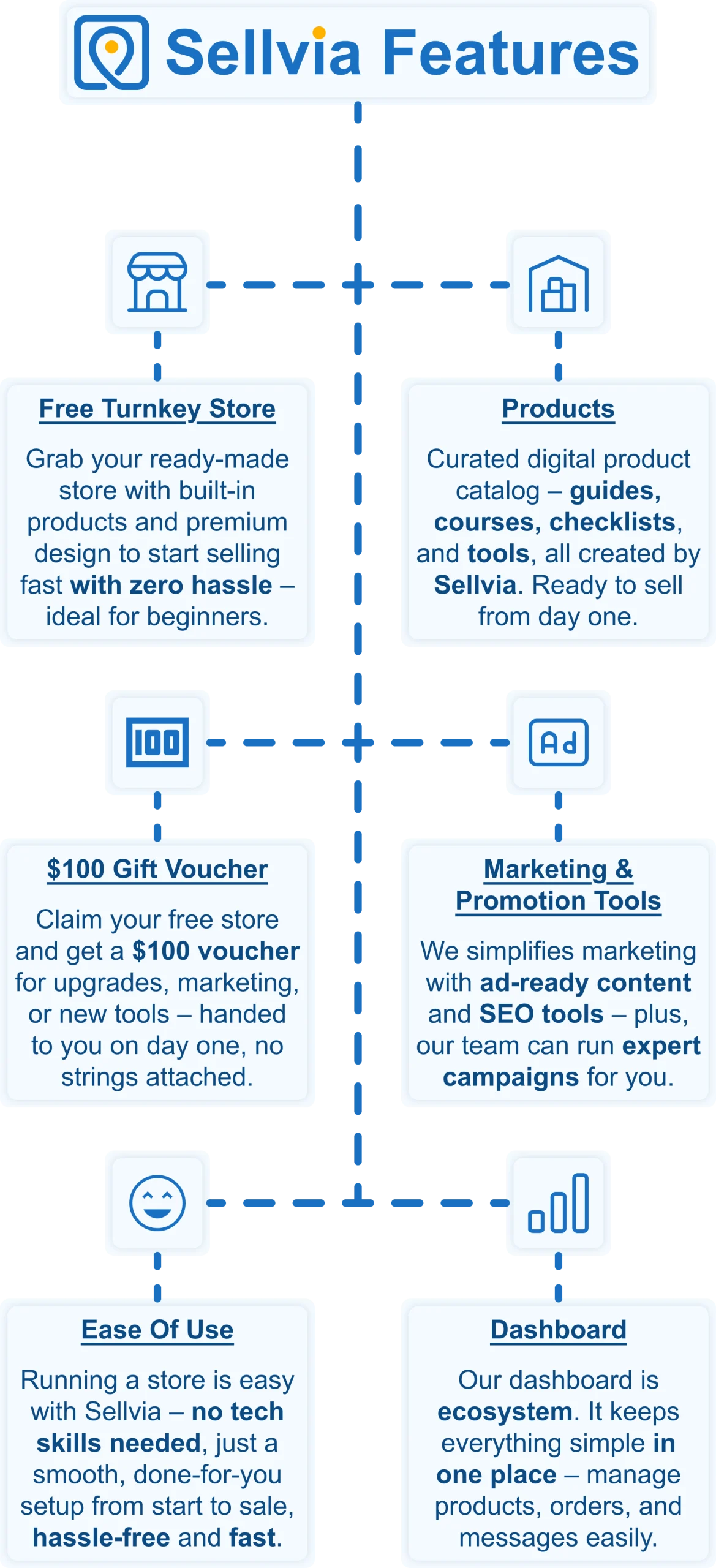
Want to start selling but don’t know where to begin? No worries! Just share your ideas, and Sellvia’s team will build a free ecommerce website that’s fully set up and ready to take orders from day one. No coding, no stress – just a store that works right out of the box.
1,000 digital products ready to sell from day one 🎁
Not sure what to sell? Sellvia solves that instantly. Your store comes pre-loaded with 1,000 ready-made digital products – guides, courses, checklists, and tools – all created by Sellvia. No writing, no recording, no product creation needed. Just pick your niche, and the products are already there waiting for your first customer.
A massive catalog of digital products to sell 🏆
One of the biggest struggles in starting an online business is figuring out what to sell. Sellvia solves that completely. Your store comes pre-loaded with digital products – guides, courses, checklists, and tools – all created by Sellvia. You keep 50–70% of every sale. No inventory. No shipping. No logistics headaches.
Everything in one easy-to-use platform 🔥
Managing an online store shouldn’t be complicated. With Sellvia, you can handle orders, add new products, and even chat with customers – all from a simple and user-friendly platform. No need to mess with confusing tools or deal with unnecessary tech stuff. It’s all smooth sailing.
No upfront costs, just start selling 💰
A big reason people hesitate to start an online business is the cost. But here’s the good news: With Sellvia, you don’t need to invest in stock, storage, or shipping supplies. You can run your store with no upfront costs, keeping things low-risk while still making money.
Support that’s always got your back 🤝
Running a business comes with questions, but you’re never alone. Sellvia’s dedicated support team is available 24/7 to help with anything you need. Whether it’s a small question or a big challenge, they’ve got you covered.
Vermont residents who are ready to build a real income from home have everything they need to start right now. Get your free store with 1,000 digital products ready to sell.
Do I need a business license to sell online in Vermont?
How much does it cost to start an online business in Vermont?
The startup cost for an online business in Vermont depends on your model. A sole proprietorship with no DBA can cost 0 dollars to register. An LLC costs 125 dollars to form plus 35 dollars per year in annual report fees. If you use a platform like Sellvia, the free 14-day trial means your store is live at no cost to start. Beyond registration, most digital product businesses have no inventory cost, no shipping cost, and no storage cost. The main ongoing expense is your monthly platform plan, which for Sellvia runs 39 dollars per month after the trial period.
What is the best online business to start in Vermont?
The best online business to start in Vermont for someone with no experience is a digital product store. You do not need to create any products, build a website from scratch, or learn complex marketing. Platforms like Sellvia provide a fully built store loaded with 1,000 ready-made products. You keep 50 to 70 percent of every sale, and delivery is instant and automated. For Vermont residents looking for a low-risk entry into online income, this model combines the lowest startup cost with one of the highest earning ceilings available.
Do I pay sales tax on online sales in Vermont?
Vermont has a state sales tax rate of 6 percent, but most downloadable digital products are currently exempt from Vermont sales tax under state law. Vermont follows the Streamlined Sales and Use Tax Agreement, and digital goods such as guides, courses, and downloadable tools generally do not trigger a sales tax obligation. However, this can depend on the specific product category. You should verify your product type with the Vermont Department of Taxes at tax.vermont.gov before scaling your business. Federal income tax and Vermont income tax on your earnings still apply regardless of sales tax exemption.
Can I start an online business in Vermont with no money?
Yes, you can start an online business in Vermont with no money if you choose your model carefully. A sole proprietorship requires no registration fee and can begin operating immediately. Platforms like Sellvia offer a free 14-day trial with no credit card required, which means your store can be live and taking orders before you spend a single dollar. The trial also includes a 40 dollar advertising credit to help drive your first traffic. After the trial, the monthly plan is 39 dollars. Most digital product sellers cover this cost within the first few sales.