Every week, thousands of New York residents search for a way to start an online product business from home. Many land on the same traditional model – one that involves finding suppliers, managing orders, and hoping packages arrive on time.
But before you go that route, it is worth taking a hard look at what running that kind of business actually requires in 2026 – and whether there is a faster, lower-risk path to the same goal.
Quick Answer: You can absolutely start an online product business in New York with no experience and no upfront inventory. But the model matters. Traditional physical-product selling requires supplier relationships, thin margins, and logistics you cannot control. Selling digital products online – guides, courses, tools, and checklists – removes every one of those friction points and lets you start faster, earn more per sale, and run your business from a phone. This guide covers both honestly, so you can choose the right path for you.
New York is the third most populous state in the country with nearly 20 million residents, a median household income of $85,974, and over 90% household broadband access. It is one of the most active online retail markets in the United States. Whatever model you choose, the audience is here – and so is the opportunity.
Why online selling works in New York
New York is not just a large state – it is a digitally active one. More than 90% of New York households had broadband access as of 2021, up from 86% in 2019, with federal programs continuing to expand access for lower-income households. Over 1.3 million New York households receive affordable broadband subscriptions with federal support. That connectivity translates directly into online purchasing behavior.
U.S. ecommerce sales totaled $1.23 trillion in 2025, growing 5.4% year over year. Online sales now represent more than 16% of all retail in the country – a share that has grown every single year since 2015. New York State, with its advanced tech infrastructure, diverse economy, and dense urban and suburban populations, is one of the most active ecommerce markets in the nation.
The demographic picture reinforces the opportunity. New York’s population is spread across dense metro areas like New York City, mid-sized cities like Buffalo, Rochester, and Albany, and a large rural upstate population – all of whom shop online.
The state’s median household income of $85,974 reflects significant purchasing power, and the demand for digital knowledge products – guides, tools, how-to resources – is growing alongside it.
New York’s cost of living also creates motivation on the seller side. Whether you are in the Bronx, in Syracuse, or anywhere in between, the pressure to earn more is real. Online selling from home addresses that need without requiring a second commute, a second uniform, or a second boss.
Online business models for New York residents – a real comparison
Not all online selling models are equal. Before choosing one, it is worth understanding what each actually requires – including the parts that most guides gloss over. Here is an honest side-by-side look at the most common options.
The comparison is not about dismissing other models – it is about being honest with yourself about what your current situation allows. If you have limited time, no existing audience, and need results within weeks rather than months, a digital product store offers the shortest path from start to first sale.
Tax considerations for online sellers in New York
New York has one of the more complex tax environments for online sellers in the country. Understanding your obligations before you start is far easier than untangling them after the fact.
New York sales tax and online sellers
New York’s statewide base sales tax rate is 4%. Local jurisdictions add their own taxes, bringing combined rates to 7%–8.875% depending on the buyer’s location. New York City has the highest combined rate at 8.875% (4% state + 4.5% city + 0.375% MCTD surcharge). New York is a destination-based state, meaning you charge the rate at your customer’s delivery address, not your own location.
Economic nexus for remote sellers
New York’s economic nexus threshold applies once a remote seller exceeds both $500,000 in gross sales and 100 or more separate transactions delivered into New York in the preceding four sales tax quarters. Both thresholds must be met – hitting one alone does not trigger registration. Most new online sellers will not approach these thresholds in their first year, but it is worth tracking from the start.
Marketplace facilitator law
Since June 2019, New York requires marketplace providers – platforms like Amazon, Etsy, and eBay – to collect and remit sales tax on behalf of their sellers for tangible personal property. If you sell through a qualifying marketplace, the platform handles the tax on those transactions.
You are still responsible for collecting tax on any direct sales outside the marketplace, and marketplace sales still count toward your economic nexus threshold calculation.
Digital products and New York sales tax – a critical distinction
This is where New York diverges significantly from many other states, and it matters directly for your business model choice.
New York does not tax most downloaded digital goods transmitted electronically – including ebooks, PDFs, guides, music files, videos, audiobooks, and digital art. These categories are generally exempt from sales tax when delivered as a download to the customer.
New York does tax prewritten software and Software-as-a-Service (SaaS), treating them as taxable tangible personal property regardless of delivery method. A January 2026 New York appellate court ruling reinforced this position, confirming that web-based platform access is taxable as prewritten software even when delivered through a subscription model.
Important: The specific tax treatment of your digital products depends on how they are classified. Downloadable guides, PDFs, and ebooks sold as one-time purchases are generally not subject to New York sales tax. Subscription-based software tools or interactive platforms may be taxable. Always confirm the classification of your specific products with a New York tax professional before collecting or remitting.
New York income tax for online sellers
New York has a progressive state income tax with nine brackets ranging from 4% to 10.9% for the 2025 tax year. Most new online sellers earning modest income will fall in the 4%–5.25% range. NYC residents owe an additional local income tax of 3.078%–3.876%.
Self-employment tax at the federal level is 15.3% on net earnings once your online business earns more than $400 in a year. Quarterly estimated tax payments to both the IRS and the New York Department of Taxation and Finance are required once your expected tax bill exceeds $1,000 annually.
See your state tax breakdown at a glance
Simply enter your annual net profit, select your state, and the calculator will instantly generate a detailed tax breakdown while showing how your state’s tax burden compares to others.
How to register your online business in New York
You do not need a registered business entity to start selling online in New York. Most solo online sellers begin as sole proprietors, reporting business income on their personal tax return with no state filing required. This is the simplest starting point and is entirely legitimate.
If you want personal liability protection – meaning your personal assets are shielded from any business-related legal exposure – an LLC is the appropriate structure. Here is what that costs in New York:
Articles of Organization: $200 filing fee with the New York Department of State. This is the document that officially forms your LLC.
Publication requirement: Within 120 days of formation, all New York LLCs must publish a notice in two local newspapers – one daily, one weekly – for six consecutive weeks. After publication, you file a $50 Certificate of Publication with the state.
Newspaper costs vary dramatically by county: as low as $80–$100 in some upstate counties, and $1,500–$2,000 in New York City. This requirement is unique to New York and adds significant cost for NYC-based founders.
Total LLC formation cost: Typically $350–$3,695 depending on your county. NYC-based founders should budget toward the higher end.
Biennial Statement: $9 every two years to keep your LLC in good standing.
File your Articles of Organization online through the New York Department of State at dos.ny.gov. Standard processing takes 7–10 business days; expedited options cost $25–$150.
One note on timing: Many successful New York online sellers start as sole proprietors, generate their first months of revenue, and then transition to an LLC once the income makes the formation cost proportionate. Starting simple is not the same as starting wrong.
Step-by-step guide to starting an online product business in New York
Step 1: Choose what to sell
The single most important decision you make at the start is what you will sell and how it will be delivered. Physical products require supplier relationships, order fulfillment coordination, and customer service for things outside your control – damaged packages, delayed deliveries, out-of-stock items.
Digital products eliminate all of that. A guide, course, checklist, or tool is delivered instantly, costs nothing to fulfill, and earns 50–70% margin per sale regardless of volume.
If you do not have products of your own, you do not need to create them. Platforms like Sellvia give you a store pre-loaded with 1,000 ready-made digital products across popular niches – no writing, no recording, no design required. For New York residents who need to start fast and start lean, that is the most practical entry point available.
For a full overview of all six online business models and which suits different goals and situations, see our guide on how to start an online business in New York.
Step 2: Register your business in New York
Start as a sole proprietor if budget is a concern. No state filing, no formation cost, and you can be operational the same day. Register your LLC when your monthly revenue makes the $200–$3,695 formation cost feel proportionate. File at dos.ny.gov when you are ready.
Step 3: Set up your store
A ready-built store with pre-loaded products is the fastest path to your first sale. Sellvia’s free 14-day trial – no credit card required – gives you a fully operational store from day one. No coding, no design work, no product sourcing. The store is live and the products are loaded before you have spent a dollar. After the trial, the monthly plan is $39 (about $1.30 a day).
If you prefer to build independently, you will need a store platform, a domain name, a payment processor, and products. Budget realistically for the time required – independent store setup typically takes days to weeks, not hours.
Step 4: Handle New York taxes
Track your income from your first sale. If you sell downloadable guides and PDFs, those are generally not subject to New York sales tax. If you sell platform access or prewritten software tools, they likely are.
Confirm your product classification with a tax professional before your first transaction if there is any uncertainty. Set aside 25–35% of net profit for combined federal and state income taxes and self-employment tax from the beginning – it is easier to put it aside than to come up with it at year-end.
Step 5: Start marketing
Organic social media is free and a legitimate starting point. Post daily on the platforms where your target customers spend time – Instagram, Facebook, TikTok, Pinterest – and be consistent. For faster results, Sellvia’s built-in advertising system lets you activate paid ads with one click, with a starting budget of $10–$50 per day.
Most customers who activate ads see orders the same day, though results vary based on effort, ad spend, and consistency. Paid advertising compounds over time – the longer you run it, the more data you accumulate, and the more efficiently your ads perform.
Best niches for New York online sellers
The right niche depends on your audience and your strengths – but for New York online sellers focusing on digital products, here are five categories with proven demand and strong margins.
Personal finance and money management
New York’s high cost of living and significant income inequality create strong demand for practical financial guidance. Budgeting guides, debt payoff planners, and savings tools sell consistently across all demographics in a state where financial stress affects millions of households.
Digital guides in this category require no credentials to sell and address a pain point that is both universal and urgent for a large portion of New York’s population.
Career and professional development
New York’s large workforce – concentrated in healthcare, education, finance, professional services, and construction – generates strong demand for career-advancement resources. Resume templates, interview prep guides, and professional skills courses appeal to the state’s ambitious, upwardly mobile middle class. The NYC metro area alone has one of the highest concentrations of white-collar workers in the world.
Health, wellness, and fitness
Health and wellness content is among the most consistently in-demand digital product categories nationally, and New York’s fitness-conscious urban population makes it especially strong here. Meal planning guides, home workout programs, and mental wellness resources sell year-round with minimal seasonal variation.
Parenting and family resources
New York has millions of families with children, and parents consistently seek practical, downloadable guidance – activity planners, educational worksheets, parenting guides, and family organization tools. This niche benefits from a deeply motivated buyer who prioritizes value and convenience, and digital delivery fits the on-the-go lifestyle of New York parents perfectly.
Home-based business and side income guides
The same population searching for ways to start an online product business in New York is also the audience for guides on earning from home, building a side income, and managing a small business. If you are starting your own store, you are already living this niche – and that authenticity resonates with buyers who are earlier on the same journey.
Common challenges for New York online sellers
Starting an online product business in New York comes with a few friction points worth knowing about before you begin.
High LLC formation costs – especially in New York City
New York’s mandatory newspaper publication requirement adds a cost that does not exist in most other states. If you are based in NYC, publication costs alone can run $1,500–$2,000, making total LLC formation one of the most expensive in the country.
The practical solution is to start as a sole proprietor, generate early revenue, and form your LLC when the income justifies the expense. Alternatively, choosing a lower-cost upstate county for your registered address – if your business does not require a NYC presence – can significantly reduce publication costs.
New York’s layered tax environment
State income tax, NYC or Yonkers local income tax, self-employment tax, and potential sales tax obligations create a more complex picture than most states.
The answer is not to avoid the issue – it is to track income and expenses from day one, make quarterly estimated payments, and consult a professional once your business is generating consistent revenue. The New York SBDC offers free advising that includes basic tax guidance for small business owners.
Choosing the right product model from the start
The most common mistake New York online sellers make is starting with a product model that has more complexity than their current situation allows. Physical product businesses require supplier management, logistics coordination, and customer service for problems outside your control.
Digital product stores remove those variables entirely. For most first-time online sellers in New York, starting with digital products is not a compromise – it is the smarter, lower-risk choice that gets you to your first sale faster.
Resources for New York online sellers
New York has one of the strongest small business support ecosystems in the country. Here is where to find free help.
SBA Metro New York District Office – Serves 14 counties including New York City, Long Island, and surrounding areas. Free workshops on starting a business, navigating compliance, and accessing loans. Located at 26 Federal Plaza, Suite 3100, New York, NY 10278. Visit sba.gov/district/metro-new-york.
New York SBDC – 20 regional centers and 70+ satellite locations statewide, administered through the SUNY system. Free one-on-one business advising and low-cost workshops at every stage. Find your nearest center at nysbdc.org.
SCORE New York – Free mentorship from experienced business professionals, available in person and virtually across the state. Find a chapter at score.org.
NYC Small Business Services (SBS) – For New York City residents: free business courses, licensing guidance, and neighborhood-based support. Visit nyc.gov/sbs.
Empire State Development – New York State’s small business hub with a program wizard to match you with state grants, loans, and support. Visit esd.ny.gov.
New York Department of Taxation and Finance – For sales tax registration (Certificate of Authority), nexus guidance, and digital product taxability resources. Visit tax.ny.gov.
Why Sellvia is a game-changer for your online store 🚀
Sellvia isn’t just another ecommerce tool. We are a trusted name in the industry, recognized by Forbes and even ranked in Inc.’s list of the 5,000 fastest-growing companies in the U.S. So if you’re serious about starting as a solopreneur, this is a smart place to begin.
Starting an online business can feel overwhelming, but that’s exactly where Sellvia steps in. It takes care of the tricky parts, so you can focus on making sales and growing your brand. Let’s break down what makes it such a great choice.
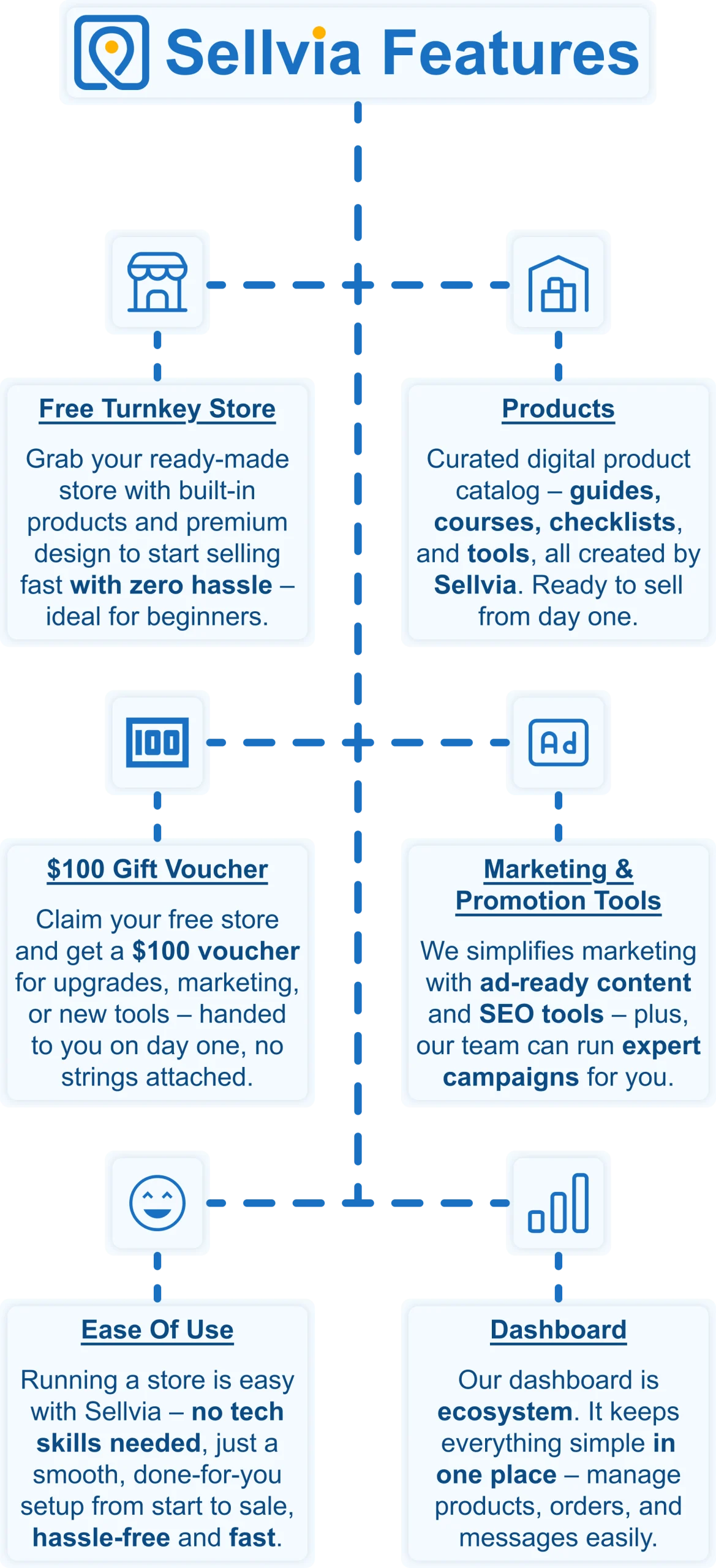
Get a ready-to-go store hassle-free 🎯
Want to start selling but don’t know where to begin? No worries! Just share your ideas, and Sellvia’s team will build a free ecommerce website that’s fully set up and ready to take orders from day one. No coding, no stress – just a store that works right out of the box.
1,000 digital products ready to sell from day one 🎁
Not sure what to sell? Sellvia solves that instantly. Your store comes pre-loaded with 1,000 ready-made digital products – guides, courses, checklists, and tools – all created by Sellvia. No writing, no recording, no product creation needed. Just pick your niche, and the products are already there waiting for your first customer.
A massive catalog of digital products to sell 🏆
One of the biggest struggles in starting an online business is figuring out what to sell. Sellvia solves that completely. Your store comes pre-loaded with digital products – guides, courses, checklists, and tools – all created by Sellvia. You keep 50–70% of every sale. No inventory. No shipping. No logistics headaches.
Everything in one easy-to-use platform 🔥
Managing an online store shouldn’t be complicated. With Sellvia, you can handle orders, add new products, and even chat with customers – all from a simple and user-friendly platform. No need to mess with confusing tools or deal with unnecessary tech stuff. It’s all smooth sailing.
No upfront costs, just start selling 💰
A big reason people hesitate to start an online business is the cost. But here’s the good news: With Sellvia, you don’t need to invest in stock, storage, or shipping supplies. You can run your store with no upfront costs, keeping things low-risk while still making money.
Support that’s always got your back 🤝
Running a business comes with questions, but you’re never alone. Sellvia’s dedicated support team is available 24/7 to help with anything you need. Whether it’s a small question or a big challenge, they’ve got you covered.
New York online sellers who switch from physical products to digital find fewer headaches, higher margins, and a business they can run from anywhere in the state. Get your free store with 1,000 digital products ready to sell today.
How do I start an online store in New York?
Do I need a business license to sell online in New York?
New York does not require a general statewide business license for online sellers. Operating as a sole proprietor requires no state filing at all – you report business income on your personal tax return. If you want to use a business name different from your own legal name, a DBA certificate from your county clerk typically costs 25 to 100 dollars. If you sell certain regulated products or operate in a licensed industry, additional permits may apply. Always check with your municipality and the New York Department of State if your products fall into specialized categories.
How much does it cost to start an online store in New York?
The minimum cost to start an online store in New York is close to zero. Operating as a sole proprietor costs nothing to register, and platforms like Sellvia offer a 14-day free trial with no credit card required. After the trial, the monthly plan is 39 dollars. If you later form an LLC, plan for 200 dollars in state filing fees, a 50 dollar Certificate of Publication fee, and newspaper publication costs ranging from 80 to 2,000 dollars depending on your county. New York City founders should budget at least 1,700 to 2,250 dollars total for LLC formation. Upstate founders can often complete the same process for 350 to 500 dollars.
What do online sellers pay in taxes in New York?
New York online sellers owe federal self-employment tax of 15.3% on net earnings above 400 dollars per year, plus New York State income tax ranging from 4% to 10.9% depending on income bracket. NYC residents also owe local income tax of 3.078% to 3.876%. For sales tax, the statewide base rate is 4%, with combined state and local rates reaching 7% to 8.875% depending on the buyer location. Downloadable digital goods such as guides, ebooks, and PDFs are generally not subject to New York sales tax. Prewritten software and SaaS products are taxable. Economic nexus applies once you exceed 500,000 dollars in sales and 100 transactions into New York in the preceding four quarters.
What is the easiest online business to start in New York?
A digital product store is the easiest online business to start in New York in 2026 for someone with no prior experience. There are no products to create, no supplier relationships to manage, and no logistics to coordinate. Platforms like Sellvia provide a fully built store with 1,000 ready-made digital products – guides, courses, checklists, and tools – that are ready to sell from day one. Margins run 50 to 70 percent per sale, and the built-in advertising system lets you activate paid ads with one click. Most customers who activate ads see orders the same day, though results vary based on effort, ad spend, and consistency.


